• Irish Immigrants and the Underground Railroad

    Medium
    2015-07-02
    Liam Hogan


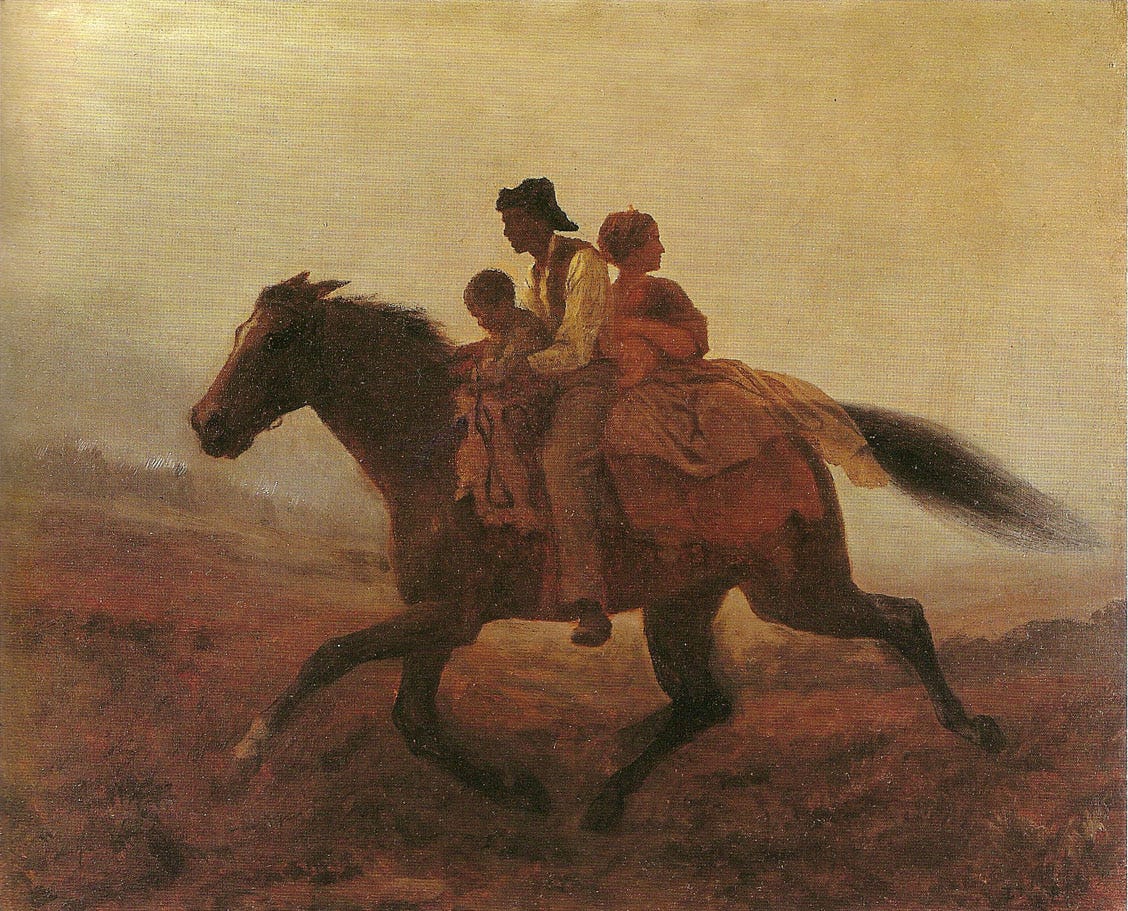
    A Ride for Liberty — The Fugitive Slaves, oil on paperboard, ca. 1862, Brooklyn Museum

    But the Irish are indeed a strange people. How varied their aspect — how contradictory their character.
    William Wells Brown (1852)

    What William Wells Brown should have said was “the Irish are human.”

    The sad history of anti-black violence perpetrated by some Irish immigrants in the United States is well known. This was often the abominable product of racism, political self-interest, craven leadership and labour competition. While these incidents, such as the New York Draft riots (1863) or the Memphis massacre (1866), were committed by a fraction of Irish immigrants who settled in the United States, they have certainly cast a long shadow over the historical relationship between the Irish-American and African-American communities. Some Irish were also active in disrupting the activities of the Underground Railroad. See the famous case of the self-emancipated slave Anthony Burns who was arrested under the Fugitive Slave Law in 1854 and held in custody in Boston. When a group of African Americans and white anti-slavery activists attempted to rescue him by force, it was an Irish militia which suppressed their advances. One of their deputised number was stabbed and killed during the altercation. When African Americans held a vigil before Burns was sent back to his owners they were subjected to the “jeers and insults of pro-slavery Irishmen.” Sojourner Truth witnessed how Burns was marched on to the ship, a solitary figure, under the armed guard of two thousand armed white men. Some of those in the crowd, likely to be Irish-Americans, cheered at this pathetic procession. They also pointed at prominent abolitionists in the crowd, shouting “there go [the] murderers” of an Irish labourer. The historian Noel Ignatiev has described the actions of the Boston Irish militia as being evidence that the Irish were “the Swiss Guards of the Slave Power.”

    William Still included an account of a group of Irishmen who attacked fugitive slaves in his seminal work The Underground Railroad, A Record (1872) According to his correspondent, these Irish attackers were either a group of slave-catchers following up on a bounty or racist thugs looking to attack African Americans as part of their Halloween entertainment. Either way, they got more than they bargained for…

    …Perhaps it is for these reasons that the role of a number of Irish immigrants in helping slaves escape their bondage has been overlooked. It helps to explain why the cordial relationships and marriages, although the latter were relatively rare, between Irish immigrants and African Americans in the early nineteenth century have been mostly forgotten. This complex relationship is illustrated well by Frederick Douglass’ guarded reaction to two sympathetic Irish labourers in Baltimore

    Who were these Irish born “conductors”?

    Because of the nature of this surreptitious activity, attempts to verify what actually happened are often difficult, if not impossible. While it may make the academic historian wince, this history generally relies on oral tradition. From the few names I have found, it seems that the Irish immigrants who supported the Underground Railroad were mostly middle class, some were Presbyterian, others were Catholic, and a majority hailed from Ulster. The class aspect is not a surprise as it mirrors the general make up of the anti-slavery movement in Ireland in the late eighteenth to mid-nineteenth century. The following list is far from exhaustive, so please get in touch if you know of more individuals from Ireland who were involved…

    Name: Mary Weaver
    From: Ireland
    Location of UR Activity: Richmond, Virginia
    Narrative: The remarkable story of Mary Weaver is recounted by William Still. Mary Weaver and John Hall, a slave, fell in love and wished to marry. Hall was the property of a slave owner named John Dunlap but he singled out his prior owner, a man named Burke, as being especially cruel. Both of these men might also have been Irish. Mary then proceeded to save money and make arrangements to pay for his escape via the Underground Railroad to Canada. She later joined him there and the two were soon married.

    “[Hall] was also under the influence and advice of a daughter of old Ireland. She was heart and soul with John in all his plans which looked Canada-ward. It is very certain, that this Irish girl was not annoyed by the kinks in John’s hair. Nor was she overly fastidious about the small percentage of colored blood visible in John’s complexion. It was, however, a strange occurrence and very hard to understand. Not a stone was left unturned until John was safely on the Underground Rail Road. Doubtless she helped to earn the money which was paid for his passage. And when he was safe off, it is not too much to say, that John was not a whit more delighted than was his intended Irish lassie, Mary Weaver. John had no sooner reached Canada than Mary’s heart was there too.”

    “Circumstances, however, required that she should remain in Richmond a number of months for the purpose of winding up some of her affairs. As soon as the way opened for her, she followed him. It was quite manifest, that she had not let a single opportunity slide, but seized the first chance and arrived partly by means of the Underground Rail Road and partly by the regular train. Many difficulties were surmounted before and after leaving Richmond, by which they earned their merited success. From Canada, where they anticipated entering upon the matrimonial career with mutual satisfaction, it seemed to afford them great pleasure to write back frequently, expressing their heartfelt gratitude for assistance, and their happiness in the prospect of being united under the favorable auspices of freedom!”…

    Read the entire article here.

  • Nuns told her that “no man will ever want you, because you’re black”; a career counsellor said she should “consider taking man friends” to support herself. “I was told I wouldn’t amount to anything and should consider prostitution,” [Rosemary] Adaser says.

    Her black background was vilified and even denied, she says, and she was constantly told that she would never be wanted in Irish society. “I was not allowed any identity at all. That is very, very damaging for the soul.”

    Kitty Holland, “Mixed Race Irish: ‘We were the dust to be swept away’,” The Irish Times, July 18, 2015. http://www.irishtimes.com/news/social-affairs/mixed-race-irish-we-were-the-dust-to-be-swept-away-1.2287196.

  • Meet this year’s outstanding contributors at The Globies!

    The Seattle Globalist
    2015-07-17

    Christina Twu, Editor/Contributor

    The Seattle Globalist is proud to recognize three brilliant Globalist writers that have made outstanding contributions to our publication this year, helping to grow our coverage and make 2015 a phenomenal year for us.

    Please join us in recognizing these dynamos at our Third Annual Globie Awards on Saturday, Sept. 26, along with Globalist of the Year Rita Meher:…

    Sharon H. Chang

    Social Justice Commentator of the Year

    Sharon H. Chang, a mom, mixed-race parenting expert and activist, was the writer who really launched the Globalist into intentionally covering racial justice issues.

    Sharon’s stories reflect deep reporting enriched by her personal experiences and analysis, further pushing our publication and city to engage in important dialogue.

    She has sparked critical conversation on race, education, housing access and gentrification. In fact, her first published story with us went viral and started conversations on race across Seattle for months after it was published.

    “Looking back over the past year I realized Sharon’s piece on Seattle’s ‘Progressive Mystique’ symbolized a turning point for The Seattle Globalist,” says Stuteville, “one where we completely embraced our role as a publication poised to explore some of the most critical social justice issues in our region.”

    Read Sharon’s stories and more about her here. Read the entire Globalist profile here.

  • How should a dancer look? Ask Misty Copeland and Stella Abrera

    The Melissa Harris-Perry Show
    MSNBC
    2015-07-18

    Melissa Harris-Perry, Host

    Dancers Misty Copeland and Stella Abrera discuss their pioneering work as, respectively, the first African American and Filipino American principal ballerinas at the American Ballet Theater.

    Watch the video (00:07:46) here.

  • Mr. President, on behalf of an ungrateful nation, thank you

    WFTS: ABC Action News
    Tampa Bay, Florida
    2015-07-16

    Dick Meyer, Chief Washington Correspondent
    Scripps News

    Some points to ponder about Obama’s record

    WASHINGTON, D.C. – I’ve never written a column like this. Readers rarely believe it, but I am not on any political team. Generosity toward the high and mighty isn’t among my few virtues. But this needs to be said: Americans are lucky to have Barack Obama as president and we should wake up and appreciate it while we can.

    President Obama will go down in history as an extraordinary president, probably a great one. He will have done this in era that doesn’t aggrandize leaders and presidents, but shrinks them. All presidents have had profound opposition, vicious enemies and colossal failures. A few were beloved and others deeply respected in their day, but none in the modern era and certainly not Obama.

    Why? Marcus Aurelius said, “Man is puny in the face of destiny.” If the stoic king were writing about modern, democratic sovereigns, he might say, “Kings are puny in a world blind to destiny, a world seen through the sacred screens of televisions and computers that can view only the puny.”

    Many presidents fared better in history than in office. But it would be a morale booster and a sign of civic maturity if more Americans appreciated what an exceptional president they have right now. It could be a long wait for the next one.

    One can hate Democrats, disagree with Obama on big issues, dislike his style or be disappointed the excitement of his election didn’t last. But his accomplishments, ambitious goals, dignity and honesty under tough circumstances demand admiration and appreciation.

    This is, of course, perverse liberal-media propaganda to conservative Obama-haters. It’s wobbly centrism to a left-flank frustrated Obama hasn’t done more for them. And it’s naïve hot air to Washington’s political clans that think Obama doesn’t play the game well.

    Changing minds with a keypad is a fool’s errand; I’m surely a fool, but not on that count. I simply offer some points for the open-minded to ponder…

    Read the entire article here.

  • The Adoption Papers

    Bloodaxe Books
    1991
    64 pages
    21.6 x 13.9 x 0.5 cm
    Paperback ISBN: 978-1852241568

    Jackie Kay, Professor of Creative Writing
    Newcastle University

  • The “Telling Part”: Reimagining Racial Recognition in Jackie Kay’s Adoptee Search Narratives

    Contemporary Women’s Writing
    Volume 9, Issue 2 (July 2015)
    pages 277-296
    DOI: 10.1093/cww/vpu041

    Pamela Fox, Professor of English
    Georgetown University, Washington, D.C.

    This article examines Jackie Kay’s earliest and renowned autobiographical poetic text, The Adoption Papers (1991), in relation to her latest narrative memoir, Red Dust Road (2010), and in the context of racial recognition theories recently revived in transracial adoption (TRA) discourse, as well as in transnational adoptee versions of TRA search narratives. Investigating the tropes of mirrors and bodily markings recurring in both texts, the article also draws on literary theories of recognition to enrich our understanding of Kay’s unique and dual intervention into TRA debates around notions of kinship, as well as autobiographical narrative models that fully reject or embrace a longing for racialized epistemic and narrative wholeness. Kay periodically preserves yet ultimately reimagines the myriad tensions of seeking and practicing racial recognition by constituting it as a distinct but momentary kind of vision. Her practice of life writing highlights reading (both literal and interpretive) as a crucial component of self-construction that continually mediates between individual and group identities. She presents the adoptive self as a freeing constellation of shifting affiliations, but as the product of intertwined Western and diasporic histories and relations, her texts also bear the marks of longing for a singular legible “home,” a stable “I.”

    Read or purchase the article here.

  • Mixed Race Irish: ‘We were the dust to be swept away’

    The Irish Times
    2015-07-18

    Kitty Holland, Staff Reporter


    ‘I lived in a state of pure terror’: Rosemary Adaser, co-founder of the group Mixed Race Irish. Photograph: Joanne O’Brien

    Mother and Baby Homes Commission of Investigation urged to confront the racism endured by children taken into care and abused because they had a non-white parent

    In October 1958, when Rosemary Adaser was admitted, as an 18-month-old, to a mother-and-baby home in Dublin, her admission notes described her as “illegitimate and coloured”. Fifteen years later, when she was pregnant and sent to a mother-and-baby home in Co Meath, they described her as “rather mature for her age; accepts her colour well”.

    “My file is peppered with references to my colour,” she says. “The racism was relentless and brutalising. My formative years were devastated by it.”

    Adaser is one of about 70 mixed-race people who have come together in the past few years as Mixed Race Irish, a campaign and support group. They believe they were taken into care because they were mixed race, that there was a different unspoken “policy” for them and that they suffered an “extra layer of abuse” because of their racial identity. They say racism was endemic, systemic and systematic, in the care system and in Irish society, and that their experiences were particular to them…

    …Like other mixed-race Irish children in the mother-and-baby homes, she was never offered for adoption. She believes this was policy, based on a presumption that nobody would want to adopt a mixed-race baby. Instead she was fostered, or boarded out. “When I was four I was sent to a couple in their 60s. No, they weren’t vetted. They were invited to select a child. People were paid by the State to take in children. This couple had no pension, and I was an income source.

    “The woman was vicious. I have a clear memory of fearing the gardening gloves, because she would go and cut branches from the rose bushes and cut the flowers off. She called me filthy and nasty and would strip me naked. I was four, remember, and she would whip me with the thorns. Years later I still had scars on my back, buttocks, stomach, legs, arms and soles of my feet, but not my face,” Adaser says. “The whippings were so bad I was hospitalised. After 18 months I was returned to St Patrick’s.”…

    Read the entire article here.

  • My Name is Cool: Stories from a Cuban-Irish-American Storyteller

    Familius
    2013-08-05
    170 pages
    Paperback ISBN: 9781938301568
    eBook ISBN: 9781939629029

    Antonio Sacre

    “In 1960 my father got into a rowboat from Havana, Cuba and rowed 90 miles to the United States to start his new life. By the time I got into seventh grade, I was telling my friends that my father saved all of his family, all of his friends, piled everyone into that boat and rowed everybody over to America. By the time I got into high school, I was telling my friends that my father stole five boats from Castro’s navy, saved all of his friends, all of his family, all of his first, second, third, fourth, and fifth cousins, everyone on his block, all of the pets, and everybody on his baseball team. He piled them into the boat. There was no room for him in the boat, so he tied those boats together with a big rope, put that rope around his shoulders and he swam everybody over to the United States. . .”

    Born in Boston to a Cuban father and an Irish-American mother, Antonio Sacre is one of the few leprecanos on the national speaking circuit. Using his own personal history and telling the stories that audiences across the nation have found so captivating and wonderful, this award-winning storyteller and author weaves the Spanish language, Cuban and Mexican customs, and Irish humor into an unforgettable book of humor, inspiration, tradition, and family.

    My Name is Cool is a classic story sure to transcend, like the author himself, cultures and boundaries.

  • The black president some worried about has arrived

    The Washington Post
    2015-07-15

    Janell Ross, Reporter

    There’s this thing people sometimes say down South.

    So-and-so is “acting brand new.” Sometimes that’s a reference to people behaving like they don’t know old friends and family — that they have evolved past their old crowd. Sometimes that’s Southern-speak for the emboldened, people behaving like they either don’t know the rules or have outright decided to disregard them.

    In the past four weeks, we’ve seen President Obama take up residence in a place that sits somewhere in-between.

    He’s spoken off the cuff about race relations on a widely circulated podcast (even using the n-word) and then eloquently followed that with what can only be described as a sermon on race relations in America before breaking into song. He’s challenged America to go deeper in its support of equality than retiring symbols of slavery (such as the Confederate flag) and impolitic words (such as the n-word).

    While eulogizing a slain minister and state lawmaker allegedly killed by a white supremacist in Charleston, S.C., he outlined a whole raft of ways in which discrimination remains and inequality continues to grow. And now, in the span of two weeks, he has announced two major reform packages — housing last week and criminal justice on Tuesday — that could, if ultimately implemented, be of particular benefit to people of color in the United States.

    Here’s the thing: This Obama might look or sound “brand new” to some Americans. He might even sound a little something like the black president some white Americans across the political spectrum feared (or hoped for). But to people who watch the White House closely, this is the President Obama who has been developing for some time…

    Read the entire article here.