• “There is an important difference between identity and identification, which Karen and I have talked about in our book Racecraft. Rachel Dolezal was able to define her identity well enough to become what she said she was in her environment, in Spokane. And that’s something available to her partly because of the way that we as a society define who is black and who is not.

    Anybody can be black — black is defined as any known or visible ancestry — or “one drop of blood.” So it’s really not based on what you look like, even if you go to the trouble of tanning and wearing a wig and whatnot.

    Most Afro Americans don’t have any control over identification. Their identity, how they define themselves, how they perceive themselves, can be overruled by that identification. That’s what happens when we see Afro-American police officers killed by their comrades by mistake. Their identity as a police officer is overruled instantly and fatally because the identification takes precedence.

    That’s what happens to people who are visibly Afro American or who are identified that way in our racist society, if not always in so dramatic and terminal a way. Mistaken identification can put an end to one’s identity by terminating the human being it’s attached to.” —Barbara J. Fields

    Jason Farbman, “How Race Is Conjured,” Jacobin, (June 29, 2015). https://www.jacobinmag.com/2015/06/karen-barbara-fields-racecraft-dolezal-racism/.

  • The weird, strange narrative of Rachel Dolezal

    The Remix
    WHYY-FM Philadelphia, Pennsylvania
    2015-06-17

    James Peterson, Host

    What determines your race? Is it about genetics or cultural identification? The curious case of Rachel Dolezal, a white woman who has been passing for black, has been met with surprise, outrage and confusion. Dolezal, former president of the Spokane NAACP, says she has self-identified as black from an early age, even though she was born to and raised by two white parents. Her comments have launched another contentious debate about the definition of race and racial identity in America. Joining us to talk about it all are Donald Tibbs and James Peterson. Tibbs teaches Law at Drexel University. Peterson is Director of Africana Studies at Lehigh University and host of WHYY’s podcast “The Remix.”

    Listen to the interview (00:13:44) here.

  • Pets, Playmates, Pedagogues (From Chapter Four of Oreo)

    The Offing: A Los Angeles Review of Books Channel
    2015-07-06

    Fran Ross

    Oreo, Fran Ross’s ground-breaking satire, was originally published in 1974. It is being re-issued this week by New Directions, with an introduction by Danzy Senna and a foreword by Harryette Mullen. Mat Johnson of NPR called it “one of the funniest books I have ever read” and writer Paul Beatty deemed it “hilarious.” We are honored to present an excerpt of this extraordinary novel.

    — The Fiction Editors

    Christine and Jimmie C.

    From the Jewish side of the family Christine inherited kinky hair and dark, thin skin (she was about a 7 on the color scale and touchy). From the black side of her family she inherited sharp features, rhythm, and thin skin (she was touchy). Two years after this book ends, she would be the ideal beauty of legend and folklore — name the nationality, specify the ethnic group. Whatever your legends and folklore bring to mind for beauty of face and form, she would be it, honey. Christine was no ordinary child. She was born with a caul, which her first lusty cries rent in eight. Aside from her precocity at mirror writing, she had her mother’s love of words, their nuance and cadence, their juice and pith, their variety and precision, their rock and wry. When told at an early age that she would one day have to seek out her father to learn the secret of her birth, she said, “I am going to find that motherfucker.” In her view, the last word was merely le mot juste

    Read the entire chapter here.

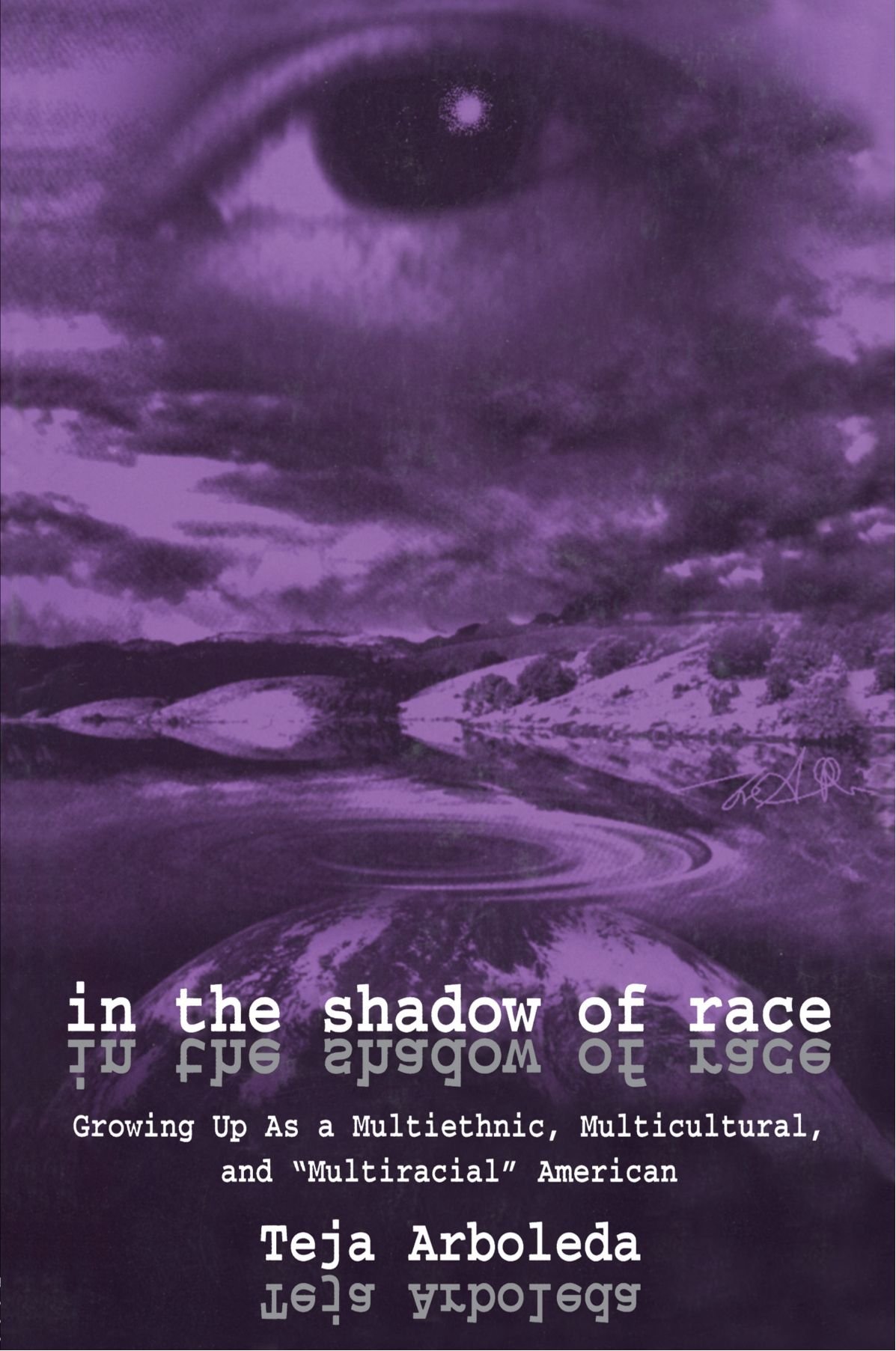
  • In the Shadow of Race: Growing Up As A Multiethnic, Multicultural, and “multiracial” American

    Routledge
    1998
    280 pages
    Paperback ISBN: 978-0805825756

    Teja Arboleda, President/Creative Director
    Entertaining Diversity, Inc.

    My father’s father was Filipino-Chinese…
    My father’s mother was African American-Native American…
    My mother’s father was German-Danish…
    My mother’s mother was German…
    I was born in Brooklyn, New York, but I grew up in Japan…

    For once it’s not just black and white. In this compelling chronicle of his journey through life as a multicultural and multiethnic American, Teja Arboleda uniquely and personally challenges institutionalized notions of race, culture, ethnicity, and class. Arboleda has presented his story around the United States through his one-man performance-lecture Ethnic Man! Now, in this book, he fleshes out the depth of his experience as a culturally and racially mixed American, illustrating throughout the enigma of cultural and racial identity and the American identity crisis.

    To facilitate its use as a course text, In the Shadow of Race is offered with a Teacher’s Guide written by Christine Clark. Topics for discussion include:

    • the social construction of race
    • racial separatism vs. diversity
    • racial, ethnic, and cultural identity development
    • the politics of racial categorization
    • mixed “race” peoples
    • cultural identity vs. identity by heritage
    • the concept of a “cultural home
    • changing identities within cultures

    Contents:

    • Preface
    • Chapter 1: Race Is a Four Letter Word
    • Chapter 2: Among the Trees
    • Chapter 3: Four Walls and a Cellar
    • Chapter 4: Checkmate
    • Chapter 5: Carrots?
    • Chapter 6: Plastic Armies
    • Chapter 7: Old Fence, New Paint
    • Chapter 8: Paper Houses, Horses, and Swords
    • Chapter 9: Squares in a Circle
    • Chapter 10: Shuffle
    • Chapter 11: The Connection
    • Chapter 12: The Adjustable Pedestal
    • Chapter 13: Hokkaido
    • Chapter 14: Two Steps Back
    • Chapter 15: The Official Proxy
    • Chapter 16: “You’re From China, Right?”
    • Chapter 17: The Awakening
    • Chapter 18: This Land Is Your Land
    • Chapter 19: Top of the Hill
    • Chapter 20: Letting Go
    • Chapter 21: Check One Only
    • Chapter 22: Losses
    • Chapter 23: The Testimony
    • Chapter 24: One
    • Chapter 25: Cool Winds Return Home
    • Chapter 26: Home
    • About the Author
    • Ancilary Materials for Educators
  • Oreo: Fiction by Fran Ross with a contribution by Danzy Senna and Harryette Mullen

    New Directions Publishing
    2015-07-07 (originally published in 1974)
    240 pages
    Paperback ISBN: 9780811223225
    Ebook ISBN: 9780811223232

    Fran Ross (1935–1985)

    A pioneering, dazzling satire about a biracial black girl from Philadelphia searching for her Jewish father in New York City

    Oreo is raised by her maternal grandparents in Philadelphia. Her black mother tours with a theatrical troupe, and her Jewish deadbeat dad disappeared when she was an infant, leaving behind a mysterious note that triggers her quest to find him. What ensues is a playful, modernized parody of the classical odyssey of Theseus with a feminist twist, immersed in seventies pop culture, and mixing standard English, black vernacular, and Yiddish with wisecracking aplomb. Oreo, our young hero, navigates the labyrinth of sound studios and brothels and subway tunnels in Manhattan, seeking to claim her birthright while unwittingly experiencing and triggering a mythic journey of self-discovery like no other.

  • What It Really Means To Be Transracial And Black

    The Huffington Post
    2015-07-08

    Zeba Blay


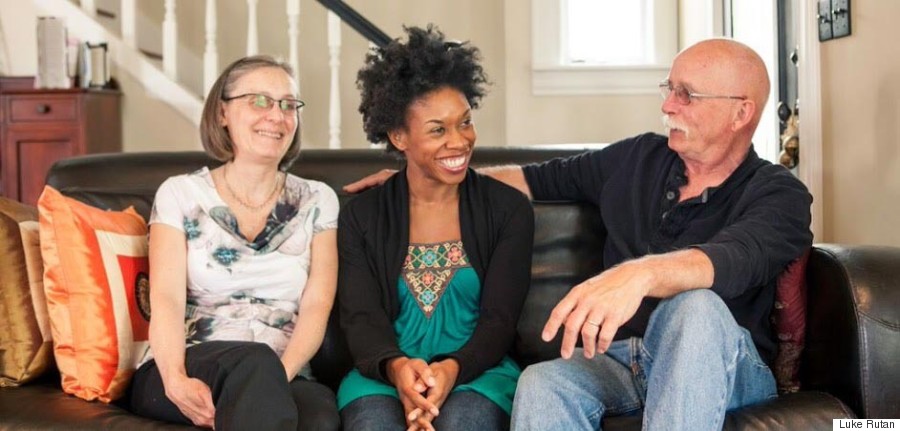
    Photo by Luke Ratan

    It’s been weeks since the nation became obsessed with — then subsequently forgot about — Rachel Dolezal. In choosing to identify as a black woman, Dolezal introduced the concept of being transethnic or “transracial” into the mainstream. Faulty comparisons to Caitlyn Jenner and the transgender community abounded, and many commentators (including myself) rejected them, arguing that being transracial “is not a thing.”

    I’ve since learned that being transracial is a thing — just not in the way Dolezal interpreted it. The first known use of the word dates back to the 1970s. Transracial applies to those adopted by parents of another race. It’s an experience often overlooked, and a vibrant community of transracial speakers, writers, and activists have come forward in the wake of Dolezal to take back ownership of the word and their unique identities.

    What have their experiences been, not only in the wake of the scandal, but in their day to day lives? What does it mean to be transracial?

    For many transracial adoptees, to reclaim “transracial” is to reclaim themselves…

    …Transracial identity, like all identity, can be such a nebulous thing. Some adoptees feel untethered, or as if they’re forced to choose between sides. Many experience an intimate, insider relationship with whiteness and white privilege while simultaneously experiencing racism. Blogger Katakasrainbow described that in-between plainly as the word “transracial” began to trend. “I wasn’t really black due to a lack of present black parents and family, but I could never ever ever really be white either,” she wrote…

    Read the entire article here.

  • It’s official: Latinos now outnumber whites in California

    The Los Angeles Times
    2015-07-08

    Javier Panzar


    Source: The Los Angeles Times

    The demographers agreed: At some point in 2014, Latinos would pass whites as the largest ethnic group in California.

    Determining when exactly that milestone would occur was more of a tricky question. Counting people isn’t like counting movie ticket receipts.

    The official confirmation had to wait until new population figures were released by the Census Bureau this summer. The new tally, released in late June, shows that as of July 1, 2014, about 14.99 million Latinos live in California, edging out the 14.92 million whites in the state.

    The shift shouldn’t come as a surprise. State demographers had previously expected the change to occur sometime in 2013, but slow population growth pushed back projections. In January 2014, the state Department of Finance estimated the shift would take place at some point in March.

    Either way, the moment has officially arrived…

    Read the entire article here.

  • The Divine Auditor

    Prarie Schooner: Stories, Poems, Essays, and Reviews since 1926
    Volume 87, Issue 2 (2013 Summer)

    Sarah Valentine, Visiting Assistant Professor of English
    Northwestern University, Evanston, Illinois

    It is still dark when my cell phone begins to buzz. When I flip it open, my mother’s voice comes through a connection often interrupted by the apartment building’s iron girders. We make some awkward small talk and then she says:

    “I guess you want to talk about the email you sent me last week.”

    “Yes,” I whisper, trying not to wake my boyfriend, Zoran, who is asleep beside me. I glance at the clock and realize it is 6:30 a.m..

    “Before I say anything,” she says after a long pause, “tell me if you think we’ve always loved you.”

    I begin to tear up at this, and I feel my body grow weak. I know what is coming.

    “Of course,” I manage.

    She too begins to cry and through sobs tells me a disconnected story about when she was at a spring break house party as a sophomore in college. Someone put something in her drink… She woke up the next day knowing something had happened, someone had taken advantage of her.

    “Are you saying . . . you were raped,” I ask, trying to soften my voice as I do so. She cries and does not answer. “Was he . . .” I continue but cannot finish the sentence.

    “Yes,” she says. “He was African American.”

    “He was black . . .”

    “He was,” she says.

    “Who was it?” I ask, clambering over Zoran in my underwear, taking the phone into the hallway so as not to wake him.

    “I don’t know,” she says. “I don’t remember.”

    Now I don’t know what to say. I want to know more, but her crying, her hurt sounds make me afraid to push. I know that I am sounding harsh when I speak again, but I can’t help it. She doesn’t know who it was, but she knows he was black. She knows that. How does she remember that? But I don’t ask her that.

    “Why are you only telling me this now?” I say.

    “Because you asked. I have to go, I’m going to be late,” she says.

    Then she hangs up and goes to her shift at the hospital.

    I stand there shivering in the dark. I cannot decide which is more shocking; that I was conceived in rape or that my father is not the man I’ve grown up with, but some black guy my mother went to school with, whose name she does not remember, who may or may not have drugged her. I have so many questions, but it is this that sticks in my head: both of my parents and my two younger brothers are white. After years of suspecting I was not, finally at the age of twenty-seven I gathered the courage to ask my mother about it. And this is how she tells me. I don’t even know if my father knows. I mean the man I have called my father for twenty-eight years. Is this a secret from him, too? Sadness mixes with anger and disbelief. But there is also a sense of resolution; so I’m not a freak of nature. There is a rational explanation for me after all. This is what I tell myself, but none of it is rational. My brain is still trying to make sense of it all…

    Read an excerpt of the essay here.
  • Q & A with Ana Carolina Vidal + her Afro-Futuristic project

    Rooted In Magazine
    2015-07-08

    Annina Chirade


    O Mestiço Revisited II, Ana Carolina Vidal

    São Paulo native, Ana Carolina Vidal, is a multi-racial Brazilian artist who explores the dynamics of her country through her art. Her work is largely focused on portraiture; each piece in her ongoing Afro-Futuristic project is both an affirmation and reimagining of her identity. Through each subject, she pushes for us to see the ancestors that exist within us. Her gaze is filled with an emotional honesty towards a society still at odds with its past. Ana centres her Indigenous, African and European roots within a larger social framework; the political and personal can’t help but be intertwined in her work.

    It’s precisely because of her honesty that one is able to understand the deep love she has for her homeland. In every conversation we’ve had, her knowledge and quest to share the fullness of her country’s many cultures leaves one wanting to know more. She embraces its music, art, film, literature, dance, food and politics with passion. Ana is part of a young generation looking to break down the simplistic images many have of Brazil, and to shape its future. She has even created a Tumblr page, Brasil of Color, to let fellow Brazilians learn and share their histories. So how does her art speak to a society so awash with culture and complexity? I set up an interview to find out.

    Annina: What is your background as an artist – do you consider yourself as mostly self-taught?

    Ana: When I was a child, my aunt was my first contact with art. She was a painter and inspired me to pursue what I love – even if it took me a lifetime – I should do it! I would bother my parents a lot as a child to put me in a local artisan group; they taught me some handicrafts and how to paint, but I took those classes for a short period. Then when I was very young at school I took extra-curricular painting classes. In my teenage years I stopped painting. I was mainly self-taught, I still feel I need to learn so much. I think it’s interesting to have that academic basis, not only of techniques, but ways of thinking and building your creative process; learning new ways to relate to art that are different from the ways you already do…

    …Annina: In your work you give special focus to Afro-Brazilian and Indigenous people, why is that important to you?

    Ana: I think it’s important to reaffirm myself to me. Although I have many privileges by being white-passing, my family is so multi-racial. I heard a lot of stories and encountered so many backgrounds which were extremely different. I always had the feeling that most of my family got lost in time; you don’t know the name of someone, you don’t know their story, because many of them were very poor. I always wanted to document them so that they would no longer be forgotten.

    We have this myth of ‘Brazilian racial democracy’, but we know our [people of colour] experiences are different and I could always see that growing up. I could see how different my father’s life was from my mother’s; how my mother could get further being a white woman. In my father’s family, I could see the difference between him as a black man and my aunt’s as black women; how they stayed behind for obvious gender and race reasons. Although I am privileged enough to not go through a lot of that, I was still affected in many ways. I still hear comments – they are less offensive – I’m always questioned about my identity…

    Read the entire interview here.

  • Respecting and Celebrating Black Writing and Storytelling presented by Dr Anita Heiss

    Flinders University
    182 Victoria Square
    Adelaide, South Australia, Australia
    2015-07-09, 18:00-19:00 ACDT (Local Time)


    Anita Heiss

    A NAIDOC Week event co-hosted by Yunggorendi First Nations Centre with the School of Humanities and Creative Arts

    Anita will address staff, students and members of the community for NAIDOC Week around this year’s theme: We all Stand on Sacred Ground: Learn, Respect and Celebrate.

    This seminar will discuss the ways in which Aboriginal authors across genres write about concepts of space, respect for place and connection to country, and why we should be celebrating this new Australian literature…

    For more information, click here.