Mixed Race Studies

Scholarly perspectives on the mixed race experience.

    • About This Site
    • Bibliography
    • Contact Information
    • Date and Time Formats
    • Forthcoming… (Updated 2021-09-01)
    • Likely Asked Questions
    • List of Book Publishers
    • List of Definitions and Terms
    • My Favorite Articles and Papers
    • My Favorite Posts
    • My Recent Activities
    • Praise for Mixed Race Studies
    • Tag Listing
      • Tag Listing (Ordered by Count)
    • US Census Race Categories, 1790-2010
    • 1661: The First ‘Mixed-Race’ Milestone
    • 2010 U.S. Census – Some Thoughts

recent posts

  • The Routledge International Handbook of Interracial and Intercultural Relationships and Mental Health
  • Loving Across Racial and Cultural Boundaries: Interracial and Intercultural Relationships and Mental Health Conference
  • Call for Proposals: 2026 Critical Mixed Race Studies Conference at UCLA
  • Participants Needed for a Paid Research Study: Up to $100
  • You were either Black or white. To claim whiteness as a mixed child was to deny and hide Blackness. Our families understood that the world we were growing into would seek to denigrate this part of us and we would need a community that was made up, always and already, of all shades of Blackness.

about

  • Twitter
  • Facebook
  • Instagram
  • Why Rachel Dolezal Needed To Construct Her Own Black Narrative

    2015-06-23

    Why Rachel Dolezal Needed To Construct Her Own Black Narrative

    BuzzFeed
    2015-06-13

    Adam Serwer, BuzzFeed News National Editor

    In order to pass as black, Dolezal took advantage of the black community’s long tradition of inclusion regardless of skin tone.

    In 1895, when Justice Henry Billings Brown ruled that Louisiana’s law segregating train cars was constitutional, he didn’t want to get into the messy business of determining whether or not passenger Homer Plessy was actually black. Though only possessing “one eighth African blood,” with “the mixture of colored blood” not “discernible in him,” whether Plessy was black was a matter for the state to decide.

    “[T]here is a difference of opinion in the different States, some holding that any visible admixture of black blood stamps the person as belonging to the colored race,” wrote Brown, “others that it depends upon the preponderance of blood; and still others that the predominance of white blood must only be in the proportion of three-fourths.”

    Plessy v. Ferguson became the legal cornerstone of Jim Crow even though Homer Plessy was so light-skinned he could probably drive through Ferguson, Missouri, today without getting a ticket. In other words, who is black is a complicated question, one that remains fraught more than a hundred years after Brown’s ruling blessing racial apartheid in a country founded on the premise of equality under the law. But the long tradition of African-American resistance is one that excels in turning efforts to subjugate black Americans into advantages. One of these is the reversal of the infamous “one-drop rule,” which allows anyone who was a descendant of enslaved black Americans to identify as a member of the African-American community, which is why the NAACP’s Walter White used his racial ambiguity to report on lynchings in the South while passing as white. To claim is to be claimed; to love is to be loved in return. It is that very tradition of love and acceptance that Rachel Dolezal, the NAACP leader in Spokane, Washington, who for years passed as a light-skinned black woman, took advantage of by manufacturing a biography that reads like a racial caricature of a dystopian young adult novel.

    Dolezal knew it wasn’t enough to perm and dye her hair and do whatever it is she did to her skin, and to tell everyone she was black. She also had to invent a history in which she and her family had borne the scars of racism, one in which she was born in a “tepee in Montana” and went hunting for food with bows and arrows. One in which she and her siblings endured beatings according to skin tone, and were lashed with “baboon whips” that were “pretty similar to what was used as whips during slavery,” to say nothing of the years she spent filing questionable reports with police about hate crimes. With that connection, even someone as light as her could be black.

    The irony is that racial barriers in America have always been permeable and ambiguous, even when they have been most violently enforced…

    Read the entire article here.
  • Joseph Emidy: From slave fiddler to classical violinist

    2015-06-23

    Joseph Emidy: From slave fiddler to classical violinist

    BBC News
    2015-06-21

    Miles Davis, BBC News Online


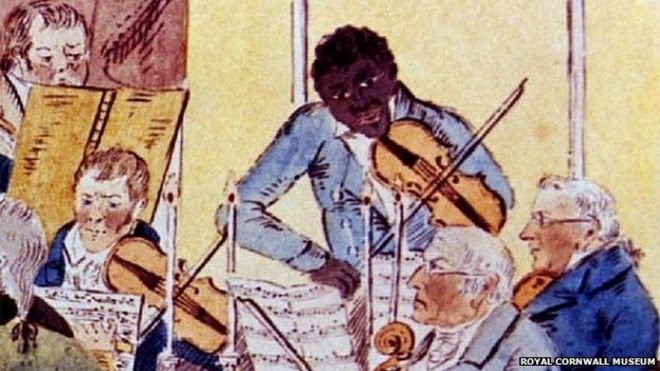
    Joseph Emidy led the Truro Philharmonic Orchestra

    The remarkable life of a former slave who became a pioneer of classical music has been commemorated.

    The “genius” violinist Joseph Emidy, from West Africa, was enslaved for two long periods of his eventful life.

    But having finally gained his freedom in 1799, Emidy became “Britain’s first composer of the African diaspora”.

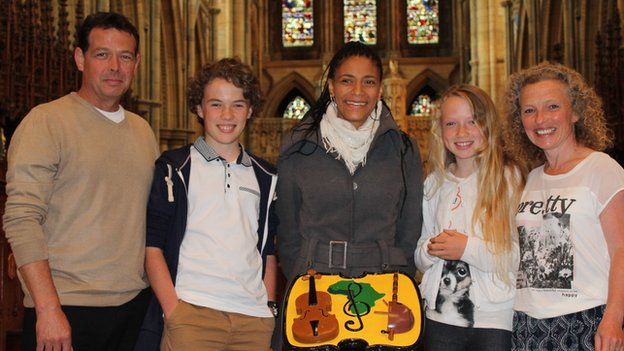
    His achievements were marked at Truro Cathedral on Sunday with the erection of a ‘boss‘ – a painted wooden carving featuring a violin and a map of Africa.

    On his death in 1835, The West Briton newspaper reported in Emidy’s obituary: “As an orchestral composer, his sinfonias may be mentioned as evincing not only deep musical research, but also those flights of genius.”…

    …Emidy was finally discharged four years later in the port of Falmouth on 28 February 1799.

    He married a local woman, Jenefer Hutchins, in 1802, started taking on music students and became involved with the the first of Truro’s biennial concerts in 1804.


    Beverley Wilson (far right) the great, great, great, great grand-daughter of Joseph Emidy met kora player Sona Jobarteh (centre)

    Silk Buckingham described him as “an exquisite violinist, a good composer, who led at all the concerts of the county, and who taught equally well the piano, violin, violoncello, clarionet and flute”…

    Read the entire article here.

  • But Ms. Dolezal’s view of herself — however confused, or incongruent with society’s — reveals an essential truth about race: It is a fiction, a social construct based in culture and not biology.

    2015-06-22

    But Ms. [Rachel A.] Dolezal’s view of herself — however confused, or incongruent with society’s — reveals an essential truth about race: It is a fiction, a social construct based in culture and not biology. It must be “made” from what people believe and do. Race is performative. It is the memories that bind us, the stories passed down to us, the experiences that we share, the social forces that surround us.

    Allyson Hobbs, “Rachel Dolezal’s Unintended Gift to America,” The New York Times, June 17, 2015. http://www.nytimes.com/2015/06/17/opinion/rachel-dolezals-unintended-gift-to-america.html.

  • Episode 613 – President Barack Obama

    2015-06-22

    Episode 613 – President Barack Obama

    WTF with Marc Maron
    Monday, 2015-06-22

    Marc Maron, Host

    Barack Obama, President of the United States


    Marc and President Obama in the garage (Photo: Pete Souza)

    Marc welcomes the 44th President of the United States of America, Barack Obama, to the garage for conversation about college, fitting in, race relations, gun violence, changing the status quo, disappointing your fans, comedians, fatherhood and overcoming fear. And yes, this really happened. This episode is presented without commercial interruption courtesy of Squarespace. Go to MarcMeetsObama.com to see behind-the-scenes photos and captions.

    Listen to the episode here. Download the episode here.

  • What the 1920s Tell Us About Dolezal and Racial Illogic

    2015-06-22

    What the 1920s Tell Us About Dolezal and Racial Illogic

    The Chronicle of Higher Education
    2015-06-19

    Carla Kaplan, Stanton W. and Elisabeth K. Davis Distinguished Professor of American Literature
    Northeastern University, Boston, Massachusetts

    Carla Kaplan is author of Miss Anne in Harlem: The White Women of the Black Renaissance (Harper, 2013).

    What does it mean to identify across race lines and to claim a racial identity disconnected from background or biology? Why does so-called reverse passing (white to black) generate such extraordinary attention and controversy? The Rachel Dolezal case reveals a conundrum in race debates that remains unresolved.

    Dolezal, who evidently has been passing for black for years as an activist and Africana-studies instructor, maintains that she is black because she feels black. She says that she “certainly can’t be seen as white” and be the mother of a black son. She asserts that her choices are “misunderstood” because “race as a construct has a fluid understanding.” Her defense of what some dub deception is consistent with social constructionism, which maintains that there is no biological or essential basis to race and that all notions of racial difference are rooted in culture. And this makes her case especially troubling.

    While the bulk of commentary on Dolezal has been condemnatory, some observers have described her as a “Voluntary Negro” to indicate that they “admire,” as the black female journalist Camille Gear Rich put it, Dolezal’s “choice to live her life as a black person.”

    The category “Voluntary Negro,” however, was never intended for whites. The term was coined in the 1920s to describe — and honor — light-skinned blacks, like the NAACP official Walter White, who looked white but insisted on being identified as black (and had the black ancestry to back that up). Blacks who might have passed for white, but didn’t, were lionized by their community. Voluntary Negroes were those who expressed loyalty to their “own” race, not those who cross-identified. They became exemplars of what was seen as a proper ethical relation to race, an embodiment of the “race pride” that was the heart of “New Negro” sensibilities. They were celebrated as part of a broader cultural argument for affirming blackness in the face of white prejudice, and as part of the larger energies of black self-determination and self-definition that fueled cultural renaissances in Harlem, Chicago, and elsewhere. Voluntary Negroes became icons of what Alain Locke, often considered the “midwife” of the Harlem Renaissance, called “the admirable principle of loyalty.”…

    Read the entire article here.

  • U.S. ‘Not Cured’ of Racism, Obama Says, Citing Slavery’s Legacy

    2015-06-22

    U.S. ‘Not Cured’ of Racism, Obama Says, Citing Slavery’s Legacy

    The New York Times
    2015-06-22

    Michael D. Shear, White House Correspondent

    Christine Hauser, Reporter

    WASHINGTON — Just days after nine black parishioners were killed in a South Carolina church, President Obama said the legacy of slavery still “casts a long shadow” on American life, and he said that choosing not to say the word “nigger” in public does not eliminate racism from society.

    In a wide-ranging conversation about race, including his own upbringing as a man born to a black father and a white woman, Mr. Obama insisted that there was no question that race relations have improved in his lifetime. But he also said that racism was still deeply embedded in the United States.

    “The legacy of slavery, Jim Crow, discrimination in almost every institution of our lives, you know, that casts a long shadow, and that’s still part of our DNA that’s passed on,” the president said during an interview for Marc Maron’s “WTF” podcast that was released on Monday. “We’re not cured of it. And it’s not just a matter of it not being polite to say nigger in public. That’s not the measure of whether racism still exists or not.”

    He added, “Societies don’t overnight completely erase everything that happened two to 300 years prior.”

    Mr. Obama has been more open about the issue of race during his second term, in part because of racially charged episodes in the last several years. The killing of Trayvon Martin, a black teenager in Florida, and the protests that followed several police shootings have prompted the president to be more reflective about his own racial identity and the nation’s.

    In the hourlong interview, Mr. Obama talked about being a rebel during his youth and “trying on” different kinds of personas as he struggled to understand what kind of African-American man he wanted to be.

    “I’m trying on a whole bunch of outfits,” Mr. Obama said. “Here’s how I should act. Here’s what it means to be cool. Here’s what it means to be a man.”

    He said that a lot of his issues when he was young “revolved around race” but that his attitude changed around the time he turned 20. That is when he began to understand how to honor both sides of his racial identity, the president said.

    “I don’t have to be one way to be both an African-American and also someone who affirms the white side of my family,” he said. “I don’t have to push back from the love and values that my mom instilled in me.”…

    Read the entire article here.

  • Misty Copeland: meet the ballerina who rewrote the rules of colour, class and curves

    2015-06-22

    Misty Copeland: meet the ballerina who rewrote the rules of colour, class and curves

    The Telegraph
    2015-06-21

    Jane Mulkerrins

    Facing opposition about her race, shape, even her hair, the ballet dancer Misty Copeland battled the establishment – and her own mother – to make it to the top

    Misty Copeland can pinpoint the precise moment when she realised her success in ballet held a broader significance. “It was the night I danced The Firebird at the Metropolitan Opera House in June 2012. I had never seen an audience that was 50 per cent African-American. It was overwhelming to know that so many of them were there to support what I stood for.”

    As only the third black soloist (one rung down from a principal dancer, or prima ballerina) in the history of New York’s prestigious American Ballet Theatre (ABT) – and the first in two decades – Copeland, 32, is elegantly dismantling the barriers of race and class that have long surrounded the art form. “When I talk to [black] families, they tell me, ‘We never went to the ballet before. Why would we bring our children when they can’t see themselves reflected on the stage?’ ” she says.

    Her profile reaches beyond the rarefied realms of ballet: she has performed with Prince on stage, her recent advert for the sportswear brand Under Armour has had eight million views, and she has been namechecked as an inspiration by both Barack Obama and Beyoncé.

    In April, she was named as one of Time magazine’s 100 most influential people in the world and was one of the five cover stars for the issue, along with Bradley Cooper, Kanye West, the US news anchor Jorge Ramos and the supreme court justice Ruth Bader Ginsberg. That month, she sparked huge media coverage – and a frenzied rush on the box office – when she and Brooklyn Mack became the first black duo to dance the leading roles of Odil/Odette and Prince Siegfried in Swan Lake for a major ballet company.

    But Copeland’s prominence and influence is all the more incredible given her wholly untraditional path to the top. As she recounts in her bestselling autobiography, Life in Motion: An Unlikely Ballerina, which is now being developed into a Hollywood film, she did not begin lessons until the age of 13 – positively geriatric in the dance world…

    Read the entire article here.

  • The problems with Rachel Dolezal and the social construction of race

    2015-06-22

    The problems with Rachel Dolezal and the social construction of race

    Nerding Out with Dorian Warren
    MSNBC
    2015-06-17

    Dorian Warren, Host and Associate Professor of Political Science and International and Public Affairs
    Columbia University, New York, New York

    Christina Greer, Assistant Professor of Political Science
    Fordham University, The Jesuit University of New York

    Allyson Hobbs, Assistant Professor of History
    Stanford University

    Joseph Lowndes, Associate Professor of Political Sciences
    University of Oregon

    Dorian Warren talks with professors Allyson Hobbs, Christina Greer, and Joseph Lowndes about what the social construction of race does and does not mean in the case of Rachel Dolezal. Plus, writer and advocate Parker Molloy speaks on what the media gets wrong when it compares the experiences of the transgender community to those of Rachel Dolezal.

    Watch the interview (00:50:52) here.

  • An open letter to President Obama: This is a moral emergency

    2015-06-21

    An open letter to President Obama: This is a moral emergency

    Jewish Journal
    2015-06-19

    Todd Samuel Presner, Professor and Director, Alan D. Leve Center for Jewish Studies
    University of California, Los Angeles

    Dear President Barack Obama,

    I appreciate your comments on the “heartache and the sadness and the anger” that many Americans are feeling after the shooting of nine African-American congregants at the Emanuel African Methodist Episcopal Church. You pointed out that “this type of mass violence does not happen in other advanced countries,” and you argued, as you have before, for stricter gun control laws. I agree. After the torture and death of Freddie Gray, you said that we – as a nation – “have some soul-searching to do” and that race-based police violence was not something new. Indeed, it is not. After the shooting death of Trayvon Martin, you said that Trayvon could have been you “35 years ago,” and you pointed out the ways our criminal justice system disproportionately targets and imprisons African American men. You wondered: “But beyond protests or vigils, the question is, are there some concrete things that we might be able to do?”  After the strangulation of Eric Garner, you said that “this is not just a black problem or a brown problem. This is an American problem.” You are absolutely right. And after the death of Michael Brown, you said “we should comfort each other and talk with one another in a way that heals, not in a way that wounds.” You called for prayers, peace, and soul-searching. But with all due respect President Obama, none of this is enough. We – all Americans – have to call this violence out for what it really is: It is racism. And racism perpetuated and legitimized by the persistent failure of Americans to confront this most urgent, most pernicious, and most vile moral and existential catastrophe at the core of our nation…

    Read the entire article here.

  • From Ferguson to Charleston and Beyond, Anguish About Race Keeps Building

    2015-06-21

    From Ferguson to Charleston and Beyond, Anguish About Race Keeps Building

    The New York Times
    2015-06-20

    Lydia Polgreen, Johannesburg Bureau Chief

    Ferguson. Baltimore. Staten Island. North Charleston. Cleveland.

    Over the past year in each of these American cities, an unarmed black male has died at the hands of a police officer, unleashing a torrent of anguish and soul-searching about race in America. Despite video evidence in several of the killings, each has spurred more discord than unity.

    Grand juries have tended to give the benefit of the doubt to police officers. National polls revealed deep divisions in how whites and blacks viewed the facts in each case. Whites were more likely to believe officers’ accounts justifying the use of force. Blacks tended to see deeper forces at work: longstanding police bias against black men and a presumption that they are criminals.

    Then, on Wednesday night, a young white man walked into a historic black church in Charleston, S.C., and joined a group of worshipers as they bowed their heads over their Bibles. He shot and killed nine of them. In his Facebook profile picture, the suspect, Dylann Roof, wore the flags of racist regimes in South Africa and the former Rhodesia.

    The massacre at Emanuel African Methodist Episcopal Church in Charleston was something else entirely from the police killings. But it, too, has become a racial flash point and swept aside whatever ambiguity seemed to muddle those earlier cases, baldly posing questions about race in America: Was the gunman a crazed loner motivated by nothing more than his own madness? Or was he an extreme product of the same legacy of racism that many black Americans believe sent Michael Brown, Freddie Gray, Eric Garner, Walter Scott and Tamir Rice to their graves?

    The debate has already begun…

    …America is living through a moment of racial paradox. Never in its history have black people been more fully represented in the public sphere. The United States has a black president and a glamorous first lady who is a descendant of slaves. African-Americans lead the country’s pop culture in many ways, from sports to music to television, where show-runners like Shonda Rhimes and Lee Daniels have created new black icons, including the political fixer Olivia Pope on “Scandal” and the music mogul Cookie Lyon on “Empire.”

    It has become commonplace to refer to the generation of young people known as millennials as “post-racial.” Black culture has become so mainstream that a woman born to white parents who had claimed to be black almost broke the Internet last week by saying that she was “transracial.”

    Yet in many ways, the situation of black America is dire…

    Read the entire article here.

Previous Page
1 … 583 584 585 586 587 … 1,428
Next Page

Designed with WordPress