• Miengun’s Children: Tales from a Mixed-Race Family

    Mrs. Jessie W. Hilton of Albuquerque, N.M., who summers at her cottage Mi-en-gun Walszh (Wolf’s Den) in Northport, was hostess at 5:00 o’clock Wednesday at Schuler’s of this city honoring Mrs. C. Stuker of Oak Park, III., house guest of her sister, Mrs. Basil Milliken of Oklahoma City, Okla., summer resident at Northport.

    Traverse City [Michigan] Record Eagle, July 7, 1954

    Frontiers: A Journal of Women Studies
    Volume 29, Numbers 2/3, Intermarriage and North American Indians (2008)
    pp. 146-185
    DOI: 10.1353/fro.0.0016

    Susan E. Gray, Associate Professor of History
    Arizona State University

    At the time of this gathering of summer society in a northern Michigan resort town, Jessie Milton was eighty-nine years old. For more than fifty years, she had been a summer resident of Northport, on the tip of the Leelanau Peninsula, north and west of Traverse City, leaving her home in Oklahoma City every June and returning from Michigan in October, events noted in the society pages of newspapers in both places. The only break in this pattern occurred in 1947, when she moved from Oklahoma City to her daughter’s house in Albuquerque, from which she continued to commute each summer to the Leelanau. Despite Jessie’s social standing, however, her annual pilgrimages differed from most sojourns of the genteel and well-heeled to northern Michigan. Twice divorced, she was long accustomed to supporting herself, and she ran a shop in Northport during the summer tourist season, selling Indian handicrafts and pies that she made from the cherries for which the Traverse region is famous. The silverwork for sale at the “Cherry Buttery” came from New Mexico, but the sweet grass and split ash baskets were the work of local Odawa and Ojibwe people, some of whom Hilton had known far longer than she had been summering on the Leelanau. Indeed, the annual arrival of Jessie Hilton, society matron and purveyor of Indian handicrafts, at the Wolf’s Den signaled the complexity and fluidity of a mixed-race identity that she, like her twelve brothers and sisters, had spent a lifetime negotiating.

    Read or purchase the article here.

  • Hybrid Knowledge

    History Workshop Journal
    Published online 2011-02-25
    DOI: 10.1093/hwj/dbq062

    Anna Winterbottom, Tutorial Fellow in Early Modern History
    Sussex University, Brighton, England

    The Brokered World: Go-Betweens and Global Intelligence, 1770-1820, ed. Simon Schaffer, Lissa Roberts, Kapil Raj, James Delbourgo; Science History Publications, Sagamore Beach MA, 2009; 552 pp.; 0-88135-374-4.

    As the editors of this volume note, the terms ‘broker’ and ‘go-between’ tend to evoke back-room introductions and the shuffling of suspicious papers, rather than the traditionally triumphal images of Enlightenment knowledge. The people who embodied the global connections through which information flowed between cultures have only relatively recently become a focus of English-language scholarship. This is in part the legacy of dualistic conceptualizations of race, empire and science in Anglo-American colonial discourse. In an imagined world divided between black and white, ruler and ruled, modern and traditional, scientific and emotional, rational and spiritual, the people or ideas that crossed boundaries posed not only an administrative headache, but also a threat to the cosmic order. A rejection of the idea of mixing, physically or intellectually, also came from many of those who opposed colonialism. For example, Anglo-Indians were generally sidelined rather than celebrated in the Indian independence movement. Writing from a colonial gaol, Nehru argued that despite the efforts of a few more enlightened individuals, opportunities for cultural, social and scientific exchange were deliberately quashed and that European and Asian systems of knowledge remained more or less separate.  During the colonial period, therefore, people who crossed the borders of knowledge, like those who transgressed racial categories, were characterized on all sides as untrustworthy and potentially treacherous.

    In Spanish, Portuguese and French, the words for the intermingling of cultures and those who are the agents of this process have a longer history of academic discussion and cultural politics. While fears concerning the dangers of cultural and racial…

    Read or purchase the article here.

  • More Hawaii residents identify as mixed race

    USA Today
    2011-02-24

    William M. Welch

    Hawaii, the nation’s most ethnically diverse state, has seen a big increase in residents identifying themselves as being of mixed race, according to Census data released Thursday.

    Among adults 18 and older, those saying they are of two or more races rose 31% from 2000 to 2010. They make up 18.5% of the state’s adult population.

    Among all ages, the increase of those citing two or more races was 23.6%. Overall, almost one in four Hawaii residents are of mixed race.

    Residents citing some Asian heritage make up 57.4% of the state’s population. Their numbers grew by 11%, though other ethnic groups grew more rapidly.

    Sarah C. W. Yuan, a demographer at the University of Hawaii’s Center on the Family, said the racial trends reflect growth and acceptance of multiracial marriages and an increased willingness of people to claim more than one racial identity. She said the decline in people identifying with one race only, from 78.6% in 2000 to 76.4% in the 2010 Census, was expected.

    “Hawaii’s population has been more diverse over the years,” she said. “There are many multiracial marriages, so we do see two-or-more-race groups increase over the years.”

    Hawaii’s overall population grew 12.3% to 1.36 million…

    Read the entire article here.

  • Black, Red and Proud: An Interview with Radmilla Cody

    The Root
    2011-02-22

    Cynthia Gordy

    Radmilla Cody’s crowning as Miss Navajo Nation in 1997 triggered an outcry and a conversation about what it means to be Native American. Now she’s featured in a museum exhibit showing the rarely told history of African-Native Americans.

    In a 1920 edition of the Journal of Negro History, Carter G. Woodson observed, “One of the longest unwritten chapters in the history of the United States is that treating of the relations of the Negroes and the Indians.” [See: C. G. Woodson, “Negroes and Indians in Massachusetts,” Journal of Negro History, Volume 5, Number 1 (January 1920).]

    Red/Black: Related Through History,” a new exhibit at Indianapolis’ Eiteljorg Museum of American Indians and Western Art, illuminates this rarely told story. Since the first arrival of enslaved Africans in North America, the relationships between African Americans and Native Americans have encompassed alliances and adversaries, as well as the indivisible blending of customs and culture.

    “It’s not received a lot of attention because it’s not the dominant culture’s story, although it’s very important to the dominant culture’s bigger view of the past,” says James Nottage, curator of the exhibit, which includes narratives of enslaved blacks who traveled the Trail of Tears with their Native owners; slaves who intermarried into Native tribes as an escape from bondage; and the largely African-featured members of the Shinnecock tribe of New York, as well as shared traditions in food, dress and music…

    …Cody, also the subject of a 2010 documentary, Hearing Radmilla, talked to The Root about growing up both black and Navajo, and how she handles frequent “Wow, you don’t look Indian” comments.

    The Root: The experience of having your Miss Navajo Nation reign challenged calls to mind the debate over the Cherokee Freedmen. Is this a common issue across the Native community, of African-Native Americans having trouble finding acceptance?

    Radmilla Cody: I grew up having to deal with racism and prejudices on both the Navajo and the black sides, and when I ran for Miss Navajo Nation, that especially brought out a lot of curiosity in people. It’s something that we’re still having to address as black Natives, still having to prove ourselves in some way or another, because at the end of the day, it all falls back to what people think a Native American should look like.

    But there’s been many times when people have said to me, “Oh, my great-great-grandmother was an Indian.” I’ll ask them if they know what tribe, and they don’t. It’s very important because in order to be acknowledged as a tribal member, you have to be enrolled. So I can see where Native people are protective about defining who’s a tribal member, and are questioning of people claiming Native ancestry…

    TR: What does that preparation entail, exactly? I understand it’s not a typical pageant.

    RC: Basically you’re tested on your knowledge of the Navajo government, the culture, the stories, the songs and the Navajo philosophy of life. You’re tested on butchering a sheep and making fry bread and other traditional foods of the Navajo people. It usually lasts about a week. What separates our pageant from the Miss USA pageant is the bikini—we don’t have a swimsuit category!…

    Read the entire article here.

  • Red/Black: Related Through History

    Eitejorg Museum of American Indians and Western Art
    White River State Park
    500 West Washington Street
    Indianapolis, Indiana
    2011-02-12 through 2011-08-07

    Explore the interwoven histories of African Americans and Native Americans with Red/Black: Related Through History. This groundbreaking exhibition is the result of a partnership between the Eiteljorg Museum and the Smithsonian’s National Museum of the American Indian (NMAI). Red/Black includes the NMAI panel exhibit IndiVisible: African-Native American Lives in the Americas and portrays the shared experiences of African and Native Americans as allies and adversaries, through images, artifacts, film and more. The exhibition also explores issues of race and identity and the question: “Who am I and who gets to say so?” Red/Black will be supported by performances, genealogy workshops, lectures and other dynamic programming.
     
    The story of this largely ignored subject is told through personal narratives, paintings, baskets, pottery, photographs and other rare items gathered from private collections and museums across the country. See a basket made by a Cherokee-owned slave and hear drum music with shared African and Native rhythms. Learn how the exhibit narrative relates to you, what we know about the past and how people judge one another…

    For more information, click here.

  • Seven Hours To Burn

    Women Make Movies
    USA/Canada, 1999
    9 minutes
    Color/BW, VHS/16mm
    Order No. W01699

    Shanti Thakur

    “A visually expressive personal documentary that explores a family’s history. Filmmaker Thakur mixes richly abstract filmmaking with disturbing archival war footage to narrate the story of her Danish mother’s and Indian father’s experiences. Her mother survives Nazi-occupied Denmark while her father experiences the devastating civil war in India between Hindus and Muslims. Both émigrés to Canada, they meet and marry, linking two parallel wars. Their daughter lyrically turns these two separate histories into a visually rich poem linking past and present in a new singular identity.” Doubletake Documentary Film Festival Catalogue

    View the trailer here.

  • Mixed Blood: Intermarriage and Ethnic Identity in Twentieth-Century America [Review: Daniel]

    Contemporary Sociology
    Volume 22, Number 3 (May 1993)
    pages 381-382

    Mixed Blood: Intermarriage and Ethnic Identity in Twentieth-Century America, by Paul R. Spickard. Madison: University of Wisconsin Press, 1991. 532 pp. cloth ISBN: 0-299-12110-0. paper ISBN: 0-299-12114-3.

    G. Reginald Daniel, Professor of Sociology
    University of California at Santa Barbara

    As an ethnohistory conversant with sociological discourse, Paul Spickard’s Mixed Blood is not only a valuable resource for both historians and sociologists specializing in race and ethnic relations but also a welcome change from traditional social science litera- ture on this topic. These previous studies, by seeking to construct generalizable models from quantitative data, unfortunately have not taken into account the nuances of personal experience and subtleties of space and time. In Spickard’s study, however, intermarriage emerges as a multivariate historical process of attitudes and behavior which are derivative of not only intergroup, but also interpersonal, dynamics, as illustrated by the author’s rich anecdotal sources.

    The main portion of Mixed Blood is devoted to a comparative study of the intermarriage patterns of Jewish, Japanese, and African Americans. This choice allows Spickard to highlight important contemporary variations in the strength of pluralism and integration, that is, the persistence and permeability of boundaries of gender, race, culture, ethnicity, and class as they relate to the pretwentieth century history of each of the three groups. Spickard’s analysis of the intergenerational increase in out-marriage by Jewish Americans, for example, clearly indicates that the boundary which formerly might have marked an intermarriage is less distinct than it had been among European- Americans from different ethnocultural backgrounds…

    Read or purchase the review here.

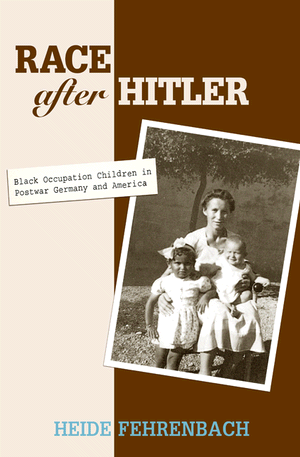
  • Race after Hitler: Black Occupation Children in Postwar Germany and America

    Princeton University Press
    2005
    288 pages
    6 x 9, 17 halftones, 1 line illustration, 2 maps
    ISBN13: 978-0-691-13379-9

    Heide Fehrenbach, Presidential Research Professor of History
    Northern Illinois University

    When American victors entered Germany in the spring of 1945, they came armed not only with a commitment to democracy but also to Jim Crow practices. Race after Hitler tells the story of how troubled race relations among American occupation soldiers, and black-white mixing within Germany, unexpectedly shaped German notions of race after 1945. Biracial occupation children became objects of intense scrutiny and politicking by postwar Germans into the 1960s, resulting in a shift away from official antisemitism to a focus on color and blackness.

    Beginning with black GIs’ unexpected feelings of liberation in postfascist Germany, Fehrenbach investigates reactions to their relations with white German women and to the few thousand babies born of these unions. Drawing on social welfare and other official reports, scientific studies, and media portrayals from both sides of the Atlantic, Fehrenbach reconstructs social policy debates regarding black occupation children, such as whether they should be integrated into German society or adopted to African American or other families abroad. Ultimately, a consciously liberal discourse of race emerged in response to the children among Germans who prided themselves on—and were lauded by the black American press for—rejecting the hateful practices of National Socialism and the segregationist United States.

    Fehrenbach charts her story against a longer history of German racism extending from nineteenth-century colonialism through National Socialism to contemporary debates about multiculturalism. An important and provocative work, Race after Hitler explores how racial ideologies are altered through transnational contact accompanying war and regime change, even and especially in the most intimate areas of sex and reproduction.

    Table of Contents

    • List of Illustrations
    • Acknowledgments
    • Introduction: Democratizing the Racial State: Toward a Transnational History
    • Chapter One: Contact Zones: American Military Occupation and the Politics of Race
    • Chapter Two: Flaccid Fatherland: Rape, Sex, and the Reproductive Consequences of Defeat
    • Chapter Three: “Mischlingskinder” and the Postwar Taxonomy of Race
    • Chapter Four: Reconstruction in Black and White: The Toxi Films
    • Chapter Five: Whose Children, Theirs or Ours? Intercountry Adoptions and Debates about Belonging
    • Chapter Six: Legacies: Race and the Postwar Nation
    • Abbreviations of Archives Consulted
    • Notes
    • Select Bibliography
    • Index

    THE MILITARY occupation of Germany by American troops elicited two striking responses that were organized around irony and issues of race. One came from Germans, who noted with incredulity and derision that they were being democratized by a nation with a Jim Crow army and a host of anti-miscegenation laws at home. The second came from African American GIs who, in their interactions with Germans, were stunned by the apparent absence of racism in the formerly fascist land and, comparing their reception with treatment by white Americans, experienced their stay there as unexpectedly liberatory. Both responses criticized the glaring gap between democratic American principles and practices; both exposed as false the universalist language employed by the United States government to celebrate and propagate its political system and social values at home and abroad. Yet both also suggested the centrality of intercultural observation and exchange for contemporaries’ experience and understanding of postwar processes of democratization…

    Read Chapter One in HTML or PDF.

  • Multiracial: Border Crosser: Stephen Murphy-Shigematsu navigates nations, cultures and academia

    Nichi Bei: A mixed plate of Japanses American News & Culture
    2010-05-20

    Akemi Johnson

    Stephen Murphy-Shigematsu is looking again toward Japan.

    A psychotherapist, writer and academic, Murphy-Shigematsu has lived in Palo Alto, Calif. the past eight years, teaching at Stanford University and running an independent multicultural consulting practice. Life in the Bay Area, he says, is easy for someone like him, the son of an Irish American man and Japanese woman. Conflict—tensions associated with being mixed race—is rare.

    This wasn’t always the case. Early in his career, Murphy-Shigematsu, who was born in Tokyo in 1952 and raised in Massachusetts, faced questions about his legitimacy working in Asian American studies. In 1984 he began an internship at the National Asian American Psychology Training Center. One of the first people who welcomed him there said, “So, you’re interested in working with Asian Americans?”

    “That really threw me,” Murphy-Shigematsu said. The other man saw him as an outsider to the workshop, whereas Murphy-Shigematsu viewed himself as an insider, a fellow Asian American.

    Or there was the time in the late ’80s when Murphy-Shigematsu spoke to an Asian American studies class at San Francisco State University.

    “Are you Asian?” the students asked.

    “Why do you ask?” Murphy-Shigematsu replied.

    “Because you don’t look Asian,” they said.

    At academic conferences, Murphy-Shigematsu would stand out physically, and some people would regard him with an attitude of “Why are you here?”

    An influential figure for Murphy-Shigematsu during that time was Lane Hirabayashi. Hirabayashi, a noted mixed-race Japanese American scholar, had advocated using the word “hapa,” and claiming the right to self-define, instead of being labeled by well-intentioned others. Impressed with this, Murphy-Shigematsu sought out Hirabayashi…

    Read the entire article here.

  • More students identifying as multiracial

    Collegiate Times
    Virginia Polytechnic Institute and State University (Virginia Tech)
    2011-02-17

    Sarah Watson, News Reporter

    More students pursuing a secondary education identify themselves as multiracial or multiethnic.

    Students across the nation and in the Virginia Tech community are checking the box “two or more races” when filling out college applications. However, this increase is not based on more opportunity for multiracial students, a new categorization system for race or any other preconceived ideas alone.

    Multiracial and multiethnic movements are not a new phenomenon, according to Wornie Reed, director of the center for race and social policy research.

    “This has been going on for some time,” Reed said, adding that multiracial movements have been occurring for the past three decades. 

    Reed said the moments were part of a new social context “that race is not a biological construct, but a social construct — but it doesn’t make it any less real.”

    According to Ray Williams, director of Tech’s multicultural programs and services, the increase of students identifying themselves as multiracial or multiethnic has been influenced by the post-Civil Rights movement era that encapsulates our society.

    “People are more comfortable coming out and saying that they are either one thing or another, or a mix,” Williams said…

    Read the entire article here.