• Cultural Activities, Identities, and Mental Health Among Urban American Indians with Mixed Racial/Ethnic Ancestries

    Race and Social Problems
    Volume 2, Number 2 (2010)
    pages 101-114
    DOI: 10.1007/s12552-010-9028-9

    Yoshitaka Iwasaki, Professor of Rehabilitation Sciences and Social Work
    Temple University

    Namorah Gayle Byrd, Assistant Professor, Developmental English
    Gloucester County College, New Jersey

    Focus groups were conducted to appreciate the voices of Urban American Indians (UAI) who have mixed ancestries residing in Philadelphia, Pennsylvania. Participants (15 women and 10 men, 19–83 years of age) with a variety of Native ancestries coming from different nations (i.e., blackfeet, blackminkwa, Cherokee, Creek, Delaware, Lakota, Powhatan, Seminole, and Shawnee) reported to also have a Non-Native racial/ethnic ancestry such as African/black, Hispanic, and/or Caucasian/white. Specifically, this study provided evidence about (a) the complexity and challenge of being “mixed” UAI (e.g., “living a culture” as opposed to blood quantum in determining a personal identity) (b) the linkage of cultural identities to mental health (c) contributions of cultural activities to identities and mental health (e.g., therapeutic and healing functions of cultural activities), and (d) very limited urban Native-oriented mental health service (e.g., visions for Native American-centered mental health clinic in an urban setting). Building on those UAI’s voices, this paper provides a context for the need of a culturally respectful transformation of urban mental health system by highlighting the clinical significance of cultural identity and mental health promotion for UAI.

    Read or purchase the article here.

  • Other Tongues: Mixed-Race Women Speak Out

    Inanna Publications
    November 2010
    250 pages
    ISBN-10: 1926708148
    ISBN-13: 978-1-926708-14-0

    Edited by

    Adebe De Rango-Adem (Adebe D. A.)

    Andrea Thompson

    This anthology of poetry, spoken word, fiction, creative non-fiction, spoken word texts, as well as black and white artwork and photography, explores the question of how mixed-race women in North America identify in the twenty-first century. Contributions engage, document, and/or explore the experiences of being mixed-race, by placing interraciality as the center, rather than periphery, of analysis. The anthology also serves as a place to learn about the social experiences, attitudes, and feelings of others, and what racial identity has come to mean today.

    Adebe De Rango-Adem recently completed a research writing fellowship at the Applied Research Center in New York, where she wrote for ColorLines, America’s primary magazine on race politics. She has served as Assistant Editor for the literary journal Existere, and is a founding member of s.t.e.p.u.p.—a poetry collective dedicated to helping young writers develop their spoken word skills. Her poetry has been featured in journals such as Canadian Woman Studies, The Claremont Review, Canadian Literature, and cv2. She won the Toronto Poetry Competition in 2005 to become Toronto’s first Junior Poet Laureate, and is the author of a chapbook entitled Sea Change (2007). Her debut poetry collection, Ex Nihilo, will be published in early 2010.

    Andrea Thompson is a performance poet who has been featured on film, radio, and television, with her work published in magazines and anthologies across Canada. Her debut collection, Eating the Seed (2000), has been featured on reading lists at the University of Toronto and the Ontario College of Art and Design, and her spoken word CD, One, was nominated for a Canadian Urban Music Award in 2005. A pioneer of slam poetry in Canada, Thompson has also hosted Heart of a Poet on Bravo tv, CiTr Radio’s spoken word show, Hearsay. In 2008, she toured her Spoken Word/Play Mating Rituals of the Urban Cougar across the country, and in 2009 was the Poet of Honour at the Canadian Festival of Spoken Word.

    Table of Contents (Thanks to Nicole Asong Nfonoyim)

    • Acknowledgements
    • Preface – Carol Camper
    • Introduction – Adebe DeRango-Adem and Andrea Thompson1
    • RULES/ROLES
      • Enigma – Andrea Thompson
      • Blond- Natasha Trethewey
      • Mixed- Sandra Kasturi
      • pick one – Chistine Sy and Aja
      • My Sista, Mi Hermana – Phoenix Rising
      • little half-black-breed – Tasha Beeds
      • “White Mask” – Jordan Clarke
      • “Nothing is just black or white” – Jordan Clarke
      • Roll Call – Kirya Traber
      • What Am I? – Marijane Castillo
      • Casting Call: Looking for White Girls and Latinas – D.Cole Ossandon
      • Conversations of Confrontation – Natasha Morris
      • “why i don’t say i’m white”- Alexis Kienlen
      • “Confession #8” – Mica Lee Anders
      • “Other Female” – Mica Lee Anders
      • “MMA and MLA” – Mica Lee Anders
      • The Pieces/Peace(is) in Me – monica rosas
      • Generation Gap (Hawaiian Style) – ku’ualoha ho’omanawanui
      • The Incident that Never Happened – Ann Phillips
      • In the Dark – Anajli Enjeti-Sydow
      • ananse vs. anasi (2007) – Rea McNamara
      • Contamination-  Amber Jamilla Musser
      • A Mixed Journey From the Outside In – Liberty Hultberg
      • What Are You? – Kali Fajardo-Anstine
      • One Being Brown – Tru Leverette
      • One for Everyday of the Week – Michelle Lopez Mulllins
      • Savage Stasis – Gena Chang-Campbell
      • The Half-Breed’s Guide to Answering the Question – M. C. Shumaker
      • My Definition – Kay’la Fraser
      • Pop Quiz – Erin Kobayashi
    • ROOTS/ROUTES
      • Melanomial – Sonnet L’Abbe
      • half-breed – Jonina Kirton
      • “Inca/Jew” – Margo Rivera-Weiss
      • Open Letter – Adebe DeRango Adem
      • Prism Woman – Adebe DeRango-Adem
      • Southern Gothic – Natasha Trethewey
      • The Drinking Gourd- Miranda Martini
      • Reflection – Jonina Kirton
      • “Untitled” White Sequence – Cassie Mulheron
      • “Untitled” Black Sequence – Cassie Mulheron
      • Mapping Identities – Gail Prasad
      • Whose Child Are You? – Amy Pimentel
      • From the Tree – Lisa Marie Rollins
      • My sister’s hair – ku’ualoha ho’omanawanui
      • I, too, hear the dreams – Peta Gaye-Nash
      • Learning to Love Me – Michelle Jean-Paul
      • A Conversation among Friends – Nicole Salter
      • The Combination of the Two – Rachel Afi Quinn
      • “Loving Series: Elena Rubin” – Laura Kina
      • On the Train – Naomi Angel
      • Coloured – Sheila Addiscott
      • Of Two Worlds – Christina Brobby
      • What is my Culture? – Karen Hill
      • mo’oku’auhau (Genealogy) – ku’ualoha ho’omanawanui
      • Siouxjewgermanscotblack [cultural software instructions] – Robin M. Chandler
      • “Loving Series: Shoshanna Weinberger” – Laura Kina
      • A Hairy Situation – Saedhlinn B. Stweart-Laing
      • “Pot Vida” – Margo Rivera-Weiss
      • Songs Feet Can Get – Rage Hezekiah
      • Opposite of Fence – Lisa Marie Rollins
      • Applique – Lisa Marie Rollins
      • Blanqueamiento – Adebe DeRango-Adem
      • The Land – Farideh de Bossett
      • Native Speaker: Daring to Name Ourselves – Nicole Asong Nfonoyim
    • REVELATIONS
      • Colour Lesson I – Adebe DeRango-Adem
      • Concealed Things – Adebe DeRango-Adem
      • Serendipity – Priscila Uppal
      • “Ultramarine” – Margo Rivera-Weiss
      • before i was this – Katherena Vermette
      • Firebelly – Andrea Thompson
      • From Chopsticks to Meatloaf and Back Again – Jasmine Moy
      • My Power – Sonnet L’Abbe
      • Whitewashed – Kathryn McMillan
      • Actually, I’m Black – Marcelite Failla
      • “Self” – Lisa Walker
      • Grey (A Bi-racial Poem) – Sonya Littlejohn
      • Nubia’s Dream – Mica Valdez
      • both sides – Jonina Kirton
      • Mulatto Nation – Marika Schwandt
      • Colour Lesson II – Adebe DeRango-Adem
      • racially queer femme – Kimberly Dree Hudson
      • mypeople – Ruha Benjamin
      • My Life in Pieces – Jennifer Adese
      • Burden of Proof: From Colon-Eyes to Kaleidoscope – Angela Dosalmas
      • Recipe for mixing – Tomie Hahn
      • Metamorphosis – Gena Chang-Campbell
      • The Land Knows – Shandra Spears Bombay
      • Land in Place: Mapping the Grandmother – Joanne Arnott
      • “I am the leaf, you are the leaf” – Lisa Walker
      • Language and the Ethics of Mixed Race – Debra Thompson
      • Hybrid Identity and Writing of Presence – Jackie Wang
    • Contributors Notes
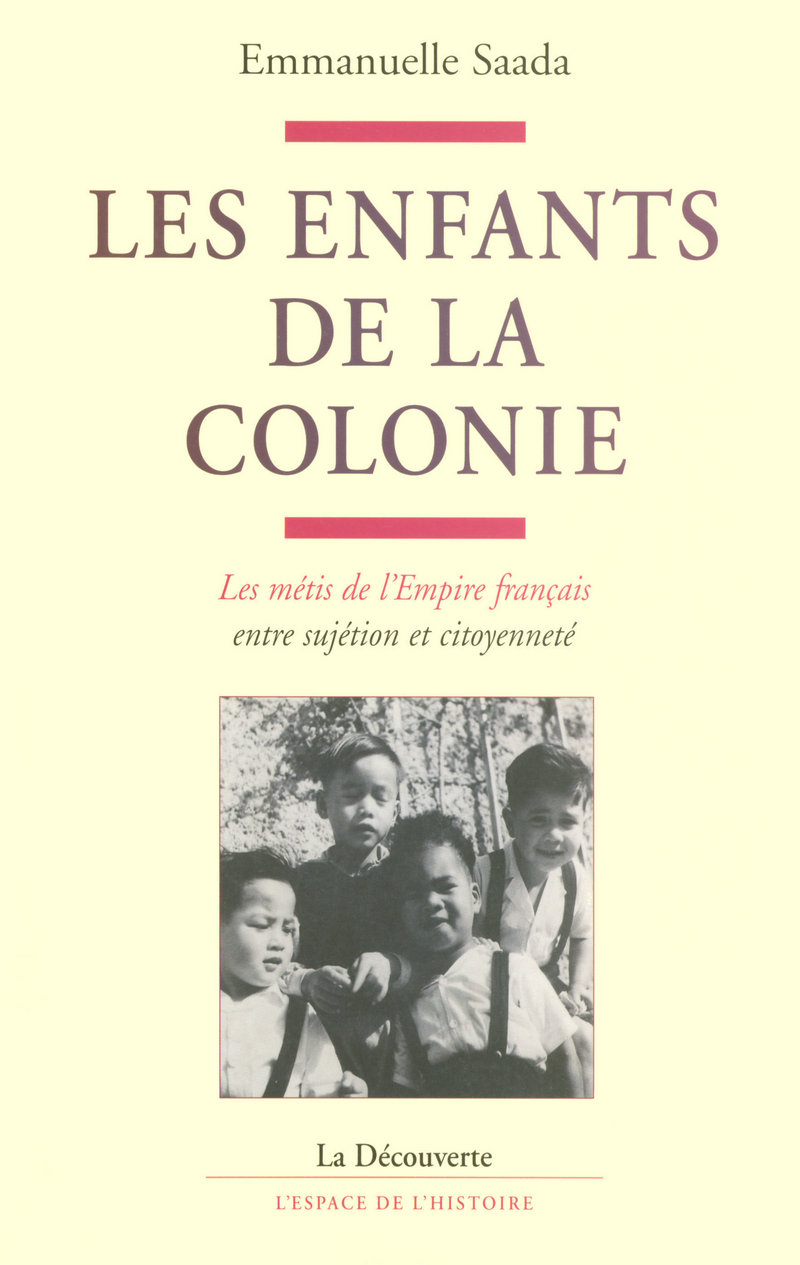
  • Les Enfants de la colonie: Les métis de l’Empire français entre sujétion et citoyenneté / Children of The Colonies: The Métis of the French Empire: Citizens or Subjects?

    Éditions La Découverte
    2007
    336 pages
    Dimensions: 155 * 240 mm
    ISBN: 9782707139825

    Emmanuelle Saada, Associate Professor and Director of the Center for French and Francophone Studies
    Columbia University

    The colonial encounter in the French Empire produced tens of thousands of ‘métis’ children. Most were the product of short-term relationships between European men and native women. Many were abandoned by their fathers, and condemned to illegitimacy. Colonial elites considered them a threat because they blurred the sharp distinction between citizens and subjects on which the colonial order rested. Colonial authorities met this challenge with an array of social and legal efforts to resolve this ambiguity—to «reclassify» the « métis problem » out of existence. Education and culture played a key role in this process, as métis children were placed in special orphanages devoted to « straightening out their heredity », turning them into French citizens of « soul and quality ». This book explores the forgotten history of these children of the colonies, and of their central place in larger strategies of imperial domination and the management of colonial sexuality. It pays special attention to Indochina, which served as a laboratory for the “métis question”, but it is also an account of a global Empire marked by the persistent challenge of maintaining boundaries between citizen and subject. In exploring this intersection between sexuality, race and citizenship in the colonial context, this book challenges and revises the ‘republican model’ of nationhood that has dominated histories of France since the 19th century.

    Pendant la colonisation française, des dizaines de milliers d’enfants sont nés d’« Européens » et d’« indigènes ». Souvent illégitimes, non reconnus puis abandonnés par leur père, ces métis furent perçus comme un danger parce que leur existence brouillait la frontière entre « citoyens » et « sujets » au fondement de l’ordre colonial. Leur situation a pourtant varié : invisibles en Algérie, ils ont été au centre des préoccupations en Indochine. La « question métisse » a également été posée à Madagascar, en Afrique et en Nouvelle-Calédonie.

    Retraçant l’histoire oubliée de ces enfants de la colonie, cet ouvrage révèle une face cachée, mais fondamentale, de l’histoire de l’appartenance nationale en France : il montre comment les tentatives d’assimilation des métis ont culminé, à la fin des années 1920, avec des décrets reconnaissant la citoyenneté à ceux qui pouvaient prouver leur « race française ». Aux colonies, la nation se découvrait sous les traits d’une race.

    Cette législation bouleversa le destin de milliers d’individus, passant soudainement de la sujétion à la citoyenneté : ainsi, en Indochine, en 1954, 4 500 enfants furent séparés de leur mère et « rapatriés » en tant que Français. Surtout, elle introduisait la race en droit français, comme critère d’appartenance à la nation. Cela oblige à revoir le « modèle républicain » de la citoyenneté, fondé sur la figure d’un individu abstrait, adhérant volontaire à un projet politique commun et à souligner les liens entre filiation, nationalité et race.

    Table of Contents

    • Préface, par Gérard Noiriel
    • Introduction
    • I / Le métissage : une question sociale coloniale
    • 1. Une question impériale – Nouvel empire, nouvelle question – Hybrides et bâtards – Géographie de la question métisse – Un problème impérial – Les chiffres du métissage
    • 2. Menace pour l’ordre colonial – Légionnaires, filles de peu et parias – Déracinés et déclassés – Le spectacle du désordre – Dignité et prestige en situation coloniale
    • 3. « Reclasser » les métis – Produire des métis en leur portant secours ? – De la nécessité d’intervenir – Vers une prise en charge par l’État colonial – Notables vs. prolétaires de la colonisation – Dépister, signaler et secourir – Passer les frontières – Vers une demande de droit
    • II / La question métisse saisie par le droit
    • 4. Nationalité et citoyenneté en situation coloniale – Les enjeux d’une condition juridique – Les juristes et l’indigène – La citoyenneté française en pratique – Les métis entre sujétion et citoyenneté
    • 5. La controverse des « reconnaissances frauduleuses » – Les « reconnaissances frauduleuses », « fraudes » à la citoyenneté – Destin d’une controverse juridique – La production d’un droit impérial – Paternité, citoyenneté et ordre politique
    • 6. La recherche de paternité aux colonies – La recherche de paternité en métropole : un texte de compromis – Un débat colonial – Paternité et citoyenneté : nature et volonté – Paternité et race
    • 7. Citoyens en vertu de la race – Le droit hors de lui – La « question métisse » saisie par le droit – Le retournement de la jurisprudence – La fabrique du droit colonial – Vérité sociologique/vérité biologique, « droit reflet »/« droit instituant » – Mise en œuvre d’un droit racial
    • III / La force du droit
    • 8. Le passage du droit : les effets de la citoyenneté sur la catégorie de « métis » – La racialisation des pratiques administratives – Renforcement de la prise en charge des métis – Les métis, des cadres de la colonisation – Une question postcoloniale
    • 9. Des identités saisies par le droit – Des Français des colonies – Vers un multiculturalisme impérial ? – Catégorie juridique et sentiment d’identité
    • 10. Le statut des métis, miroir de la nationalité et de la citoyenneté françaises ? – La race dans la loi – Métis coloniaux et métis juifs – La question métisse et les « modèles républicains » de la nationalité et de la citoyenneté
    • Conclusion – Sources – Bibliographie.
  • Dangerous Liaisons: Sex and Love in the Segregated South

    The University of Arkansas Press
    2003
    160 pages
    6″x9″
    Paper: 1-55728–833-X (978-1-55728-833-2)
    Cloth: 1-55728-755-4 (978-1-55728-755-7)

    Charles F. Robinson II, Associate Professor of History, Vice Provost for Diversity, and Director of African American Studies program
    University of Arkansas

    In the tumultuous decades after the Civil War, as the southern white elite reclaimed power, “racial mixing” was the central concern of segregationists who strove to maintain “racial purity.” Segregation—and race itself—was based on the idea that interracial sex posed a biological threat to the white race. In this groundbreaking study, Charles Robinson examines how white southerners enforced anti-miscegenation laws. His findings challenge conventional wisdom, documenting a pattern of selective prosecution under which interracial domestic relationships were punished even more harshly than transient sexual encounters. Robinson shows that the real crime was to suggest that black and white individuals might be equals, a notion which undermined the legitimacy of the economic, political, and social structure of white male supremacy.

    Robinson examines legal cases from across the South, considering both criminal prosecutions brought by states and civil disputes over marital and family assets. He also looks at U.S. Supreme Court decisions, debates in state legislatures, comments in the U.S. Congressional Record, and newspaper editorials. He not only shows the hardening of racial categories but assesses the attitudes of African Americans about anti-miscegenation laws and intermarriage.

    Dangerous Liaisons vividly documents the regulation of intimacy and its fundamental role in the construction of race.

  • The other thing is, as Reggie [G. Reginald Daniel] said, Reggie knows that we are all multiracial.  He doesn’t need a genetic test to prove that.  I mean, we know that. Even though this can tell us new information—and I think it is an opportunity for conversation—it’s not enough because we already know it and it hasn’t been enough.  You know that slave owners knew those brown children where their children. Did it matter?  They knew those were multiracial children were related to them.  It didn’t make a difference… To me it is a political revolution that we need to see that we’re connected as human beings.  Genetics isn’t going to do it by itself.

    Dorothy Roberts, “A Rx for the FDA: Ethical Dilemmas for Multiracial People in Race-Based Medicine” (panel at the Critical Mixed Race Studies Conference, DePaul University, Chicago, Illinois, November 5-6, 2010).

  • Recent Studies on Biracial Identity and Hypodescent to be Discussed on Mixed Chicks Chat (Pre-recorded)

    Mixed Chicks Chat (The only live weekly show about being racially and culturally mixed. Also, founders of the Mixed Roots Film & Literary Festival) Hosted by Fanshen Cox, Heidi W. Durrow and Jennifer Frappier
    Website: TalkShoe™ (Keywords: Mixed Chicks)
    Episode: #186 – Discussion on Recent Studies on Biracial Identity and Hypodescent
    When: Tuesday, 2010-12-28, 22:00Z (17:00 EDT, 16:00 CDT, 14:00 PDT)


    In this pre-recorded episode recent studies by Harvard Ph.D. student, Arnold K. Ho (“Evidence for hypodescent and racial hierarchy in the categorization and perception of biracial individuals”) and University of Vermont Assistant Professor Nikki Khanna (“Passing as Black: Racial Identity Work among Biracial Americans”) will be discussed.

    Listen to the episode here.  Download the episode here.

  • “’Tain’t no tragedy unless you make it one”: Imitation of Life, Melodrama, and the Mulatta

    Arizona Quarterly: A Journal of American Literature, Culture, and Theory
    Volume 66, Number 4, Winter 2010
    pages 93-113
    E-ISSN: 1558-9595, Print ISSN: 0004-1610

    Molly Hiro, Assistant Professor of English
    University of Portland, Portland, Oregon

    “I just moved here. My name is Maureen Peal. What’s yours?”

    “Pecola.”

    “Pecola? Wasn’t that the name of the girl in Imitation of Life?”

    “I don’t know. What is that?”

    “The picture show, you know. Where this mulatto girl hates her mother ’cause she is black and ugly but then cries at the funeral. It was real sad. Everybody cries in it. Claudette Colbert too.”

    Toni Morrison, The Bluest Eye, 1970

    Sometimes, when I feel as though I cannot stand this agony, this torture, this scorn, I’m utterly glad that Peola did what she did. Sometimes when Fannie Hurst is engraved deeply in my mind, I say to myself while I am washing dishes or getting dinner, “I wonder how Peola and her white husband got along. I wonder if he ever found out.”

    —from a fan letter to Fannie Hurst, 1934

    The epigraphs with which I begin demonstrate the remarkable emotional staying power of Peola, the young mixed-race character in Fannie Hurst’s 1933 novel Imitation of Life and the two film adaptations titled the same. Yet even a cursory glance shows that Peola appeals quite differently to one of these speakers than to the other. In The Bluest Eye, Maureen Peal remembers Imitation of Life for its power to make “everybody cr[y]” along with Peola, who herself expresses regret for “hat[ing] her mother” by “cr[ying] at the funeral” (67). Here, Peola’s fate—what makes the story “real sad”—communicates a clear moral lesson through a shared emotional experience, but in the second quotation, Peola is made to seem far less accessible, her fate far more open-ended. The anonymous…

    Read or purchase the article here.

  • Imitation of Life

    Duke University Press
    2004 (Originially published in 1933)
    352 pages
    6 b&w photos, 1 line drawing
    Paperback ISBN: 978-0-8223-3324-1

    Fannie Hurst (1889–1968)

    Edited by:

    Daniel Itzkovitz, Associate Professor of  American Literature and Culture
    Stonehill College, North Easton, Massachusetts

    A bestseller in 1933, and subsequently adapted into two beloved and controversial films, Imitation of Life has played a vital role in ongoing conversations about race, femininity, and the American Dream. Bea Pullman, a white single mother, and her African American maid, Delilah Johnston, also a single mother, rear their daughters together and become business partners. Combining Bea’s business savvy with Delilah’s irresistible southern recipes, they build an Aunt Jemima-like waffle business and an international restaurant empire. Yet their public success brings them little happiness. Bea is torn between her responsibilities as a businesswoman and those of a mother; Delilah is devastated when her light-skinned daughter, Peola, moves away to pass as white. Imitation of Life struck a chord in the 1930s, and it continues to resonate powerfully today.

    The author of numerous bestselling novels, a masterful short story writer, and an outspoken social activist, Fannie Hurst was a major celebrity in the first half of the twentieth century. Daniel Itzkovitz’s introduction situates Imitation of Life in its literary, biographical, and cultural contexts, addressing such topics as the debates over the novel and films, the role of Hurst’s one-time secretary and great friend Zora Neale Hurston in the novel’s development, and the response to the novel by Hurst’s friend Langston Hughes, whose one-act satire, “Limitations of Life” (which reverses the races of Bea and Delilah), played to a raucous Harlem crowd in the late 1930s. This edition brings a classic of popular American literature back into print.

  • Interpreting the Census: The Elasticity of Whiteness and the Depoliticization of Race 

    2007
    pages 155-170 

    Katya Gibel Mevorach, Associate Professor of Anthropology
    Grinnell College 

    From the anthology: 

    Racial Liberalism and the Politics of Urban America
    Michigan State University Press
    2007
    280 pages
    6 ” x 9 ”
    ISBN: 0-87013-669-0, 978-0-87013-669-6 

    Edited by: 

    Curtis Stokes, Professor of Political Philosophy and African American Thought
    James Madison College of Public Affairs
    Michigan State University 

    Theresa A. Melendez, Associate Professor of Chicano/Chicana Literature
    Michigan State University 

    I begin with a brief review of how whiteness was established as a norm and context for considering initial media reports of U.S. Census data on race released in March 2001.  This is followed by reflections on the politically conservative ramifications of multiracialism and multiculturalism, which have had an exaggerated impact on popular interpretations of the census.  As a preface, it should be noted that although we are, collectively, caught in the trap of using race as a noun, race should be understood as a verb—a predicate that requires action.  People do not belong to a race but the are raced; in this context, race operates as a social fact with concrete material consequences for the manner in which experiences shape individual lives and their meaning. 

    Let us take note of an overlooked but rather obvious observation: inequality is not distributed equally.  Therefore Americans of all colors and national origins need a constant reminder that Africans brought to the English colonies in the 1600s were strategically and explicitly excluded, by law and social custom, from the privileges and rights accorded English men.  This is a critical factor in how U.S. history has been shaped.  Emphasizing the unequal distribution of inequality underlines the continuities and clarifies the linkages between the past and the present.  Beginning in the colonial period, being white was perceived and defined as having certain privileges and rights, including right to citizenship,  to vote, to serve in the militia and bear arms, and to be a member of a jury.  Most important of all was the right of self-possession—in other words, he right to be identified as a free person and to act on that right.  Children of enslaved African females were legally designated as slaves and property of their masters, who often where their biological fathers.  As blackness quickly came to be associated with slave status, the law set the parameters within which, conceptually, people with African ancestors would be legally and socially identified as Negroes (Fields 1990)… 

    …In sum, the multiracial movement has successfully blurred the lines between two very different forms of identifying: public self-identification and personal or private plural identities. From Elk magazine to Seventeen and ABC to MTV, the notion of mixed-race and multiracial identities is given positive visibility as a celebration of how much America is changing. Curiously, this multimedia arena has neglected a discussion of the limitations of a notion of multiracialism that refers only to children whose parents are raced differently. In fact, the campaign for a multiracial category completely obscures the fact that black or African American is already a multiracial category. Patricia Williams skillfully interprets this phenomenon when she writes, “what troubles me is the degree to which few people in the world, and most particularly in the United States, are anything but multiracial, to say nothing of biracial. The use of the term seems to privilege the offspring of mixed marriages as those ‘between’ races without doing much to enhance the social status of us mixed-up products of the illegitimacies of the not so distanct past” (1997, 53)…

    Read the entire chapter here.

  • The genealogical imagination: the inheritance of interracial identities

    The Sociological Review
    Volume 53, Issue 3 (August 2005)
    pages 476–494
    DOI: 10.1111/j.1467-954X.2005.00562.x

    Katharine Tyler, Lecturer in Race and Ethnicity
    Department of Sociology
    University of Surrey

    The aim of this article is to examine ethnographically how ideas of descent, biology and culture mediate ideas about the inheritance of racial identities. To do this, the article draws upon interviews with the members of interracial families from Leicester, a city situated in the East Midlands region of England. The article focuses upon the genealogical narratives of the female members of interracial families who live in an ethnically diverse inner-city area of Leicester. Attention is paid to the ways in which the women mobilise and intersect ideas about kinship, ancestry, descent, belonging, place, biology and culture when they think about the inheritance of their own and/or their children’s interracial identities. The article’s emphasis upon the constitution of interracial identities contributes to the sociological study of race and genealogy by exploring the racialised fragmentation of ideas of inheritance and descent across racial categories and generations.

    Read or purchase the article here.