• Hybridity in Cooper, Mitchell and Randall: Erasures, Rewritings, and American Historical Mythology

    McGill University, Montreal
    Department of English
    August, 2004
    86 pages

    Marie Thormodsgard

    Submitted in partial fulfillment for a Masters degree in English

    This thesis starts with an overview of the historical record tied to the birth of a new nation studied by Alexis de Tocqueville and Henry Steele Commager. It singles out the works of Henry Nash Smith and Eugene D. Genovese for an understanding, respectively, of the “myth of the frontier” tied to the conquest of the American West and the “plantation myth” that sustained slavery in the American South. Both myths underlie the concept of hybridity or cross-cultural relations in America. This thesis is concerned with the representation or lack of representation of hybridity and the roles played by female characters in connection with the land in two seminal American novels and their film versions—James Fenimore Cooper’s The Last of the Mohicans, and Margaret Mitchell’s Gone With the Wind—and Alice Randall’s rewriting of Mitchell’s novel, The Wind Done Gone, as a point of contrast. Hybridity is represented in the mixed-race bodies of these characters. Mitchell’s novel, and its film version in particular, create images which, according to bell hooks, “in the space of popular media culture black people in the U.S. and black people globally often look at [them]selves through images, through eyes that are unable to truly recognize [them], so that [they] are not represented as [them]selves but seen through the lens of the oppressor” (Yearning 155). I analyze how this “lens” has created a selective American cultural memory that leaves out the syncretism that is part of the American historical record and privileges the fostering of notions ofracial “purity.” My overall argument links the recurrent patterns of destruction visited on the hybrid bodies of mixed-race females with the destruction of the environment. This thesis demonstrates how literary and cinematic representations in American popular culture siphon lived history into cultural memory through the use and misuse of the hybrid female body.

    The first chapter addresses James Fenimore Cooper’s The Last of the Mohicans; concentrating on the characterization of Cora, who in the text is of mixed Caribbean ancestry, and is sacrificed for the “pure” American ideal to develop. The 1992 film version, however, erases Cora’s mixed-ethnicity and sacrifice while she still stands for the figure of the frontier heroine. The second chapter focuses on Margaret Mitchell’s Gone With the Wind and the 1939 film version. While Mitchell does not directly confront the issue of racial mixing, the Reconstruction half of the text portrays the Klu Klux Klan as resulting from a fear of white women and former slaves reproducing and therefore is representative of the South’s mythology and identity politics. The film erases Mitchell’s single hybrid character, Dylcie, and all references to hybridization and the KKK. The third chapter concentrates on Alice Randall’s The Wind Done Gone, which deconstructs the racial markers of polarized pigmentations in the original text. Essentially, Randall’s novel brings out what was left out of both Mitchell’s novel and its film version: the distorted notion of racial “purity” among slaves and slaveowners.

    Table of Contents

    • Acknowledgments
    • Introduction
    • Chapter One: Cooper’s The Last of the Mohicans
    • Chapter Two: Mitchell’s Gone with the Wind
    • Chapter Three: Randall’s The Wind Done Gone
    • Conclusion
    • Works Cited

    Read the entire thesis here.

  • Métis, mixed-ness and music: Aboriginal-Ukrainian encounters and cultural production on the Canadian prairies

    The Henry M. Jackson School of International Studies
    University of Washington
    Canadian Studies Center
    Walker-Ames Room, Kane Hall
    Wednesday, 2011-04-20 19:00 PDT (Local Time)

    Marcia Ostashewski, Fulbright Visiting Research Chair in Canadian Studies

    Aboriginal/non-Aboriginal intermarriages, often described as “mixed-race,” have been the focus of historians and anthropologists, and represent an important legacy of the colonial pasts and present of both the United States and Canada which require further investigation. As an ethnomusicologist, Ostashewski is investigating a legacy of Aboriginal/Eastern European settler encounters and relations in music, dance and related expressive culture on the Canadian prairies. In this presentation, she focuses on Alberta-based musician Arnie Strynadka, “The Uke-Cree Fiddler”—looking at the ways in which his musical life and performance represent a particular encounter and fusion of ethnicities, examining experiences of hybridity and intercultural relations in the context of this unique, western Canadian musical life.

    For more information, click here.

  • Journeys in Multiracial America

    C-SPAN
    Elliot Bay Book Company
    Seattle, Washington
    2007-01-27

    Elliott Lewis

    Journalist Elliott Lewis discusses his life as a biracial American at Elliott Bay Book Company in Seattle. In his memior Fade: My Journeys in Multiracial America, the author explains that while he was raised with two parents of mixed racial heritage who identified themselves as black, he eventually evolved into a biracial self-identity. The book also examines transracial adoption, interracial dating and immigration through the eyes of several multiracial people.

    Elliott Lewis is a freelance television news reporter in Washington, DC. He has worked for CNN Headline News, BET, Associated Press Television, WJLA-TV, and the Washington bureaus of Tribune Broadcasting and Hearst-Argyle Television. Mr. Lewis is a member of the National Association of Black Journalists and currently serves on their Board of Directors.

  • Eurafricans in Western Africa: Commerce, Social Status, Gender, and Religious Observance from the Sixteenth to the Eighteenth Century [Book Review]

    H-Africa
    H-Net Reviews
    March 2004

    Eric S. Ross, Coordinator, School of Humanities and Social Sciences
    Al Akhawayn University, Ifrane, Morocco

    George Brooks’s Eurafricans in Western Africa is the sequel to his Landlords and Strangers (1993). This book covers Western African coastal trading networks from the Senegal River to Cape Palmas (including the Cape Verde Islands) from the sixteenth to eighteenth centuries. Brooks uses the term “Eurafrican” to designate Luso-Africans, Franco-Africans, and Anglo-Africans, the offspring of the union of transient European male traders and African women, often of elite social status. The term is meant to emphasize the greater African heritage of the mothers, as opposed to the Portuguese, French, or English heritage of the fathers.

    As the subtitle indicates, the book deals extensively with social status, religion, and gender-related issues among Eurafricans. According to Brooks, African laws regarding inheritance and property rights largely determined the social status of Eurafricans, and these laws differed considerably depending on whether a society was acephalous or politically stratified. Religious observances and gender roles, in turn, depended on social status. Brooks makes good use of primary sources, particularly the accounts of Portuguese, French, Dutch, and English travelers and traders, nearly all of them men. In the preface, the author recognizes that his assessment of Eurafricans is limited by these informants and observers, who were “misinformed, self-serving, and imbued with racial prejudice” (p. xi). Also, only the most “successful” Eurafricans, of elite status, have survived in the historical record; porters, mariners, servants, and slaves, as all too often, re main anonymous seen but not heard…

    Read the entire review here.

  • Eurafricans in Western Africa: Commerce, Social Status, Gender, and Religious Observance from the Sixteenth to the Eighteenth Century

    Ohio University Press / Swallow Press
    2003
    392 pages
    6¹⁄₈ x 9¼
    Copublished with James Currey, Oxford OCBCEK
    Hardcover ISBN: 978-0-8214-1485-9
    Paperback ISBN: 978-0-8214-1486-6

    George E. Brooks, Emeritus Professor of History
    Indiana University, Bloomington
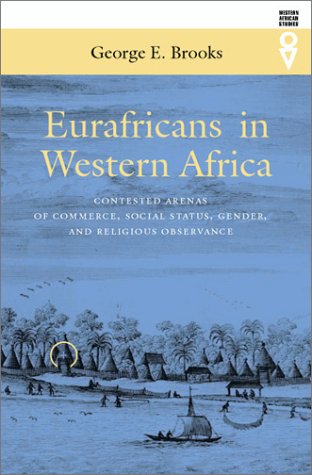
    Eurafricans in Western Africa traces the rich social and commercial history of western Africa. The most comprehensive study to date, it begins prior to the sixteenth century when huge profits made by middlemen on trade in North African slaves, salt, gold, pepper, and numerous other commodities prompted Portuguese reconnaissance voyages along the coast of western Africa. From Senegal to Sierra Leone, Portuguese, including “New Christians” who reverted to Judaism while living in western Africa, thrived where riverine and caravan networks linked many African groups.

    Portuguese and their Luso-African descendants contended with French, Dutch, and English rivals for trade in gold, ivory, slaves, cotton textiles, iron bars, cowhides, and other African products. As the Atlantic slave trade increased, French and Franco-Africans and English and Anglo-Africans supplanted Portuguese and Luso-Africans in many African places of trade.

    Eurafricans in Western Africa follows the changes that took root in the eighteenth century when French and British colonial officials introduced European legal codes, and concludes with the onset of the French Revolution and Napoleonic Wars, when suppression of the slave trade and expanding commerce in forest and agricultural commodities again transformed circumstances in western Africa.

    Professor George E. Brooks’s outstanding history of these vital aspects of western Africa is enriched by his discussion of the roles of the women who married or cohabited with European traders. Through accounts of incidents and personal histories, which are integrated into the narrative, the lives of these women and their children are accorded a prominent place in Professor Brooks’s fascinating discussion of this dynamic region of Africa.

    Table of Contents

    • List of Maps
    • Preface and Acknowledgments
    • Introduction
    • Chapter 1: Western Africa Ecological Zones and Human Geography
    • Chapter 2: Commercial Networks Biafada-Sapi, Banyun-Bak, and Cabo Verdean–Lançado
    • Chapter 3: Portuguese, Luso-Africans, and European Competitors
    • Chapter 4: Western Africa and the Onset of an Era of Droughts, Famines, and Global Economic Transformations
    • Chapter 5: The Evolution of “Nharaship” in Senegambia
    • Chapter 6: Trade with the Kaabu Empire and Serra Leoa
    • Chapter 7: Era of the Second Cacheu Company
    • Chapter 8: Expanding Slave-Trading Networks and the Corruption of African Social and Cultural Patterns
    • Chapter 9: Senegambia Luso-Africans Supplanted by Franco-Africans
    • Chapter 10: Geba-Grande and Serra Leoa Luso-Africans Challenged and Supplanted by Anglo-Africans
    • References
    • Index

    Introduction

    The geographic scope of this book was essentially determined by Eurafricans and their African landlords, while many of the chronological chapter breaks derived from the disruptions to trade caused by European wars and commerce raiding. Western Africa, depicted on Map 1.1, extends some three thousand kilometers from the Senegal River in the north to the Bandama River in the south and fifteen hundred kilometers east from the Atlantic littoral to the bend of the Niger River, equivalent to the part of the United States that lies east of the Mississippi River. The great majority of the inhabitants of this vast and geographically diverse territory speak languages belonging to two principal families—West Atlantic and Mande, the former principally in coastal regions, the latter mainly in the interior.

    The peoples of western Africa have been linked by commercial networks since ancient times. Mande-speaking traders and smiths pioneered caravan routes from the interior that connected the riverine networks of West Atlantic–speaking groups, promoting long-distance trade in salt, gold, iron, kola, malaguetta pepper, and numerous other commodities. By the third century a.d., western Africa’s trade networks connected trans-Saharan routes, and exchanges with North Africa multiplied over the centuries. The huge profit that Maghrebian middlemen exacted from Europeans for gold, ivory, malaguetta pepper, and other western African commodities was a principal factor promoting Portuguese reconnaissance voyages along the coast of western Africa during the fifteenth century.

    When Portuguese mariners arrived in western Africa, they were constrained to accommodate to centuries-old landlord-stranger reciprocities concerning the host societies’ treatment of itinerant traders, hunters, migrants, and other travelers. Portuguese had to use African modes of barter commerce, pay tolls and taxes, visit only where they were invited by African hosts, and adhere to local customs and practices while ashore. Lançados—venturesome Portuguese and Luso-African inhabitants of the Cape Verde Islands, who were allowed to reside in African communities—were subject to numerous constraints. African landlords refused to rent lançados more land than needed for dwellings and stores, rendering them dependent on indigenous communities for food, water, and other necessities. Of inestimable consequence for the lançados, however, they, like African strangers, were permitted to cohabit with local women, usually relatives or dependents of infuential members of communities who sought the advantages that came with affiliation with foreign traders. Wives were invaluable to the lançados as interpreters of languages and cultures and as collaborators in commercial exchanges—roles subsequently undertaken by many of their Luso-African children.

    Luso-Africans, the children of Portuguese traders and African women, represented a new and unprecedented element in western African societies. In social and cultural terms, these children, raised in African communities, acquired much more of the heritage of their mothers than of their Portuguese fathers, many of whom died or departed after a brief stay. This imbalance is conveyed in the word Luso-African itself, in which the short prefix Luso (derived from Lusitania, the Roman name for the area of Portugal) is combined with the longer African. The same can be said for the words Anglo-African and Franco-African, as well. Eurafrican serves as a generic term.

    Raised in African societies, Eurafricans’ lifeways were chiefy determined by the social status of their mothers. But there were significant differences in this regard between stratified and acephalous societies. The stratified and patrilineal societies of SenegambiaWolof, Serer, and Mandinkaexcluded Portuguese and Luso-Africans from marrying free persons. Luso-African children were denied membership in the “power associations” that educated youths and conferred adult status in these societies. Social outcasts, Luso-Africans lacked the rights and privileges of other members of their age sets, including the right to cultivate land. Luso-African males in these societies sought employment as sailors, interpreters, and compradors working for Portuguese and fellow Luso-Africans, with the bleak prospect that whatever wealth and possessions they acquired would be expropriated by rulers and other elites. Female Luso-Africans shared the same disabilities and became interpreters and intermediaries for European traders and African elites. Luso-African men and women contested their pariah status. They wore European-style garments, displayed crucifixes and rosaries attesting their adherence to Catholicism, spoke Crioulo (which derived from Portuguese and West Atlantic languages), and asserted that they were “Portuguese,” “whites,” and “Christians”—claims derided by Portuguese and other Europeans…

    Read the entire Introduction here.

  • The Society for French Historical Studies 57th Annual Meeting

    Sponsored by The Citadel, The Military College of South Carolina
    The Francis Marion Hotel
    Charleston, South Carolina
    2011-02-11 through 2011-02-12

    Includes the following sessions:

    1A “Representation and Commemoration in France and Its Colonies”…

    Black and White: Figuring the Senegalese Signares [definition in French]
    Thérèse De Raedt, Associate Professor of Languanges and Literature
    University of Utah

    4H “Children and Families in the French Empire”…

    Who is French? Mixed-Race Children in the First Indochina War
    Christina Firpo, Assistant Professor of History
    California Polytechnic State University, San Luis Obispo

    For the program guide, click here.

  • Defying the Civil Rights Lobby: The American Multiracial Movement

    Benjamin L. Hooks Institute for Social Change
    University of Memphis
    April 2007
    35 pages

    Kim M. Williams, Associate Professor of Public Policy
    Harvard University

    Throughout the 1990s a handful of advocates argued to stunning if partial success that it was both inaccurate and an affront to force multiracial Americans into monoracial categories. They called for the addition of a multiracial designator on the U.S. Census to bolster the self-esteem of multiracial children; furthermore, they maintained that the recognition of racial mixture could help defuse American racial polarization. Fearing the potential dilution of minority numbers and political power, ironically, civil rights groups emerged as the staunchest opponents of the multiracial category effort. Nevertheless, from 1992 to 1998, six states passed legislation to add a multiracial category on state forms. Further, in 1997 the Office of Management and Budget (OMB) announced an unprecedented “mark one or more” (MOOM) decision, which did not add a multiracial category to the census, but nevertheless, allowed Americans to identify officially with as many racial groups as they saw fit. Although in some ways its immediate impact might seem negligible, I argue in in Race Counts: American Multiracialism & Post-Civil Rights Politics [Mark One or More: Civil Rights in Multiracial America] (The University of Michigan Press, Forthcoming) that MOOM will eventually reach deeply into the nation’s civil rights agenda. Ultimately this recent restructuring of the American racial classification system, in tandem with coexisting trends, could push the nation to rethink the logic of civil rights enforcement.

    The multiracial movement started with a handful of adult-based groups that formed on the West Coast in the late 1970s and early 1980s. Currently there are approximately thirty active adult-based multiracial organizations across the United States and about the same number of student organizations on college campuses. Most of the adult-based groups are oriented toward social support more than political advocacy, but in 1988, a number of these local organizations joined forces to create the Association for Multi-Ethnic Americans (AMEA). At that point, the primary political goal of this new umbrella group was to push the Census Bureau to add a multiracial category on the 1990 census. Soon after the establishment of AMEA, two other national umbrella organizations formed: Project RACE (Reclassify All Children Equally) and A Place for Us. Beyond agenda setting, this small, disorganized social movement exerted little to no influence over the aforementioned outcomes. At the height of movement activity it involved no more than 1,000 individuals in a loose network of groups (Figure 5.1) scattered across the country and only twenty or so core, committed activists at the helm

    Read the entire paper here.

  • Passings That Pass in America: Crossing Over and Coming Back to Tell About It

    The History Teacher
    Volume 40, Number 4 (August 2007)
    32 paragraphs

    Donald Reid, Professor of History
    University of North Carolina, Chapel Hill

    TEMPORARILY PASSING as an other is a universal fantasy and a not uncommon practice. From Arab potentates dressed as commoners to check on the governance of their realms, to women going into combat as male soldiers, it has a long history, and passing is a phenomenon of particular resonance in the contemporary United States. In the affluent postwar decades, the belief that the middle class would come to encompass all was challenged by white middle-class exclusion of African-Americans from membership in this classless utopia, and of women from a patriarchal order. Today, this ideology of prosperity has changed; it is now predicated on the permanent existence of extremes in wealth and poverty, the unrelenting insecurity of an unconstrained market society and the emotional costs of gender norms. These are the contexts for the appearance of a number of widely-read accounts of race, class, and gender passing in the United States. 

     American culture glorifies the self-made man and this self-making extends to individual identity. The United States celebrates geographical and social mobility and the very anomie this produces is also the site of secular rebirths. In this essay, I will examine a literary genre that draws upon the American faith in self-transformation in an effort to confront the social boundaries that define its limits: narratives of white middle-class individuals who seek to live as an other for a while with the aim of revealing to their social group of origin its role in creating and sustaining the marginalization and oppression of the other whose identity they temporarily assume. John Howard Griffin’s Black Like Me and Grace Halsell’s Soul Sister and Bessie Yellowhair were products of an era when the challenges that racial integration presented to white middle-class society gave new impetus to the tradition of participant-observer social scientists and journalists living as workers and reporting on the experience. I conclude with a reading of recent accounts of inter- and intra-class passing: Barbara Ehrenreich’s Nickel and Dimed and Bait and Switch, and Norah Vincent’s memoir of gender passing, Self-Made Man

    Read the entire article here.

  • The Social Ontology of Race in the “Post-Racial” Era

    The University of Memphis Department of Philosophy
    7th Annual Philosophy Graduate Student Association Conference
    2011-02-11 through 2011-02-12

    Keynote Speaker

    Jennifer Lisa Vest, Assistant Professor of Philosophy
    University of Central Florida

    In the past several decades, mainstream philosophical discourse has examined the ontology of race from a number of philosophical vantage points. During this period, thinkers have called our philosophical attention to the widespread acknowledgment in the scientific community that the concept of race has no biological basis. However, African American scholars in a variety of disciplines have been debating the question of the reality of race since the late nineteenth century. Of particular import has been the question of the ontological currency of the concept of race apart from its dubious biological status.

    In contemporary academic discourse, the social ontology of race is a vibrant and dynamic question with implications across various traditions and subfields within the discipline of philosophy in both the analytic and continental traditions and beyond. Interdisciplinary by nature, discussion surrounding this question has reverberations in companion disciplines such as ethnic studies, political theory, philosophy of law, history, feminist theory, queer theory, gender studies, sociology, anthropology, and psychology.

    Just what does it mean to be racialized as non-white in American culture today? To what extent does such a classification still carry negative connotations? How has the growing population of “mixed race” people affected how race is understood in America? How, if at all, has the election of our first black/ “mixed race” president changed the social ontology of race in America? Does this landmark event signify the onset of a “post-racial” era? How do these questions intersect with other issues of social ontology? These are the kinds of questions we hope to address in our 7th annual Philosophy Graduate Student Association conference at the University of Memphis. We invite philosophy papers on any of these topics, or any related topic. Interdisciplinary approaches are welcomed.

    Deadline for submission of papers is January 1, 2011 (extended). Papers should be sent as Word documents not to exceed 12 double-spaced pages. Papers should be suitable for blind review, including a cover letter with all relevant personal information (name, contact information, university affiliation).

    For more information, click here.

  • With Shades of Gray

    Emory Magazine
    Emory University
    Spring 2009: Coda: A Changing Country

    Reflections on the Inauguration of President Barack Obama

    Taharee Jackson, ’10 PhD

    The last thing I could afford to do was attend the presidential inauguration at the National Mall, but I simply couldn’t miss it. I had to go and represent my multiracial family. As a multiracial woman, I am seldom presented with the opportunity to see someone just like me in the public eye.

    Tiger Woods has made multiraciality somewhat “cool,” yet people still have trouble identifying him in photos. That being said, to have the entire globe’s gaze finally affixed on a biracial person—on Barack Obama—compelled me to travel to Washington, D.C., to support him. He wouldn’t know I was there, but my family and I would . . . and it would mean the world to us.

    …I braved subzero temperatures, no sleep, millions of people, closed train stations, and hours of no food or bathroom usage, not because I think of Obama as our first black president. True, I am part black, but so is he. He is part black. Barack Obama is half black and half white—he is biracial. To acknowledge one part of him—his blackness—is certainly not to deny his whiteness, unless we deny him the right to identify himself…

    Read the entire article here.