Mixed Race Studies

Scholarly perspectives on the mixed race experience.

    • About This Site
    • Bibliography
    • Contact Information
    • Date and Time Formats
    • Forthcoming… (Updated 2021-09-01)
    • Likely Asked Questions
    • List of Book Publishers
    • List of Definitions and Terms
    • My Favorite Articles and Papers
    • My Favorite Posts
    • My Recent Activities
    • Praise for Mixed Race Studies
    • Tag Listing
      • Tag Listing (Ordered by Count)
    • US Census Race Categories, 1790-2010
    • 1661: The First ‘Mixed-Race’ Milestone
    • 2010 U.S. Census – Some Thoughts

recent posts

  • The Routledge International Handbook of Interracial and Intercultural Relationships and Mental Health
  • Loving Across Racial and Cultural Boundaries: Interracial and Intercultural Relationships and Mental Health Conference
  • Call for Proposals: 2026 Critical Mixed Race Studies Conference at UCLA
  • Participants Needed for a Paid Research Study: Up to $100
  • You were either Black or white. To claim whiteness as a mixed child was to deny and hide Blackness. Our families understood that the world we were growing into would seek to denigrate this part of us and we would need a community that was made up, always and already, of all shades of Blackness.

about

  • Twitter
  • Facebook
  • Instagram
  • Paintings Of Barack And Michelle Obama Unveiled At Portrait Gallery

    2018-02-12

    Paintings Of Barack And Michelle Obama Unveiled At Portrait Gallery

    National Public Radio
    2018-02-12

    Camila Domonoske


    Former President Barack Obama and former first lady Michelle Obama stand next to their newly unveiled portraits during a ceremony Monday at the Smithsonian’s National Portrait Gallery in Washington, D.C.
    Mark Wilson/Getty Images

    Brand new portraits of former president Barack Obama and former first lady Michelle Obama — wearing matching calm, strong expressions — were revealed on Monday at the National Portrait Gallery in Washington, D.C.

    Kehinde Wiley painted Barack Obama sitting in a chair, elbows in his knees, leaning forward with an intense expression. The background, typical of a Wiley painting, is a riotous pattern of intense greens.

    “Pretty sharp,” Obama said with a grin.

    Amy Sherald, a Baltimore-based artist, painted Michelle Obama sitting in a floor-length gown, chin on her hand, looking directly at the viewer with a calm, level gaze.

    The paintings, like the presidency they honor, are a historic first. Wiley and Sherald — both already famous for their portraits of black Americans — are the first black painters to receive a presidential portrait commission from the museum…

    Read the entire article here.

  • Inside the Biracial Advertising Boom

    2018-02-12

    Inside the Biracial Advertising Boom

    The Daily Beast
    2018-02-05

    Hallie Golden
    Salt Lake City, Utah


    State Farm

    Biracial couples and families are becoming increasingly common. Companies are using them in advertisements to reflect that reality, and to sell to those who value diversity.

    Infiniti USA recently released an advertisement featuring a dad repeatedly heading out to grab more food for a holiday meal with his wife and two daughters.

    First it’s sweet potatoes, then shrimp, and finally the wife takes over to get a pecan pie. It’s a fairly straightforward 30-second advertisement riffing off of the idea that the husband and wife love to drive their cars so much they look forward to these types of trivial errands.

    The unique part has to do with the actors who play this adoring family: The father is white, the mother is black, and their teenage daughters are biracial.

    By casting the ad in such a way, Infiniti has joined a growing list of companies selling everything from breakfast cereal to cars to clothing that portray the American family in TV advertisements as more than a single race.

    But why are all these companies jumping on the diversity bandwagon?…

    Read the entire article here.

  • I’m kind of interested in how do bodies like mine that were raped into existence – our community doesn’t look the way it looks without systematic rape – and so how do communities like ours, with this long history of sexual violence and sexual predation…

    2018-02-12

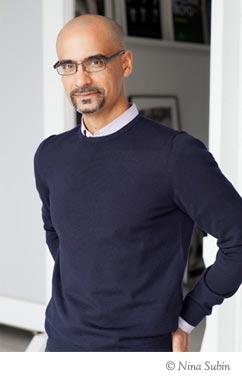
    “I was born in the Dominican Republic,” he said. “My work, among many of the things that it wrestles with, wrestles with the kind of, the often invisible and vigorously disavowed, long shadow of enslavement. I’m very much interested in how people like me, who are part of the African Diasporic community, and how do we deal with the consequences of the fallout from the calamity that we call slavery. And most specifically, I’m kind of interested in how do bodies like mine that were raped into existence – our community doesn’t look the way it looks without systematic rape – and so how do communities like ours, with this long history of sexual violence and sexual predation, how do we as a consequence of that wrestle with the possibility of intimacy. In other words, where does love reside in bodies that spent centuries being told that they could not partake in love?” —Junot Diaz (University of Missouri, January 22, 2018)

    Sara Shahriari, Abby Ivory-Ganja & Elena Rivera, “Intersection – Author Junot Díaz on Immigration, Empire and White Supremacy,” KBIA 91.3 FM, Columbia, Missouri, February 6, 2018. http://kbia.org/post/intersection-author-junot-d-az-immigration-empire-and-white-supremacy.

  • “You can’t be a white Australian writer and spend your whole life ignoring the greatest, most important aspect of our history, and that is that we – I – have been the beneficiaries of a genocide.”

    2018-02-12

    A Long Way from Home, Peter Carey’s 14th novel, uses the story of a light-skinned Indigenous Australian who has been brought up white to address the country’s brutal history of racism. It seems strange at first that Carey – surely Australia’s greatest living novelist, even if he hasn’t dwelled there for decades – has taken so long to get around to the subject. In a recent interview in the Australian, he said that he’d always felt that it was not the place of a white writer to tell this tale. Then something changed: “You can’t be a white Australian writer and spend your whole life ignoring the greatest, most important aspect of our history, and that is that we – I – have been the beneficiaries of a genocide.”

    Alex Preston, “A Long Way from Home review – Peter Carey’s best novel in decades,” The Guardian, January 15, 2018. https://www.theguardian.com/books/2018/jan/15/a-long-way-from-home-peter-carey-review.

  • Intersection – Author Junot Díaz on Immigration, Empire and White Supremacy

    2018-02-12

    Intersection – Author Junot Díaz on Immigration, Empire and White Supremacy

    Intersection
    KBIA 91.3 FM
    Columbia, Missouri
    2018-02-06

    Sara Shahriari, Abby Ivory-Ganja & Elena Rivera

    This week on Intersection, we bring you excerpts from author Junot Díaz’s Jan. 22 talk at MU [University of Missouri].

    Díaz won the 2008 Pulitzer prize for his first novel, “The Brief Wondrous Life of Oscar Wao.” He received a MacArthur ‘Genius’ Fellowship and co-founded the Voices of Our National Arts Foundation, which holds workshops for writers of color. He is a professor of writing at MIT.

    Díaz immigrated from the Dominican Republic to the United State when he was six. In his literary work and activism, he tackles issues including immigration, assimilation and oppression.

    His speech was part of the MU Celebrates Martin Luther King Jr. event. During the talk, Díaz spoke about white supremacy, the role of artists and the lasting effects of slavery…

    Read the story here. Listen to the speech (00:28:27) here.

  • Kit de Waal: ‘Make room for working class writers’

    2018-02-11

    Kit de Waal: ‘Make room for working class writers’

    The Guardian
    2018-02-10

    Kit de Waal


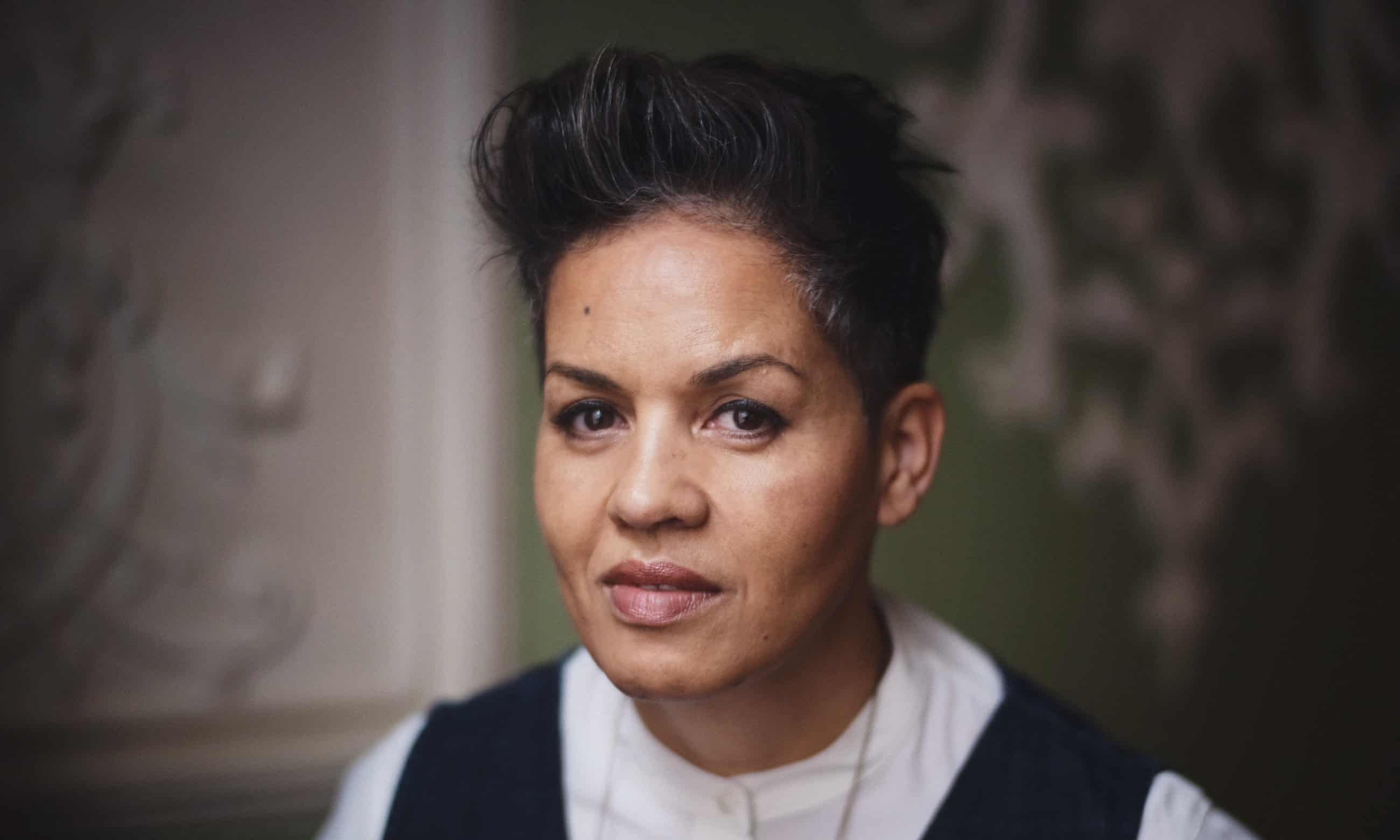
    ‘A writing career never entered my head.’ … Kit de Waal. Photograph: Sarah Lee for the Guardian

    When Kit de Waal was growing up in 1970s Birmingham, no one like her – poor, black and Irish – wrote books. Forty years on, the author asks, what has changed?

    Reading at school was agony. A slow, child by child rotation around the class, six pages each. Great Expectations. Vanity Fair. The Mill on the bloody Floss. The boys with their flatline monotones. The girls, careful not to stumble and be humiliated. English was my best subject, so this process was painful. I wanted to race ahead and get to the end of the story. Yet the idea of taking that book home to read later and finish, that never occurred to me. Not when we owned the ultimate big novel: the Bible. We were Jehovah’s Witnesses and three times a week we’d sit in a draughty hall on the backstreets of Sparkbrook in Birmingham, wrapped around a paraffin heater discussing the 66 books that made up the Old and the New Testaments. I’ve read it cover to cover at least five times.

    Leviticus and Numbers were hard going, all that counting and recounting, all those laws and exhortations, but there were very beautiful passages, too. The Song of Solomon, Psalms, Proverbs. The Gospels, too, four different takes on one big adventure. They had the ingredients of a good thriller with a hero, a call to arms, a savage tragedy. Without realising it, I was learning what you had to do to write well, how to characterise, how to keep your reader turning the page without the threat of eternal damnation as an incentive.

    But writing as a career? That never entered my head. The only writers I knew were dead. And apart from Enid Blyton, they were dead men. And white. And posh. Even when I began to read widely in my 20s, it was still a case of: if you can’t see it, you can’t be it. No one from my background – poor, black and Irish – wrote books. It just wasn’t an option…

    Read the entire article here.

  • Barack Obama [Recent Acquisition of the Smithsonian National Portrait Gallery]

    2018-02-11

    Barack Obama [Recent Acquisition of the Smithsonian National Portrait Gallery]

    National Portrait Gallery
    Washington, D.C.

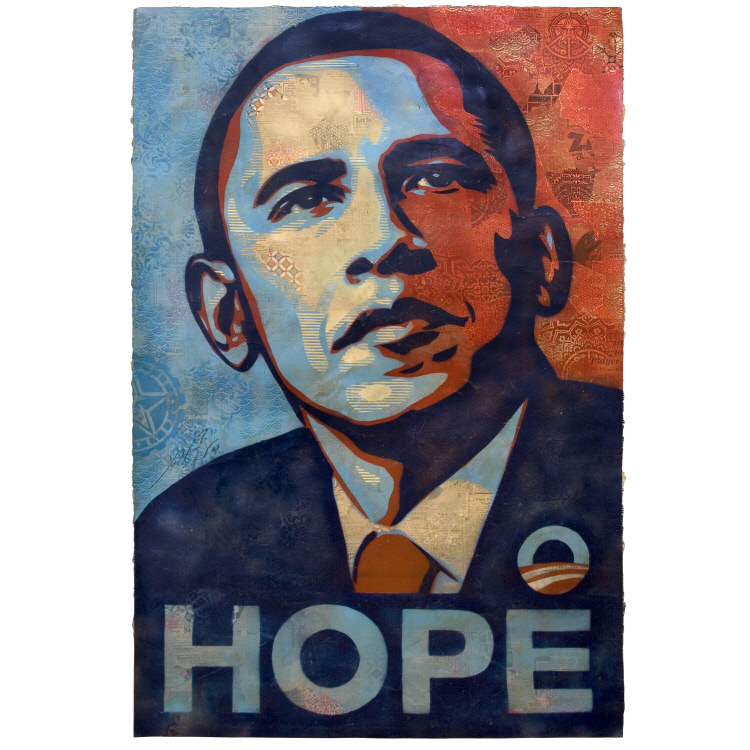
    Title: Obama “HOPE” Portrait
    Artist: Shepard Fairey, born 1970
    Copy After: Mannie Garcia, born 1953
    Sitter: Barack Hussein Obama, born 4 Aug 1961
    Date: 2008
    Type: Collage
    Medium: Hand-finished collage, stencil, and acrylic on heavy paper
    Dimensions: Sheet: 176.7 x 117.5 cm (69 9/16 x 46 1/4″)
    Frame: 187.3 x 127 x 5.1 cm (73 3/4 x 50 x 2″)
    Credit Line: National Portrait Gallery, Smithsonian Institution; gift of the Heather and Tony Podesta Collection in honor of Mary K. Podesta
    Rights: ©Shepard Fairey/ObeyGiant.com
    Object number: NPG.2008.52
    Culture: Barack Hussein Obama: American\African American
    Exhibition Label: Forty-fourth president
    Shepard Fairey’s Barack Obama Hope poster became the iconic campaign image for the first African American president of the United States. Early in 2008, the Los Angeles–based graphic designer and street artist designed his first Obama portraits, with a stenciled face, visionary upward glance, and inspiring captions. The artist’s intention that the image be widely reproduced and “go viral” on the Internet exceeded his greatest expectations. Campaign supporters and grassroots organizations disseminated tens of thousands of T-shirts, posters, and small stickers; Fairey himself produced mural-sized versions; and a free, downloadable graphic generated countless more repetitions. In this fine-art version of that unprecedented and powerful campaign icon, Fairey incorporated the familiar heroic pose and patriotic color scheme. But he translated the portrait into a collage with a rich, elegant surface of decorative papers and old newsprint.
    Data Source: National Portrait Gallery

    For more information, click here.

  • 2018-02-11

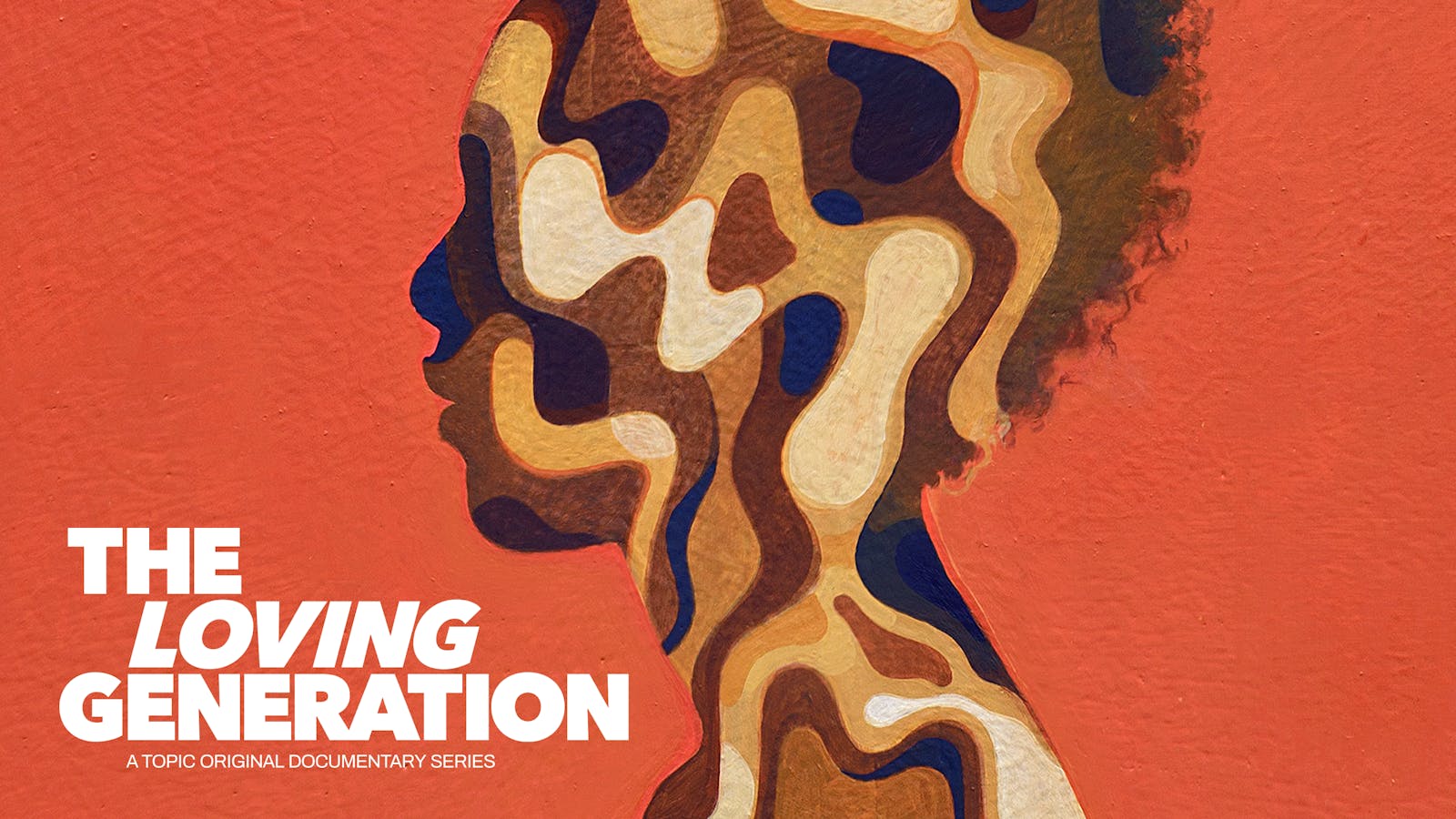
    The Loving Generation: A Topic Original Documentary Series

    Topic
    February 2018

    Directed and Produced by Lacey Schwartz and Mehret Mandefro
    Executive Produced by Ezra Edelman and Anna Holmes

    4 films | 10 min

    In 1967, the Supreme Court decision Loving v. Virginia overturned all laws outlawing interracial marriage. The Loving Generation tells the story of a generation of Americans born to one black parent and one white parent. Their narratives provide a fascinating and unique window into the borderland between “blackness” and “whiteness”, and, in some cases, explode fixed ideas about race and identity.

    View the films here.

  • Black With (Some) White Privilege

    2018-02-11

    Black With (Some) White Privilege

    Sunday Review
    The New York Times
    2018-02-10

    Anna Holmes, Editorial Director
    Topic.com


    Credit Illustration by Anthony Gerace; Photographs by SensorSpot, via Getty Images

    When I was in my early 30s, I started making a list of every child I could think of who had a black parent and a white parent and was born between 1960 and the mid- to late 1980s. It was a collection of people like me, who grew up and came of age after the Supreme Court decision in 1967 that overturned the laws in more than a dozen states that outlawed interracial marriage.

    I was thinking of people I knew or had heard of, so of course the list included actors like Tracee Ellis Ross (born 1972) and Rashida Jones (1976); athletes like Derek Jeter (1974) and Jason Kidd (1973); singers like Mariah Carey (1969) and Alicia Keys (1981); and, eventually, politicians and public servants like Adrian Fenty (1970) and Ben Jealous (1973).

    It occurred to me, looking at the names I’d gathered, that what I was making was not just a snapshot of a particular generation but an accounting of some of the most notable, successful, widely recognized black people in American public life — cultural, political, intellectual, academic, athletic.

    It made sense: The people I could think of were the people who were the most publicly visible. But what did it mean about race and opportunity in the United States that many of the most celebrated black people in American cultural life in the late 20th and early 21st centuries happened to have been born to one white parent? What if my and my cohort’s achievements as African-Americans, especially in fields to which we historically had little access, were more about how we benefited from having one white parent in a racist society than our hard work?…

    …Of course, to be a black American is to be, by definition, mixed: According to a study released in 2014, 24 percent of the genetic makeup of self-identified African-Americans is of European origin. Colorism, which places black people in an uncodified but nevertheless very real hierarchy, with the lighter-skinned among us at the top, was a fact of American life long before Loving v. Virginia. Light-skinned black Americans, even those with two black parents, have, for centuries, been considered to be closer to white people, closer to white ideals about, well, most everything…

    Read the entire article here.

  • Lena Horne Honored With A Stamp From the United States Postal Service

    2018-02-11

    Lena Horne Honored With A Stamp From the United States Postal Service

    WBGO Journal
    WBGO 88.3 FM
    Newark, New Jersey
    2018-01-30

    Ang Santos


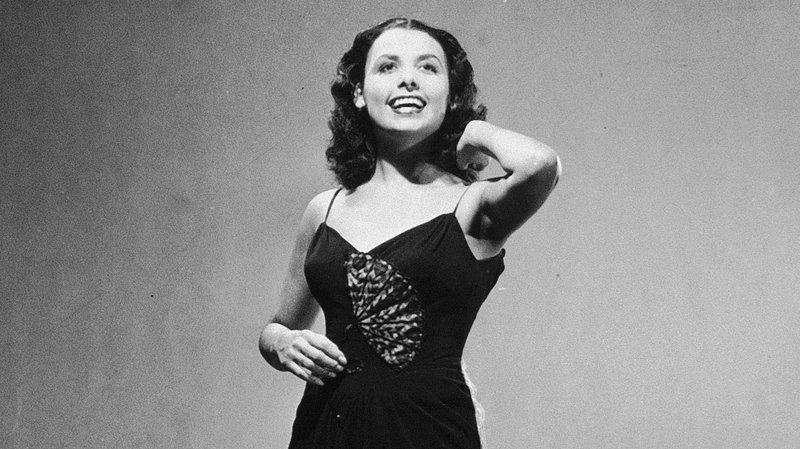
    Lena Horne
    Hulton Archive/Getty Images

    Lena Horne is remembered as an all-around entertainer, Hollywood actress, Grammy Award winning singer, and a Tony Award winning Broadway star. But equally important to her legacy was a willingness to use fame as a platform to promote Civil Rights in the 1960s.

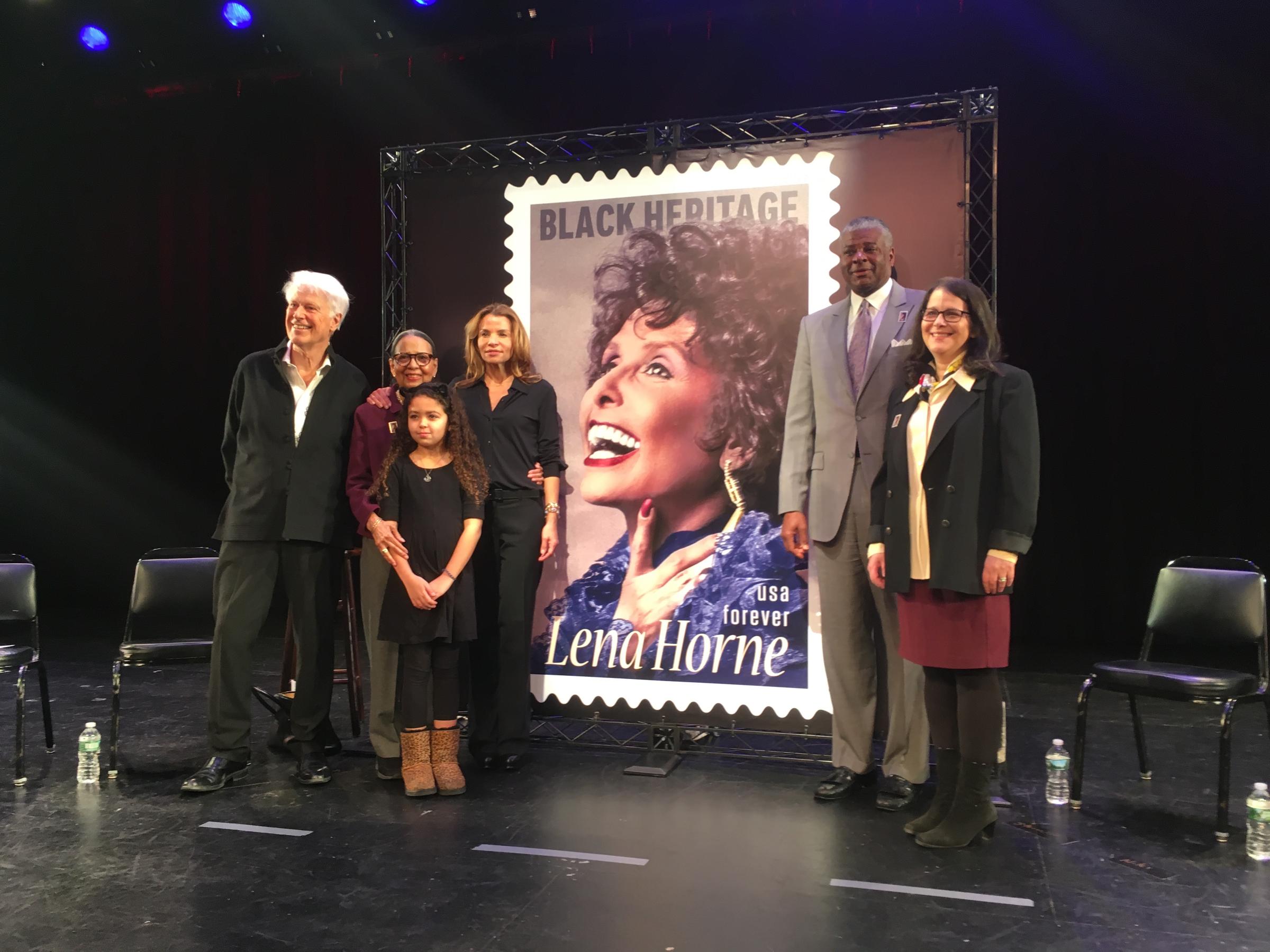
    Horne’s daughter Gail Lumet Buckley believes her mother would be proud to be put alongside the other members of the USPS Black Heritage Stamp Series.


    Stamp photographer Christian Steiner, Horne’s daughter Gail Lumet Buckley (with family members), USPS Deputy Postmaster General Ronald Stroman, and WBGO President Amy Niles shared personal memories and stories during the Lena Horne stamp unveiling.
    Credit Ang Santos / WBGO

    Read the entire article here. Listen to the story (00:02:57) here.

Previous Page
1 … 231 232 233 234 235 … 1,428
Next Page

Designed with WordPress