• Colouring the Caribbean: Race and the art of Agostino Brunias

    Manchester University Press
    December 2017
    272 pages
    Hardcover ISBN: 978-1-5261-2045-8
    eBook ISBN: 978-1-5261-2047-2

    Mia L. Bagneris, Jesse Poesch Junior Professor of Art History
    Tulane University, New Orleans, Louisiana

    Colouring the Caribbean offers the first comprehensive study of Agostino Brunias’s intriguing pictures of colonial West Indians of colour – so called ‘Red’ and ‘Black’ Caribs, dark-skinned Africans and Afro-Creoles, and people of mixed race – made for colonial officials and plantocratic elites during the late-eighteenth century. Although Brunias’s paintings have often been understood as straightforward documents of visual ethnography that functioned as field guides for reading race, this book investigates how the images both reflected and refracted ideas about race commonly held by eighteenth-century Britons, helping to construct racial categories while simultaneously exposing their constructedness and underscoring their contradictions. The book offers provocative new insights about Brunias’s work gleaned from a broad survey of his paintings, many of which are reproduced here for the first time.

    Contents

    • Introduction
    • 1. Brunias’s tarred brush, or painting Indians black: race-ing the Carib divide
    • 2. Merry and contented slaves and other island myths: representing Africans and Afro-Creoles in the Anglxexo-American world
    • 3. Brown-skinned booty, or colonising Diana: mixed-race Venuses and Vixens as the fruits of imperial enterprise
    • 4. Can you find the white woman in this picture? Agostino Brunias’s ‘ladies’ of ambiguous race
    • Coda – Pushing Brunias’s buttons, or re-branding the plantocracy’s painter: the afterlife of Brunias’s imagery
    • Index
  • “Yeah, its wild how the one drop rule is still such a prevalent thing today. I often joke how I’m just as much white as I am black because my whole life I’m the “black friend” or the classic “C’mon Chase you’re not actually black?!” Comments like that are a constant, and in all honesty, every ounce of racism I have faced or will face is all fuel to the fire. I truly believe that being mixed is a privilege. It has allowed me to understand more about different backgrounds and how all races are working towards the very same goal in the end. I sometimes feel like being mixed is a bridge for one culture to start learning about another. Labeling is sustaining racism and things like black history month will constantly hinder us being equal. There is no white history month or Asian history month. We need to start understanding what is marginalizing and how to change it.” —Chase Hall

    Sunny Lee, “Chase Hall,” Coveal Magazine, December 5, 2017. https://www.coeval-magazine.com/coeval/chase-hall.

  • An Interview with the American Photographer Chase Hall in the East Village, Manhattan

    Arteviste
    2016-09-29

    Flora Alexandra Ogilvy, Founder


    Portrait by Flora Alexandra Ogilvy (2016)

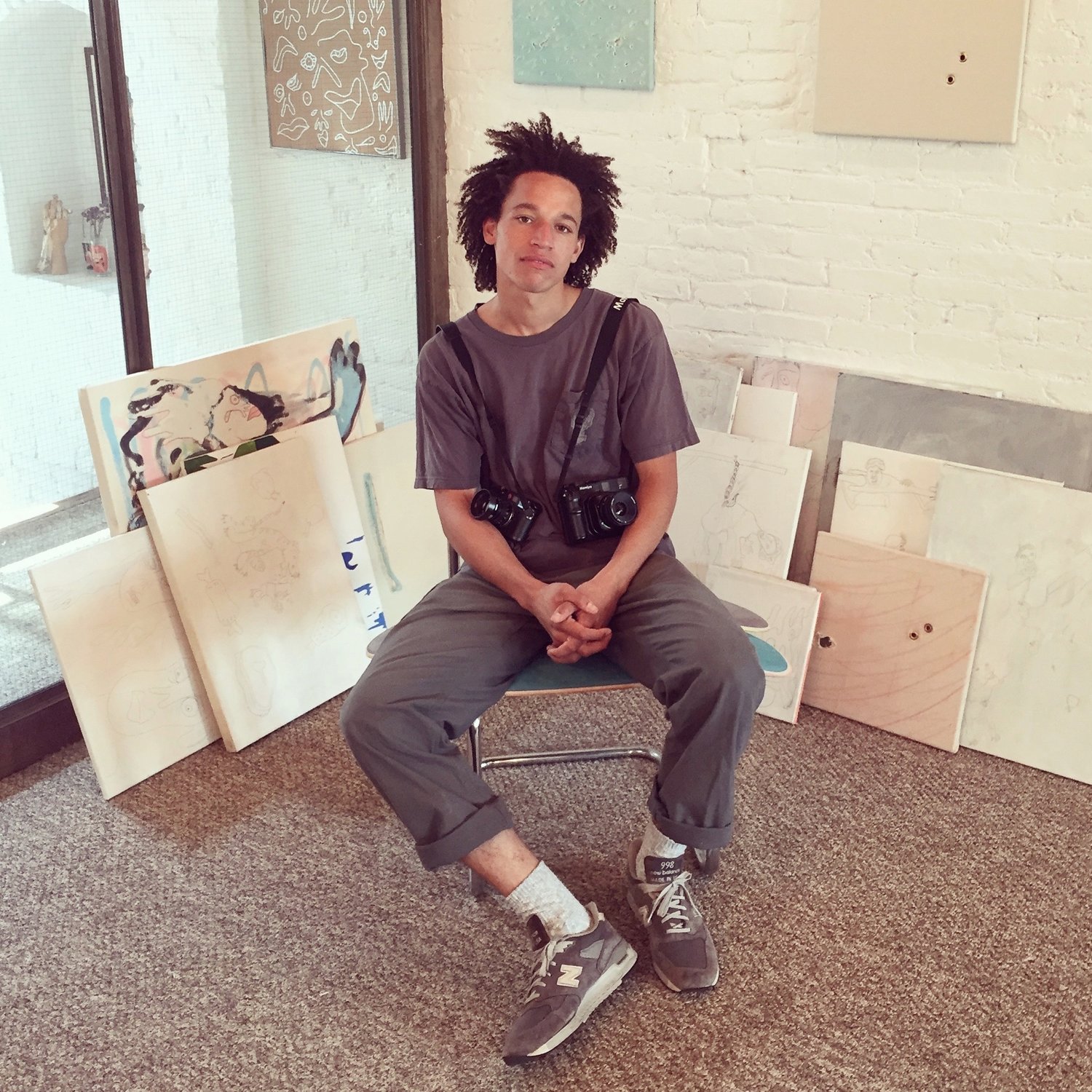
    Raised across Minnesota, Chicago, Las Vegas, Dubai and Malibu, the multifaceted photographer and painter Chase Hall now lives in the East Village, New York. Before moving to Manhattan to be surrounded by fellow artists, he worked in LA as an assistant on fashion shoots and did some commercial photography. We first met in the East Village live/work space in which he maintains a disciplined routine, waking up at dawn to work on his ongoing projects and self-taught skills, which are often learnt on YouTube. Known for his work’s optimism and carefree aesthetic, Chase is all about the process, and believes we ought to see more of the effort behind even the most spontaneous works of art. Although he doesn’t work directly within a collective, he draws from contemporaries Reed Burdge, Tucker Van Der Wyden and Grear Patterson with whom he has often discussed ideas and shared his work.

    Using film cameras like the Leica M6 and Mamiya 6, Chase chooses a monochrome palette when working in the urban setting and takes colour photographs when travelling. When I looked through his portfolio there were gritty street scenes, colourful shots from the Jamaican jungle and simple compositions taken in California – he isn’t afraid of diversifying his subject matter. When in New York, he’ll set out each morning and walk up to 15 miles around the city, capturing people on the streets, whilst hoping to communicate a sense of optimism in his work. In fact, Chase is developing his street photography into a simple documentary about the effects of smiling on the streets. With each of his subjects, he writes journals about their stories, but also makes voice recordings so that he can remember the narrative behind the people in his portraits and can really take the time to get to know them…

    Read the entire interview here.

  • Chase Hall

    Coveal
    2017-05-30

    Sunny Lee


    “roots not fruits” produce boxes on wood 30″ x 60″

    With a geographical upbringing as far-flung as the mediums he pursues, Chase Hall has been mostly known for his stunning portrait series, which prominently features a populace that goes largely unnoticed; though, he’ll be quick to let you know that his fine art has been an equal extension of his creative production since he was 9. From sculptures to drawings, to paintings, Hall’s disparate mediums come together in a cohesive oeuvre, articulating often overlooked counternarratives that don’t fit so neatly within the public’s imagination, but that’s not to say he attempts to control any narrative but his own. For Hall, it can only begin with the personal, regardless of what viewers can glean from his work. Read on as Hall talks about how his background has played a major role in his work and why he eschews any labels—plus, scoop up some hints for his upcoming book come Fall 2017. Till then, be on the lookout for any updates via his Instagram

    You were raised across Minnesota, Chicago, Las Vegas, Dubai, Colorado, and Malibu. Can you tell me a bit more about that and how that’s come to inform your practice?

    I was raised by a single mom who was always grinding for us to live a better life. That came with many pros and cons but being exposed to the beauty and struggles around the world has really opened my eyes…

    Hence, the reason why race figures so heavily into your work. Can you tell me a bit more about your mixed-race experiences as well?

    Yeah, its wild how the one drop rule is still such a prevalent thing today. I often joke how I’m just as much white as I am black because my whole life I’m the “black friend” or the classic “C’mon Chase you’re not actually black?!” Comments like that are a constant, and in all honesty, every ounce of racism I have faced or will face is all fuel to the fire. I truly believe that being mixed is a privilege. It has allowed me to understand more about different backgrounds and how all races are working towards the very same goal in the end. I sometimes feel like being mixed is a bridge for one culture to start learning about another. Labeling is sustaining racism and things like black history month will constantly hinder us being equal. There is no white history month or Asian history month. We need to start understanding what is marginalizing and how to change it…

    Read the entire article here.

  • Ellen Gallagher

    Coveal
    2017-12-05

    Helene Kleih

    Artist Ellen Gallagher was born in Providence, Rhode Island in 1965 to parents of Cape Verdian and Irish Catholic origin. Growing up as a biracial woman and identifying as an African American, Gallagher’s racial politics are evident in her works. She infuses imagery from an array of sources; nature, anthropology, social history, art and myth, to create works that seamlessly interweave her sphere of influences…

    Read the entire article here.

  • There are mixed race people on both sides of [Corinne] Bailey Rae’s family – she has “brown cousins” on her mum’s English side as well as her dad’s. When she comments on her cousin’s shades, it reminds me that I’ve read that the term she prefers to use to describe herself is “brown” too. “At first we were brown and then we were half-caste and then mixed-race and then dual-heritage and then it was ok to just be black,” says Bailey Rae, obviously aware of the debate around how mixed-race people should define themselves, but disparaging. “I feel like I don’t really have a term if I’m really honest. That’s why I say it [brown] in like an almost silly way. As it’s almost like I’ve been labelled so many different things in the past 38 years that none of them feel familiar or satisfying.”

    Charlie Brinkhurst Cuff, “Corinne Bailey Rae on her nomadic lifestyle, racial identity and pregnancy,” gal-dem, October 16, 2017. http://www.gal-dem.com/corinne-bailey-rae-on-her-nomadic-lifestyle-racial-identity-and-pregnancy/.

  • Painter Ellen Gallagher’s tragic sea tales: How African slaves went from human to cargo on the Atlantic

    The Los Angeles Times
    2017-11-17

    Carolina A. Miranda


    An installation view of Ellen Gallagher’s painting “Aquajujidsu” at Hauser & Wirth in Los Angeles. (Fredrik Nilsen / Hauser & Wirth)

    On first glance, the painting that greets visitors to the South Gallery at Hauser & Wirth in downtown Los Angeles looks like a crab quietly resting on the bottom of an ocean floor. But look again and that crab morphs into the fragmented face of a person, its myriad pieces coming undone in a watery deep.

    In her first solo show in Los Angeles, painter Ellen Gallagher broaches the history of the Middle Passage in ways that are both poetic and surprising — rendering underwater scenes that seem perfectly innocent at first glance, but that on second, third and fourth viewing, quietly evoke the terrible tragedies that occurred in the Atlantic Ocean during the roughly four centuries of the slave trade.

    “These are history paintings,” she says thoughtfully, as she settles into a sleek chair in a small lounge at Hauser & Wirth. “It’s this portrait of this space in between, this space where you are dead and alive at the same time.”


    Artist Ellen Gallagher. Ellen Gallagher / Hauser & Wirth

    The artist, who divides her time between New York and Rotterdam, and whose work resides in the permanent collections of the Museum of Modern Art in New York and the Museum of Contemporary Art Los Angeles, has long explored questions of history and power in works that straddle the gray area between figurative and abstract…

    Read the entire article here.

  • This film affected me remarkably. As an individual of mixed races, I am all too familiar with the dilemma of being caught between cultures and I thought that Imitation of Life captured the failure of American binaries perfectly. It was only by overcoming my desire to be stereotypically beautiful (read: white), was I able to recognize my own place independent of racial expectations. The unresolved ending between Lora and Susie in the 1959 version seems to represent the lack of resolution regarding race. Although troublesome endings may have been a convention of postclassical films, [Douglas] Sirk forces the audience to consider the future of Lora, Steve and Susie, and, in the process, alludes to the unresolved issues of Sarah Jane’s existence. Annie’s death may have forced her to recognize her misgivings as a daughter, but her life as a light-skinned young woman has only begun, just as our battle with civil rights.

    Charisse L’Pree, “Imitation of Life,” Charisse L’Pree, Ph.D.: The Media Made Me Crazy, April 20, 2005. https://charisselpree.me/2005/04/20/imitation-of-life/.

  • Corinne Bailey Rae on her nomadic lifestyle, racial identity and pregnancy

    gal-dem
    2017-10-16

    Charlie Brinkhurst Cuff


    photography Kiran Gidda

    If you’re a voracious reader, you’ll know something about being drawn into worlds that aren’t your own. It’s a tantalising prospect, especially for introverts. What I discovered earlier this year, is that singer-songwriter Corinne Bailey Rae has the same magical quality as an enchanting novel. It’s a strange idea but bear with me, because if you’re lucky enough to meet her and spend time with her, to listen to her music, you’ll understand what I mean. Her world, soundtracked by sweet, soulful vocals, a picked guitar and stretching across oceans thanks to her nomadic lifestyle, has just a pinch of magic – black girl magic. She’s created it in her image.

    Bailey Rae was part of the soundtrack of my youth (her debut came out when I was 12), but thanks to her ageless looks it’s difficult to believe she’s not just a couple of years older. Growing up in Scotland as a mixed-race girl amongst a blisteringly white population, she offered something that I didn’t realise I needed. Her image was attainable and aspirational. Here was a black, mixed-race British woman making beautiful music with her hair in natural curls, and the type of expressiveness that made her immediately relatable. I sang three of Bailey Rae’s songs (‘Like a Star’, ‘Till it happens To You’ and ‘Choux Pastry Heart’) from her eponymous debut album Corinne Bailey Rae for my music exams – A*’s you know – and, like everyone else during the summer of 2006, had her huge hit ‘Put Your Records On’ playing on repeat for months…

    …From earlier conversations I know that Bailey Rae is interested and articulate on the topic of race. She was enamoured by the Kerry James Marshall exhibition in LA and recommends to me a book by Nell Irvin Painter, on the history of white people. “My dad had come from the Caribbean, but he didn’t talk to me a lot about racism which I think was a deliberate thing because he wanted to protect us,” she says about her childhood. “He didn’t want to suggest this sort of inherent thing […] And then my mum was very engaged. I learnt about South Africa and apartheid.”

    Although she admits that she and her sisters would “pick the peas out of our rice and peas”, and didn’t necessarily know their black Caribbean nana’s culture “as well as we should have done”, it’s clear that she is very in touch with her blackness. When she performs at AFROPUNK London a few weeks after our interview, a festival which loudly celebrates black culture, Matthew Morgan, the founder of AFROPUNK, tells me that Bailey Rae had been very keen to play. “She approached me multiple times,” he says. On stage she tells the crowd: “I wish this community had been here for me when I was 15.” I’m at the front of the audience, screaming every lyric back at her like an embarrassing “stan” (mega fan).

    There are mixed race people on both sides of Bailey Rae’s family – she has “brown cousins” on her mum’s English side as well as her dad’s. When she comments on her cousin’s shades, it reminds me that I’ve read that the term she prefers to use to describe herself is “brown” too. “At first we were brown and then we were half-caste and then mixed-race and then dual-heritage and then it was ok to just be black,” says Bailey Rae, obviously aware of the debate around how mixed-race people should define themselves, but disparaging. “I feel like I don’t really have a term if I’m really honest. That’s why I say it [brown] in like an almost silly way. As it’s almost like I’ve been labelled so many different things in the past 38 years that none of them feel familiar or satisfying.”…

    Read the entire article here.

  • Southerner For Miscegenation

    The Denver Star (Source: Chronicling America: Historic American Newspapers)
    Denver, Colorado
    Saturday, 1913-07-05
    page 1, columns 1-2

    (New York Age.)

    Prof. H. E. Jordan, a Southern white man, of the University of Virginia, advances an opinion which means that miscegenation will be the ultimate solution of the Negro problem. He makes the assertion in an article in The Popular Science Monthly for June in which occurs the remarkable statement that the mulatto is the leaven with which to lift the Negro race.

    Prof. Jordan does not hold to the commonly accepted accepted opinion that half-breeds are inferior to the race of either parent. On the contrary he thinks that the half-breed is usually a better and more useful citizen than the man of pure race.

    He believes that the solution of the Negro problem is facilitated instead of complicated by the presence of the mulatto, and claims that the breed has been proved most effective in some other lands notably in the English island colony of Jamaica. In Jamaica there are about 50,000 mulattoes in a population of 700,000, and it is noted he says, that the mulattoes contribute the artisans, the teachers, the business and professional men. “They are the very backbone of wonderful Jamaica.”

    There Will Be More Mulattoes.

    There are now two million mulattoes in-the United States and there will be more, says Prof. Jordan, if statements are worth anything, He claims that the prevalence of defective half-breeds is due to mating of inferior types of the black and white races but that a Negro-white cross does not inherently mean degeneracy.

    Discussing this phase of the question, he says:

    “I admit the general inferiority of the black-white offspring. Defective half-breeds are too prevalent and obtruding to permit denying the apparently predetermined result of such crosses. But I emphatically deny that the result is inherent in the simple fact of cross breeding. There are not a few very striking exceptions among my own acquaintances. Absolutely the best mulatto family I have ever known traces its ancestry back on both the maternal and paternal side to high grade white grandfathers and pure type Negro grandmothers. The reason for the frequently inferior product of such crosses is that the better elements of both races under ordinal conditions of easy mating with their own type feel an instinctive repugnance to intermarriage. Under these usual circumstances a white man who stoops  to mating with a colored woman or a colored woman who will accept a white man, are already of quite inferior type. One would not expect inferior offspring from such parents if it concerned horses or dogs.

    Why should we expect the biologically impossible in the case of man? If the parents are of good type, so will be the offspring. And even with the handicap of frequently degraded white ancestry, the mulatto of our country forms the most intelligent and potentially useful element of our colored population.

    Negro-White Cross Does Note Mean Degeneracy.

    The fact, then, is established beyond all possibility of disproof, it seems to me that a Negro-white cross does not inherently mean degeneracy; and that the mulatto, measured by present day standards of Caucasian civilization, from economic and civic standpoints, is an advantage upon a pure Negro. In further support of the potency of even a relative remote white ancestor may be cited the almost unique instance of the Moses of the colored race, Booker T. Washington. As one mingles day by day with colored people of all grades and shades one is impressed with the significance of even small admixtures of Caucasian blood. What elements of hope or menace lie hidden in these mulatto millions? How can they help to solve or confuse the ‘problem’?”

    Prof. Jordan asserts that the Negro cannot undergo mental development beyond a certain maximum, and that it is possible to approximate a “pure” mulatto race combining the best elements of black and white. We can approach it, he holds, by education and the fostering of Negro racial pride. He says further:

    “The point seems clear that in the presence of 2,000,000 mulattoes, steadily increasing in number, we have a key to the solution of our problem, The mulatto is the leaven with which to lift the Negro race. He serves as our best lever for Negro elevation.”

    The mulatto does not feel the instinctive mental nausea to Negro mating. He might even be made to feel a sacred mission in this respect. Possibility of marriage with mulatto would be a very real incentive to serious efforts for development on the part of the Negro. The logical conclusion may follow in the course of the ages. At any rate, from present indications our hope lies in the mulatto.

    A wise statesmanship and rational patriotism will make every effort to conserve him, and imbue him with his mission in the interests of brotherhood of a better man. The problem seems possible of solution only as the mulatto will undertake it, with the earnest help of the white.