• Toeing The Race Line — What I Am And What I Am Not

    Medium
    2017-12-07

    Kristie De Garis
    Edinburgh, Scotland

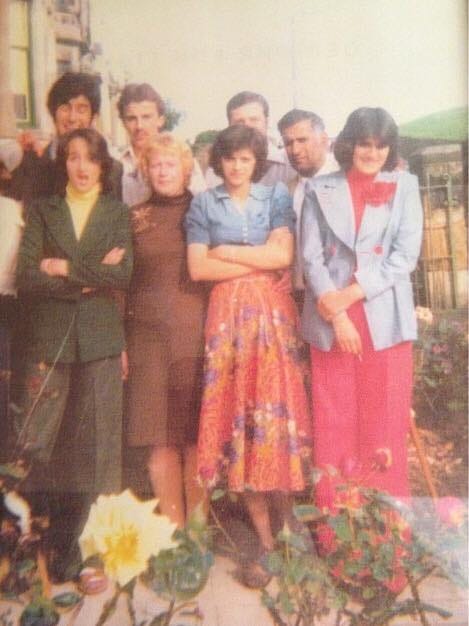
    I think often of my mum’s choice to change her name from Mohammed. How she must have felt when she accepted that she and her children would be safer without that name. What she had to give up within herself to change it. Growing up I loved to spell it out over and over again. M-O-H-A-M-M-E-D. To me it was a beautiful word that felt full and strong in my mouth. I had no idea of its power beyond that. The fact is, my life as ‘Kristie Mohammed’ would have been a very different life to the one I have lived as Kristie Kelbie and then after marrying my first husband, Kristie De Garis.

    People are interested in my current name, ‘De Garis’. I get many compliments on how ‘exotic’ it is and how it’s an asset to have such an unusual name. When I tell people that my name could have been ‘Mohammed’, the most common response I get is ‘Whoa!’ and a pained facial expression. My western names mean my looks are accepted as western too because my name provides people with a false context. Throw ‘Mohammed’ into the mix and my intriguing appearance (‘Are you part Spanish or something?’) takes on a different context. A less desirable context…

    Read the entire article here.

  • Imitation of Life

    Charisse L’Pree, Ph.D.: The Media Made Me Crazy
    2005-04-20

    Charisse L’Pree, Assistant Professor of Communications
    S.I. Newhouse School of Public Communications
    Syracuse University, Syracuse, New York

    Written during the dismal conditions of the Great Depression, Fannie Hurst’s novel, Imitation of Life, was adapted to film in 1934 and 1959. It tells the story of two widowed mothers, one white and one black, raising their daughters amidst a climate of capitalism and racism. Despite the drastic changes in the movie industry and culture, both versions met great success. Using the conventions of female melodrama, the story foregrounds the dilemmas of motherhood while commenting on capitalism, racism and image. In this paper, I will address how this story manages to transcend a generation and how the narrative was changed to accommodate a postwar audience. I will also discuss how the movie industry affected the production and marketing of Imitation of Life at the cusp of the tumultuous 1960s.

    Released in 1932, Hurst tells the story of Bea Pullman, a young widow looking to sell her deceased husband’s excess of maple syrup and take care of her daughter, Jessie. She hires Delilah Johnson as a sleep-in housemaid who brings her remarkably light skinned daughter, Peola, to complete the family. After eating Delilah’s pancakes, Bea decides to go into business selling pancakes on the boardwalk of Atlantic City. The story then follows as the business becomes successful, Bea falls in love with Steve and the daughters begin to grow up and begin to develop their own lives. Hurst was a close friend of acclaimed author Zora Neale Hurston and Hurst’s descriptions of the black American experience are remarkably detailed and fitting for the time…

    …The year before America’s famed sixties, Imitation of Life was released in theaters. Sirk’s story was different from Hurst’s or Stahl’s. Bea Pullman was renamed Lora Meredith, an aspiring actress struggling in New York City with her daughter, Susie. On the beach, they meet Annie Johnson and her daughter, Sarah Jane, who are currently between residences. In a moment of heartfelt sympathy, Lora invites the Johnsons to spend the night at her small apartment. The next morning, Annie tends to the housework while Lora sleeps in, securing the new family dynamic. With Annie’s domestic assistance, Lora becomes a famous Broadway actress. Meanwhile, Annie tries to raise her light-skinned daughter, Sarah Jane, who desperately wants to be white. This version travels deeper into the issues of Sarah Jane’s internalized oppression; it takes the audience to the seedy nightclubs where she works after running away from home and inserts a scene where her white boyfriend beats her in an alley after learning that she is black. True to form, Imitation of Life (1959) still addresses issues of motherhood, capitalism and racism but does so through the eyes of an acclaimed, German-born, melodramatic director…

    Read the entire review here.
  • Let’s Talk About Whiteness

    On Being
    2017-01-19

    Krista Tippett, Host/Executive Producer

    Eula Biss, Professor of Instruction
    Department of English
    Northwestern University, Evanston, Illinois


    Image by Ann Hamilton

    Could we learn to talk about whiteness? The writer Eula Biss has been thinking and writing about being white and raising white children in a multi-racial world for a long time. She helpfully opens up words and ideas like “complacence,” “guilt,” and something related to privilege called “opportunity hoarding.” To be in this uncomfortable conversation is to realize how these words alone, taken seriously, can shake us up in necessary ways — but also how the limits of words make these conversations at once more messy and more urgent.

    Listen to the interview (00:51:21) here. Download the interview here. Read the transcript here.

  • Review: To Sweeten Bitter by Raymond Antrobus

    Estruch Notebook: Website of Sarala Estruch, Writer and Poet
    2017-11-02

    Sarala Estruch
    London, England

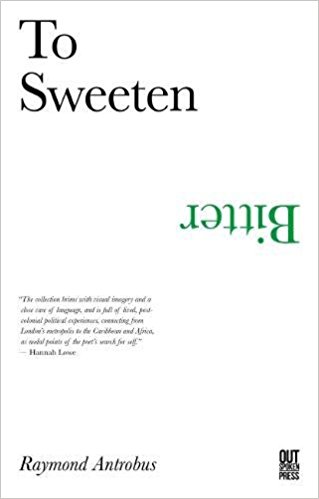
    To Sweeten Bitter by Raymond Antrobus
    Published by Outspoken Press, London, 2017
    49pp. £8.

    To Sweeten Bitter, Raymond Antrobus’ third pamphlet, is a deeply moving and important collection. Within these twenty-one poems, Antrobus deftly interweaves personal grief and the individual struggle to reclaim a sense of identity after his father’s death with postcolonial grief and the continued struggle for a sense of identity among persons of dual heritage living in a postcolonial world.

    ‘In the Supermarket’ describes the poet attempting to reclaim his deceased father by purchasing ‘everything [he] used to see in his house’. In this poem, inanimate objects are deployed to simultaneously conjure up the character of the deceased father, the character of the bereaved son, and the nature of grief itself.

    I would be holding
    on too hard
    to my humming father
    who is wind and mirror
    and West Indian Hot Pepper Sauce

    Read the entire review here.

  • Race, Sex And the Supreme Court

    The New York Times
    1964-11-22

    Anthony Lewis

    WASHINGTON.

    OVER the last decade, the legal foundations of racial discrimi­nation in this country have been washed away in the Supreme Court. One after another, state and local laws drawing lines between hu­man beings on the basis of their color have been found in conflict with the 14th Amendment’s promise of “the equal protection of the laws.”

    Only one area in the law of race relations has escaped this judicial scrutiny, and that is the most sensi­tive of all—sex. During the decade, the Supreme Court strained to avoid passing on the constitutionality of the network of laws forbidding the sexual relations between the races in the South and some other states.

    Now the time for decision appears to be at hand. The Court has heard argument this term in a case chal­lenging a Florida law against inter­racial cohabitation—a case which threatens to stir again the deepest Southern racial fears.

    Even those who are ordinarily most skeptical of psychological generalisa­tions are likely to agree with the view of many social scientists that sex is a fundamental factor in Southern racial attitudes.

    “Would you like to have your daughter marry a Negro?”

    Twenty years ago, Gunnar Myrdal observed that this question was the automatic response of the Southern man on the street “to any plea for social equality” among whites and Negroes. Anyone who has argued the issues of racial discrimination has heard the question in one form or another, again and again…

    Read the entire article here.

  • To Sweeten Bitter

    Out-Spoken Press
    2017-04-10
    49 pages
    8.5 x 0.4 x 5.5 inches
    ISBN-13: 978-0993103872

    Raymond Antrobus

    Consider the name of Raymond Antrobus’ extraordinary collection of poems for a moment: To Sweeten Bitter. It’s a phrase of infinite possibility and tender worry, open and searching, wanting and volatile. And in this sense, it serves as a kind of secret refrain for us, a haunted current that charges after each line and image, each heart-fraught question (“you think you’re going / to go free?”) and tentative hope (“there is always enough time / in our lives to see / what we must see”). Here, a father laughs “you cannot love sugar and hate your sweetness” and a son reckons with all that might mean “in the scratched light” of history and the “turning / and the losing of myself.” Derek Walcott once reflected that “I have never separated the writing of poetry from prayer;” these poems— in all their urgent beauty—affirm that faith, embody it. —R.A. Villanueva

  • White House photographer’s book a powerful portrait of Obama’s presidency

    The New Orleans Times-Picayune
    2017-12-24

    Sheila Stroup, The Times-Picayune


    When 5-year-old Jacob Philadelphia wonders if his hair is like Barack Obama’s, the president offers him an opportunity to judge for himself. (Photo by Pete Souza, The White House)

    I didn’t mean to read “Obama: An Intimate Portrait.” I was only going to look at a few of the pictures before I wrapped it up for Christmas. I’ve always felt it was cheating to read a book you’re giving as a gift.

    I knew I wanted to give the book of photographs to our daughter Shannon and our grandchildren, Cilie and Devery, as soon as I heard Terry Gross interview Pete Souza, President Barack Obama’s Chief Official White House Photographer, on NPR’sFresh Air.” It sounded fascinating, and I wanted them to see that a person with skin the color of theirs could be president of our country.

    Shannon adopted Cilie and Devery when they were babies. There was never any doubt they were hers, and nobody could love them more than she does.

    Cilie is 8 now, and Devery is almost 6, and I know they must have questions about why their skin is a different color from their mom’s and their grandparents and their other relatives. I know they must get questions from other children.

    I’ve never forgotten what happened one day when I took Devery to his swimming lesson a few years ago. There was a young dad there whose skin was the same beautiful tone as his, and he looked at Devery and said, “Oh, he’s going to get questions.”…

    Read the entire review here.

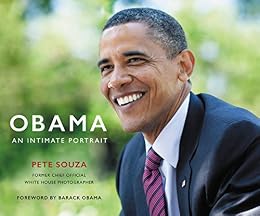
  • Obama: An Intimate Portrait: The Historic Presidency in Photographs

    Little, Brown and Company
    2017-11-07
    352 pages
    Hardcover ISBN-13: 9780316512572

    Pete Souza

    Foreword by: Barack Obama

    Relive the extraordinary Presidency of Barack Obama through White House photographer Pete Souza’s behind-the-scenes images and stories in this #1 New York Times bestseller–with a foreword from the President himself.

    During Barack Obama’s two terms, Pete Souza was with the President during more crucial moments than anyone else–and he photographed them all. Souza captured nearly two million photographs of President Obama, in moments highly classified and disarmingly candid.

    Obama: An Intimate Portrait reproduces more than 300 of Souza’s most iconic photographs with fine-art print quality in an oversize collectible format. Together they document the most consequential hours of the Presidency–including the historic image of President Obama and his advisors in the Situation Room during the bin Laden mission–alongside unguarded moments with the President’s family, his encounters with children, interactions with world leaders and cultural figures, and more.

    Souza’s photographs, with the behind-the-scenes captions and stories that accompany them, communicate the pace and power of our nation’s highest office. They also reveal the spirit of the extraordinary man who became our President. We see President Obama lead our nation through monumental challenges, comfort us in calamity and loss, share in hard-won victories, and set a singular example to “be kind and be useful,” as he would instruct his daughters.

    This book puts you in the White House with President Obama, and will be a treasured record of a landmark era in American history.

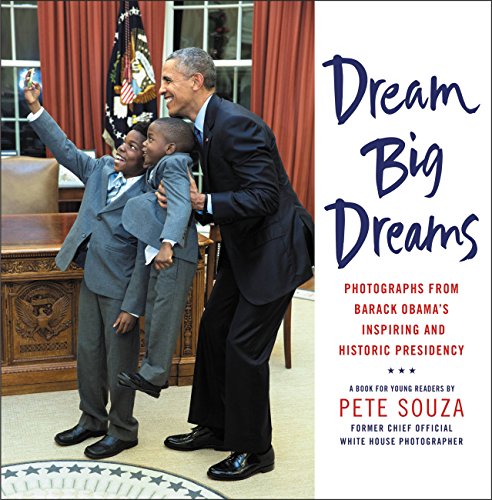
  • Dream Big Dreams: Photographs from Barack Obama’s Inspiring and Historic Presidency (Young Readers)

    Little, Brown and Company Young Readers (an imprint of Hachette Book Group)
    2017-11-21
    96 pages
    Hardcover ISBN-13: 9780316514392
    E-Book: ISBN-13: 9780316514118

    Pete Souza

    From former Chief Official White House Photographer Pete Souza comes a book for young readers that highlights Barack Obama’s historic presidency and the qualities and actions that make him so beloved.

    Pete Souza served as Chief Official White House Photographer for President Obama’s full two terms. He was with the President during more crucial moments than anyone else – and he photographed them all, capturing scenes both classified and candid. Throughout his historic presidency, Obama engaged with young people as often as he could, encouraging them to be their best and do their best and to always “dream big dreams.” In this timeless and timely keepsake volume that features over seventy-five full-color photographs, Souza shows the qualities of President Obama that make him both a great leader and an extraordinary man. With behind-the-scenes anecdotes of some iconic photos alongside photos with his family, colleagues, and other world leaders, Souza tells the story of a president who made history and still made time to engage with even the youngest citizens of the country he served. By the author of Obama: An Intimate Portrait, the definitive visual biography of Barack Obama’s presidency, Dream Big Dreams was created especially for young readers and not only provides a beautiful portrait of a president but shows the true spirit of the man.

  • ‘Twisting herself into all shapes’: blackface minstrelsy and comic performance in Harriet Wilson’s Our Nig

    European Journal of American Studies
    9-1 | 2014 : Spring 2014

    Elizabeth Boyle, Lecturer
    Department of English
    University of Hull, Hull, United Kingdom


    Figure 1: Caroline Fox Howard as ‘Topsy’ in Uncle Tom’s Cabin, c. 1854.

    This article argues that the practical jokes running throughout Wilson’s novel Our Nig; or Sketches from the Life of a Free Black (1859) are evidence of a deliberate and sophisticated comic strategy that exploits the spectacular body’s potential for subversive performance and works against the alienating conditions of social and political marginalisation experienced by African Americans in the antebellum period. Initially utilising the crude humour of minstrelsy, Wilson deliberately capitalised on her readers’ laughter in order to defamiliarise the ‘spectacle’ of blackness in both popular performance culture and indentured servitude. Using movement, costume and material props, Wilson imagines new ways to present her protagonist’s body through the minstrel stereotypes of Topsy, Jim Crow, Zip Coon and Jasper Jack. Wilson then turns the joke on her white readers, ultimately demonstrating that whiteness, like blackness, is a performative identity. Taken as a whole, Wilson’s comic strategy, with its ‘embodied insurgency’, aligns her with the period’s most politically racial African American performers.

    1. Introduction

    The idea for this article sprang from a seemingly simple question: why are there so many practical jokes played in Harriet Wilson’s novel, Our Nig (1859)? Although the novel—generally recognised as the first to be published in the United States by an African American—centres on the tragic story of a young, mulatto indentured servant mistreated by her Northern mistress, the narrative consistently undermines its mid-nineteenth century sentimental framework by including short comic sketches performed by the supposedly tragic protagonist, who nevertheless ‘was ever at some sly prank’, and would often ‘venture far beyond propriety’ in entertaining herself and those around her (Wilson 38). Are these comic interruptions evidence of narrative inconsistency? Or, is Wilson’s persistent inclusion of the figure of the black comic performer in fact a shrewd exploration of a powerfully resonant theatrical tradition and its manifold racial discourses? And what does it mean for a female African American author writing at the crux of the ‘slavery question’ in the run-up to the Civil War—and near the peak of blackface minstrel popularity—to delve into the complex social meanings behind popular comic performances of blackness? Why these pranks, in this manner, at this time?…

    Read the entire article here.