• National Identity, Citizenship, and Belonging: Afro-descendants in Spain and Catalonia – Agnes

    The Afropean: Adventures in Afro Europe
    2017-10-27

    Abena Wariebi

    The second excerpt from interviews taken from a Master’s thesis carried out by Abena Wariebi at the Universitat Pompeu Fabra in Barcelona, Spain.

    Entitled “National Identity, Citizenship, and Belonging: Afro-descendants in Spain and Catalonia”, the thesis is an investigation of black identities in Barcelona, specifically exploring what it means to be black and Spanish, or black and Catalan.

    These interviews represent a small part of the black community in Barcelona. This thesis is in no way conclusive or overall encompassing. It does not represent the views or opinions of all Afro-descendants in Barcelona or Spain. Nevertheless, these accounts are powerful, enriching, and demonstrate the unquestionable solidarity that exists within the diaspora.

    Name: Agnes
    Age: 20
    Profession: Teacher and Photographer


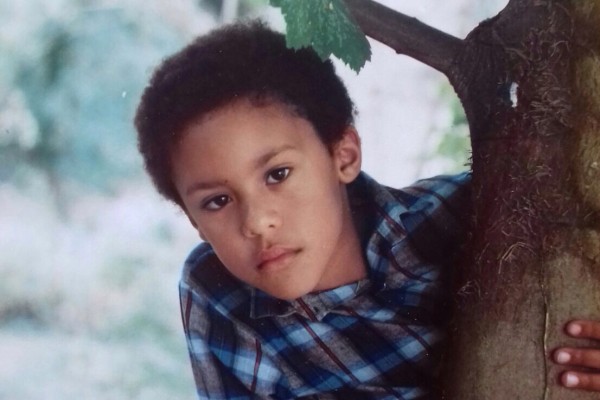
    Agnes, teacher and photographer

    “I think my mum is the only person in the world who thinks I’m Spanish. Because when I go out on the street, when like a policeman comes and they see my passport or whatever they keep asking ‘oh but where are you from? This says Spain; this says you were born in Barcelona but where are you from? Where is your dad from? Where is your mum from? So, I feel like, I don’t want to be Spanish.

    I really feel like I’m Cameroonian. And in a way my dad always tried to raise me to feel like I’m not Spanish, I’m Cameroonian.”…

    Read the entire article here.

  • Does Race Matter in America’s Most Diverse ZIP Codes?

    The New York Times
    2017-11-24

    John Eligon


    Darryl Johnson, center, and his wife, Marissa Johnson, with their daughter Sienna at their restaurant in Vallejo, Calif. The city is one of the most racially balanced in the United States.
    Credit Jim Wilson/The New York Times

    VALLEJO, Calif. — Beyond the burgers and fries coming from the kitchen and the oldies blaring from the radio, the scene playing out daily at the Original Red Onion might appear unfamiliar to much of the country.

    The restaurant’s married owners — Marissa Johnson, a Filipino-American, and Darryl Johnson, an African-American — work alongside Jahira Fragozo, who is of Miskito and Yaqui Indian descent. Ms. Johnson bonds with a customer, Hillory Robinson, who is black, over the challenges of motivating their children in the winter. “They need something to do,” Ms. Robinson says.

    Ms. Johnson gushes a short time later when a regular, Dylan Habegger, who is white, decides to tackle the restaurant’s new, spicy creation with a name that describes its effect. “Uh oh,” Ms. Johnson tells him, “you’re trying the Burner today.”

    The Original Red Onion sits in one of the country’s most racially diverse ZIP codes: 94591, in Vallejo, Calif. About 30 miles north of Oakland, it is the rare place in the United States where black, white, Asian and Hispanic people not only coexist in nearly equal numbers, but actually connect…

    Read the entire article here.

  • Life in The Hinterlands; Growing up Gay & Mixed Race on The Isle of White

    The Afropean: Adventures in Afro Europe
    2017-05-09

    Ashley Thomas

    Life as a mixed gay man seems a singular experience.

    Who, what and where are the fluid foundations on which I’m constructed, construed and constrained. To some I am black but not Black, clearly not white or not Black enough. To others, I am an undecided shade of, well, I suppose you might say…

    …Brown?

    The Isle of Wight is a brilliant homophone. With its crumbling chalk and its crumbling people, it’s REALLY FUCKING WHITE. It’s located somewhere between the English south coast and 27 years ago. The island could seem blank or barren, but this is no creative backwater. At best, rural seaside racism is imaginative: I admired coconut-kicker most for its tropical rhythm…

    Read the entire article here.

  • The Concept of “Passing”…

    Another View Radio Show
    WHRV 89.5 FM
    Norfolk, Virginia
    2017-10-07

    Barbara Hamm Lee, Executive Producer and Host

    It’s a phenomenon unique to communities of color – those with very light skin “passing” for white, particularly for African Americans, during the Jim Crow era. On the next Another View we’ll talk with Donna Drew Sawyer, author of Provenance: A Novel, about what happens in the life of a fictional character who passes for white; and historian Dr. Cassandra Newby-Alexander who shares the history of this practice.

    Download the interview (01:00:00) here.

  • Some Social Differences on the Basis of Race Among Puerto Ricans

    The Center for Puerto Rican Studies (Centro)
    Hunter College, City College of New York
    Issued December 2016
    Centro RB2016-10
    12 pages

    Carlos Vargas-Ramos, Research Associate

    Puerto Ricans are a multiracial people. This is given by the fact that the Puerto Rican population is composed of people from different categories of socially differentiated and defined racial groups, and also because not an insignificant number of Puerto Rican individuals share ancestry derived from multiple racial groups. Yet, the analysis of social difference and inequities among Puerto Ricans on the basis of physical difference is largely avoided, and when it is conducted its findings are often neglected.

    This avoidance and neglect among Puerto Ricans tends to exist because the subject of race is generally fraught and uncomfortable, often sidestepped by allusions to color-blindness couched in racial democracy arguments or by claiming that in an extensively miscegenated population not any one person or any one group of people could claim superiority over any other on the basis of physical attributes.1 Moreover, social inequities on the basis of physical differences also tend to be avoided and neglected as a subject of meaningful discussion and engagement for the sake of group or national solidarity.2

    The brief analysis that follows seeks to shed light on current socioeconomic conditions among Puerto Ricans and highlights how physical differences denoted by socially defined racial categories may affect those conditions.

    One immediate issue to raise is how to categorize racial difference among Puerto Ricans. By and large, the most extensive sources of data available for the analysis of social conditions for Puerto Ricans rely on data from the U.S. Bureau of the Census and other agencies of the United States government, which in turn conform to directives by the Office of Management and Budget to establish racial categories in the United States. Presently, and since the 1970s, these categories have been listed broadly as American Indian and Alaska Native, Asian, Black, Native Hawaiian and other Pacific Islander, and White. The Office of Management and Budget has also made a provision to include an open ended residual category to capture other racial categories or designations that those listed may not (i.e., Some Other Race). Moreover, since 2000, at least for census purposes, the Census Bureau allows for multiple racial designations so that an individual may select more than one racial category with which to identify himself or herself.

    The appropriateness and validity of these official governmental categories to describe the Puerto Rican population (and other Hispanics) as well as other population has been challenged.3 But in the absence of as extensive and as reliable sources of data and given the official nature of these categories, and therefore their weightiness in public policy, the analysis will proceed using them…

    Read the entire report here.

  • Being Black: Still a multi-front struggle

    DW
    2017-04-07


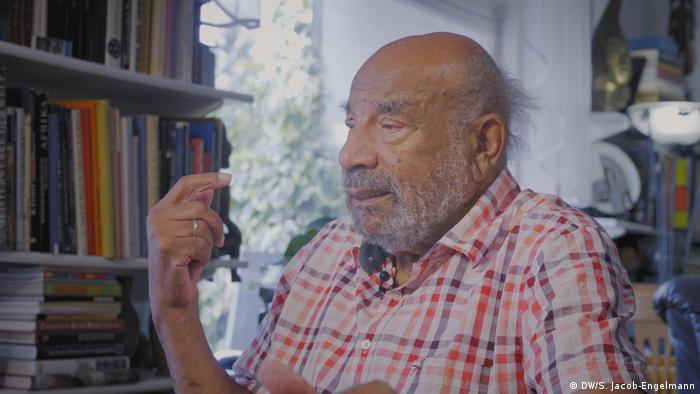
    Theodor Wonja Michael

    A particular excerpt of the DW documentary “Afro.Germany” went viral: the touching testimony of one of the oldest Afro-Germans born in Berlin. Here’s what can be learned from social media users’ hundreds of reactions.

    “I am an African – I didn’t even know Cameroon and Togo were German colonies,” said one social media user, reacting to an online video clip about the life and times of Theodor Wonja Michael, one of Germany’s oldest contemporary witnesses.

    The clip is an excerpt from “Afro.Germany,” a documentary project by Deutsche Welle, which aims to chronicle the diversity of Black experiences in Germany and challenge the historical amnesia surrounding Germany’s colonial past.

    The video narrates Michael’s extraordinary experiences as a Black person in Germany.

    Born in Berlin in 1925, Michael was forced to act in “human zoos” during his childhood. He survived the Nazi era and later became an actor and author

    A further challenge: fluid identities

    However, subsequent analysis by researchers such as E. P. Johnson, has drawn attention to the more troubling implications of Black identity politics.

    Black pride can inadvertently promote the problematic notion of Black authenticity – that is to say, it can construct an image of the the “real Blacks” and the “real” Black experience, to which the individuals must conform and relate. This line of thinking can hinder efforts geared towards separating identity from race.

    For example, one commentator insisted on referring to Michael as “mixed-race” and denounced the acceptance of “trans-racial crap.”

    Race does not define us, but it does influence our experience of the world. Needless to say, “Black” includes a spectrum of peoples whose experience of race varies depending on the interaction of other factors, such as class, culture, gender, nationality, etc. For many people, race is not a black and white issue, but a multi-front struggle for inclusion in their “own” communities.

    “My mother was French, my father was American […] Being light skinned, I fought blacks because I wasn’t dark enough. I fought whites because I was colored. Fought Spanish, Puerto Ricans because they said I was a ‘wanna be’ and fake,” said one commentator…

    Read the entire article here.

  • Africa has the greatest amount of phenotypic variability in skin color, and yet it’s been underrepresented in large scale endeavors,” said Alicia Martin, a postdoctoral scientist in the lab of Broad Institute member Mark Daly. “There are some genes that are known to contribute to skin pigmentation, but by and large there are many more new genes that have not been discovered.”

    David Cameron, “Skin pigmentation is far more genetically complex than previously thought,” Broad Institute, November 30, 2017. https://www.broadinstitute.org/news/skin-pigmentation-far-more-genetically-complex-previously-thought.

  • Eve Rosenhaft and Robbie Aitken

    The New Book Network
    2017-02-04

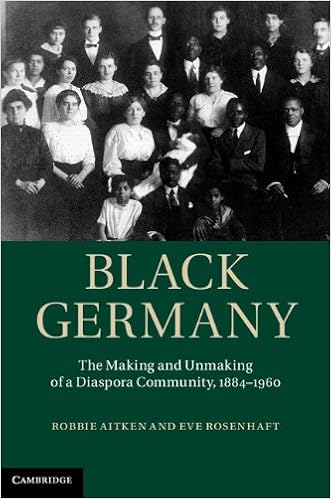
    Black Germany: The Making and Unmaking of a Diaspora Community, 1884-1960 (Cambridge University Press 2015)

    “There were black Germans?”

    My students are always surprised to learn that there were and are a community of African immigrants and Afro-Germans that dates back to the nineteenth century (and sometimes earlier), and that this community has at times had an influence on German culture, society, and racial thinking that belied its small size.

    Germany’s role in colonizing Africa has received increased attention lately, with an exhibit on German colonialism appearing at the Deutsches Historisches Museum in October and recent headway on a deal for Germany to pay reparations to the descendants of Herero and Nama genocide victims in Namibia. In Black Germany: The Making and Unmaking of a Disapora Community, 1884-1960 (Cambridge University Press, 2015), Eve Rosenhaft and Robbie Aitken supply a part of the colonial story that gets even less attention than that of Germans in Africa: what about Africans in Germany? Focusing primarily on a community of West-African-born black Germans and their families, Rosenhaft and Aitken trace the groups evolution in the nineteenth century through its persecutions by the Nazi state and postwar existence.

    Download the interview (00:25:27) here.

  • Works Progress Austin (“Casta” by Adrienne Dawes)

    Salvage Vanguard Theater
    1110 Barton Springs Road
    Austin, Texas 78704
    Telephone: (512) 474-7886
    2017-12-22, 20:00-21:30 CST (Local Time)

    Casta a new play by Adrienne Dawes

    Casta is inspired by a series of casta paintings by Miguel Cabrera, a mixed-race painter from Oaxaca. Casta paintings were a unique form of portraiture that organized racial mixtures of the New World according to a hierarchy defined by Spanish elites. How do Old World anxieties about ambiguous racial identity reflect contemporary biases?

    This is the third WPA workshop for Casta. In this current draft of Casta, the creative team is incorporating puppetry, expanding music by composer Graham Reynolds and exploring bilingual text. After a week of developing these new elements, audiences are invited to witness the piece in its current form.

    For more information, click here.

  • Why Is Skin Color Different? Huge Genetic Study Reveals Prevailing Theory of Pigmentation is Wrong

    Newsweek
    2017-11-30

    Kastalia Medrano, Staff Writer


    These are South African individuals in a household that exemplify the substantial skin pigmentation variability in the Khomani and Nama populations.
    Brenna Henn

    Scientists used to think that the same small handful of genes accounted for about half of all pigment variation in human skin. A new study shows the genetic picture behind skin color is far more complex.

    Research supporting the prior, simpler conclusion was skewed by Eurocentrism. Because it focused almost exclusively on Northern Eurasian populations from higher latitudes, the data missed a huge swath of the globe. Now, scientists have factored in people of color living in lower latitudes—and found that the prevailing theory is wrong.

    Scientists from the Broad Institute of MIT and Harvard, Stanford University, and Stony Brook University worked with groups of indigenous southern African peoples called the KhoeSan, notable to some for their use of “click” language. They interviewed them, measured their respective heights and weights, and used a tool called a reflectometer to measure their skin pigmentation.

    After seven years of research, and data gathered from about 400 individuals, the researchers realized that the closer a population lives to the equator, the greater the number of genes play a part in determining skin pigmentation. A paper describing the research was published November 30 in the scientific journal Cell.

    “Previous work has shown the biomedical consequences of ethnically biased studies. Over the past 10 years, approximately 80 percent of genetic association studies were performed in European-descent groups,” Alicia Martin, a postdoctoral scientist in the lab of Broad Institute member Mark Daly, told Newsweek by email. “What we find here is that the biology of pigmentation or ‘architecture’ can be very different in Africans.” Martin says the findings emphasize the need to fund more genetic work in diverse populations…

    Read the entire article here.