• Steeped in Heritage: The Racial Politics of South African Rooibos Tea

    Duke University Press
    2017-10-27
    272 pages
    3 illustrations
    Hardcover ISBN: 978-0-8223-6993-6
    Paperback ISBN: 978-0-8223-6993-6

    Sarah Ives, Postdoctoral Fellow and Lecturer
    Stanford University
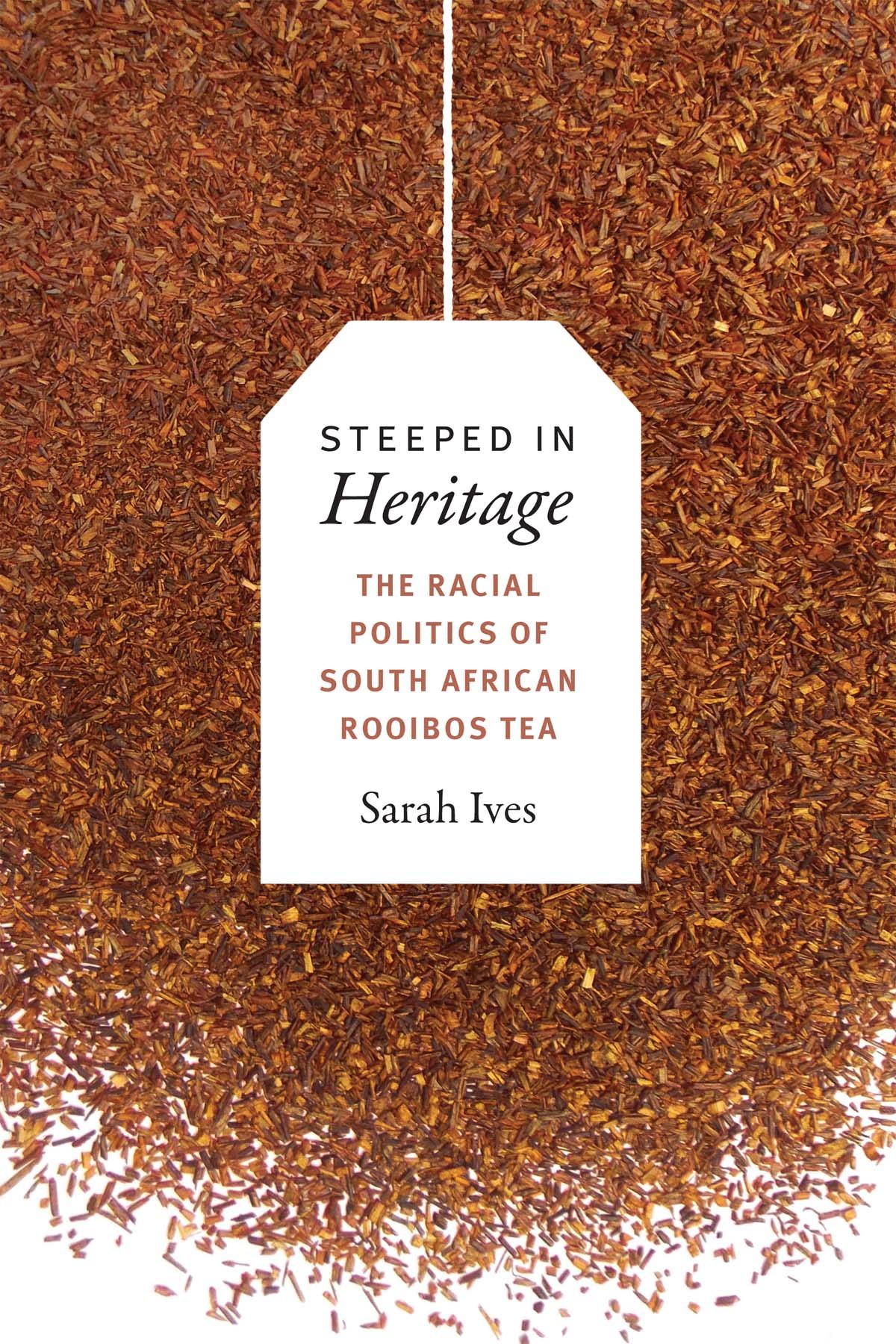
    South African rooibos tea is a commodity of contrasts. Renowned for its healing properties, the rooibos plant grows in a region defined by the violence of poverty, dispossession, and racism. And while rooibos is hailed as an ecologically indigenous commodity, it is farmed by people who struggle to express “authentic” belonging to the land: Afrikaners who espouse a “white” African indigeneity and “coloureds,” who are characterized either as the mixed-race progeny of “extinct” Bushmen or as possessing a false identity, indigenous to nowhere. In Steeped in Heritage Sarah Ives explores how these groups advance alternate claims of indigeneity based on the cultural ownership of an indigenous plant. This heritage-based struggle over rooibos shows how communities negotiate landscapes marked by racial dispossession within an ecosystem imperiled by climate change and precarious social relations in the post-apartheid era.

    Table of Contents

    • Preface
    • Acknowledgments
    • Introduction. The “Rooibos Revolution”
    • 1. Cultivating Indigeneity
    • 2. Farming the Bush
    • 3. Endemic Plants and Invasive People
    • 4. Rumor, Conspiracy, and the Politics of Narration
    • 5. Precarious Landscapes
    • Conclusion. “Although There Is No Place Called Rooibos”
    • Notes
    • References
    • Index
  • Being mixed-race is a blessing

    Just Analise
    2017-11-08

    Analise Kandasammy

    Being mixed-race is a blessing in disguise.

    True it can be uncomfortable, annoying and hurtful but the lack of comfort that comes from being mixed-race can be a positive, transcendent life experience.

    A human who belongs to a specific ethnic group builds a sense of belonging inside of a culture or people from that culture. For mixed race persons like myself, we have no such belonging, no such home and so it is this feeling of not belonging that makes us feel like we are not worthy or lovable as a human being.

    However, let’s turn that upside down…

    Read the entire article here.

  • ‘The Inscrutable Alexander Fitten’

    The Atlanta Journal Constitution
    2017-11-03

    Marc Fitten

    An excerpt from ‘We Wear the Mask: 15 True Stories of Passing in America.’ By Marc Fitten

    My full legal name is Marc Jeffrie Fitten, but I have always disliked it. It’s like the skin tag hanging from my neck that I keep promising myself I will do something about.

    Since I was 6, I have never been comfortable with hearing it spoken or saying it out loud. I have never identified with it. Ever since I was a child, everything in my DNA rejected this name. Probably because I instinctively knew it was a fake.

    My real name is lost to my family and me. Lost for many reasons, but especially because along the way an ancestor realized his name gave away an ethnicity that was more trouble than it was worth. So he changed it. Twice. A shoemaker and a migrant who traveled around the Caribbean taking odd jobs, my half-Chinese great grandfather managed to hide his identity from the people around him and from his descendants for 100 years…


    Marc Fitten looks at a recently discovered photo of his great grandfather, who Marc learned was part Chinese after his 2-year-old nephew was diagnosed with Kawasaki disease, an illness prone to Asians. HYOSUB SHIN / HSHIN@AJC.COM

    …The twist is intriguing as well. While mixed-race African-Americans were passing as white in the United States, in the Caribbean, a Chinese Jamaican wanted to hide his name and ethnicity and for his children to pass as colored.

    My great-grandfather — forever after known as Mr. Fitten — even had the good sense to die early, and so he took his secrets with him…

    Read the entire article here.

  • William Gilliland, an associate biology professor at Depaul University, explained that “DNA tests for ethnicity are entertainment value only,” noting that while DNA tests can connect you to family members, there is no solid DNA marker or “diagnostic nucleotide” for race.

    Woman takes 2 ancestry tests, gets 2 wildly different results,” The Grio, November 4, 2017. http://thegrio.com/2017/11/03/woman-dna-tests-ancestry/.

  • White Supremacy Has a Deep Impact on Interracial Families

    Wear Your Voice: Intersectional Feminist Media
    2017-11-04

    Savannah Lee-Thomas
    Toronto, Ontario, Canada

    For interracial Black and white families, honest discussions about racism need to be had in a white supremacist world.

    While I recognize that we are all the same species, due to pigmentation and a white supremacist culture, some of us are treated differently than others, and some of us are treated unfairly. In the ninth grade, our class read ‘To Kill A Mockingbird’ and I remember reading that the children of a mixed couple were considered nothings. Non existent.

    As a mixed child, I had to stomach that that situation would have been a reality for me during that time. With a West Indian mother and a White father, I grew up knowing that I was mixed but never understanding.I didn’t understand why I was bullied for no reason or not liked by my teachers. I didn’t understand why dolls didn’t look like me or why I didn’t see myself on television.

    And then, there was my family. I was brought up under the impression that we are all the same. I was never taught about Trinidadian culture or tradition and lived with a father who had spent his entire life in a small suburban town outside of the city. There was no access to my culture and I was never taught about it in school. Because of this, I had an extremely difficult time connecting with others and getting to know myself as an individual…

    Read the entire article here.

  • Woman takes 2 ancestry tests, gets 2 wildly different results

    The Grio
    2017-11-03

    A Chicago-area woman wanted to test the accuracy of the popular DNA tests that are supposed to find your family history, but when she mailed away her DNA, the results she got were vastly different from each other.

    Jennifer Smith was interested in her family ancestry, so she tried out a DNA kit from Ancestry.com, but was shocked when her breakdown showed that she was 97 percent European and 2 percent Asian.

    “I’m a Black girl; I am not a Jewish white lady,” Smith told Fox32 Chicago, recalling her utter confusion at her results…

    William Gilliland, an associate biology professor at Depaul University, explained that “DNA tests for ethnicity are entertainment value only,” noting that while DNA tests can connect you to family members, there is no solid DNA marker or “diagnostic nucleotide” for race…

    Read the entire article here.

  • The one woman show

    The New Indian Express
    Chennai, Tamil Nadu, India
    2017-10-14

    Ablnaya Kalyanasundaram, Chennai Express

    • Natasha Marshall’s solo play Half-breed aims to start a social discussion about racism
    • She also attempts to reach out to victims of racism through her 60-minute play

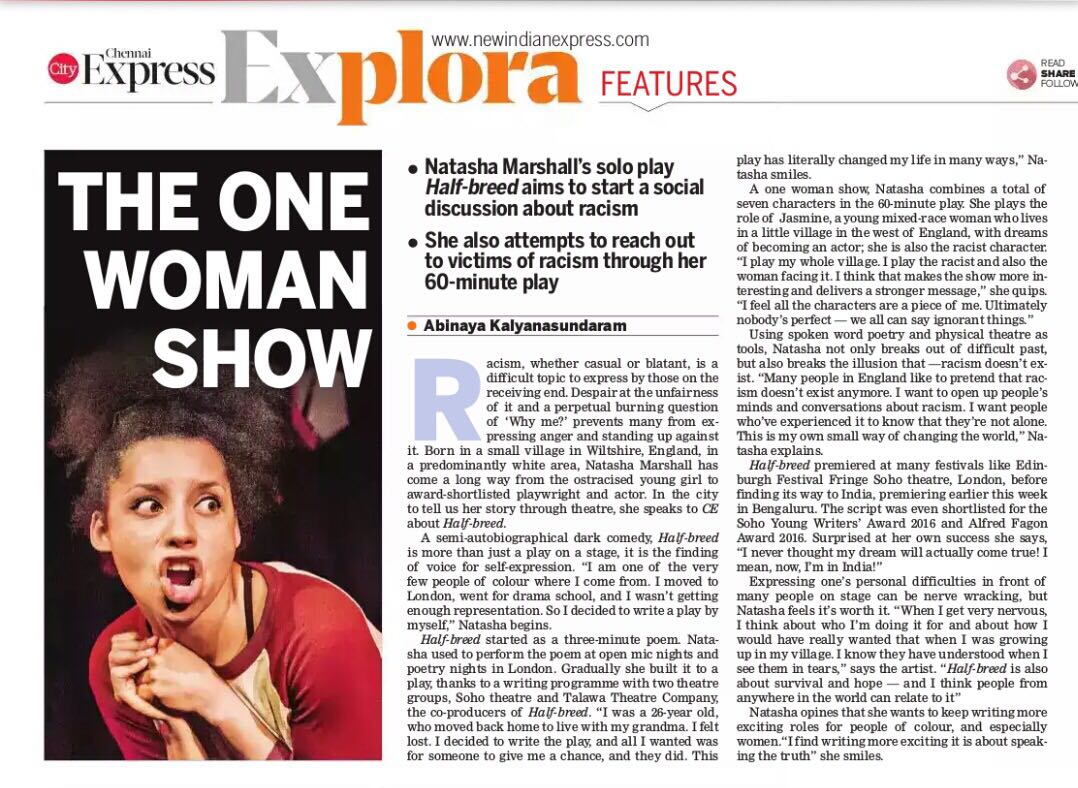
    Chennai: Racism, whether casual or blatant, is a difficult topic to express by those on the receiving end. Despair at the unfairness of it and a perpetual burning question of ‘Why me?’ prevents many from expressing anger and standing up against it. Born in a small village in Wiltshire, England, in a predominantly white area, Natasha Marshall has come a long way from the ostracised young girl to award-shortlisted playwright and actor. In the city to tell us her story through theatre, she speaks to CE about Half-breed.

    Half-breed started as a three-minute poem. Natasha used to perform the poem at open mic nights and poetry nights in London. Gradually she built it to a play, thanks to a writing programme with two theatre groups, Soho theatre and Talawa Theatre Company, the co-producers of Half-breed. “I was a 26-year old, who moved back home to live with my grandma. I felt lost. I decided to write the play, and all I wanted was for someone to give me a chance, and they did. This play has literally changed my life in many ways,” Natasha smiles.

    A one woman show, Natasha combines a total of seven characters in the 60-minute play. She plays the role of Jasmine, a young mixed-race woman who lives in a little village in the west of England, with dreams of becoming an actor; she is also the racist character. “I play my whole village. I play the racist and also the woman facing it. I think that makes the show more interesting and delivers a stronger message,” she quips. “I feel all the characters are a piece of me. Ultimately nobody’s perfect — we all can say ignorant things.”…

    Read the entire article here.

  • Perishing Heathens: Stories of Protestant Missionaries and Christian Indians in Antebellum America

    University of Nebraska Press
    October 2017
    276 pages
    1 photograph, 3 tables, index
    Hardcover ISBN: 978-1-4962-0187-4

    Julius H. Rubin, Professor Emeritus of Sociology
    University of Saint Joseph, West Hartford, Connecticut

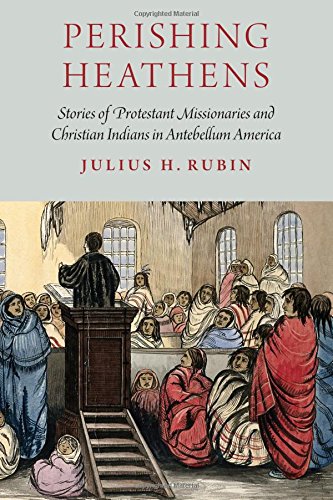
    In Perishing Heathens Julius H. Rubin tells the stories of missionary men and women who between 1800 and 1830 responded to the call to save Native peoples through missions, especially the Osages in the Arkansas Territory, Cherokees in Tennessee and Georgia, and Ojibwe peoples in the Michigan Territory. Rubin also recounts the lives of Native converts, many of whom were from mixed-blood métis families and were attracted to the benefits of education, literacy, and conversion.

    During the Second Great Awakening, Protestant denominations embraced a complex set of values, ideas, and institutions known as “the missionary spirit.” These missionaries fervently believed they would build the kingdom of God in America by converting Native Americans in the Trans-Appalachian and Trans-Mississippi West. Perishing Heathens explores the theology and institutions that characterized the missionary spirit and the early missions such as the Union Mission to the Osages, and the Brainerd Mission to the Cherokees, and the Moravian Springplace Mission to the Cherokees.

    Through a magnificent array of primary sources, Perishing Heathens reconstructs the millennial ideals of fervent true believers as they confronted a host of impediments to success: endemic malaria and infectious illness, Native resistance to the gospel message, and intertribal warfare in the context of the removal of eastern tribes to the Indian frontier.

    Table of Contents

    • List of Tables
    • Preface
    • Introduction
    • 1. The Travails of David Bacon: “A Humble Missionary of the Cross”
    • 2. The Missionary Vocation of Miss D: A Life Broken by Disease and Disappointment
    • 3. The Endless Chain of Religious Intelligence: The Emergence of an American Evangelical Identity
    • 4. The Question of K: “The First Friend of the Osage Nation unto God”
    • 5. The First Fruits of the Cherokee Nation: Catharine Brown and Sister Margaret Ann
    • 6. Métis Christian Indian Lives: Jane Johnston Schoolcraft and Mackinaw Mission Converts
    • Conclusion
    • Notes
    • Bibliography
    • Index
  • What Emerging Multiracial Plaintiff Cases Suggest About Employment Discrimination Law

    New York Law Journal
    2017-11-03

    Tanya Katerí Hernández, Professor of Law
    Fordham University School of Law

    Tanya Katerí Hernández writes: The presence of fluid mixed-race racial identities within allegations of employment discrimination leads some legal commentators to conclude that civil rights laws are in urgent need of reform.

    With the growth of a mixed-race population in the United States that identifies itself as “multiracial,” legal commentators have begun to raise concerns about how employment discrimination law responds to the claims of multiracial plaintiffs. The U.S. Census Bureau began permitting respondents to simultaneously select multiple racial categories to designate their multiracial backgrounds with the 2000 Census. With the release of data for both the 2000 and 2010 census years much media attention has followed the fact that first 2.4 percent then 2.9 percent of the population selected two or more races. The Census Bureau projects that the self-identified multiracial population will triple by 2060. Yet mixed-race peoples are not new. Demographer Ann Morning notes that their early presence in North America was noted in colonial records as early as the 1630s…

    Read the entire article here.

  • Miriam Allott Series 2017-18: Sarah Howe, TIDE Writer in Residence with Colm Toibin Fellow, Anthony Joseph

    Travel, Transculturality, and Identity in England, c. 1550-1700 (TIDE)
    2017-10-30

    Sarah Howe, TIDE Writer in Residence, and TS Eliot Prize-winning author of Loop of Jade will read with University of Liverpool’s Colm Toibin Fellow in Creative Writing, the novelist Anthony Joseph.

    Tuesday 14 November 5.30 pm, School of the Arts Library, 19 Abercromby Square.

    Funded by the European Research Council and in association with the Centre for New and International Writing at the University of Liverpool.

    For more information, click here.