• Obama’s America: A Transformative Vision of Our National Identity

    Potomac Books
    July 2012
    270 pages
    6″ x 9″; Notes; Bibliography; Index
    Clothbound ISBN: 978-1-61234-472-0

    Ian Reifowitz, Associate Professor of History
    Empire State College of the State University of New York

    What it means to be an American today

    Our national identity is defined by what it means to be an American and whom we include and why when we talk about “the American people.” A country’s national identity is fluid, and Ian Reifowitz argues that President Barack Obama, by emphasizing the ideals Americans hold dear, hopes to redefine ours in a fundamental way. Obama’s conception of America emphasizes two principles of national unity: First, all Americans, regardless of their heritage and cultural traditions, should identify with America as their country, based upon shared democratic values, a shared history, and a shared fate. Second, America should embrace all its citizens as active participants in one “family.” Reifowitz explores Obama’s belief that strengthening our common bonds will encourage Americans to rectify the injustices and heal the racial divisions that still plague our country.

    We have the opportunity to demonstrate to the world that a society of many races and cultures can truly become one people. In facing terrorism, violent fundamentalism, and other security issues, Obama’s response centers on a powerful, inspiring, and truly inclusive American narrative. By bolstering America’s identity as diverse yet unified, he aims both to counter the anxieties and fears that radicalism stokes and give proponents of religious and political freedom a model they can defend. The stakes couldn’t be any higher in determining America’s future.

    Table of Contents

    • Foreword by Ellis Cose
    • Preface
    • Acknowledgments
    • Introduction
    • 1. American National Identity: From the Revolution through the 1960s
    • 2. Since the 1960s: Radical Multiculturalism, Its Critics, and How Obama Fits In
    • 3. Obama’s Search for His Own Identity
    • 4. Obama on Racial Discrimination: Causes, Effects, and Policies to Combat It
    • 5. Candidate and President Obama’s Broader Rhetoric on Race
    • 6. Obama’s Vision of National Identity and National Unity
    • 7. Obama’s Narrative of American History and Our Place in the World
    • 8. Rejecting Obama’s America: Right-Wing Exclusionists and Left-Wing Race Critics
    • Conclusion
    • Notes
    • Selected Bibliography
    • Index
    • About the Author
  • Skeptic’s Café: Understanding Popular Uses of Percentages

    Pacific Standard
    2011-04-30

    Peter M. Nardi, Professor Emeritus of Sociology
    Pitzer College, Claremont, California

    Four New Jersey women in March accused the Campbell Soup Company of misleading customers with claims of lower sodium levels in its “25% Less Sodium Tomato Soup.” Whether the soup has more or less sodium than regular versions is not for me to investigate. I want to focus on the “25% less” phrase — a type of claim we see regularly in ads and new product labels — and in the process provide some numerical literacy skills to our arsenal of skeptical thinking tools.

    In an age when quantitative thinking is at a premium and “innumeracy,” as cognitive scientist Douglas R. Hofstadter termed it, is a problem, many people easily misinterpret numbers and become wary about statistics. Sometimes this skepticism is for good reason – remember that oft-cited phrase “there are three kinds of lies: lies, damned lies and statistics.”

    But turning our backs on numbers is a mistake. We require critical thinking skills to make sense of data that appear in commercials, politician-mediated public opinion polls, official documents and research studies…

    Consider this paragraph from a New York Times article about the increase in multiracial people in the latest 2010 U.S. Census: “In North Carolina, the mixed-race population doubled. In Georgia, it expanded by more than 80 percent, and by nearly as much in Kentucky and Tennessee. In Indiana, Iowa and South Dakota, the multiracial population increased by about 70 percent.” A few paragraphs later the article reports a possible national multiracial growth rate of 35 percent, maybe even a 50 percent increase from the last census in 2000 when 2.4 percent of Americans selected more than one race.

    With these numbers coming at you fast and furious, it takes a moment to reflect on what is actually being said and what information is missing…

    …Going back to the Census figures quoted in The New York Times, it’s one thing to claim that the multiracial population may increase 50 percent, but when the original figure is only 2.4 percent of Americans, a 50 percent increase simply means that the 2010 multiracial population could end up around 3.6 percent of the population. The number 50 surely sounds more impressive than the smaller 3.6 figure. Manipulating these numbers can create misleading impressions, sometimes done with intention…

    Read the entire article here.

  • 2010 Census Shows Multiple-Race Population Grew Faster Than Single-Race Population

    United States Census Bureau
    New Releases
    News Release: CB12-182
    2012-09-27

    The 2010 Census showed that people who reported multiple races grew by a larger percentage than those reporting a single race. According to the 2010 Census brief The Two or More Races Population: 2010, the population reporting multiple races (9.0 million) grew by 32.0 percent from 2000 to 2010, compared with those who reported a single race, which grew by 9.2 percent.

    Overall, the total U.S. population increased by 9.7 percent since 2000, however, many multiple-race groups increased by 50 percent or more.

    The first time in U.S. history that people were presented with the option to self-identify with more than one race came on the 2000 Census questionnaire. Therefore, the examination of data from the 2000 and 2010 censuses provides the first comparisons on multiple-race combinations in the United States. An effective way to compare the multiple-race data is to examine changes in specific combinations, such as white and black, white and Asian, or black and Asian.

    “These comparisons show substantial growth in the multiple-race population, providing detailed insights to how this population has grown and diversified over the past decade,” said Nicholas Jones, chief of the U.S. Census Bureau’s Racial Statistics Branch…

    Read the entire news release here.

  • Mulatto Bend: Free People of Color in Rural Louisiana, 1763-1865

    Tulane University
    2012-04-02
    307 pages
    Publication Number: AAT 3519906
    ISBN: 9781267512932

    Johanna Lee Davis Smith

    A DISSERTATION SUBMITTED ON THE SECOND DAY OF APRIL 2012 TO THE DEPARTMENT OF HISTORY IN PARTIAL FULFILLMENT OF THE REQUIREMENTS OF THE SCHOOL OF LIBERAL ARTS OF TULANE UNIVERSITY FOR THE DEGREE OF DOCTOR OF PHILOSOPHY

    This dissertation examines community and identity formation among free people of color in rural Louisiana between 1763 and 1865. The group studied here used the family, community, and financial benefits available to them as the mixed-race descendants of European and African ancestors in order to set themselves apart from the larger enslaved community and to avoid possible re-enslavement. Atlantic World influences played a key part in the establishment of Mulatto Bend, a small community of white and free black residents located on the Mississippi River in close proximity to Baton Rouge. Ideas of race and the paternalism of the French period resulted in a group of mixed-race offspring of French men and African women who were freed by their fathers and sometimes received financial assistance from them. Spanish control of Louisiana resulted in the even more relaxed environment in which authorities hungry to find settlers suitable to populate and guard their colony freely granted land to free people of color as well as whites. The community which developed was constituted of free mixed-race individuals who were property-owning Catholics, who intermarried, lived in a single geographical area, and cooperated in almost all facets of social, legal, and economic life in order to maintain their identity as a group. The records of the Spanish government of West Florida, parish probate documents, church parish sacramental records, and census records provide the major sources of information regarding the community. While quite successful during the Spanish period, the community began to decline in size by the 1830s as a result of financial stress brought on by general economic malaise and the sociopolitical hardening of the American period. Finally, emancipation removed the major difference between free people of color and slaves, forcing the former to search for ways to maintain their pre-emancipation social and economic status, most of which had been eroded by the depredations of war. This study will add to the body of knowledge regarding the lives of free people of color in the Gulf South who did not live in the more intensely studied city of New Orleans.

    Purchase the dissertation here.

  • The Cayton Legacy: An African American Family

    Washington State University Press
    2002
    272 pages
    6″ x 9″
    Photographs, notes, bibliography, index
    Paperback ISBN: 978-0-87422-251-7

    Richard S. Hobbs

    The evolution of a remarkable African American family—the Caytons—is a brilliantly told tale set primarily in Seattle and Chicago. The Caytons lived a true American saga, illuminating the black and white experience in the United States and the troubled, tortuous course of race relations.

    Several generations of the Horace and Susie Cayton family spanned the period from the Civil War to the present. They were a distinguished family, conscious of their historical heritage and distinct identity. The Caytons sought to define themselves in relation to their family traditions and to society as a whole. In the process, they attained financial success and influence both nationally and regionally. They published newspapers, authored books and articles, held public office, worked for civil and human rights, and established relationships with major black and white community and cultural leaders in America.

    They also faced racial discrimination and duress, business and professional failures, and even poverty. And, some struggled against the personal challenges of alcoholism, depression, and drug addiction. Yet the force of the family legacy—of being “a Cayton”— impelled most of them to make significant contributions.

    They speak to us with deep insight about our society—sharpening our understanding of the past, and enhancing our sense of individual and collective identity in the modern age.

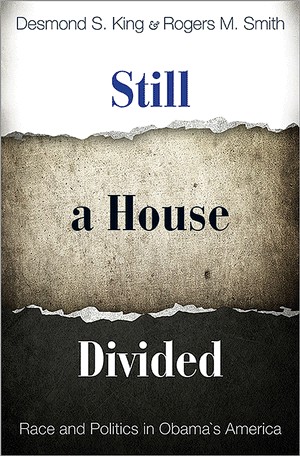
  • Still a House Divided: Race and Politics in Obama’s America

    Princeton University Press
    2011
    320 pages
    6 x 9; 5 halftones; 36 tables
    Cloth ISBN: 9780691142630
    eBook ISBN: 9781400839766

    Desmond S. King, Andrew W. Mellon Professor of American Government
    University of Oxford

    Rogers M. Smith, Christopher H. Browne Distinguished Professor of Political Science
    University of Pennsylvania

    Why have American policies failed to reduce the racial inequalities still pervasive throughout the nation? Has President Barack Obama defined new political approaches to race that might spur unity and progress? Still a House Divided examines the enduring divisions of American racial politics and how these conflicts have been shaped by distinct political alliances and their competing race policies. Combining deep historical knowledge with a detailed exploration of such issues as housing, employment, criminal justice, multiracial census categories, immigration, voting in majority-minority districts, and school vouchers, Desmond King and Rogers Smith assess the significance of President Obama’s election to the White House and the prospects for achieving constructive racial policies for America’s future.

    Offering a fresh perspective on the networks of governing institutions, political groups, and political actors that influence the structure of American racial politics, King and Smith identify three distinct periods of opposing racial policy coalitions in American history. The authors investigate how today’s alliances pit color-blind and race-conscious approaches against one another, contributing to political polarization and distorted policymaking. Contending that President Obama has so far inadequately confronted partisan divisions over race, the authors call for all sides to recognize the need for a balance of policy measures if America is to ever cease being a nation divided.

    Presenting a powerful account of American political alliances and their contending racial agendas, Still a House Divided sheds light on a policy path vital to the country’s future.

    TABLE OF CONTENTS

    • List of Figures and Tables
    • Acknowledgments
    • PART ONE: Obama’s Inheritance
    • PART TWO: The Making and Unmaking of Racial Hierarchies
      • CHAPTER 2 “That is the last speech he will ever make”: The Antebellum Racial Alliances
      • CHAPTER 3 “We of the North were thoroughly wrong”: How Racial Alliances Mobilized Ideas and Law
    • PART THREE: The Trajectory of Racial Alliances
      • CHAPTER 4 “This backdrop of entrenched inequality”: Affirmative Action in Work
      • CHAPTER 5 To “affi rmatively further fair housing”: Enduring Racial Inequalities in American Homes and Mortgages
      • CHAPTER 6 “To Elect One of Their Own”: Racial Alliances and Majority-Minority Districts
      • CHAPTER 7 “Our goal is to have one classification-American” Vouchers for Schools and the Multiracial Census
      • CHAPTER 8 “We can take the people out of the slums, but we cannot take the slums out of the people”: How Today’s Racial Alliances Shape Laws on Crime and Immigration
    • PART FOUR: America’s Inheritance
      • CHAPTER 9 Prospects of the House Divided
    • Notes
    • Index
  • White Mothers of Biracial Sons and Daughters in U.S. Schools:  Colliding, Colluding, and Contending with White Privilege

    Jennifer Little, a Ph.D. candidate in the Leadership for the Advancement of Learning and Service program at Cardinal Stritch University, is looking to build out her list of mothers to interview for her dissertation—which is titled “White Mothers of Biracial Sons and Daughters in U.S. Schools: Colliding, Colluding, and Contending with White Privilege”

    The purpose of this study is to collect and examine descriptions and portrayals from White mothers of biracial sons and daughters of their interactions with the teachers and principals who work at the public schools in the United States (US) that their children attend. The research questions are:

    1. What common discourse components are contained in their descriptions?
    2. How do the location differences among the mothers play a role? How do mothers who live in locations where the majority of residents self-identify as White compare to locations where the majority of the residents are not White?
    3. How do the mothers’ depictions of the interactions compare to the teachers’ and principals’ portrayals?

    A critical discourse analysis approach is planned for examining the descriptions provided by the study participants. The study will interview White mothers of biracial sons and daughters attending public schools across the US. In order to support triangulation, interviews or focus groups with teachers and principals will also be conducted. All the interviews and focus groups will be video recorded. The analysis of the data collected will be completed by reviewing the videos.

    If you or someone you know would like to participate in her study, or if you have questions please contact her via e-mail.

    She plans to start the interviewing phase in January 2013. She plans to travel to several metropolitan areas around the United States to conduct the interviews. She also plans to video record the interviews for use in a documentary. Some interviews she may need to do via the internet.

  • Mixed-race Jewish children locate their communal comfort zone

    The Jewish Chronicle Online
    2009-11-12

    Sue Fishkoff

    Dafna Wu, a 48-year-old San Francisco nurse, was born to a Jewish mother and Chinese father. She was raised Jewish but looks Asian, as does her daughter, nine-year-old Amalia, whose father was also Chinese.

    The Hebrew School Amalia attends is filled with mixed-race children, but the parents in the congregation are all white, as is the majority of American Jewry. That concerns her mother.
     
    “All my life I’ve had to defend being Jewish,” says Ms Wu. “When I go to a new synagogue, people ask who I’m with. I don’t want her to have to explain her Judaism, or be exoticised for it. I just want her to be a kid, not ‘that special, multi-racial kid’.”
     
    That’s why Ms Wu brings Amalia to Be’chol Lashon (In Every Tongue), a San Francisco-based organisation for ethnically and racially diverse Jews. At the group’s most recent retreat last month, at a camp north of San Francisco, Amalia played with other Jewish children who are black, Hispanic and Asian. They sang Hebrew songs, built a succah, and learned about tzedakah, but they also talked openly with their counsellors about what it means to be Jews of colour, to have an identity people do not see due to the colour of their skin.

    About 5.4 per cent of America’s Jews are either non-white or Hispanic, according to the 2000-2001 National Jewish Population Survey. A 2004 study by the Institute for Jewish and Community Research, Be’chol Lashon’s parent organisation, puts that number at about 10 per cent. Nevertheless, say activists in the field, the prevailing assumption is that Jews are white, and that Jews of other racial or ethnic backgrounds are adoptees or converts. Sometimes they are, but increasingly they are not, as the children of mixed-race couples grow to adulthood and begin raising their own Jewish children…

    Read the entire article here.

  • Jewish multiracial families grow in numbers and commitment

    The Denver Post
    Denver, Colorado
    2012-09-25

    Electa Draper

    Three Denver mothers heading multiracial families are seeking to build on what it means to live in Jewish community.

    The community is changing.

    It’s perhaps a surprising slice of demography that shows that 16 percent of metro Denver Jewish households headed by people ages 39 and younger are multiracial.

    Among all age groups, 9 percent are multiracial, according to the 2007 Metro Denver/Boulder Jewish Community Study. National organizations note that the trend is increasing through conversion, marriage and adoption…

    …For years, American Jews have been characterized as a “white” ethno-religious group, “both in terms of their racial classification and in terms of their cultural alignment in American society,” reported the UJA-Federation of New York in its comprehensive 2011 study released in June.

    “However, several factors — intermarriage and adoption among them — have been working to alter that nearly all-white imagery and reality to some extent,” the report states…

    Read the entire article here.

  • From Slave Ship to Harvard: Yarrow Mamout and the History of an African American Family

    Fordham University Press
    May 2012
    310 pages
    6 x 9
    25 Black and White Illustrations
    Hardcover ISBN: 9780823239504

    James H. Johnston, Lawyer and Writer
    Washington, D.C.

    From Slave Ship to Harvard is the true story of an African American family in Maryland over six generations. The author has reconstructed a unique narrative of black struggle and achievement from paintings, photographs, books, diaries, court records, legal documents, and oral histories. From Slave Ship to Harvard traces the family from the colonial period and the American Revolution through the Civil War to Harvard and finally today.

    Yarrow Mamout, the first of the family in America, was an educated Muslim from Guinea. He was brought to Maryland on the slave ship Elijah and gained his freedom forty-four years later. By then, Yarrow had become so well known in the Georgetown section of Washington, D.C., that he attracted the attention of the eminent American portrait painter Charles Willson Peale, who captured Yarrow’s visage in the painting that appears on the cover of this book. The author here reveals that Yarrow’s immediate relatives—his sister, niece, wife, and son—were notable in their own right. His son married into the neighboring Turner family, and the farm community in western Maryland called Yarrowsburg was named for Yarrow Mamout’s daughter-in-law, Mary “Polly” Turner Yarrow. The Turner line ultimately produced Robert Turner Ford, who graduated from Harvard University in 1927.

    Just as Peale painted the portrait of Yarrow, James H. Johnston’s new book puts a face on slavery and paints the history of race in Maryland. It is a different picture from what most of us imagine. Relationships between blacks and whites were far more complex, and the races more dependent on each other. Fortunately, as this one family’s experience shows, individuals of both races repeatedly stepped forward to lessen divisions and to move America toward the diverse society of today.

    Contents

    • Introduction
    • 1. Yarrow Mamout. a West African Muslim Slave
    • 2. Tobacco and the Importation of a Labor Force
    • 3. Welcome to America
    • 4. Slavery and Revolution
    • 5. Yarrow of Georgetown
    • 6. The Portraits: Peale, Yarrow, and Simpson
    • 7. Free Hannah, Yarrow’s sister
    • 8. Nancy Hillman, Yarrow’s Niece
    • 9. Aquilla Yarrow
    • 10. Mary “Polly” Turner Yarrow
    • 11 Aquilla and Polly in Pleasant Valley
    • 12. Traces of Yarrow
    • 13. Unpleasant Valley
    • 14. Freedom
    • 15. From Harvard to Today
    • Epilogue: Guide to the Yarrows’ and Turners’ World Today
    • Notes
    • Bibliography
    • Acknowledgments
    • Index