• The colour of money in multiracial Jamaica

    The Jamaica Gleaner
    Jamaica, West Indies
    2012-09-23

    Carolyn Cooper, Professor of Literary and Cultural Studies
    University of the West Indies, Mona, Jamaica

    On a flight from Miami several years ago, I sat next to a little girl who seemed to be about 10 or so years of age. She was looking through a magazine and came across a picture of three little girls – black, white and brown. I mischievously asked her, “Which one of them looks like you?” She picked the black child.

    I then asked her, “Which one do you look like?” And, believe it or not, she chose the brown child. ‘Mi nearly dead.’ I wondered if she had misunderstood. After all, it was a kind of trick question I was asking her about racial identity. But no, she did understand. As far as she was concerned, the black girl looked like her but she did not look like the black girl. And, in a funny way, it made perfectly good sense. It’s OK for the black girl to look like her; but not for her to look like the black girl.

    So who is responsible for this crazy conundrum? Was this just an exceptional case of a little child confused by the ‘fool-fool’ questions of a nosy adult? Or were the little girl’s curious answers a sign of our collective paranoia about race in Jamaica? How does our national motto complexify the problem, as the Americans say? Oh, yes! If you can simplify, it’s perfectly logical to complexify…

    Read the entire essay here.

  • Prestigious grant award for research on President Obama

    Edge Hill University
    Ormskirk, Lancashire, United Kingdom
    News
    2010-06-04

    Edge Hill University and key partners have been awarded a prestigious grant to develop a research network on The Presidency of Barack Obama.

    The Arts and Humanities Research Council has given an award of £31,320 to the institution in collaboration with the University of Manchester.

    The special two-year project, which will run from January 2011 to December 2012, is particularly unique because the research will be undertaken while Obama is still in office and will cover topical issues and developments as they happen.

    It will provide a unique opportunity to analyse key issues President Obama has had to deal with around race relations, foreign policies, the economy crisis and Obama’s wars. The funding will also be used to organise a series of high-profile lectures, the creation of an interactive website, a book, new teaching tools, a schools’ conference to run alongside the actual American presidential election in 2012, an exhibition and other community events.

    Professor Kevern Verney, Associate Head of the History Department at Edge Hill, explained: “The election of Barack Obama in November 2008 was a key moment in the history of the United States as he was the first African American President. It attracted enormous popular and scholarly interest not just in America but around the world. The inspirational ideas and rhetoric of the Obama campaign generated high expectations of change. In sharp contrast to such high expectations the political realities confronting the new President could hardly have been more discouraging. From the outset his administration faced unprecedented domestic and foreign policy challenges, including the worst national and international economic crisis since the 1930s and involvement in two costly unresolved foreign wars, in Iraq and Afghanistan. Race also remains an issue.

    “The success or failure of the Obama administration in addressing these issues will have profound implications not just for the citizens of the United states but also for governments and people around the world. This important project will discuss a number of key issues as they unfold and in the wake of either his continued presidency or his legacy.”…

    Read the entire news release here.

  • The Victorian Reinvention of Race: New Racisms and the Problem of Grouping in the Human Sciences

    Routledge
    2010-06-23
    248 pages
    Paperback ISBN: 978-0-415-65278-0
    Hardback ISBN: 978-0-415-88125-8
    eBook ISBN: 978-0-203-84498-4

    Edward Beasley, Associate Professor of History
    San Diego State University

    In mid-Victorian England there were new racial categories based upon skin colour. The ‘races’ familiar to those in the modern west were invented and elaborated after the decline of faith in Biblical monogenesis in the early nineteenth century, and before the maturity of modern genetics in the middle of the twentieth. Not until the early nineteenth century would polygenetic and racialist theories win many adherents. But by the middle of the nineteenth century in England, racial categories were imposed upon humanity. How the idea of ‘race’ gained popularity in England at that time is the central focus of The Victorian Reinvention of Race: New Racisms and the Problem of Grouping in the Human Sciences.

    Scholars have linked this new racism to some very dodgy thinkers. The Victorian Reinvention of Race examines a more influential set of the era’s writers and colonial officials, some French but most of them British. Attempting to do serious social analysis, these men oversimplified humanity into biologically-heritable, mentally and morally unequal, colour-based ‘races’. Thinkers giving in to this racist temptation included Alexis de Tocqueville when he was writing on Algeria; Arthur de Gobineau (who influenced the Nazis); Walter Bagehot of The Economist; and Charles Darwin (whose Descent of Man was influenced by Bagehot). Victorians on Race also examines officials and thinkers (such as Tocqueville in Democracy in America, the Duke of Argyll, and Governor Gordon of Fiji) who exercised methodological care, doing the hard work of testing their categories against the evidence. They analyzed human groups without slipping into racial categorization. Author Edward Beasley examines the extent to which the Gobineau-Bagehot-Darwin way of thinking about race penetrated the minds of certain key colonial governors. He further explores the hardening of the rhetoric of race-prejudice in some quarters in England in the nineteenth century – the processes by which racism was first formed.

    Contents

    1. Introduction – Reinventing Racism
    2. Tocqueville and Race
    3. Gobineau, Bagehot’s Precursor
    4. The Common Sense of Walter Bagehot
    5. Bagehot Rewrites Gobineau
    6. Darwin and Race
    7. Argyll, Race, and Degeneration
    8. Frederick Weld and the Unnamed Neighbours
    9. By Way of a Conclusion – Arthur Gordon
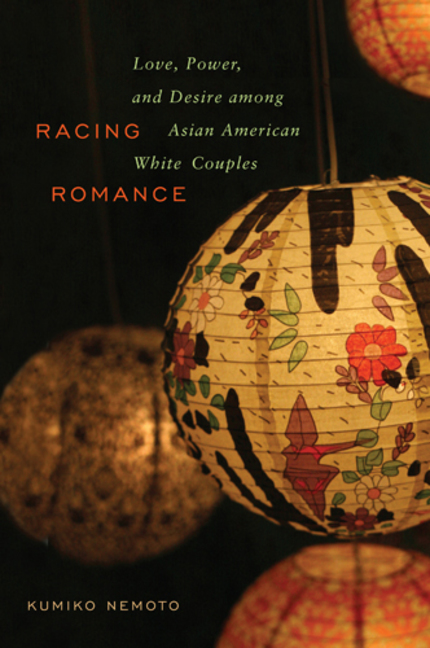
  • Racing Romance: Love, Power, and Desire Among Asian American/ White Couples

    Rutgers University Press
    June 2009
    208 pages
    6 x 9
    Paper ISBN: 978-0-8135-4533-2
    Cloth ISBN: 978-0-8135-4532-5
    Web PDF ISBN: 978-0-8135-4852-4

    Kumiko Nemoto, Associate Professor of Sociology
    Western Kentucky University

    Despite being far from the norm, interracial relationships are more popular than ever. Racing Romance sheds special light on the bonds between whites and Asian Americans, an important topic that has not garnered well-deserved attention until now. Incorporating life-history narratives and interviews with those currently or previously involved with an interracial partner, Kumiko Nemoto addresses the contradictions and tensions—a result of race, class, and gender—that Asian Americans and whites experience.

    Similar to black/white relationships, stereotypes have long played crucial roles in AsianAmerican/white encounters. Partners grapple with media representations of Asian women as submissive or hypersexual and Asian men are often portrayed as weak laborers or powerful martial artists. Racing Romance reveals how allegedly progressive interracial relationships remain firmly shaped by the logic of patriarchy and gender inherent to the ideal of marriage, family, and nation in America, even as this ideal is juxtaposed with discourses of multiculturalism and color blindness.

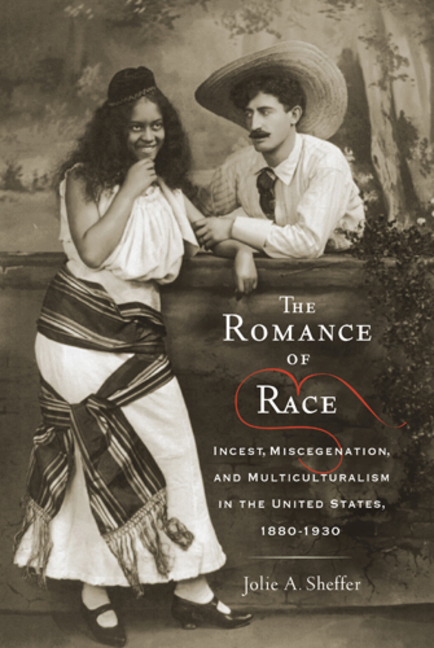
  • The Romance of Race: Incest, Miscegenation, and Multiculturalism in the United States, 1880-1930

    Rutgers University Press
    January 2013
    240 pages
    Paper ISBN: 978-0-8135-5462-4
    Cloth ISBN: 978-0-8135-5463-1
    eBook ISBN: 978-0-8135-5464-8

    Jolie A. Sheffer, Associate Professor, English and American Culture Studies
    Bowling Green State University, Bowling Green, Ohio

    In the United States miscegenation is not merely a subject of literature and popular culture. It is in many ways the foundation of contemporary imaginary community. The Romance of Race examines the role of minority women writers and reformers in the creation of our modern American multiculturalism.

    The national identity of the United States was transformed between 1880 and 1930 due to mass immigration, imperial expansion, the rise of Jim Crow, and the beginning of the suffrage movement. A generation of women writers and reformers—particularly women of color—contributed to these debates by imagining new national narratives that put minorities at the center of American identity. Jane Addams, Pauline Hopkins, Onoto Watanna (Winnifred Eaton), María Cristina Mena, and Mourning Dove (Christine Quintasket) embraced the images of the United States—and increasingly the world—as an interracial nuclear family. They also reframed public debates through narratives depicting interracial encounters as longstanding, unacknowledged liaisons between white men and racialized women that produced an incestuous, mixed-race nation.

    By mobilizing the sexual taboos of incest and miscegenation, these women writers created political allegories of kinship and community. Through their criticisms of the nation’s history of exploitation and colonization, they also imagined a more inclusive future. As Jolie A. Sheffer identifies the contemporary template for American multiculturalism in the works of turn-of-the century minority writers, she uncovers a much more radical history than has previously been considered.

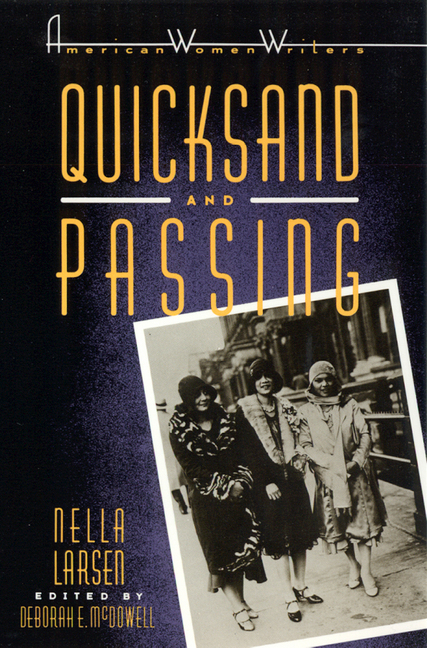
  • Quicksand and Passing

    Rutgers University Press
    1986
    246 pages
    Paper ISBN: 0-8135-1170-4

    Nella Larsen (1891-1964)

    Edited by

    Deborah E. McDowell, Alice Griffin Professor of English
    University of Virginia

    Nella Larsen’s novels Quicksand (1928) and Passing (1929) document the historical realities of Harlem in the 1920s and shed a bright light on the social world of the black bourgeoisie. The novels’ greatest appeal and achievement, however, is not sociological, but psychological. As noted in the editor’s comprehensive introduction, Larsen takes the theme of psychic dualism, so popular in Harlem Renaissance fiction, to a higher and more complex level, displaying a sophisticated understanding and penetrating analysis of black female psychology.

    Table of Contents

    • Acknowledgments
    • Introduction
    • Notes to Introduction
    • Selected Bibliography
    • A Note on the Texts
    • Quicksand
    • Passing
    • Explanatory Notes
  • For minorities in France, Obama still casts a spell

    France 24: International News
    2012-08-09

    Jon Frosch

    Though his reputation among blacks and Arabs in France is showing ever-so-slight signs of wear and tear, US President Barack Obama remains a powerful symbol for French citizens of colour. France24.com takes a closer look.

    When Barack Obama was elected in 2008, Anthony Borval, a black Frenchman of Caribbean descent, was elated.

    “It was intense, I felt almost American,” the 29-year-old office manager confided. “Obama indirectly sent us a message that anything was possible, a message of hope for minorities in France, where it’s difficult for us to succeed.”

    Four years later, as Obama spends the end of his tumultuous first term fighting a tough re-election battle against Republican challenger Mitt Romney, the US president is still a hero for Borval. “His victory taught French people of colour to believe in ourselves,” he said. “Today, I still feel great pride that an African-American is running the world’s superpower.”

    …Perhaps more common than that bluntly pragmatic view is a sense among some French minorities that Obama is an admirable figure who has not fully lived up to his promise. Aziz Senni, 36, is a Moroccan-born Frenchman who founded an investment fund specialising in economic development in the “banlieue”. Like many people of colour in France, Senni says he was captivated by Obama’s rise and impressed with Americans for voting a black man into the White House just decades after the civil rights movement.

    But Senni also noted that “like all new things, time goes by, the shine fades, and there are disappointments”. He cited Obama’s failure to advance the Mideast peace process, something that has tarnished the US president’s image among Arabs around the world. “We had a lot of hope after his Cairo speech, but he’s mainly been the same as his predecessors on the Israeli-Palestinian conflict,” Senni assessed. “That’s the reality of being an American president.”…

    …French mistrust of multiculturalism has deep roots: since the French Revolution, the country has clung to the notion that a common French identity could override differences in race and creed. The problem, according to Ndiaye, is that “Frenchness” has not always been as inclusive in practice as it is in principle. “After France’s colonies became independent, France thought of itself as essentially white,” the historian stated. “And many French people feared that immigration from former colonies would cause the republic to be fractured.”

    The result is a theoretically colour-blind country in which close-knit ethnic and religious groups are often viewed warily, politicians avoid referring to specific communities of voters, and disdain for affirmative action (known here as “positive discrimination”) is common on both sides of the political aisle.

    According to Ndiaye, however, it is affirmative action that could eventually help France create conditions from which a French Obama might one day emerge. “Obama didn’t come out of nowhere,” he explained. “There is a critical mass of 10,000 elected black officials in America, from sheriffs to mayors to Congressmen to the president. Affirmative action helped. We need that in France.”…

    Read the entire article here.

  • Argentina: Land of the Vanishing Blacks

    Ebony Magazine
    October 1973
    pages 74-85

    Era Bell Thompson

    Once outnumbering whites five to one, blacks were absorbed and inundated by massive immigration

    “If you are looking for black people, why,” they asked helpfully, “did you come to Argentina? Why don’t you go to Brazil?”

    Well, I had been to Brazil (Ebony July, September 1965), the “most mulatto” nation in South America, hopefully in the process of becoming white through amalgamation. Now I was in Argentina where massive European immigration was the catalyst that converted an erstwhile mixed-blood people into the whitest nation on the continent.

    I had read that there were no more blacks in that Spanish-speaking country. But I had also heard rumors of a small black colony in Buenos Aires, the capital. So what happened to Argentina’s involuntary immigrants, those African slaves and their mulatto descendants who once outnumbered whites five to one, and who were for 250 years “an important element” in the total populations which is now 97 percent white? Had they been entirely absorbed by, or simply inundated in successive waves of the new Argentines?

    What I found was not a viable, but a vanishing black people: relatively few in numbers, relatively free of racial discrimination and relatively content. Summarized one gentleman, “If there were more of us, perhaps it would be different.”

    The white Argentine, who is overwhelmingly of Italian and Spanish descent, doubts there ever were many blacks in their section of the old Rio de la Plata viceroyalty and are unaware of those still within their midst. The ranks of the few slaves channeled into the port of Buenos Aires, they believe, were decimated largely by disease and war. The survivors who did not emigrate to neighboring countries were absorbed by the mestizos.

    The question of what happened to Argentine blacks is not a new one. Ysabel P. Rennie, author of the book. The Argentine Republic, calls it “one of the most intriguing riddles of Argentine history.” In his book, Argentina, a City and a Nation, James R. Scobie says “the disappearance of the Negro from the Argentine scene has puzzled demographers far more than the vanishing Indian.”

    When Josephine Baker visited the country during Juan Peron’s first term as president, the entertainer asked Dr. Ramon Carrillo, mulatto minister of public health, “Where are the Negroes?”

    “There are only two,” he laughingly replied. “You and I.”

    My first impressions of Buenos Aires were: the man was right. In Buenos Aires, the city, and Buenos Aires province, where the preponderance of the entire population is found. Afro-Argentines, especially the fair-skinned ones, and not easily distinguishable from Latin-type whites. And then there is a matter of definitions. The terms Negro and mulatto are still used, but with slightly different connotations. Negro (small ‘n’) is the Spanish word for black. It took me some time to get used to hearing négro sprinkled throughout conversations that had nothing to do with race. Mulatto (or moreno) is an African-Spanish mixture, as differentiated from mestizo, which technically means only Spanish-Indian, but more often than Argentines care to admit, includes an admixture of black blood. Zambo (not Sambo) means African-Indian, but the term—if not the practice which produced it—has been discontinued, as have the names of two social classes: the gaucho, now cowboy, and cabecitas négras, or little black heads, as people fresh in from the provinces were once called. A Creole is an Argentine-born white.

    When I posed Josephine Baker’s question, the average creole could recall only a doorman here or a porter there. Brown people who were not mestizos were Brazilian tourists. A secretary in a government office said she was 16 before she saw a black man. Fortunately, I did not have to wait that long…

    Read the entire article here.

  • Afroargentines

    The Argentina Independent
    2007-03-23

    Laura Balfour

    As a descendant of two slaves, Maria Lamadrid has a hard time biting her tongue when airport officials think her Argentine passport is not real because ‘there are no blacks in Argentina’.
     
    And that was in 2002.
     
    The 25th of March marks the landmark 200th anniversary of the 1807 Abolition of the Slave Trade Act. Though the trade continued after this date, it marked the beginning of the end of the transatlantic trafficking of Africans.
     
    Ms Lamadrid is fighting to alter the common belief that all blacks who live in Argentina are foreigners. In 1997 she founded Africa Vive, a non-governmental organisation that defends the rights of African descendants. Today, she claims, there are 2m Afroargentines in Argentina.
     
    Ms Lamadrid and Miriam Gomez, a history professor at the University of Buenos Aires, have dedicated themselves wholly to the NGO’s cause because “there is so much to do and very few people to do it.”…

    …Africa Vive has requested that a separate category for African descendants be reintroduced in the 2010 census. Ms Lamadrid said the most frustrating thing is that there used to be one: 1887 was the final year that Afroargentines were recognised in the census; the results showed that 2% of the residents of Buenos Aires were of African descent at that time. She added that indigenous people, who have also suffered discrimination, have their own category because they have more support…

    Read the entire article here.

  • Although earlier psychological research focused on those who are biracial or multiracial experiencing a “fractured sense of self,” Sanchez believes the stereotype is unfounded. The multiracial people she has studied are comfortable with who they are.  “They seem to be just as well-adjusted as their monoracial peers,” says [Diana] Sanchez, who is half Puerto Rican and half Czechoslovakian (I called myself “Czecha Rican,” she jokes.)

    Carrie Stetler, “Rutgers Group Brings Students Together to Explore the Complexities of Being Multiracial,” Rutgers Focus, (September 2012). http://news.rutgers.edu/issue.2012-08-28.1598204061/article.2012-09-21.6397021568.