• Afro-Latino/a Identities: Challenges, History, and Perspectives

    Anthurium: A Caribbean Studies Journal
    Volume 9, Issue 1 (2012-04-20)
    Article 5

    Sobeira Latorre, Assistant Professor of Spanish
    Southern Connecticut State University

    Miriam Jiménez Román and Juan Flores, editors, The Afro-Latin@ Reader: History and Culture in the United States. (Durham, NC: Duke University Press, 2010), 584 pp.

    The Afro-Latin@ Reader: History and Culture in the United States explores the contradictions, complexities, and ambiguities surrounding the term “Afro-Latin@.” As editors Juan Flores and Miriam Jiménez Román argue: “The term befuddles us because we are accustomed to thinking of ‘Afro’ and ‘Latin@’ as distinct from each other and mutually exclusive: one is either Black or Latin@” (1). This distinction, as the editors rightly underscore, denies the experience of those who identify themselves or whose experiences mark them as both Black and Latino/a, and who do not fit comfortably into either category. The Afro-Latin@ Reader emerges as a noteworthy and valuable effort to validate that individual experience and to voice, document and historicize the collective experience of Black Latino/as in the US.

    The editors of this groundbreaking collection argue that despite the historical relevance and rich cultural legacy of Afro-Latino/as, described as “people of African descent in Mexico, Central and South America, and the Spanish-speaking Caribbean and by extension those of African descent in the United States whose origins are in Latin America and the Caribbean” (1), racial paradigms in the US remain rigid and narrow in their definition and the contributions and diverse experiences of this growing population in the United States continue to be understudied. Adopting a multidisciplinary and transnational approach to the study of Afro-descendants of Caribbean and Latin American background in the United States, The Afro-Latin@ Reader makes an invaluable contribution to the fields of Latino/a, Caribbean, African American and African diaspora Studies.

    The exploration of the African heritage in the Americas is not a new scholarly topic. Different aspects of the African presence in Latin America and the Spanish-speaking Caribbean, particularly around music, religion, and other socio-cultural manifestations, have been documented, especially among scholars in disciplines such as history, anthropology, and Latin American and Caribbean Studies. Studies on individual Latin American and Caribbean countries have also yielded significant insights into the particularities of racial discourse within distinct national contexts. More recently, this exploration is taking place within the context of the United States and has extended to fields like Latino/a, Black/African American, and Ethnic Studies…

    Read the entire review here.
  • Obama’s race still has bearing on media coverage

    The Louisiana Weekly
    2012-09-04

    Nadra Kareem Nittle, Contributing Writer

    (Special to the Trice Edney News Wire from the Maynard Institute) – Long before a little-known Illinois politician ran for president, the mainstream media focused on his race. When he flourished as a presidential candidate four years ago, everyone in America knew that Barack Obama was Black.
     
    Have his blackness and extensive coverage of that fact boosted his political career or made it more difficult for him to win re-election? Perhaps surprisingly, some of the nation’s best political minds are divided on this question.
     
    Obama’s race dominated media coverage about him before he became president. In 2004, he made headlines for becoming only the third African-American elected to the U.S. Senate since Reconstruction. In the 2008 presidential campaign, news stories questioned whether he could connect with African-American voters because he was born to a white Kansan mother and a Black Kenyan father, neither connected to Blacks in America.
     
    When Obama became the first Black president, mainstream media portrayed his historic accomplishment as a symbol of a post-racial, colorblind America. That framing is contrary to the experience of millions of African-Americans and other people of color beset by conscious and unconscious bias daily in this country.
     
    As Obama’s first term nears its end, the impact of his race in mainstream media coverage remains unclear…

    Read the entire article here.

  • Now, I have always believed that what is now widely considered one of slavery’s worst legacies—the Southern “one-drop” rule that indicted anyone with black blood as a nigger and cleaved American society into black and white with a single stroke—was also slavery’s only upside. Of course I deplore the motive behind the law, which was rooted not only in white paranoia about miscegenation, but in a more practical need to maintain social order by keeping privilege and property in the hands of whites. But by forcing blacks of all complexions and blood percentages into the same boat, the law ironically laid a foundation of black unity that remains in place today. It’s a foundation that allows us to talk abstractly about a ” black community” as concretely as we talk about a black community in Harlem or Chicago or L.A.’s South Central (a liberty that’s often abused or lazily applied in modern discussions of race). And it gives the lightest-skinned among us the assurance of identity that everybody needs to feel grounded and psychologically whole—even whites, whose public non-ethnicity is really ethnicity writ so large and influential it needs no name. Being black may still not be the most advantageous thing in the world, but being nothing or being neutral—the rallying cry of modern-day multiculturalists—has never made any emotional or real-world sense. Color marks you, but your membership in black society also gives you an indestructible house to live in and a bed to rest on. I can’t imagine growing up any other way.

    Erin Aubry Kaplan, Black Talk, Blue Thoughts, and Walking the Color Line: Dispatches from a Black Journalista,  (Lebanon, New Hampshire: University Press of New England, 2011), 16.

  • Race Mixture in Nineteenth-Century U.S. and Spanish American Fictions: Gender, Culture, and Nation Building (review)

    The Americas
    Volume 62, Number 2, October 2005
    pages 280-281
    DOI: 10.1353/tam.2005.0157

    Nancy E. Castro
    University of Illinois, Urbana-Champaign

    Race Mixture in Nineteenth-Century U.S. and Spanish American Fictions: Gender, Culture, and Nation Building. By Debra J. Rosenthal. Chapel Hill: University of North Carolina Press, 2004. Pp. x, 182. Notes. Bibliography. Index.

    This study adds to the growing body of scholarship in transamerican studies that, as Rosenthal puts it, “rezones the hemisphere” (p. 1). Her specific contribution focuses on nineteenth-century U.S. and Spanish American narrative, specifically Andean and Cuban works. Its theme, like that of the 2002 critical anthology she co-edited with Monika Kaup, is race mixture or miscegenation, which Rosenthal deems “formative in the history of the Americas primarily in terms of cultural constitution, political organization, nation building, civil identity, and . . . literary expression” (Ibid.). “Racial hybridity,” she argues, “can be situated at the heart of the literature of the Americas” (Ibid.). In that literature, she explains, “mixed-race characters” “somaticize” novelistic dialogism by serving as corporeal sites where “competing discourses of race” meet (p. 11). Rosenthal rightly notes, as have others, “nowhere is the anxiety of miscegenation concentrated greater than in the female body” (Ibid.). Accordingly, women’s emplotment in scripts of cross-racial desire, marriage, and incest figures prominently in the book’s analyses.

    The Introduction reviews the terms associated with hybridity in a New World context, explaining why, at the risk of anachronism and mis-translation, “miscegenation,” which implies both sexual union and social taboo, is most apropos for Rosenthal’s study. Chapter 1 reads representations of American Indians by Cooper, Child, Sedgwick, Jackson, and Twain alongside those in Mera’s Cumandá and Matto de Turner’s Aves sin nido, arguing that these authors “based [national] literary sovereignty on Indian-white racial mixing” (p. 18). This chapter brings the Andean literary movements of indianismo and indigenismo to bear on representational shifts in U.S. narratives of the 1820s and 1880s. The most compelling aspects of Rosenthal’s study emerge in this discussion: first, a keen attention to generic conventions and how their deformation or misrecognition adds new twists to authorial deployments of cross-racial themes, and second, an illuminating elucidation of incest motifs in literary mixed-race unions. The remaining chapters focus on black-white race mixture. Chapter 2 explores Whitman’s appropriation of temperance-novel conventions in Franklin Evans, which figures miscegenation as racial intemperance, “a dark blot on the U.S. character and a threat to a healthy U.S. C/constitution” (p. 68). Chapter 3 treats Cuban exile Gertrudis Gómez de Avellaneda’s distinctly feminist creole nationalism, apparent in her depiction of Sab, the mulatto namesake of her anti-slavery novel. Chapter 4 provides a lively discussion of Child’s manipulation of the discourse of botanical hybridity, the “language of flowers,” and the literary equation of women’s writing with flora to envision a mixed-race future for the nation in A Romance of the Republic. Finally, Chapter 5 illustrates how William Dean Howells’s generic realism runs aground on An Imperative Duty’s unwitting repetition of the “tragic mulatta” literary topos while contrasting it with Harper’s own appropriation of it in Iola Leroy.

    Rosenthal’s book successfully highlights “kinships often difficult to identify when authors are classified exclusively according to national boundaries” (p. 143). Its refreshing juxtapositions render visible texts that are “culturally distinct but narratively analogous” (Ibid.), even if the examples are weighted on the U.S. side. Nonetheless, Rosenthal’s self-identified “appositional” method (p. 14, 21), which focuses on thematic and formal continuities, at times wants for historical contextualization. Rosenthal rightly asserts that “an understanding of race mixture’s impact on the hemisphere’s literary imagination is crucial” (p. 148), but such comprehension requires greater attention to period specifics than her book unevenly provides (Chapter 1 is strongest on this count). An acknowledgment, for instance, that Child’s romance is a Reconstruction text while Howells’s attempt at realism is decidedly a post-Reconstruction “nadir” artifact would have been relevant, as would some recognition that as the…

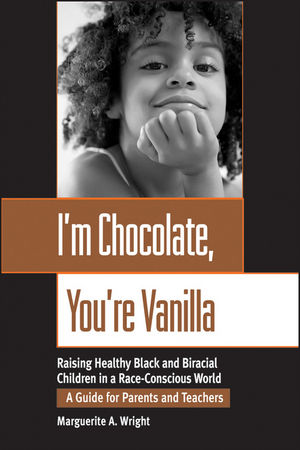
  • I’m Chocolate, You’re Vanilla: Raising Healthy Black and Biracial Children in a Race-Conscious World

    Jossey-Bass
    May 2000
    304 pages
    Paperback ISBN: 978-0-7879-5234-1

    Marguerite A. Wright

    A child’s concept of race is quite different from that of an adult. Young children perceive skin color as magical—even changeable—and unlike adults, are incapable of understanding adult predjudices surrounding race and racism. Just as children learn to walk and talk, they likewise come to understand race in a series of predictable stages.

    Based on Marguerite A. Wright’s research and clinical experience, I’m Chocolate, You’re Vanilla teaches us that the color-blindness of early childhood can, and must, be taken advantage of in order to guide the positive development of a child’s self-esteem.

    Wright answers some fundamental questions about children and race including:

    • What do children know and understand about the color of their skin?
    • When do children understand the concept of race?
    • Are there warning signs that a child is being adversely affected by racial prejudice?
    • How can adults avoid instilling in children their own negative perceptions and prejudices?
    • What can parents do to prepare their children to overcome the racism they are likely to encounter?
    • How can schools lessen the impact of racism?
    • With wisdom and compassion, I’m Chocolate, You’re Vanilla spells out how to educate black and biracial children about race, while preserving their innate resilience and optimism—the birthright of all children.

    Table of Contents

    • THAT MAGICAL PLACE: RACE AWARENESS IN THE PRESCHOOL YEARS
      • Chocolate and Vanilla: How Preschoolers See Color and Race
      • How Preschoolers Begin to Learn Racial Attitudes
      • When to Be Concerned That Race Is a Problem for Preschoolers
      • Raising the Racially Healthy Preschooler
    • THE WANING OF RACIAL INNOCENCE: THE EARLY SCHOOL YEARS
      • Shades of Brown and Black: How Early Grade-Schoolers See Color and Race
      • Black Children’s Self-Esteem: The Real Deal
      • How School Influences Children’s Awareness of Color and Race
    • REALITY BITES: RACE AWARENESS IN MIDDLE CHILDHOOD AND ADOLESCENCE
      • Fading to Black and White: How Children in the Middle Years See Race
      • How School Influences Older Children’s Ideas About Race
      • Preparing for Adolescence: The Lines are Drawn
      • A Healthy High School Experience: You Can Make the Difference
    • Epilogue
    • Appendix: Stages of Race Awareness
    • Notes
    • About the Author
    • Index
  • Lessons From a Preservice Teacher: Examining Missed Opportunities For Multicultural Education in an English Education Program

    Networks: An On-line Journal for Teacher Research
    Volume 41, Number 1 (Spring 2012)
    10 pages

    Amy M. Vetter, Assistant Professor
    Department of Teacher Education and Higher Education, School of Education
    University of North Carolina, Greensboro

    Jeanie Reynolds, Lecturer/Director of English Education
    University of North Carolina, Greensboro

    I had to get to know them [his students]. Because I am disconnected from Black culture a lot, honestly. You get people who assume I’m Black or I’m not. Before I even started teaching the very first question that I got asked was what color are you? And I never knew how big of deal that would be.

    This was one of many experiences that James described in an interview after being asked how his multiracial identities shaped his student teaching experiences. James was one of six preservice teachers that we followed in our program for three semesters in an attempt to learn more about how to better educate future high school English teachers. As his former instructors in undergraduate English Education courses, we viewed our job as providing support, facilitating dialogue, and sharing expertise with James and other teacher candidates to help them deal with the challenges of student teaching, including those related to race, class, gender and sexuality. It was not until this interview after he graduated, however, that we learned about how James’s multiracial identities shaped his student teaching experiences. We realized that as White, middle-class female instructors and researchers, we lacked insight into what it was like for James to be both an insider and outsider within the context of a public high school. In fact, we made assumptions about James and his needs rather than asking him to reflect on how his race and ethnicities shaped his experiences. As a result, James’s described experiences challenged us to transform our teaching practices and curriculum to engage all students in critical examinations about how race and culture shapes teaching and learning (Banks et al., 2005; Cochran-Smith, 1995)…

    Read the entire article here.

  • The presence of a biracial race would certainly disrupt popular ideas about race, but as scholars supporting biracial identity root it in biological notions of race “mixture,” it seems unlikely that such a disruption would result in the end of racial classifications. Work on race in the Caribbean and Latin America shows that a racially mixed identity is entirely consistent with a racialized social system. Moreover, recent work interrogating-color blindness has shown that this is the current dominant racial ideology, suggesting that a color-blind society as a goal is more likely to ensure the persistence of racism than its decline. I therefore find especially troubling the claims by Naomi Zack, G. Reginald Daniel, Kathleen Odell Korgen, Paul R. Spickard, Maria P. P. Root, and others discussed below, that the biracial project represents a progressive social movement.” In my view, based both on the popular push for such a reclassification and the scholarship discussed here, this project is less concerned with ending racism than with responding to the racialization of all people of African descent in the United States as black.

    Minkah Makalani, “Race, Theory, and Scholarship in the Biracial Project,” in Race Struggles edited by Theodore Koditschek, Sundiata Keita Cha-Jua, and Helen A. Neville Champaign, Illinois: University of Illinois Press, 2009), 139-140.

  • One of the first things we notice about people when we meet them (along with their sex) is their race. We utilize race to provide clues about who a person is. This fact is made painfully clear when we encounter someone whom we cannot conveniently racially categorize—someone who is for example, racially ‘‘mixed’’ or of an ethnic/racial group we are not familiar with. Such an encounter becomes a source of discomfort and momentarily a crisis of racial meaning.

    Michael Omi and Howard Winant, Racial formation in the United States from the 1960s to the 1990s, (New York and London: Routledge, 1994), 59.

  • PARADE Exclusive: A Conversation With the Obamas

    Parade Magazine
    2012-09-12

    Lynn Sherr, Contributor

    Maggie Murphy, Editor in Chief


    President and Mrs. Obama photographed in the White House Map Room on Aug. 10. [Photo: Ben Baker]

    You hear him before you see him. After a hearty hello to the men and women working on the ground floor of the White House, President Barack Obama bounds into the Map Room with a warm smile and an open hand. Soon the president’s eyes fall on a shimmering but empty silver tea set that has been placed on the coffee table by photographer Ben Baker. “Tea? What about chips and salsa?” With the tea service sent to the sidelines, the president settles down next to his wife, Michelle, whose gift for easy elegance is reinforced by her Tracey Reese top and J. Crew skirt. On this day before Gov. Mitt Romney would announce Rep. Paul Ryan as his running mate, the first couple ­alternately kid and cuddle for pictures. But befitting a room where decisions about World War II were once made, they quickly strike a more serious pose ­during an interview conducted by PARADE editor in chief Maggie Murphy and contributor Lynn Sherr. As they address questions from our readers about the economy, the political stalemate in D.C., and their family life, the couple hold hands, nod in support of each other’s answers, and make a case for their first four years in office and what they hope to accomplish next….

    …PARADE: If you were female, we would ask, “How has being female affected your ability to govern?” So, how has being black affected your ability to govern?

    President Obama: I’m sure it makes me more determined in assuring that everybody’s getting a fair shot—in the same way that being a father of two daughters makes me want to make sure that every woman is getting equal pay for equal work, ’cause I don’t want my daughters treated differently than somebody else’s sons. By virtue of being African-American, I’m attuned to how throughout this country’s ­history there have been times when folks have been locked out of opportunity, and because of the hard work of people of all races, slowly those doors opened to more and more people. Equal opportunity doesn’t just happen on its own; it happens because we’re vigilant about it. But part of this is not just because we’re African-American—it’s also because Michelle and I were born into pretty modest means. And so I think about my single mom and what it was like to go to school and work at the same time. And I think about Michelle’s dad, who had a disability and was working every day and didn’t have a lot of money to spare. But somehow our parents or grand­parents were able to give us these opportunities partly because they lived in a society that said that was important. And as president, I want to ­affirm that that’s important and reject the idea that if we just reward those at the top, that somehow that’s going to work for everybody—’cause that hasn’t been how America got built.

    Read the entire interview here.

  • Is Obama still black?

    Aljazeera
    2012-09-06

    Harvey Young, Associate Professor of Theatre, Performance Studies; African American Studies; Radio/Television/Film Studies
    Northwestern University
    (also Fellow at the Charles Warren Center for Studies in American History at Harvard University)

    Barack Obama, to many, is not “as noticeably” or, perhaps, “meaningfully black as he once was”, writes Young.

    Race is an attribute that generally proves less and less noticeable as a person becomes more and more familiar to us. When we first encounter strangers, we pay attention to appearance. You can learn a lot by looking at a person. Or, so we presume. My mother used to tell my sister that the truth of a man could be gleaned from a glimpse at his shoes. An ex-girlfriend once confessed to me that my having clean, trimmed fingernails when we first met was sufficient evidence that I was good boyfriend material…

    …Interestingly, as we spend more time with people, we become so well acquainted with them that we begin to overlook those visibly dramatic features that we could not help but notice during an initial encounter. Over time, and depending upon the social situations in which we locate ourselves, we can forget a person’s race as easily as husbands (or wives) can misremember their partners’ eye colour or fail to recognise a new hairstyle. Proximity and familiarity results in an overlooking of detail and, arguably, forgetting.

    Shift in perspective

    Thanks to the ubiquitous presence of the President of the United States, regardless of the person who actually holds the office, there are few international figures more familiar to global audiences. The US President is omnipresent, with his image appearing in major newspapers and magazines among other media outlets almost every day across the globe.

    Four years ago, when Barack Obama was a stranger who travelled the US and Europe in an attempt to introduce himself to the world, he was clearly, noticeably, identifiably and undeniably black. He was the black candidate for the US presidency. As the black candidate, he felt compelled to give a major talk on race and the dangers of racist vitriol. Voters, who didn’t want to vote for him, faced accusations of being a racist. Voters, who did vote for him, often cited race as an influential factor (and sometimes the only factor) in their vote. When Obama won the election, newspapers across the country resurrected the image and voice of Civil Rights leader Martin Luther King, Jr. to proudly proclaim “Dream Fulfilled”…

    Read the entire article here.