• Colin Kaepernick and the Question of Who Gets to Be Called a ‘Patriot’

    First Words
    The New York Times Magazine
    2016-09-12

    Wesley Morris, Critic-At-Large

    Citizenship is citizenship, until appearances get in the way. The world now knows, for instance, that Colin Kaepernick, a quarterback for the San Francisco 49ers, is protesting racial injustice — all because of a routine photo, taken during the singing of the national anthem before a preseason game. The photographer, Jennifer Lee Chan, tweeted the image last month, writing, “This team formation for the national anthem is not Jeff Fisher-approved.” Fisher is the head coach of the Los Angeles Rams, who, in an episode of the reality football show “Hard Knocks,” told his team that standing for the anthem was sacrosanct: “It’s an opportunity to realize how lucky you are.” Yet here was Kaepernick, sitting down.

    Kaepernick’s sitting was, it emerged, a stance. Two days later, he took reporters’ questions, including one about whether he was concerned that his actions could be taken as an indictment of law enforcement. His answer had teeth. “There is police brutality — people of color have been targeted by police,” he said. Then: “You can become a cop in six months and don’t have to have the same amount of training as a cosmetologist. That’s insane. Someone that’s holding a curling iron has more education and more training than people that have a gun and are going out on the street to protect us.”

    That’s one rejoinder to the unconditional gratitude — the compulsory expression of thankfulness for a nation that prides itself on freedom of expression — that the Jeff Fishers of the world demand. If you’re a black man, as Kaepernick is, your ambivalence about patriotic rituals may be a way of asking the same question Fisher raised: How lucky are we, exactly?…

    Read the entire article here.

  • American Segregation Started Long Before the Civil War

    What It Means to Be American: A National Conversation Hosted by The Smithsonian’s and Zócalo Public Square
    2016-09-12

    Nicholas Guyatt, University Lecturer in American History
    Cambridge University

    How the Founders’ Revolutionary Ideology Laid the Groundwork

    Segregation remains an intractable force in American life, more than 60 years after the Supreme Court’s Brown v. Board of Education ruling outlawed racial separation in America’s schools. The Government Accountability Office recently estimated that more than 20 million students of color attend public schools that are racially or socioeconomically isolated. This figure has increased in recent decades, despite a raft of federal and state initiatives.

    Major cities like New York and Chicago struggle with high levels of residential segregation, especially at the neighborhood level. The entrenched correlation between race and poverty is partly to blame, but segregation catches even affluent people of color. A recent study found that, while only 9 percent of white Americans earning $100,000 or more lived in poor areas, 37 percent of African-Americans on the same income level lived in poorer neighborhoods.

    If we want to understand why racial segregation still exists in America, we should start by understanding its origins…

    …And then there was the prospect of racial amalgamation, which scrambled the moral compasses of even the most progressive whites. Of all the European empires in the New World, British North America was the most squeamish on the question of amalgamation. But while the science and religion of the European Enlightenment suggested no barrier to intermarriage, even white Americans who embraced “all men are created equal” struggled with the practical application of that phrase. The preacher David Rice, who tried valiantly to outlaw slavery in the Kentucky constitutional convention of 1792, admitted that his own prejudices against intermarriage were hard to shake; but he was determined, he told his fellow delegates, not to allow irrational feelings to “influence my judgment, nor affect my conscience.”

    Alas, many others who spoke in the abstract against slavery failed to follow Rice’s example; or, like Thomas Jefferson, they compartmentalized their private and public lives. It’s now widely accepted that in the 1790s and 1800s, Jefferson secretly fathered six children with Sally Hemings, a multi-racial slave in his household, while insisting in public on his “great aversion” to “the mixture of color.”

    It soon became apparent that the realization of “all men are created equal” required more than an abstract recognition of black or Native humanity; it required the surrender of what we now call white privilege. When even the most liberal whites struggled to meet this challenge, they developed an alternative plan that might deliver the United States from the guilt of slavery and oppression without obliging white people to live alongside people of color: perhaps blacks and Indians could be persuaded to move elsewhere…

    Read the entire article here.

    Nicholas Guyatt teaches American history at the University of Cambridge in England. He is the author of Bind Us Apart: How Enlightened Americans Invented Racial Segregation (Basic Books).

  • The love story that shocked the world

    BBC News
    2016-09-14

    When an African prince and a white middle-class clerk from Lloyd’s underwriters got married in 1948, it provoked shock in Britain and Africa.

    Seretse Khama met Ruth Williams while he was a student at Oxford University. After his studies, he was supposed to go home to the British Protectorate of Bechuanaland (now Botswana) and marry someone from his own tribe, but his romance with Williams changed everything.

    His family disapproved and Khama was forced to renounce his claim to the throne. The British government came under pressure to show its disapproval and Khama was exiled from his homeland.

    He later became the first president of Botswana when it became an independent country.

    Witness spoke to Ruth Williams’s sister about the love that conquered prejudice.

    Watch the interview here.

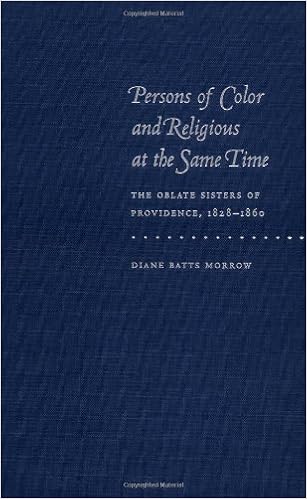
  • Persons of Color and Religious at the Same Time: The Oblate Sisters of Providence, 1828-1860

    University of North Carolina Press
    2002
    360 pages
    6.125 x 9.25, 11 illus., notes, bibl., index
    Cloth ISBN: 0-8078-2726-6
    Paperback ISBN 0-8078-5401-8
    eBook ISBN: 9780807862155

    Diane Batts Morrow, Associate Professor of History and African American Studies
    University of Georgia, Athens

    Founded in Baltimore in 1828 by a French Sulpician priest and a mulatto Caribbean immigrant, the Oblate Sisters of Providence formed the first permanent African American Roman Catholic sisterhood in the United States. It still exists today. Exploring the antebellum history of this pioneering sisterhood, Diane Batts Morrow demonstrates the centrality of race in the Oblate experience.

    By their very existence, the Oblate Sisters challenged prevailing social, political, and cultural attitudes on many levels. White society viewed women of color as lacking in moral standing and sexual virtue; at the same time, the sisters’ vows of celibacy flew in the face of conventional female roles as wives and mothers. But the Oblate Sisters’ religious commitment proved both liberating and empowering, says Morrow. They inculcated into their communal consciousness positive senses of themselves as black women and as women religious. Strengthened by their spiritual fervor, the sisters defied the inferior social status white society ascribed to them and the ambivalence the Catholic Church demonstrated toward them. They successfully persevered in dedicating themselves to spiritual practice in the Roman Catholic tradition and their mission to educate black children during the era of slavery.

  • Racism faced by black nuns in America called ‘dangerous memory’

    Crux: Taking the Catholic Pulse
    2016-08-18

    Andrew Nelson, Catholic News Service

    In early American history black women could be accepted into orders of nuns only if they could “pass for white,” and later they faced significant racial prejudice. Despite all that, they became role models for the black community in America and served as spiritual leaders.

    ATLANTA – Black women desiring to serve a life devoted to the Catholic faith were not welcomed by religious communities with anti-black acceptance requirements from the early 19th century to the middle of the 20th century, said historian Shannen Dee Williams.

    Those who could gain admittance faced discrimination from their fellow sisters, she added.

    “Black sisters matter, but they constitute a dangerous memory for the church,” said Williams, assistant professor of history at the University of Tennessee at Knoxville.

    She was joined by Sister Anita Baird, a Daughter of the Heart of Mary, and Sister Dawn Tomaszewski, general superior of the Sisters of Providence, on an Aug. 12 panel discussing racism in religious life at the assembly of the Leadership Conference of Women Religious in Atlanta.

    Williams’ upcoming book is called “Subversive Habits: Black Nuns and the Long Struggle to Desegregate Catholic America.” It was the subject of her doctoral dissertation at Rutgers University…

    Read the entire article here.

  • Books in Brief: Nonfiction

    The New York Times
    1997-10-26

    Douglas A. Sylva

    The New Colored People: The Mixed-Race Movement in America.
    By Jon Michael Spencer.
    New York University, $24.95.

    Many members of minority groups have long argued that society must recognize and accept an individual’s racial identity for that individual to enjoy feelings of self-esteem. Ironically, however, the very success of this message threatens the black community, since many people traditionally considered black now think of themselves as multiracial or of mixed race. Some even demand the right to define themselves this way on government documents. In ”The New Colored People,” Jon Michael Spencer takes on the difficult task of explaining, from a civil-rights perspective, why government should refuse to recognize such a category. Spencer, who teaches American studies and music at the University of Richmond, worries that new classifications will sap the black community of skill and vigor. He also fears that Federal relief funds for blacks will dwindle if their officially registered population declines. Whether or not he is correct, this type of argument entails a plea to put aside the desire for recognition and self-esteem for the greater good of the community…

    Read the entire review here.

  • ‘You look like the help’: the disturbing link between Asian skin color and status

    Fusion
    2016-08-25

    Mari Santos
    Toronto, Ontario, Canada

    Outside a hotel lobby in Toronto earlier this year, an elderly Asian woman stopped my mother and me to ask what time a tour bus would be arriving. Then, the woman asked in broken English: “Are you Philippine?”

    “Yes,” my mom replied.

    “Ahh, you look Korean!” the woman exclaimed. My mother graciously thanked her.

    I darted my eyes, offended and confused at the implication that looking Korean over Filipino should somehow be taken as a compliment. Later I asked my mother: “Why did you thank her?”

    “I don’t know,” she admitted sheepishly…

    Read the entire article here.

  • Toronto Film Review: ‘Barry’

    Variety
    2016-09-10

    Owen Gleiberman, Chief Film Critic


    Devon Terrell in Barry. Courtesy of TIFF

    Set in 1981, a canny and absorbing drama paints a highly convincing portrait of Barack Obama when he was a 20-year-old college student in New York, still piecing together who he was.

    In the movie world, there is often a fine line between coincidence and karma. It’s not really all that hard to fathom how two filmmakers, within a year of each other, could each come up with the notion of making a kind of snapshot biopic about the young Barack Obama. Yet the fact that both movies are emerging near the tail-end of the Obama presidency is surely no accident. The time has come to take stock, and Obama, at the twilight of his leadership, with eight years of policy and scrutiny, controversy and (yes) celebrity behind him, is ripe for the kind of mythological intimacy that the movies, perhaps uniquely, can provide.

    Southside With You,” the Sundance hit that was released into theaters just two weeks ago, is a deft and observant talkathon that turns Barack and Michelle Obama’s first date into a touching political spin on “Before Sunrise.” The Barack of that movie, which is set on a single day in 1989, is still finding his way, but he’s already a precocious young version of the Obama we know: impeccable and confident, a fusion of insight and arrogance and clarity and empathy, speaking in those rolling information-age cadences.

    The Barack Obama we meet in “Barry,” on the other hand (a movie set eight years earlier), is a very different sort of cat, a young man you feel you scarcely know at all, because he doesn’t totally know himself — which turns out to be the theme of the movie. As played by the canny Australian actor Devon Terrell, he’s not even Barack yet, he’s just Barry, rolling with the punches, a slightly gawky handsome angular dude with a fringe of Afro and a way of falling into pensive trances when he’s chain-smoking. Terrell nails the clipped vibe of awareness, and a youthful version of the stare, to an uncanny degree. His Barry is reasonably self-possessed, with a lot of ideas, but he doesn’t have a clue as to how they fit together. He’s not the talkative lawyer-professor we’re used to. He’s tentative, his brashness weighed down by hidden doubts…

    Read the entire review here.

  • Passing is both a social and political act: a form of revolt against slave owners and slavery, outlawed and feared by segregationists and white supremacists, yielding a breath of freedom and yet systemically injurious to those still oppressed. Because of this latter fact, it’s hard for me to work through how to perceive it morally, how to weigh all of its effects. As Harvard Law School professor Randall Kennedy writes in his 2001 essay, “Racial Passing,” passing, when a choice, “requires that a person be self-consciously engaged in concealment.” But it is not just a concealment of the self—my grandmother erasing who she may have been at one time, keeping her skin powdered. It’s a concealment of history—a concealment and erasure of others: we have no photographs of my grandmother’s parents, and none of their parents either—not even a photo of her brother.

    Ashlie Kauffman, “Our Secret Family Legacy,” The Rumpus, August 31, 2016. http://therumpus.net/2016/08/our-secret-family-legacy/.