• Artist Phoebe Boswell explores what ‘home’ is, migration, family and Kenya’s troubled past

    True Africa
    2015-11-05

    Phoebe Boswell is one of the most exciting young artists working today. Her moving-image installation, The Matter of Memory, was exhibited at Carroll / Fletcher Gallery in London in 2014 alongside John Akomfrah and Rashaad Newsome. She is involved in Paul Goodwin’s African Diaspora Artists of the 21st Century project and is currently collaborating with Binyavanga Wainaina on a digital literary project called Since Everything Suddens in the Hurricane.

    Her work mainly focuses on ‘transient middle points and passages of migration’, hardly surprising given her upbringing. She was born in Kenya, she spent most of her childhood in the Middle East before coming to London where she now lives and works. She took some time to tell us about her exhibition at the Gothenburg Biennale where she recreated her grandmother’s living room and what’s next for her.

    Could you tell us about the Gothenburg Biennale and your piece?

    The theme of GIBCA this year is A Story Within a Story, a title allows us as artists the opportunity to really play with the construction of storytelling. Elvira Dyangani Ose is at the curatorial helm of GIBCA and has offered us this title with the aim of contesting history, of rewriting it from new and perhaps previously silenced vantage points.

    Curatorially, she has brought together works that seek to re-examine and possibly debunk predetermined histories, histories constructed in stuffy seats of power in order to control the collective memory of who we are, where we are, why we are, and how we came to be. The question she and the Biennale are asking the audience is: ‘If you could rewrite history, what would you do?’ It’s a very participatory experience. It’s a Biennale full of works which demand the audience to be active.


    The Matter of Memory Courtesy of GIBCA ©Hendrik Zeitler

    My piece in it is an immersive installation called The Matter of Memory. Within the Hasselblad Centre of the Gothenburg Art Museum, I have recreated my grandmother’s living room and filled the fabric of it – its wallpaper, teacups, milk pots, lamps, mantelpiece etc – with drawings, props, sculptures, sound and animated projections based on stories my Kikuyu mother and fourth generation British Kenyan father told me of their childhood memories of ‘home’…

    Read the entire interview here.
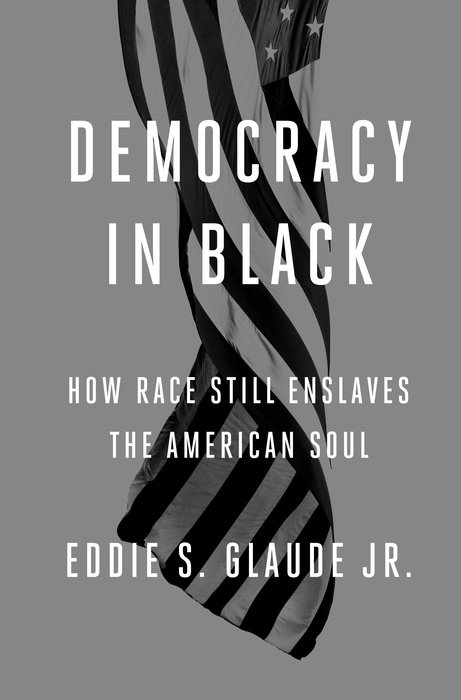
  • Review ‘Democracy in Black’ is a bracing call to action for African Americans

    The Los Angeles Times
    2016-01-21

    Kiese Laymon, Professor of English
    Vassar College, Poughkeepsie, New York

    Eddie S. Glaude Jr., Democracy in Black: How Race Still Enslaves the American Soul (New York: Crown, 2016)

    “We laud our democratic virtues to others and represent ourselves to the world as a place of freedom and equality,” Eddie Glaude writes of the U.S. in his unflinching new book, “Democracy in Black,” “all while our way of life makes possible choices that reproduce so much evil, and we don’t see it happening — or worse, we don’t want to know about it.”

    Glaude’s “Democracy in Black: How Race Still Enslaves the American Soul” is as narratively unrelenting as it is thematically percussive, calling for black Americans to take dramatic action in our lives, voting booths and on the streets to contend with a “value gap” that has left African Americans behind socially and economically.

    On Jan. 13, Barack Obama, the first black president of the United States, delivered a boastful State of the Union rooted in American exceptionalism, the importance of political cooperation and predictably, what we have, will, and can do to our enemies with our big American guns. Eight days earlier, Obama had held a press conference during which he cried over the murders of 30 American children and countless others victims of citizens wielding small American guns.

    I watched both political spectacles, knowing that while the violent, often racist American weight on President’s Obama’s back has been so terrifyingly heavy, the violent, exceptional American weight that he and all American presidents must abusively wield is heavier. “Democracy in Black,” one of the most imaginative, daring books of the 21st century, effectively argues that this weight — rooted in American exceptionalism — impedes a national reckoning of how the racial “value gap” in our nation sanctions black Americans terror while providing systemic unearned value to white Americans.

    The book asks us to reconsider not simply what presidential tears for systemic violence initiated and condoned by our nation might look like, but what can a revolution fueled by politically active black Americans wholly disinterested in presidential tears, speeches or “post-racial” policy actually accomplish. In this way, the book is not just post-Obama; it is post-presidential…

    Read the entire review here.

  • Democracy in Black: How Race Still Enslaves the American Soul

    Crown
    2016-01-12
    288 Pages
    6-1/4 x 9-1/4
    Hardcover ISBN: 9780804137416
    Ebook ISBN: 9780804137423

    Eddie S. Glaude Jr., William S. Tod Professor of Religion and African-American Studies
    Princeton University

    A powerful polemic on the state of black America that savages the idea of a post-racial society

    America’s great promise of equality has always rung hollow in the ears of African Americans. But today the situation has grown even more dire. From the murders of black youth by the police, to the dismantling of the Voting Rights Act, to the disaster visited upon poor and middle-class black families by the Great Recession, it is clear that black America faces an emergency—at the very moment the election of the first black president has prompted many to believe we’ve solved America’s race problem.

    Democracy in Black is Eddie S. Glaude Jr.’s impassioned response. Part manifesto, part history, part memoir, it argues that we live in a country founded on a “value gap”—with white lives valued more than others—that still distorts our politics today. Whether discussing why all Americans have racial habits that reinforce inequality, why black politics based on the civil-rights era have reached a dead end, or why only remaking democracy from the ground up can bring real change, Glaude crystallizes the untenable position of black America–and offers thoughts on a better way forward. Forceful in ideas and unsettling in its candor, Democracy In Black is a landmark book on race in America, one that promises to spark wide discussion as we move toward the end of our first black presidency.

  • Documenting the UK’s Black and Mixed Race Gingers

    Vice
    2105-08-24

    Natasha Culzac


    Francis Johnson by Michelle Marshall

    How would you describe a typical redhead? Do you think of Julianne Moore: light skinned and beautiful, with rust-coloured hair and a flush of crimson through her porcelain cheeks? Or do you think of Ed Sheeran?

    Either way, it’s likely the redhead in your mind is white. Red hair is mainly considered the preserve of northern Europe, a Celtic-Germanic trait. This is what resulted in London-based photographer Michelle Marshall’s quest to capture as many Afro Caribbean redheads as possible as part of her project, MC1R.

    MC1R, or Melanocortin 1 receptor if you’re feeling fancy, is the gene responsible for red hair. Mutations in it can cause various degrees of pigmentation. It’ll either work “properly”, causing your hair to get darker, or it will become dysfunctional, not activate and then fail to turn red pigment to brown, causing a build up of red pigment and thus, red hair…

    Dr George Busby from the Wellcome Trust Centre for Human Genetics agrees. He says that the red hair and freckles is the likely result of the historical interactions between Europeans and Africans in the formation of the Caribbean populations – most notably with Brits, as the Spanish and Portuguese went to South America.

    George states: “This might also explain why you occasionally see red hair on a black Caribbean person who has two black parents. By chance alone, it might be that they are both carrying a European mutation which has come together in their child.”

    Most of Michelle’s subjects have been in the UK, though she’s had a lot of interest in the US and some in mainland Europe. “I’ve got the whole of London on this,” she laughs, when describing her army of spotters…

    Read the entire article here.

  • A Tale of Two Dinners

    The Moth: True Stories Told Live
    Added: 2015-05-12
    Recorded: 1999-04-19

    Bliss Broyard

    A daughter discovers her father’s painstakingly kept secret.

    Listen to the episode here.

  • Call for Mixed Race Interviewees

    Mixed Race Feminist Blog
    2016-01-23

    Nicola Codner

    I am currently looking for mixed race people to take part in interviews for Mixed Race Feminist Blog. The aim of these interviews is to help mixed race people share their experiences without censoring and also to help them promote any work that they wish to (such as blogs, artwork and so on).

    You can see recent examples of previous interviews on the blog below:

    All mixed race perspectives are welcome! The blog is currently lacking the following voices at the moment for interviews, which are encouraged: male, LGBTQIA, non-black/ white racial mix, non-American, people in their early to mid-twenties, people living with disabilities and/or mental health issues.

    If you are interested in taking part or have any questions about the interviews, please contact me at: nicolacodner@yahoo.com

  • My Whiteness And My Blackness Are Not Reconcilable.

    RaceBaitR
    2015-08-25

    Amber Rambharose, Associate Editor
    xoJane

    Almost any given object can be split in half with each half making up 50% of whole.

    I can only think of one exception.

    When someone asks if I am half black or half white, I don’t want to give the comfortable response they are looking for. Any answer would imply that my Whiteness and Blackness are equal. Any answer would feel like a betrayal.

    It’s a stupid question…

    Read the entire article here.

  • Black Indians Formed the First American Rainbow Coalition

    The New York Times
    1991-03-17

    To the Editor:

    Census Finds Many Claiming New Identity: Indian” (front-page, March 5) discusses whites who now assert their Indian blood, but fails to mention African-Americans who can claim longer and more legitimate ties to America’s Indian heritage. Many in the New York area are pursuing their biracial heritage through such organizations as the National Alliance of Native Americans and radio stations such as WLIB.

    The African-native American connection came to light in 1503, when Gov. Nicolas de Ovando of Hispaniola complained to King Ferdinand that African slaves “fled among the Indians . . . and never could be captured.” His words announced our first rainbow coalition. Today almost every African-American family — from Frederick Douglass, Langston Hughes and Alex Haley to Alice Walker, Jesse Jackson and L. L. Cool J — has an Indian branch in its family tree. The statistics are much lower for white Americans…

    William L. Katz
    New York
    March 6, 1991

    The writer, a scholar in residence at N.Y.U., is the author of “Black Indians: A Hidden Heritage” (1986).

    Read the entire letter here.

  • Between black and white Exploring the “Biracial” Experience

    Race and Society
    Volume 1, Issue 2, 1998
    pages 197–212
    DOI: 10.1016/S1090-9524(99)80044-8

    Kerry A. Rockquemore

    Public debate surrounding the 2000 Census has focused on the addition of a multi-racial category. Advocates of this change assume that persons of mixed-race parentage identify as “biracial” or “mixed” and will continue to do so if given the opportunity on government documents. The assumption that most individuals with one Black and one White parent identify as biracial implies that “biracial” identity has a singular meaning. This paper challenges that assumption by asking two questions: (1) what does “biracial” mean to individuals within this population and (2) what social factors may lead to differences in the way these individuals interpret their racial identity. Data from in-depth interviews is used to draw a descriptive map of the multiple ways individuals understand and respond to their biracial-ness. A conceptual model is presented which explores how physical appearance and socio-economic status affect access to different types of social networks and the way that race is socially constructed and experienced within those networks.

    Read or purchase the article here.