• Born Champions [Full Episode]

    Finding Your Roots with Henry Louis Gates, Jr.
    2014-09-30

    Henry Louis Gates Jr., Host and Alphonse Fletcher University Professor and Director of the Hutchins Center for African and African American Research
    Harvard University

    Three of America’s greatest athletes, whose determination and love of sports were deeply shaped by their families, were all cut off from their true origins. Billie Jean King learns the story of her grandmother. Derek Jeter confronts his ancestors’ lives as slaves. Rebecca Lobo finds out that her Spanish ancestor fought side by side with a famous revolutionary.

    Watch the full episode here.

    Partial Transcript below:

    GATES: I’M HENRY LOUIS GATES JR. WELCOME TO FINDING YOUR ROOTS.

    TONIGHT, WE REVEAL THE ANCESTRY OF THREE OF AMERICA’S GREATEST ATHLETES: TENNIS LEGEND BILLIE JEAN KING, YANKEES ALL-STAR DEREK JETER, AND WOMEN’S BASKETBALL PIONEER REBECCA LOBO… ATHLETES WHOSE PURPOSE AND DRIVE WERE PROFOUNDLY SHAPED BY THEIR FAMILIES.

    TO DISCOVER THEIR ANCESTORS, WE’VE USED EVERY TOOL AVAILABLE…

    GENEALOGISTS HELPED STITCH TOGETHER THE PAST USING THE PAPER TRAIL THEIR FAMILIES LEFT BEHIND, WHILE GENETICISTS UTILIZED THE LATEST ADVANCES IN DNA ANALYSIS TO REVEAL SECRETS HUNDREDS OF YEARS OLD.

    GATES: The answers are in this book…

    GATES VO: AND WE’VE COMPILED EVERYTHING INTO A BOOK OF LIFE, A RECORD OF ALL OF OUR DISCOVERIES…

    LOBO: I mean it’s just amazing to see her handwriting!

    JETER: That’s unbelievable… all the way back to 1605!

    BILLIE JEAN KING: This is from a bible?  Family…we have a family bible?

    GATES: Mhm.

    BILLIE JEAN KING: This (audio cuts off 1:01:04:12) is fantastic!

    GATES: AS WE TRACE BILLIE JEAN, DEREK, AND REBECCA’S ROOTS, WE’LL EXPLORE HOW THEY BECAME CHAMPIONS, DID THEY COME TO GREATNESS THROUGH HARD WORK AND INDIVIDUAL EFFORT? IS THEIR TALENT SIMPLY ENCODED IN THEIR GENES? COULD IT BE, THESE THREE ATHLETES WERE MODELED IN WAYS THEY NEVER COULD HAVE IMAGINED? BY THE LIVES OF THEIR ANCESTORS.

    ROOTS TITLE SEQUENCE…

    …GATES VO: DEREK’S FATHER, CHARLES JETER, IS AFRICAN-AMERICAN AND HIS MOTHER, DOROTHY CONNORS, IS OF IRISH DESCENT. IT WASN’T EASY BEING THE CHILD OF A MIXED MARRIAGE. WHEN DEREK WAS YOUNG, HE OFTEN HAD TO FACE UNWANTED ATTENTION.

    JETER: You know back in the day, yeah you’d get some second glances, people trying to figure out what the dynamic is there. And if you go somewhere with both of them, obviously you get some stares.

    GATES: Mhm.

    JETER: My parents tried to explain to us that it’s just people’s ignorance they’re not used to seeing it.

    GATES: Did your parents take any flack?

    JETER: I think when you’re a young child, I think your parents don’t necessarily tell you how difficult it was…

    GATES: Yeah.

    JETER: …on them. So, you know, a lot of their troubles that they went through, I’m sure they sheltered us from it.

    GATES:  So when people come up to you and say, you know, “What are you?” what do you say?

    JETER:  Black and Irish…

    GATES: Black and Irish, that’s what you say?

    JETER: Yeah, that’s, that’s what I believe I am but I don’t know much about my history…

  • The Race Myth, Racial Disparities in Health, and Why There Are So Few African American Evolutionists

    Evolution: This View of Life
    2012-02-24

    David Sloan Wilson, Host and Distinguished Professor of Biology and Anthropology
    State University of New York, Binghamton

    Joseph L. Graves, Professor & Associate Dean for Research (author of The Race Myth: Why We Pretend Race Exists in America)
    Joint School of Nanoscience and Nanoengineering
    North Carolina A&T State University & University of North Carolina, Greensboro

    In honor of Black History month, we are pleased to present an interview with Joseph L. Graves, a distinguished evolutionist and the first African American to earn a Ph.D. in evolutionary biology. Prof. Graves explains why race is a myth, despite the undeniable fact of local adaptation. He also discusses his own research on aging, how an evolution-savvy diet saved his life, and the surprising reason why African-Americans are even less well represented in evolutionary biology than they are in science.

  • Lawsuit: Wrong sperm delivered to lesbian couple

    The Chicago Tribune
    2014-10-01

    Meredith Rodriguez, Tribune reporter

    A white Ohio woman is suing a Downers Grove-based sperm bank, alleging that the company mistakenly gave her vials from an African-American donor, a fact that she said has made it difficult for her and her same-sex partner to raise their now 2-year-old daughter in an all-white community.

    Jennifer Cramblett, of Uniontown, Ohio, alleges in the lawsuit filed Monday in Cook County Circuit Court that Midwest Sperm Bank sent her the vials of an African-American donor’s sperm in September 2011 instead of those of a white donor that she and her white partner had ordered.

    After searching through pages of comprehensive histories for their top three donors, the lawsuit claims, Cramblett and her domestic partner, Amanda Zinkon, chose donor No. 380, who was also white. Their doctor in Ohio received vials from donor No. 330, who is African-American, the lawsuit said.

    Cramblett, 36, learned of the mistake in April 2012, when she was pregnant and ordering more vials so that the couple could have another child with sperm from the same donor, according to the lawsuit. The sperm bank delivered vials from the correct donor in August 2011, but Cramblett later requested more vials, according to the suit…

    …”On August 21, 2012, Jennifer gave birth to Payton, a beautiful, obviously mixed-race baby girl,” the lawsuit states. “Jennifer bonded with Payton easily and she and Amanda love her very much. Even so, Jennifer lives each day with fears, anxieties and uncertainty about her future and Payton’s future.”

    Raising a mixed-race daughter has been stressful in Cramblett and Zinkon’s small, all-white community, according to the suit. Cramblett was raised around people with stereotypical attitudes about nonwhites, the lawsuit states, and did not know African-Americans until she attended college at the University of Akron…

    Read the entire article here.

  • The Myth of Race: The Troubling Persistence of an Unscientific Idea

    Harvard University Press
    October 2014
    384 pages
    6-1/8 x 9-1/4 inches
    4 halftones, 2 line illustrations
    Hardcover ISBN: 9780674417311

    Robert Wald Sussman, Professor of Physical Anthropology
    Washington University, St. Louis, Missouri

    Biological races do not exist—and never have. This view is shared by all scientists who study variation in human populations. Yet racial prejudice and intolerance based on the myth of race remain deeply ingrained in Western society. In his powerful examination of a persistent, false, and poisonous idea, Robert Sussman explores how race emerged as a social construct from early biblical justifications to the pseudoscientific studies of today.

    The Myth of Race traces the origins of modern racist ideology to the Spanish Inquisition, revealing how sixteenth-century theories of racial degeneration became a crucial justification for Western imperialism and slavery. In the nineteenth century, these theories fused with Darwinism to produce the highly influential and pernicious eugenics movement. Believing that traits from cranial shape to raw intelligence were immutable, eugenicists developed hierarchies that classified certain races, especially fair-skinned “Aryans,” as superior to others. These ideologues proposed programs of intelligence testing, selective breeding, and human sterilization—policies that fed straight into Nazi genocide. Sussman examines how opponents of eugenics, guided by the German-American anthropologist Franz Boas’s new, scientifically supported concept of culture, exposed fallacies in racist thinking.

    Although eugenics is now widely discredited, some groups and individuals today claim a new scientific basis for old racist assumptions. Pondering the continuing influence of racist research and thought, despite all evidence to the contrary, Sussman explains why—when it comes to race—too many people still mistake bigotry for science.

    Table of Contents

    • List of Abbreviations
    • Introduction
    • 1. Early Racism in Western Europe
    • 2. The Birth of Eugenics
    • 3. The Merging of Polygenics and Eugenics
    • 4. Eugenics and the Nazis
    • 5. The Antidote: Boas and the Anthropological Concept of Culture
    • 6. Physical Anthropology in the Early Twentieth Century
    • 7. The Downfall of Eugenics
    • 8. The Beginnings of Modern Scientific Racism
    • 9. The Pioneer Fund, 1970s–1990s
    • 10. The Pioneer Fund in the Twenty-First Century
    • 11. Modern Racism and Anti-Immigration Policies
    • Conclusion
    • Appendix A: The Eugenics Movement, 1890s–1940s
    • Appendix B: The Pioneer Fund
    • References
    • Acknowledgments
    • Index
  • Finding Your Roots: The Official Companion to the PBS Series

    University of North Carolina Press
    September 2014
    352 pages
    6.125 x 9.25, index
    Cloth ISBN: 978-1-4696-1800-5

    Henry Louis Gates Jr., Alphonse Fletcher University Professor and Director of the Hutchins Center for African and African American Research
    Harvard University

    Who are we, and where do we come from? The fundamental drive to answer these questions is at the heart of Finding Your Roots, the companion book to the PBS documentary series seen by 30 million people. As Harvard scholar Henry Louis Gates Jr. shows us, the tools of cutting-edge genomics and deep genealogical research now allow us to learn more about our roots, looking further back in time than ever before. Gates’s investigations take on the personal and genealogical histories of more than twenty luminaries, including United States Congressman John Lewis, actor Robert Downey Jr., CNN medical correspondent Sanjay Gupta, President of the “Becoming American Institute” Linda Chavez, and comedian Margaret Cho. Interwoven with their moving stories of immigration, assimilation, strife, and success, Gates provides practical information for amateur genealogists just beginning archival research on their own families’ roots, and he details the advances in genetic research now available to the public. The result is an illuminating exploration of who we are, how we lost track of our roots, and how we can find them again.

  • Race, Religion and Law in Colonial India: Trials of an Interracial Family by Chandra Mallampalli (review) [Epstein]

    Victorian Studies
    Volume 56, Number 3, Spring 2014
    pages 519-520
    DOI: 10.1353/vic.2014.0064

    James Epstein, Distinguished Professor of History
    Vanderbilt University, Nashville, Tennessee

    Mallampalli, Chandra, Race, Religion and Law in Colonial India: Trials of an Interracial Family (Cambridge, New York: Cambridge University Press, 2011)

    The case of Abraham v. Abraham (1854–63) was extraordinary. It took nearly a decade to decide as it passed through the district civil court at Bellary in southern India, the appeals court at Madras, and finally the Privy Council’s Judicial Committee. The case repeatedly confounded legal categories based alternately on Hindu and English law and the fixed categories of Britain’s post-1857 colonial regime. In Race, Religion and Law in Colonial India, Chandra Mallampalli skillfully guides readers through the intricacies of the case, studying the social world inhabited by one family drawn into litigation and measuring the gap between their life-world and the protocols of the court. The period was one of imperial crisis and transition, as the British Crown assumed direct control over Indian territories following the 1857 Rebellion and authorities adopted a more cautious approach in governing Indian society. As the author writes, the more conservative turn of liberal governance “gave rise to an imperial multiculturalism, a policy of classifying colonial subjects according to race, religion, caste, or ethnicity,” while accentuating the difference between colonial subjects and colonizers (5).

    Matthew Abraham was born into a Tamil-speaking family of “untouchables” (paraiyar community) who had converted to Catholicism. He subsequently converted to Protestantism and married Charlotte Fox, a Eurasian of Anglo-Portuguese descent. Matthew was part of the mobile group of camp followers who gravitated to the garrison town of Bellary. Access to the colonial culture centered on Bellary’s cantonment. The town’s thriving bazaar economy gave scope for Matthew’s enterprising talents and ambition; the locality’s social fluidity proved important to his self-fashioning. At the time of his marriage in 1820, he was working in the arsenal and selling military surplus items. Fairly soon he owned a distillery and most crucially was granted the East India Company contract to produce and supply liquor to the troops and local retailers—an irony, given his conversion to Evangelical Protestantism. The family prospered. Matthew assumed English customs and associated predominately with Europeans. He belonged to the class of doras, persons of local prominence, and was identified as an east Indian, a term usually reserved for those of mixed European and native blood. By a twist of fate, an oversight perhaps, the underlying complexities of this personal success story emerged in court records and now again in this fascinating book. Matthew died having left no will. His wife and his brother, Francis, who was involved in the family’s expanding business networks, fell out; they were unable to agree on a settlement or a legal heir, a necessary condition for their business dealings. From Matthew’s death in 1842 until Charlotte filed suit in 1854, the Abrahams “were a family in search of a law” (99). Once the case came to court, it produced a huge archive, with evidence taken from 271 witnesses and a series of conflicting verdicts.

    In simplest terms, the case turned on whether Hindu or English law pertained. The Anglo-Indian system of civil or personal law mandated that Indians were governed according to their own laws whether Hindu or Muslim. As Mallampalli notes, a policy initially meant to promote religious tolerance also helped to create the fiction of coherent religious communities. The law seemed incapable of accommodating the intermingling of conditions and fluid identities that characterized the lives of the Abrahams. The legal agency of Charlotte and Francis depended on their ability to exploit the legal options open to them (in a sense, this is true of all legal proceedings). Hindu law worked to the advantage of male heirs. Charlotte and her legal councilors insisted that the family had been completely assimilated into the religion, customs, and lifestyle of Europeans and was therefore subject to English law with its emphasis on individual enterprise and ownership. Matthew’s brother was merely a business agent and subordinate family member. In contrast, Francis argued for continuity with Hindu tradition and his and Matthew’s undivided brotherhood, which would leave him as sole family heir. In this version, despite their Christian religion and European attitudes, the two brothers had been born into a class of persons who continued to observe the practice of Hindu…

  • Reading Rivalry, Race, and the Rise of a Southern Middle Class in Charles W. Chesnutt’s The Marrow of Tradition

    Arizona Quarterly: A Journal of American Literature, Culture, and Theory
    Volume 70, Number 3, Autumn 2014
    pages 157-184
    DOI: 10.1353/arq.2014.0018

    Rachel A. Wise, Postdoctoral Fellow
    Department of English
    University of Texas, Austin

    This essay argues that a sustained reading of the courtship plot and Lee Ellis’s role in Charles W. Chesnutt’s The Marrow of Tradition allows us to see the novel as ultimately envisioning a New South in which racial loyalty still trumps middle-class and professional solidarity. It reads the novel’s romantic triangle as a dramatization of the rise of a white middle class whose professional capital overtakes the central role of a plantation-based aristocracy. In the process, this new class remakes a whiteness that fails to significantly challenge either the essential hierarchy of white over black or the bloody lynch law that enforces that hierarchy. Because Ellis, who initially seems one of the least prejudiced whites in the novel, succumbs to race loyalty, his romantic triumph over Tom suggests the hopelessness of any chances for solidarity, highlighting The Marrow of Tradition’s critique of black middle-class enculturation as a viable form of racial uplift.

  • Exploring Identity: The Asian American Experience at Harvard

    The Harvard Crimson: The University Daily since 1873
    Harvard University
    2014-09-25

    Maia R. Silber, Crimson Staff Writer

    While last year’s “I, Too, Am Harvard” focused on identity and belongingness on a multiracial campus, Harvard’s AAPI students will also examine these concepts within the context of their own community.

    It is a Saturday night, and it is raining—two factors counting against attendance at the talk co-hosted by Harvard’s Asian American Brotherhood and Black Men’s Forum. But a surprising number of people have filtered through the double doors of Boylston Hall, filling the plush red chairs only vaguely oriented around an old-fashioned projector. Stragglers lean against the shade-less windows, their elbows forming perpendicular angles with the droplets pounding on the other side.

    Really, it’s no surprise that neither weather nor the opportunity cost of missed social engagements has deterred the audience; the talk centers on the buzz-worthy issue of affirmative action. Both campus groups have invited an alumnus who’s an expert on the issue for two short presentations, to be followed by a Q&A.

    Gregory D. Kristof ’15, the education and politics director of AAB, a campus organization whose mission statement cites dedication to brotherhood, service, and activism, introduces AAB’s alumnus. Kristof focuses on the third part of AAB’s mission—the group’s discussions of discrimination and race-relations.

    “We can only make so much progress if we only discuss these issues among AAB—among Asian Americans,” he says.

    As discussions about race and inclusiveness have moved to the forefront of campus life with the “I, Too, Am Harvard” campaign, many Asian American student organizations have launched their own dialogues about issues pertinent to their community. But the Asian American and Pacific Islander (AAPI) community at Harvard—representing around 24 percent of the school’s population—encompasses individuals of dozens of different national, ethnic, linguistic, socioeconomic, and religious identities. It includes students born here and students born in Asia, biracial students and multiracial students. How can a unified political force emerge from such a diverse and multifaceted population? Is this even a goal to aspire to?…

    …Many students remain unsure as to how to define their own identities. “Sometimes I think of myself as Asian, but sometimes I don’t,” said Jacob. “When I see an Asian collaboration happening, do I automatically think that we should be included? Not necessarily.”

    “Asian American” identities are further complicated by biracial and multiracial heritages. Harvard’s Half Asian People’s Association holds an annual discussion called “So What Are You Anyway?”…

    Read the entire article here.

  • Making the Mexican Diabetic: Race, Science, and the Genetics of Inequality by Michael J. Montoya (review) [Wentzell]

    The Americas
    Volume 71, Number 1, July 2014
    pages 179-181
    DOI: 10.1353/tam.2014.0105

    Emily Wentzell, Assistant Professor of Anthropology
    University of Iowa

    Montoya, Michael J., Making the Mexican Diabetic: Race, Science, and the Genetics of Inequality (Berkeley: University of California Press, 2011)

    Michael J. Montoya investigates U.S.-based genetic research and discourse asserting Mexican-American susceptibility to type 2 diabetes, to reveal “the role of genetic research in the persistent use of race to divide populations in society at large” (p. 12). Montoya makes the importance of this project clear, situating it in a sociocultural context where genetics suffuse our understandings of humanness, identity, and sickness, and where folk taxonomies of race—which Montoya understands as embodiments of group-based oppression—are simultaneously contested and enduring. His chapters follow blood samples and their use from donation, though abstraction into datasets and analyses, to market and the popular cultural deployment of the scientific claims they generate. Montoya reveals how each of these moments entails the construction of scientific objects, including the recasting of borderlands residents who cannot afford healthcare as humanist donors, the elision of folk taxonomies of race into bodily attributes on the population level, and the construction of “the Mexican American population” as a homogenously admixed ethno-racial group. These chapters also illustrate the process of what Montoya terms “bioethnic conscription,” in which “ethnicity comes to be construed as meaningful for scientific research,” supporting genetic or clinical claims (p. 26) and obscuring the social origins of human difference and sickness. Overall, this book reveals how broader contexts of oppression lead well-meaning researchers to further the biologization of inequality into ethno-racial categories, which pathologize and homogenize the oppressed while obscuring the material causes of sickness.

    This work builds on the best foundations from anthropology and STS, wedding attention to the co-construction of society and science with an anthropological eye to material and social realities. Montoya’s resistance to dualities when investigating science-race relationships is at the same time a resistance to reductionist traditions. Avoiding oppositions between biology and society, he productively frames biology as part of society to understand how embodied inequality can come to look like racial disease susceptibility, and how broader social phenomena, like the existence of racial labels, filter into biological research.

    He similarly complicates debates about the use of race in science. Pointing out that scientists are themselves wary of naturalizing race, Montoya sees that simply identifying their failures is a dead end. Instead, he investigates how even those seeking to avoid biologizing folk taxonomies of race participate in broader cultural assemblages that reinforce them. His claims draw authority from his impressive engagement with scientific practice and fluency in the language of genetics, which enable him to avoid critiquing a scientific straw man.

    Such analysis draws on remarkable ethnography. Montoya conducted extensive participant observation in multiple sites of an international diabetes research consortium. This research yields data on geneticists’ daily practice in offices in Chicago, DNA sample collection along the U.S.-Mexico border, and diabetes research conferences, as well as the resulting documents such as grant proposals. Linking rich ethnography with equally rich analysis, Montoya shows readers how interactions in these sites illustrate widely varying uses and even critiques of ideas of race which ultimately, because of broader social forces, revivify ideas of human difference that perpetuate inequality. Montoya clearly situates himself in the work, discussing his intellectual and social background and its relationship to the development of his project; graduate students designing their own fieldwork will find this instructive.

    This book is a must-read for scholars seeking an ethnographically grounded yet highly theoretical read on science, sickness, race and Mexicanness. It reveals relationships between race, science, and context that should be widely understood, and Montoya expresses hope that a broadly interdisciplinary readership might apply these insights. However, this aim of applicability might be thwarted by the book’s impressive but dizzying linkage of analyses to relevant theories from multiple disciplines, as well as its inclusion (especially in the introduction) of rafts of provocative questions that will not be explicitly answered. Somewhat ironically, given Montoya’s engaging discussion of a geneticist critiquing an ethnography of science’s emphasis on “philosophy shit” (p. 128), this work uses high-level theory in a way that will excite social scientists but overwhelm others. While excerpts (especially the engaging sections analyzing rich ethnography) would be useful for undergraduate classes on medical and cultural anthropology, race…

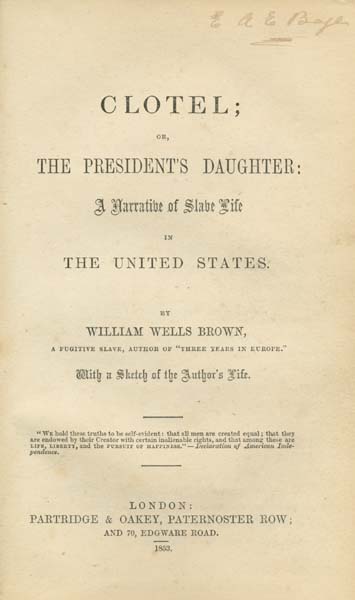
  • Clotel or, The President’s Daughter

    Penguin Press
    2003-12-30 (First published in December 1853)
    320 Pages
    Paperback ISBN: 9780142437728
    ePub ISBN: 9781440626616

    William Wells Brown (1814–1884)

    Introduction by:

    M. Giulia Fabi, Associate professor of American literature
    University of Ferrara, Italy

    First published in December 1853, Clotel was written amid then unconfirmed rumors that Thomas Jefferson had fathered children with one of his slaves. The story begins with the auction of his mistress, here called Currer, and their two daughters, Clotel and Althesa. The Virginian who buys Clotel falls in love with her, gets her pregnant, seems to promise marriage—then sells her. Escaping from the slave dealer, Clotel returns to Virginia disguised as a white man in order to rescue her daughter, Mary, a slave in her father’s house. A fast-paced and harrowing tale of slavery and freedom, of the hypocrisies of a nation founded on democratic principles, Clotel is more than a sensationalist novel. It is a founding text of the African American novelistic tradition, a brilliantly composed and richly detailed exploration of human relations in a new world in which race is a cultural construct.

    • First time in Penguin Classics
    • Published in time for African-American History Month
    • Includes appendices that show the different endings Brown created for the various later versions of Clotel, along with the author’s narrative of his “Life and Escape,” Introduction, suggested readings, and comprehensive explanatory notes