• FILM: Mixed-Race People Tell Their Stories in ‘Hafu’

    The Rafu Shimpo: Los Angeles Japanese Daily News
    2013-05-03

    J.K. Yamamoto, Rafu Staff Writer

    Hafu,” a new documentary about mixed-race people in Japan, will be screened Wednesday, May 8, at 7:30 p.m. at the Japanese American National Museum, First and Central in Little Tokyo, as part of the 29th L.A. Asian Pacific Film Fest.

    Directed by Lara Perez Takagi and Megumi Nishikura, the film had its Los Angeles premiere on April 5 at JANM during the Hapa Japan Conference. The Bay Area premiere was on April 7 at UC Berkeley.

    The title, the Japanese pronunciation of “half,” is the most common term in Japan for people who are half Japanese. It is similar to the Hawaiian word “hapa,” which originally meant someone half Native Hawaiian and half Caucasian.

    The film focuses on five stories that reflect the diversity of the Hafu experience:…

    …At the L.A. premiere, Koji Sakai of JANM noted the connections between “Hafu” and the museum’s ongoing exhibition “Visible & Invisible: A Hapa Japanese American History”: “In a lot of ways the community, or people in general, think of Hapa as a new phenomenon, but in reality Hapas have been there from the very beginning in our community, and it’s time we acknowledge and support that.”

    Duncan Ryuken Williams, co-director of the USC Center for Japanese Religions and Cultures, convener of Hapa Japan 2013, and co-curator of “Visible & Invisible,” had high praise for “Hafu”: “It’s a really thoughtful and inspirational film … The film directors did a great job of picking these five individuals. I think you’ll agree they represent the spectrum, the range of possible people in this Hafu experience … I’ve followed the making of this film and I know it’s a major labor of love for the two film directors. They put a lot into making this happen with the help of dozens of people who volunteered their time, most of whom were Hafu individuals.”…

    Read the entire article here.

  • Chinese Cubans: A Transnational History

    University of North Carolina Press
    June 2013
    352 pages
    6.125 x 9.25
    15 halftones, 3 maps, 7 tables, notes, bibl., index
    Cloth ISBN: 978-1-4696-0712-2
    Paper ISBN: 978-1-4696-0713-9

    Kathleen López, Associate Professor of History and Latino and Hispanic Caribbean studies
    Rutgers, The State University of New Jersey

    In the mid-nineteenth century, Cuba’s infamous “coolie” trade brought well over 100,000 Chinese indentured laborers to its shores. Though subjected to abominable conditions, they were followed during subsequent decades by smaller numbers of merchants, craftsmen, and free migrants searching for better lives far from home. In a comprehensive, vibrant history that draws deeply on Chinese- and Spanish-language sources in both China and Cuba, Kathleen López explores the transition of the Chinese from indentured to free migrants, the formation of transnational communities, and the eventual incorporation of the Chinese into the Cuban citizenry during the first half of the twentieth century.

    Chinese Cubans shows how Chinese migration, intermarriage, and assimilation are central to Cuban history and national identity during a key period of transition from slave to wage labor and from colony to nation. On a broader level, López draws out implications for issues of race, national identity, and transnational migration, especially along the Pacific rim.

  • Contact of Races in Brazil

    Social Forces
    Volume 19, Number 4 (May, 1941)
    pages 533-538
    DOI: 10.2307/2571211

    Arthur Ramos
    University of Brazil, Rio de Janeiro

    BRAZIL, as well as other American countries, was originally a land of conquests; the growth of its population has developed by the contact or confluence of European settlers with the Indians. In this vast laboratory of races, the New World, Brazil affords a splendid field for investigation of how heterogeneous peoples from many sources have mingled and formed one homogeneous people, one language, and one culture.

    When the Portuguese settlers came to Brazil in 1500 with the caravel guided by Pedro Álvatres Cabral, they met an Indian population occupying the Brazilian coast in an extension of about 5,000 miles. With the Portuguese settlers in the six-teenth century came an enormous number of Africans, at first from the sixteenth to the eighteenth centuries as slaves for agricultural work, and afterwards for work in mining and other tasks. After the abolition of slavery in 1888, other European contingents immigrated to Brazil. In addition to the Portuguese there were Germans, Italians, Spaniards, and other European peoples, and also some oriental peoples such as the Japanese.

    Because of the heterogeneous sources of its population, Brazil is a splendid field for investigation of human hybridism. Unfortunately the field researches are few and without any definite conclusion. But we have at our disposal several centuries of a vast experience of contact of races, this contact being moulded according to a very old Portuguese tradition, that is, the contact between the Portuguese and the peoples they discovered in their exploration and colonization. In the contact between Portuguese and Negroes, for instance, Brazil never had anything similar to the Black Code and other legal prohibitions of contacts of races by miscegenation and intermarriage such as were very frequent elsewhere in the New World, especially in the English America.

    The religious feeling has also favored interbreeding, and it was very common among the colonists. Many have emphasized the action of Catholicism with its doctrine of essential equality of mankind and its estimation of racial scruples. This position of Catholicism has been adopted by many Protestant countries influenced by modern missionaries. Important also is the legislation and the strength of the public opinion in several South American countries with reference to miscegenation and intermarriage. In…

    Read or purchase the article here.

  • Black and Bengali

    In These Times
    2013-03-02

    Fatima Shaik

    A new book traces the hidden story of a mixed-race community.

    The federal census taker comes every 10 years and, for most people in the United States, this has little consequence. But not where I lived, in New Orleans, just outside the historic district of Tremé. There, people talked to each other about whether to lie to the census taker and which lie to tell, and that conversation produced stories about who had disappeared from us and who had stayed, and what was more important: loyalty or money.

    That was the mentality in Creole New Orleans from as far back as I can remember—that is, the 1950s—until recently. The lying, the disappearing, the money and lack of it had everything to do with race.

    We were part of a mixed-race community of immigrants and Louisiana natives, and there was no place for us in the data tables of the census or in the mind of a black-and-white America. And yet we existed, for generations. Now, in a thoroughly researched new book, Bengali Harlem and the Lost Histories of South Asian America, Vivek Bald traces one vein of our lineage, from a most distant country…

    …Racially, the Bengalis confounded the official categories. On documents, they appeared as “white, colored, Negro, Indian and East Indian,” Bald notes. And after their intermarriages to local women of color, their descendants still operated in all of these categories. When I was growing up, people talked on front porches and at kitchen tables about light-skinned family members who “passed” for white and were never seen again. Other people “passed” by simply going across town each day to work in banks, stores and other places where jobs were unavailable to Negroes. Bald notes that some darker-skinned Indians escaped Negro segregation by wearing turbans and calling themselves “Turks” and “Hindoos” while selling their wares, before coming home to their black families.

    But the Bengalis in the mixed-race community kept few written accounts of their lives. Bald’s evidence is their footprint in business—restaurants and shops—and their occupations listed in census tables, for example, as countermen, chauffeurs, porters, firemen and subway laborers.

    My grandfather became a shopkeeper and lived the rest of his life in the black community of New Orleans. People from around the world melded easily into our location. In the 19th century, Tremé was home to one of the most powerful and liberal communities of free people of color in America, rooted not only in Africa but also Europe, the Caribbean and—I recently learned from a classmate—as far away as New Zealand…

    Read the entire article here.

  • “Colorblindness” Overlooks Structural Inequality

    Jesus For Revolutionaries: A Blog About Race, Social Justice, and Christianity
    2013-04-30

    Robert Chao Romero, Associate Professor of Chicana/o Studies and Asian American Studies
    University of California, Los Angeles

    Good morning.  Thanks to all who have been tracking with our multi-part series on Critical Race Theory and Christianity.  It seems like we’ve struck a nerve with this one, so I’m excited to keep sharing ideas—back and forth—between us.

    Some very thoughtful comments came in last week from Paul, a teacher, pastor, and doctoral student at my old stomping grounds—U.C. Berkeley.   He raised the important point that the colorblind approach to race ignores not only the cultural diversity which God Himself created, but also the stubborn racism which continues to pervade U.S. socio-economic and political institutions.   It is to this important point that we turn to this week.

    Supporters of “colorblindness” say that racism is behind us.  Sure, racism rears its ugly head once in a while in individual encounters between people, but, as a whole, it’s a thing of the past.  As evidence they say, “see, we elected a black, Kenyan president…”

    Read the entire article here.

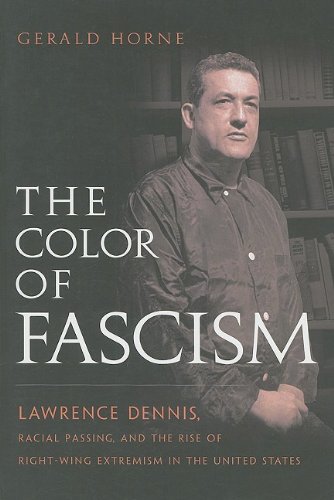
  • The Color of Fascism: Lawrence Dennis, Racial Passing, and the Rise of Right-Wing Extremism in the United States

    New York University Press
    2006-11-20
    256 pages
    4 illustrations
    ISBN: 9780814736869

    Gerald Horne, John and Rebecca Moores Professor of History
    University of Houston

    What does it mean that Lawrence Dennis—arguably the “brains” behind U.S. fascism—was born black but spent his entire adult life passing for white? Born in Atlanta in 1893, Dennis began life as a highly touted African American child preacher, touring nationally and arousing audiences with his dark-skinned mother as his escort. However, at some point between leaving prep school and entering Harvard University, he chose to abandon his family and his former life as an African American in order to pass for white. Dennis went on to work for the State Department and on Wall Street, and ultimately became the public face of U.S. fascism, meeting with Mussolini and other fascist leaders in Europe. He underwent trial for sedition during World War II, almost landing in prison, and ultimately became a Cold War critic before dying in obscurity in 1977.

    Based on extensive archival research, The Color of Fascism blends biography, social history, and critical race theory to illuminate the fascinating life of this complex and enigmatic man. Gerald Horne links passing and fascism, the two main poles of Dennis’s life, suggesting that Dennis’s anger with the U.S. as a result of his upbringing in Jim Crow Georgia led him to alliances with the antagonists of the U.S. and that his personal isolation which resulted in his decision to pass dovetailed with his ultimate isolationism.

    Dennis’s life is a lasting testament to the resilience of right-wing thought in the U.S. The first full-scale biographical portrait of this intriguing figure, The Color of Fascism also links the strange career of a prominent American who chose to pass.

    Read the preface here.

    Table of Contents

    • Preface
    • Introduction: More Than Passing Strange
    • 1. Passing Fancy?
    • 2. Passing Through
    • 3. Fascism
    • 4. The Face—of Fascism
    • 5. Fascism and Betrayal
    • 6. Approaching Disaster
    • 7. Framing a Guilty Man?
    • 8. Fascism on Trial
    • 9. A Trial on Trial
    • 10. After the Fall
    • 11. An Isolationist Isolated?
    • 12. Passing On
    • Notes
    • Index
    • About the Author
  • The Atlantic Wins Two National Magazine Awards

    The Atlantic
    Press Releases
    2013-05-02

    For media inquiries, please contact: Natalie Raabe at  (202) 266-7533.

    Washington, D.C. and New York, N.Y. (May 2, 2013)—The Atlantic won two National Magazine Awards, it was announced tonight by the American Society of Magazine Editors (ASME). Atlantic senior editor Ta-Nehisi Coates won in the Essays and Criticism category and TheAtlantic.com was selected best Web site.

    “I’m so happy for Ta-Nehisi and the entire team at The Atlantic. It’s wonderful to be recognized by our peers for excellence in one of our oldest journalistic forms, the essay, and one of our newest–the work we do every day on TheAtlantic.com,” said M. Scott Havens, president of The Atlantic.

    Coates was honored in the Essays and Criticism category for “Fear of a Black President,” published in the September 2012 issue. Marshaling history, original reporting, memoir, and a fierce but understated moral passion in advance of the 2012 election, Coates outlines the predicament constraining President Obama: wary of coming across as a politically untenable Angry Black Man, he must always strive—as many professional African Americans must—to appear “twice as good.”…

    Read the entire press release here.

  • New Demographic Perspectives on Studying Intermarriage in the United States

    Contemporary Jewry
    Published Online: May 2013
    pages 1-17
    DOI: 10.1007/s12397-013-9103-9

    Bruce A. Phillips, Professor of Jewish Communal Service
    Hebrew Union College-Jewish Institute of Religion, Los Angeles

    The study of Jewish intermarriage has largely ignored the measurement conventions prevalent in the field of demography such as using first marriages (as opposed to current marriages) and not controlling for mixed parentage. I re-analyze the NJPS 2000–2001 using first marriages and controlling for parentage and find evidence that intermarriage has leveled off among single ancestry Jews. Jewish intermarriage is placed in an American context by (1) putting in Kalmijn’s conceptual schema and (2) using the odds-ratio to compare intermarriage in controlling for group size. Single ancestry Jews are surprisingly endogamous compared with other groups in America. Two new directions for further research in a demographic context are discussed: including non-jewish spouses in population studies and thinking about mixed ancestry Jews in the context of multi-racial persons.

    Within this Article

    • What’s Missing in the Measurement of Intermarriage
    • Considering Jewish Intermarriage in the American Context
    • Discussion
    • References

    Read or purchase the article here.

  • Double-Checking the Race Box: Examining Inconsistency between Survey Measures of Observed and Self-Reported Race

    Social Forces
    Volume 85, Issue 1
    pages 57-74
    DOI: 10.1353/sof.2006.0141

    Aliya Saperstein, Assistant Professor of Sociology
    Stanford University

    Social constructivist theories of race suggest no two measures of race will capture the same information, but the degree of “error” this creates for quantitative research on inequality is unclear. Using unique data from the General Social Survey, I find observed and self-reported measures of race yield substantively different results when used to explain income inequality in the United States. This occurs because inconsistent racial classification is correlated with other respondent characteristics such as immigrant generation, educational attainment and age.

    Read or purchase the article here.

  • “Black No More”?: Walter White, Hydroquinone, and the “Negro Problem”

    American Studies
    Volume 47, Number 1 (Spring 2006)
    pages 5-30

    Eric Porter, Professor of American Studies
    University of California, Santa Cruz

    In an August 1949 Look magazine article—”Has Science Conquered the Color Line?”—NAACP Executive Secretary Walter White pondered the social implications of monobenzyl ether of hydroquinone, an antioxidant used in rubber and plastics manufacturing that had recently been found to remove melanin from human skin. Government investigators had publicly identified this effect in 1940, after investigating complaints by black and Mexican workers at a Texas tannery who developed pale patches of skin on their hands, arms and torsos because of the presence of hydroquinone in their protective gloves. Hydroquinone would eventually be used medicinally to treat severe forms of vitiligo (a disease involving the progressive loss of melanin which makes one’s skin appear mottled) by removing the remaining melanin from patients’ skin, thus evening out their skin tone. It has also been used as a fading compound to treat different kinds of localized hyper-pigmentations and is still found in often-dangerous skin lightening cosmetic products sold to people with dark complexions across the globe.

    In 1949, however, the ultimate medical, cosmetic, and social impacts of hydroquinone were still unknown. White wrote his article after traveling to Chicago to meet with scientists engaged in research on the substance. Afterwards, he took it upon himself to speculate on its future in ways that echoed George Schuyler’s 1931 prototypical black science fiction novel Black No More, in which Dr. Junius Crookman, a fictional Harlem physician, devises a way to induce vitiligo “at will” and “solve the American race problem” by turning dark skins pale. Unfortunately for White, his speculations, which might be described as a bad piece of journalism that degenerated into an involuntary piece of science fiction, rendered him a lightning rod for criticism. For the civil rights leader seemed to suggest that hydroquinone provided a solution to the problems of segregation, racism, and colonialism in the post-World War II world by enabling non-white peoples to bleach their skins.

    White’s article baffled his contemporaries. Not only did he seem to be advocating an absurd, demeaning, and physically damaging political strategy; some were also struck by the irony that the comments about hydroquinone came from the blond-haired, blue-eyed Executive Secretary of the NAACP. Early in his tenure with the organization, White had been sent to the South to gather information for the organization’s anti-lynching crusade and did so, risking his life in the process, by passing as a white traveling salesman. His career as a “race man” and his leadership of the NAACP since 1931 both affirmed as well as called into question definitions of racial identity, which in turn prompted questions about his role at the organization’s helm…

    …What I will argue, however, is that, whatever White’s professional motivations, the ideas embedded in “Has Science Conquered the Color Line?” and especially in a somewhat longer, unpublished version of the piece, the resonances of these ideas with other bits of White’s public commentary, and responses to the Look article by black leaders and lay people alike—all give insight into some of the political and moral dilemmas revolving around race, science, and civil and human rights during the immediate postwar period. Moreover, they illustrate how a scientific, political, and moral imperative to abandon racial thinking had entered African American political and popular discourse by the end of the 1940s. This imperative emanated from decades of research seeking to debunk race as a biological category, and it was given new immediacy by both the horrors of Nazi racial science put into practice and a post-Hiroshima and Nagasaki faith in science, technology, and rational thought as vehicles by which to overcome the problems of the world (the racist and genocidal applications of the bombing notwithstanding). The notion that race was irrational and irrelevant was increasingly prominent, albeit in complicated ways, through the 1940s within a broader, transnational context of academic writing, journalistic reportage, and the rhetoric of statecraft. But it had a particular and no less complicated resonance among African Americans during the immediate post-World War II era.

    White’s article and the controversies it elicited demonstrate how dilemmas around race and rights, conditioned by scientific research on race, were, in fact, significant components of black racial formations at mid-century. The imperative to move beyond race affected other political and personal choices—for example, national versus international affiliation, the primacy of race or class in social analysis, integrationist versus nationalist civil rights agendas, race consciousness versus color blindness in personal deportment and interpersonal relations—facing African Americans. And it caused people to ponder the usefulness of the sense of black virtue that constituted their own understanding of what it meant to be human.

    This essay moves next to an assessment of “Has Science Conquered the Color Line?” and issues that arose as White, a middle-class “race man” capable of passing as white, tried to debunk the idea that race had a biological basis while maintaining a link to his racial community. The investigation continues by examining the controversy surrounding White’s piece, which demonstrates how political leaders and lay people alike addressed the limitations and value in racial affiliation and racial transcendence. In the process, it explores some of the conceptual and political questions about race, science, and rights that emerged as black leaders like White contemplated the Faustian bargain of linking domestic civil rights struggles to U.S. foreign policy goals and a concomitant ethos of color blindness. The conclusion revisits the idea that engagements with scientific accounts of race were significant to African American racial formations at mid-century, and it ponders the implications of these engagements in light of scholarly claims about the importance of black political cultures and racial discourses during this period…

    Read the entire article here.