• Barack Obama’s Address to the 2004 Democratic National Convention: Trauma, Compromise, Consilience, and the (Im)possibility of Racial Reconciliation

    Rhetoric & Public Affairs
    Volume 8, Number 4, Winter 2005
    pages 571-593
    DOI: 10.1353/rap.2006.0006

    David A. Frank, Professor of Rhetoric
    Robert D. Clark Honors College
    University of Oregon

    Mark Lawrence McPhail, Dean of The College of Arts & Communication
    University of Wisconsin, Whitewater

    The two authors of this article offer alternative readings of Barack Obama’s July 27, 2004, address to the 2004 Democratic National Convention (DNC) as an experiment in interracial collaborative rhetorical criticism, one in which they “write together separately.” David A. Frank judges Obama’s speech a prophetic effort advancing the cause of racial healing. Mark Lawrence McPhail finds Obama’s speech, particularly when it is compared to Reverend Al Sharpton’s DNC speech of July 28, 2004, an old vision of racelessness. Despite their different readings of Obama’s address, both authors conclude that rhetorical scholars have an important role to play in cultivating a climate of racial reconciliation.

    …Using an approach similar to that of Forde-Mazrui, Obama’s speech drew from his multiracial background to craft a speech designed to bridge the divides between and among ethnic groups. He writes in his moving autobiography, Dreams from My Father, “I learned to slip back and forth between my black and white worlds, understanding that each possessed its own language and customs and structures of meaning, convinced that with a bit of translation on my part the two worlds would eventually cohere.” Coherence, Obama writes, is a function of translation and the capacity to move between and among worlds. He was repulsed by whites who used racist language, and could not use the phrase “white folks” as a synonym for bigot as it was undercut by the memories of the love and nonracist impulses of his white mother and grandfather. His speech at the convention reflects, as McPhail notes, an ability to integrate competing visions of reality. Obama did so by using a rhetorical strategy of consiliencey where understanding results through translation, mediation, and an embrace of different languages, values, and traditions. This embrace was intended to inspire a “jumping together” to common principles…

    Read the entire article here.

  • Uncertainty and evolution: Contributions to identity development for female college students who identify as multiracial/biracial-bisexual/pansexual

    Iowa State University
    2008
    322 pages
    Publication Number: AAT 3310805
    ISBN: 9780549596066

    Alissa Renee King

    A dissertation submitted to the graduate faculty partial fulfillment of the requirements for the degree DOCTOR OF PHILOSOPHY

    In this study, I explored how female college students who identify as multiracial/biracial-bisexual/pansexual made meaning of their racial and sexual identities, how they described their identity development process, and the ways in which college contributed to their identity formation. Utilizing a proposed model of biracial-bisexual identity development and the ecology of student development model as foundations for this study, I sought to better understand the experiences both before and during college, and the impacts of those two environments on the processes of racial and sexual identity formation for the female college students in this study. Findings, based on in-depth interviews, revealed that the females in this study were impacted in different ways during the pre-college experience and during college, with influences coming from family, peers, and the school setting before college. The themes during the college experience at the time of the interviews were related to Trying On new labels, Negotiating Self within a variety of spaces, and Finding Fit in places where the participants felt safe and supported. Findings also revealed that context had the biggest impact on identity development and that racial and sexual identity were primarily separate processes rather than intersecting experiences. I offered contributions to biracial-bisexual identity models and I shared recommendations for current practice and future research to better serve females in both secondary and post-secondary institutions who identify as multiracial/biracial-bisexual/pansexual.

    Purchase the dissertation here.

  • Time to drop racial categories in census

    The Chicago Tribune
    2012-08-16

    Arthur Caplan, Director of Division of Medical Ethics
    Department of Population Health
    New York University

    The U.S. Census Bureau announced that it wants to make a number of changes in how it counts membership in a race. The change is based on an experiment the bureau conducted during the last census in which nearly 500,000 households were given forms with the race and ethnicity questions worded differently from the traditional categories. The results showed that many people who filled out the traditional form did not feel they fit within the five government-defined categories of race: white, black, Asian, Pacific Islander and American Indian/Alaska Native. If Congress approves, the bureau says it plans to stop using the word “Negro” as part of a question asking if a person was “black, African-American or Negro.” There are a number of other changes planned for counting Hispanics and Arab-Americans.

    These changes may seem like improvements. They are not. The bureau and Congress ought to be considering a more radical overhaul of the census — dropping questions about race entirely. There are a lot of reasons why.

    First, the concept of “race” makes no biological sense. None. The classifications Americans use to divide people into groups and categories have nothing to do with genetics or biology…

    Read the entire opinion piece here.

  • Reading The Human Stain through Charles W. Chesnutt: The Genre of the Passing Novel

    Philip Roth Studies
    Volume 2, Number 2 (Fall 2006)
    pages 138-150
    DOI: 10.1353/prs.2011.0066

    Matthew Wilson, Professor of English and Humanities
    Pennsylvania State University, Harrisburg

    This article historicizes The Human Stain, placing it in the genre of the passing novel. The analysis is filtered through a reading of Chesnutt’s passing fictions, particularly The House Behind the Cedars and The Quarry.

    Philip Roth’s The Human Stain was published in 2000, the year I was on sabbatical writing my book, Whiteness in the Novels of Charles W. Chesnutt. At the time, and even more subsequently, I was struck by the surprising continuities between the passing fictions ot Chesnutt and other writers of his era and Roth’s representation of race in The Human Stain. One of Chesnutt’s novels in particular, The House behind the Cedars (1900), helps us see that although exactly one hundred years separate these two texts, little has changed with regard to race in America. Despite the dismantling of the legal system of American racial apartheid that had its origin in Chesnutt s lifetime, the American racial imagination remains largely intact, and we continue to insist on our racial binary, continue to maintain and police the color line. As Judy Scales-Trent has observed. “[W]hite America expends enormous resources in school and in the media to teach (about) the intrinsic rightness” of the color line, so that it won’t questioned and so that future generations will continue to “stand guard” (481). Of course, the genre in which this standing guard is most obvious is the passing narrative because the liminality of the “white negro” (to use a nineteenth-century locution) calls into question the supposed impermeability of the color line. In this article, I use Chesnutt’s work, both fiction and nonfiction, as a way of approaching the issue of passing and race in The Human Stain, and of exploring the persistence of racial essentialism in American thinking and the responses to that essentialism that maintain the existence of the color line.

    Before going on to discuss the issue of race in particular texts, I need to unpack the term “racial essentialism.” As Adrian Piper makes clear in her important esaay “Passing tor White, Passing for Black,” the function of racial…

  • Race

    Poem via Poetry Foundation from:

    Antebellum Dream Book
    Graywolf Press
    2001
    72 pages
    Paperback ISBN: 1-55597-354-X

    Elizabeth Alexander, President
    The Andrew W. Mellon Foundation, New York, New York

    Sometimes I think about Great-Uncle Paul who left Tuskegee,
    Alabama to become a forester in Oregon and in so doing
    became fundamentally white for the rest of his life, except
    when he traveled without his white wife to visit his siblings—
    now in New York, now in Harlem, USA—just as pale-skinned,
    as straight-haired, as blue-eyed as Paul, and black. Paul never told anyone
    he was white, he just didn’t say that he was black, and who could imagine,
    an Oregon forester in 1930 as anything other than white?…

    Read the entire poem here.

  • Susan Graham Discusses Project RACE

    Mixed Race Radio
    2012-08-15, 17:00Z (12:00 EDT, 09:00 PDT)

    Tiffany Rae Reid, Host

    Susan Graham, Executive Director
    Project RACE

    Project RACE (Reclassify All Children Equally) members are the national advocates for multiracial children, teens, adults, and our families. Project RACE was started in 1990, so we are in our 22nd year! Susan Graham, the mother of two multiracial children and Chris Ashe, the mother of a multiracial child began Project RACE because of their own frustration with their own children being forced to pick only one race on forms in America. That meant, very simply, that a child had to choose to be her mother’s race or her father’s race. Susan and Chris planned to start a grassroots movement to pass State legislation, mandate the US Census Bureau and federal agencies to add the term “multiracial” to forms, or in some way accommodate the needs of multiracial people.

    Play in your default player here.

  • Hopes Spring Eternal: ‘Three Strong Women,’ by Marie NDiaye

    The New York Times
    2012-08-10

    Fernanda Eberstadt

    Americans have a curiously limited vision of France. We may be wild about Chanel sunglasses, Vuitton handbags, Champagne or Paris in the spring, but when it comes to the kinds of contemporary French culture that can’t be bought in a duty-free shop, most of us draw a blank. Luckily, this veil of benign ignorance is being lifted as publishers in the United States introduce American readers to a new generation of hugely gifted French writers who are reworking the boundaries of fiction, memoir and history (Emmanuel Carrère, Laurent Binet, the American-born Jonathan Littell) or of high art and snuff lit (Michel Houelle­becq). Among the recent crop of writers just reaching the top of their game, Marie NDiaye, born in 1967 and now living in Berlin, is pre-eminent.

    NDiaye’s career has been stellar. When she was 18, the legendary editor Jérôme Lindon (best known as Samuel Beckett’s champion) published her first novel to high critical acclaim. Her subsequent fiction and plays have won numerous prizes and distinctions. (NDiaye’s “Papa Doit Manger,” or “Daddy’s Got to Eat,” produced in 2003, is the only play by a living woman to have entered the repertory of the ­Comédie-Française.) “Three Strong Women” — NDiaye’s most recent novel — won the Prix Goncourt when it appeared in 2009 and made her, according to a survey by L’Express-RTL, the most widely read French author of the year…

    …The expectation — whether menacing or well meaning — that NDiaye should “represent” multiracial France, or be considered a voice of the French African diaspora, has often dogged her. In fact, as NDiaye is at pains to make clear, she scarcely knew her Senegalese father, who came to France as a student in the 1960s and returned to Africa when she was a baby. Raised by her French mother — a secondary school science teacher — in a housing project in suburban Paris, with vacations in the countryside where her maternal grandparents were farmers, NDiaye describes herself as a purely French product, with no claim to biculturalism but her surname and the color of her skin. Nonetheless, the absent father — charismatic, casually cruel, voraciously selfish — haunts NDiaye’s fiction and drama, as does the shadow of a dreamlike Africa in which demons and evil portents abound, where the unscrupulous can make overnight fortunes and, with another turn of the wheel, find themselves rotting in a jail cell…

    Read the entire review here.

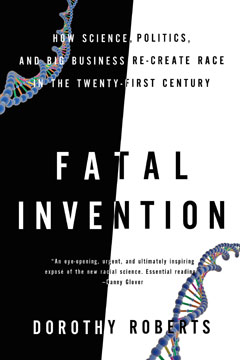
  • Fatal Invention: How Science, Politics, and Big Business Re-create Race in the Twenty-First Century

    The New Press
    Spring 2011
    512 pages
    6.125  x 9.25 inches
    Hardcover ISBN: 978-1-59558-495-3

    Dorothy Roberts, George A. Weiss University Professor of Law and Sociology; Raymond Pace and Sadie Tanner Mossell Alexander Professor of Civil Rights
    University of Pennsylvania

    A powerful new argument from a leading intellectual that explores how today’s cutting-edge genetic science helps perpetuate inequality in a “post-racial” America

    While embracing a racial ideology rooted in genetics, Americans are accepting a genetic ideology rooted in race that makes everyone responsible for managing their own lives at the genetic level instead of eliminating the social inequalities that damage our entire society.
    From Fatal Invention

    A decade after the Human Genome Project proved that human beings are not naturally divided by race, the emerging fields of personalized medicine, reproductive technologies, genetic genealogy, and DNA databanks are attempting to resuscitate race as a biological category written in our genes.

    In this provocative analysis, leading legal scholar and social critic Dorothy Roberts argues that America is once again at the brink of a virulent outbreak of classifying population by race. By searching for differences at the molecular level, a new race-based science is obscuring racism in our society and legitimizing state brutality against communities of color at a time when America claims to be post-racial.

    Moving from an account of the evolution of race—proving that it has always been a mutable and socially defined political division supported by mainstream science—Roberts delves deep into the current debates, interrogating the newest science and biotechnology, interviewing its researchers, and exposing the political consequences obscured by the focus on genetic difference. Fatal Invention is a provocative call for us to affirm our common humanity.

  • In Search of Something Akin to Freedom: Black Women, Slavery, and Power

    Florida State University
    2007
    78 pages

    Katrina Songanett Smith

    A Thesis submitted to the Department of English in partial fulfillment of the requirements for the degree of Master of Arts
     
    This thesis examines both historical and fictional representations of interracial relationships in the 18th century. My argument in this project is two-fold. First, I argue that some black women used sexual relationships with white men to gain advantages for themselves and their fellow slaves. Second, I argue that novelists of the time period re-wrote history in an attempt to erase the positive aspects of miscegenation.

    Table of Contents

    • Abstract
    • Introduction
    • Chapter One: Historical Accounts of Black Women’s Sexuality and Strategies of Resistance: The Narratives of Mary Prince, Thomas Thistlewood, John Stedman, Maria Nugent, and Janet Schaw
    • Chapter Two: The Revenge of the Shrew: Aphra Behn’s Oroonoko
    • Chapter Three: The Sacrifice of the Colored Woman in J.W. Orderson’s Creoleana
    • Epilogue
    • Works Cited

    Read the entire thesis here.

  • UCSB Ph.D. Alum Overcomes Odds and Pays Back With History Grad Parent Award

    UCSB GradPost
    University of California, Santa Barbara
    2012-07-20

    Patricia Marroquin, Guest Editor-in-Chief

    Dr. Ingrid Dineen-Wimberly believes strongly in paying back and paying forward. When she was a History Ph.D. student at UCSB just a few years ago, “graduate school was quite difficult for me. Not in terms of the intellectual rigors required but rather insofar as managing my life circumstances beyond school.” Pursuing a graduate degree is bound to be difficult when you are a disabled Navy veteran taking oral chemotherapy for a rare bone-marrow disease developed during Persian Gulf War duty; a single woman carrying a child in a high-risk pregnancy; and surviving an abusive past.

    Financial awards she received from the History Department and History Associates, including a 2005 Donald Van Gelderen Memorial Fellowship, which recognizes nontraditional students who return to graduate study after pursuing career and family interests, allowed Ingrid to support her then-infant daughter, Grace.

    “It was incredibly difficult to make ends meet while meeting my degree requirements,” she said. “However, earning my Ph.D. in History had become more than a mere personal goal. I realized that I was an example for other nontraditional students of color,” continued Ingrid, who is of African-American and Irish descent. “In fact, today African Americans still constitute only 1% of all graduate school students at UCSB.”…

    …Ingrid, who is finishing the final edits on her forthcoming book, “By the Least Bit of Blood: The Allure of Blackness Among Mixed-Race Americans of African Descent, 1862-1935,” discusses her experiences as a teacher, student, parent, philanthropist, and role model…

    Read the entire article here.