• The Emotional Tug of Obama

    The New York Times

    2012-05-26

    Frank Bruni

    FORGET your political affiliation. Never mind your assessment of his time in office so far. If you have any kind of heart, you’re struck by it: the photograph of Barack Obama bent down so that a young black boy can touch his head and see if the president’s hair is indeed like his own. It moves you. It also speaks to a way in which Obama and Mitt Romney, whose campaigns are picking up the pace just as polls show them neck and neck, are profoundly mismatched.


    Pete Sousa/White House

    In a story that quickly went viral, The Times’s Jackie Calmes wrote last week about the photograph, which was taken three years ago when the boy, then 5, visited the White House. It has hung there ever since, left on the wall even as other pictures were swapped out, as is the custom, for newer, fresher ones.

    David Axelrod, one of the chief architects of Obama’s political career, told Calmes: “It doesn’t take a big leap to think that child could be thinking, ‘Maybe I could be here someday.’ This can be such a cynical business, and then there are moments like that that just remind you that it’s worth it.”

    Axelrod’s words, meanwhile, are a reminder that more than three and a half years after Obama made history as the first black man elected to the presidency, he still presents more than a résumé and an agenda. He still personifies the hope, to borrow a noun that he has used, that we really might evolve into the colorblind, fair-minded country that many of us want. His own saga taps into the larger story of this country’s fitful, unfinished progress toward its stated ideal of equal opportunity.

    And that gives many voters an emotional connection to him that they simply don’t have to most other politicians, including Romney, a privileged and intensely private man whose strengths don’t include the easy ability to humanize himself. There’s a Mitt-versus-myth element to the 2012 campaign, and it influences the manner in which Romney’s supporters and Romney himself engage the president and make their pitch. They must and do emphasize job-creation numbers over personal narrative, the technocratic over the touchy-feely.

    Obama and his advisers don’t exactly tack in the opposite direction. Understandably concerned about longstanding prejudices, they don’t invoke his racial identity all that frequently.

    But when they do, it’s powerful. The photograph released last week instantly reminded me of one taken in mid-April, when Obama visited a museum in Dearborn, Mich. It showed him seated in the bus that Rosa Parks made famous. And it, too, pinged fast and far around the Web…


    Obama aboard the Rosa Parks bus in Dearborn’s Henry Ford Museum, April 18, 2012. (Credit: Official White House Photo by Pete Souza)

    Read the entire opinion piece here.
  • EPSY 203: Exploring Biracial/multiracial Identity Course Description

    University of Illinois, Urbana-Champaign
    (Part of the EPSY 203: Social Issues Group Dialogue Courses)

    EPSY 203 provides students with opportunities to converse on diversity and social justice topic areas. Each section uses a structured dialogue format to explore intergroup and intragroup differences and similarities within historical and contemporary contexts. Each section uses active learning exercises, in addition to weekly readings, reflective writing assignments, and topic-based dialogues. EPSY 203 may be repeated in separate terms to a maximum of 6 hours.

    This course explores biracial/multiracial identities offers a dialogue opportunity for students to explore the different concepts, perspectives and experiences of individuals identifying as having a biracial and/or a multiracial identity within the United States. Students will have an opportunity to personally explore, understand, and describe their understandings of biracial and multiracial identities and how those identities have changed over time. The course will focus on the implications for group definitions, personal and community identities, relationships and culture.

  • Obama, Zombies, and Black Male Messiahs

    In Media Res
    2009-10-01

    Elizabeth McAlister, Associate Professor of Religion, African American Studies and American Studies
    Wesleyan University

    Insofar as they occupy the symbolic place of messiah in these zombie apocalypses, it interesting that from Ben in Night, to Peter in Dawn, and John in Day, to Robert Neville in I Am Legend, a central male hero is Black, two of whom are West Indian. All are solid, dependable, capable Black men who strategize and fight their way to survive the zombie outbreak. All Romero’s Black men make alliances with the one White woman in each group, who also makes it to the post-apocalypse.   What can we make of this interesting pattern that zombies seem to be the monsters it is the province of Black men to vanquish? We might wonder, in turn, what it is about whiteness in zombie films that the Black male secular messiah characters point to… …Obama has been said to possess an image in the American psyche that lends itself to being cast as a Magical Negro; he has also been referenced in a messianic idiom, and scores of commentators have noted the many times that people use exalted, prophetic vocabulary in describing Obama. Obama was elected in the teeth of an economic super-crisis, a hero who would slay the zombie-banks threatening to cannibalize the nation’s funds. Obama is also figured as a multi-racial person who will usher in America’s multiracial future (the implicit future of these zombie films)…

    Read the entire essay here.

  • Framing a Deterritorialized, Hybrid Alternative to Nationalist Essentialism in the Postcolonial Era: Tjalie Robinson and the Diasporic Eurasian “Indo” Community

    Diaspora: A Journal of Transnational Studies
    Volume 16, Numbers 1/2, (Spring/Fall 2007)
    pages 1-28
    DOI: 10.1353/dsp.2007.0002

    Jeroen Dewulf, Queen Beatrix Professor in Dutch Studies
    University of California, Berkeley

    In her study of Transnational South Asians (2008), Susan Koshy highlights the systematic neglect by scholars of the perspectives and activities of such seemingly peripheral actors as diasporic subjects in the macro-narratives of nationalism and globalization. Such neglect was even more pronounced in the case of the “repatriates” from European colonies in Asia and Africa. The epistemological implications of the dislocated, de-territorialized discourse produced by repatriates from former European colonies remain largely overlooked. One of those groups that seem to have slipped between the pages of history is the diasporic Eurasian “Indo” community that has its roots in the former Dutch East Indies. In this article, I focus on Tjalie Robinson, the intellectual leader of this community from the 1950s to the mid-1970s. In recent decades, there has been a growing interest in what Homi Bhabha, inThe Location of Culture (1994, 38), called “the conceptualization of an international culture, based not on the exoticism of multiculturalism or the diversity of cultures, but on the inscription and articulation of culture’s hybridity.” Long before Bhabha, Robinson had already published substantially on hybrid, transnational identity. As the son of a Dutch father and a British-Javanese mother, Robinson had made a name in Indonesia with his writings. He left Indonesia in 1954, and soon became the leading voice of the diasporic Indo community in the Netherlands and, later, also in the United States. His engagement resulted in the founding of the Indo magazine Tong Tong and the annual Pasar Malam, the world’s biggest Eurasian festival. With his writings, Robinson played an essential role in the cultural awareness and self-pride of the Indo community through the acceptance of their essentially hybrid and transnational identity.

    Read or purchase the article here.

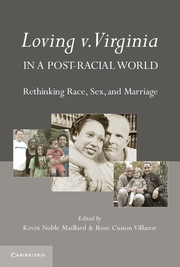
  • Loving vs. Virginia in a Post-Racial World: Rethinking Race, Sex, and Marriage

    Cambridge University Press
    June 2012
    300 pages
    Hardback ISBN-13: 9780521198585
    Paperback ISBN-13: 9780521147989

    Edited by

    Kevin Noble Maillard, Professor of Law
    Syracuse University

    Rose Cuison Villazor, Professor of Law
    University of California, Davis

    In 1967, the U.S. Supreme Court ruled that laws prohibiting interracial marriage were unconstitutional in Loving vs. Virginia. Although this case promotes marital freedom and racial equality, there are still significant legal and social barriers to the free formation of intimate relationships. Marriage continues to be the sole measure of commitment, mixed relationships continue to be rare, and same-sex marriage is only legal in 6 out of 50 states. Most discussion of Loving celebrates the symbolic dismantling of marital discrimination. This book, however, takes a more critical approach to ask how Loving has influenced the “loving” of America. How far have we come since then, and what effect did the case have on individual lives?

    Table of Contents

    • Introduction Kevin Noble Maillard and Rose Cuison Villazor
    • Part I: Explaining Loving v. Virginia
      • 1. The legacy of Loving John DeWitt Gregory and Joanna L. Grossman
    • Part II: Historical Antecedents to Loving
      • 2. The ‘love’ of Loving Jason A. Gillmer
      • 3. Loving in Indian territory: tribal miscegenation law in historical perspective Carla Pratt
      • 4. American mestizo: Filipinos and antimiscegenation laws in California Leti Volpp
      • 5. Perez v. Sharp and the limits of Loving: race, marriage, and citizenship reconsidered R. A. Lenhardt
    • Part III: Loving and Interracial Relationships: Contemporary Challenges
      • 6. The road to Loving: the legacy of antimiscegenation law Kevin Noble Maillard
      • 7. Love at the margins: the racialization of sex and the sexualization of race Camille A. Nelson
      • 8. The crime of Loving: Loving, Lawrence, and beyond I. Bennett Capers
      • 9. What’s Loving got to do with it? Law shaping experience and experience shaping law Renée M. Landers
      • 10. Fear of a ‘Brown’ planet or a new hybrid culture? Jacquelyn Bridgeman
    • Part IV: Considering the Limits of Loving
      • 11. Black pluralism in post-Loving America Taunya Lovell Banks
      • 12. Multiracialism and reparations: accounting for political blackness Angelique Davis
      • 13. Finding a Loving home Angela Onwuachi-Willig and Jacob Willig-Onwuachi
    • Part V: Loving outside the United States Borders
      • 14. Racially inadmissible wives Rose Cuison Villazor
      • 15. Flying buttresses Nancy K. Ota
      • 16. Crossing borders: Loving v. Virginia as a story of migration Victor Romero
    • Part VI: Loving and Beyond: Marriage, Intimacy and Diverse Relationships
      • 17. Black vs. gay: centering LBGT people of color in civil marriage debates Adele Morrison
      • 18. Forty years after Loving: a legacy of unintended consequences Rachel F. Moran
      • 19. The end of marriage Tucker Culbertson
      • 20. Afterword Peter Wallenstein
  • Slaves, Cannibals, and Infected Hyper-Whites: The Race and Religion of Zombies

    Anthropological Quarterly
    Volume 85, Number 2, Spring 2012
    pages 457-486
    DOI: 10.1353/anq.2012.0021

    Elizabeth McAlister, Associate Professor of Religion, African American Studies and American Studies
    Wesleyan University

    The first decade of the new millennium saw renewed interest in popular culture featuring zombies. This essay shows that a comparative analysis of nightmares can be a productive method for analyzing salient themes in the imaginative products and practices of cultures in close contact. It is argued that zombies, as the first modern monster, are embedded in a set of deeply symbolic structures that are a matter of religious thought. The author draws from her ethnographic work in Haiti to argue that the zonbi is at once part of the mystical arts that developed there since the colonial period, and comprises a form of mythmaking that represents, responds to, and mystifies the fear of slavery, collusion with it, and rebellion against it. In turn, some elements of the Haitian zonbi figure can be found in patterns that haunt recent American zombie films. Zombies in these films are read as figures in a parable about whiteness and death-dealing consumption. This essay suggests that the messianic mood surrounding the presidential candidacy of Barack Obama was consistent with a pattern in zombie films since the 1960s where many zombie-killing heroes are figured as black American males. Zombies are used in both ethno-graphic and film contexts to think through the conditions of embodiment, the boundaries between life and death, repression and freedom, and the racialized ways in which humans consume other humans.

    Read or purchase the article here.

  • Creolization: History, Ethnography, Theory

    Left Coast Press
    March 2007
    276 pages
    6 x 9
    Hardback ISBN: 978-1-59874-278-7
    Paperback ISBN: 978-1-59874-279-4
    eBook ISBN: 978-1-61132-467-9
    eBook Rental (180 Days) ISBN: 978-1-61132-467-9

    Edited by

    Charles Stewart
    Department of Anthropology
    University College London

    Social scientists have used the term “Creolization” to evoke cultural fusion and the emergence of new cultures across the globe. However, the term has been under-theorized and tends to be used as a simple synonym for “mixture” or “hybridity.” In this volume, by contrast, renowned scholars give the term historical and theoretical specificity by examining the very different domains and circumstances in which the process takes place. Elucidating the concept in this way not only uncovers a remarkable history, it also re-opens the term for new theoretical use. It illuminates an ill-understood idea, explores how the term has operated and signified in different disciplines, times, and places, and indicates new areas of study for a dynamic and fascinating process.

    Table of Contents

    • Introduction: Creolization: History, Ethnography, Theory, Charles Stewart
    • 1. Creole Discourse in Colonial Spanish America, Jorge Cañizares-Esguerra
    • 2. Creoles in British America: From Denial to Acceptance, Joyce Chaplin
    • 3. The ‘C-Word’, Again: From Colonial to Postcolonial Semantics, Stephan Palmié
    • 4.Creole Linguistics from its Beginnings, Through Schuchardt, To the Present Day, Philip Baker and Peter Mühlhäusler
    • 5. From Miscegenation to Creole Identity: Portuguese Colonialism, Brazil, Cape Verde, Miguel Vale de Almeida
    • 6. Indian-Oceanic Creolizations:Processes and Practices of Creolization on Réunion Island, Françoise Vergès
    • 7. Creolization in Anthropological Theory and in Mauritius, Thomas Hylland Eriksen
    • 8. Is There a Model in the Muddle? ‘Creolization’ in African Americanist History and Anthropology, Stephan Palmié
    • 9. Adapting to Inequality: Negotiating Japanese Identity in Contexts of Return, Joshua Roth
    • 10. The Créolité Movement: Paradoxes of a French Caribbean Orthodoxy, Mary Gallagher
    • 11. Creolization Moments, Aisha Khan
  • An Estimate of Assimilation Rate of Mixed-Blood Aborigines in New South Wales

    Oceania
    Volume 32, Number 3 (March, 1962)
    pages 187-190

    J. Le Gay Brereton

    Some anthropologists have suggested that the Aboriginal population of New South Wales (very largely mixed-bloods) will prefer integration to assimilation. It is therefore important to obtain some estimate of the rate of assimilation in recent years (Elkin, 1960; Bell, 1960).

    Assimilation here is taken to have occurred if mixed-bloods (1) no longer mix predominantly with mixed-bloods but find their friends as much or more among white Australians ; (2) live in houses typical of white Australians, dispersed among white Australians, at a standard of living like that of white Australians ; and (3) for purposes of census regard themselves as white Australians, and not mixed-blood or Aboriginal Australians.

    An estimate of crude birth-rate and death-rate of mixed-bloods was made from published records of Stations in the Reports of the Aboriginal Welfare Board for the years 1944 to 1959. The birth-rates and death-rates were calculated for each year and the variation analysed by the linear regression of these rates on time. No trend was demonstrable for birth-rate, but the death-rate showed a fall which was significant (P<0.01). The average birth-rate and death-rate over the whole period was 41.8748 and 13.2056 per 1,000 persons per year, giving a crude net increase of 28.6692. No countries have a higher rate than this except Mexico (34.0 persons per 1,000 persons per year) (Commonwealth Year Book, 1959). Although it has been shown that the erode death-rate is falling, it will be assumed that the life table is fixed; in this way the population capacity to increase is underestimated. The crude net increase (28.6692) is not an ideal figure for estimating the growth of the population. It would be better to use the true rate of natural increase (Dublin and Lotka, 1925). However, this cannot be calculated owing to the lack of reliable life-tables and age-specific fecundities for the mixed-blood population. Nevertheless calculations were made using various life-tables and age-specific fecundities, and a standard mean length of a generation (28.5 years). These results are set out in Table 1. They show that to obtain a crude birth-rate as high as 23.0 live births per 1,000 persons per year, a population must have a good survival rate, and in contrast to most high age-specific fecundity schedules, high fertility in the 15-19 and 20-24 years age classes.  The crude birth-rate on stations is considerably higher than this,…

  • Examining the Legacy of European Names in the Elmina-Cape Coast Area of Ghana

    Afroeuropa: Journal of Afroeuropean Studies
    Volume 1, Number 3 (2007)
    22 pages

    Amma Kyerewaa Akrofi
    Texas Tech University

    Lawrence Owusu-Ansah
    Texas Tech University

    The prevalence of European family and place names in Fante areas of Ghana is one of the best known vestiges of the interaction between African and European cultures, but there has been little systematic study of it. The aim of this research was to investigate the European and Europeanized names commonly found in the Cape CoastElmina area. Using data obtained from interviews and a variety of written sources, the names were collected, classified, and their linguistic characteristics analyzed. The results of the study show that 1) there is a pervasiveness of such names still used by the citizens of the area under study, 2) the names are classifiable according to origin, and 3) there is a tendency toward hybridization.

    1. Ancient Cities Marked by History

    The interaction between Europe and modern day Ghana dates back to the fifteenth century. Francis K. Buah (1980) recounts that the Portuguese were the first European power to arrive on Ghana’s shores in January 1471, lured by the rich trade in gold. They operated from Elmina where, in 1492, they built the Sao Jorge da Mina castle and settled for about a century and a half being engaged in trade. Later, the Dutch came and conquered the Portuguese and, after staying there for about half a century, they also left, selling their holdings to the English. Buah further informs us that about a century and a half after the advent of the Portuguese, the English settled in Cape Coast and in 1664 built the Cape Coast Castle. From there they traded in merchandise and slaves and later ruled the colony until the capital was moved to Accra in 1876. Joseph Brookman-Amissah (1972) supports Buah’s account and provides further evidence of other Europeans frequenting the coastal towns of Cape Coast and Elmina. Notable among them were the French, the Danes, the Swedes and even the German Bradenbergers, the latter two staying for only a short time. Therefore, Mylène Rémy and Jean-Claude Klotchkoff’s (1992, 109) description of Elmina and Cape Coast as ancient cities marked by history is appropriate. Rémy and Klotchkoff elaborate this portrayal (1992, 109) with an assertion that the past seems more present than the present itself in both towns. However, in making this statement, Rémy and Klotchkoff’s thoughts seem to dwell more on historical monuments like the castles and forts and colonial architecture than on anything else, as evidenced by the following description of central Elmina as an aggregate of:

    old creole-style houses, a totally unexpected Italian palace, and the equally startling statue of a doughty Queen Victoria in the middle of one of the town squares (Rémy and Klotchkoff 1992, 109).

    But it is not only the antiquated European architecture that gives the two towns their nostalgic charm. They get their charm also from a unique characteristic –the prevalence of European and Europeanized family names. Buah (1980, 75) referred to this phenomenon as another lasting result of European activities in the country.

    It is most intriguing that after 50 years of independence, the people of Cape Coast and Elmina still maintain the pre-colonial and colonial practice of giving European and Europeanised family names to their offspring. However, apart from brief and scattered comments such as the one by Buah quoted above, no systematic study has been made of those names, although they constitute some of the most obvious vestiges of the interaction between Europe and Ghana. This study attempted to establish that the names are an important record not only of that interaction but also of the different European powers who visited that part of the world. We asked the following research questions: 1) what kinds of European and Europeanized names are currently used in the area, 2) why are they used, and 3) what are the future trends? The cordial relationship between the Europeans and the Africans as evidenced by those names is a living testimony of the oneness of humanity, a fact that is often ignored in a world struggling to come to terms with ethnic conflicts and racial intolerance…

    …6. Reasons for Adopting European and Europeanized Names

    The informants who were interviewed gave five main reasons for adopting European or Europeanized names: European ancestry, conversion to Christianity, acquisition of formal education, to obtain colonial jobs, and miscellaneous reasons. We discuss these below.

    6.1. European ancestry

    Several of the European names, especially those of Portuguese and Dutch origin, were given directly by European fathers to their children with African women and these have been passed down to the present generation. A very good example of this is the name Bartels, which is common in Elmina. Originally German, it came to Elmina when Governor Bartels, whose family had migrated to Holland earlier, married a Fante woman.2 The Bartels family in Elmina today is descended from the children of this marriage, including Johann Carl Bartels who was a very rich merchant in his day. In addition to this, many families whose histories are not well documented claim direct descent from European forebears, e.g. the LeJeune and Guichard families of Elmina and Cape Coast, respectively. In both cases, as in many others, bi-racial characteristics support the claim…

    Read the entire article here.

  • Does The Heritage Controversy Tell Us More About Warren Or The Media?

    Radio Boston
    WBUR
    2012-05-22

    Dan Mauzy, Associate Producer

    Hosts

    Meghna Chakrabarti, Co-Host

    Anthony Brooks, Co-Host

    Guests

    Kevin Noble Maillard, Associate Professor of Law (member of the Seminole Nation of Oklahoma)
    Syracuse University

    David Catanese, National Political Reporter
    Politico

    Here’s a bit of a problem that political reporters have to contend with: How should we handle those stories that appear to distract from what most regard as the big, important issues of the day? When a particular campaign or a political party fans the flames of one of these sidebar stories in an effort to keep a controversy alive, what should the media do?
     
    The story about Elizabeth Warren’s claims of Native American ancestry presents one of those challenges.
     
    The Harvard law professor who’s challenging Sen. Scott Brown has talked proudly about her Native American heritage, and we’ve learned that she listed herself as a “minority” for nearly a decade back in the late 1980s and early 90s. Warren has tried to explain why and there’s no evidence that Harvard, or any other university, hired her because of her claim…

    Read the entire article here. Listen to the interview (00:25:32) here. Download it here.