• Afro-Descendants, Identity, and the Struggle for Development in the Americas

    Michigan State University Press
    April 2012
    344 pages
    6 x 9, notes, references
    ISBN: 978-1-61186-040-5

    Edited by:

    Bernd Reiter, Associate Professor of Comparative Politics
    University of South Florida

    Kimberly Eison Simmons, Associate Professor of Anthropology and African American Studies; Director of the Latin American Studies Program
    University of South Carolina

    A detailed analysis of issues facing African descendants in Latin America

    Indigenous people and African descendants in Latin America and the Caribbean have long been affected by a social hierarchy established by elites, through which some groups were racialized and others were normalized. Far from being “racial paradises” populated by an amalgamated “cosmic race” of mulattos and mestizos, Latin America and the Caribbean have long been sites of shifting exploitative strategies and ideologies, ranging from scientific racism and eugenics to the more sophisticated official denial of racism and ethnic difference. This book, among the first to focus on African descendants in the region, brings together diverse reflections from scholars, activists, and funding agency representatives working to end racism and promote human rights in the Americas. By focusing on the ways racism inhibits agency among African descendants and the ways African-descendant groups position themselves in order to overcome obstacles, this interdisciplinary book provides a multi- faceted analysis of one of the gravest contemporary problems in the Americas.

  • Invisible citizens?

    IDB America: Magazine of Inter-American Development Bank
    August 2001

    Charo Quesada

    Censuses in many Latin American countries omit questions about race, rendering minority groups statistically invisible

    If we relied entirely on censuses to understand what the people of Latin America and the Caribbean look like, the picture that would emerge would be a complete fantasy.

    While the cities and villages of this part of the world abound with color and vitality thanks to the multitude of ethnic groups that live together on its soil, most of the region’s censuses do not include questions about race or ethnicity. As a result many indigenous communities and, in particular, millions of citizens of African descent, are not officially recognized as such by their governments. In many cases, questions about the respondent’s native language are also absent from census forms.

    Despite the fact that more than 30 percent of the population of Latin America and the Caribbean is of indigenous or African descent, less than one-third of the region’s countries gathers information on its population of African descent explicitly. The data collected on indigenous peoples, while somewhat more abundant, tend to be incomplete and flawed.

    Since these two groups are not taken into account or are poorly covered in official figures, their particular needs are not reflected by government programs in which resources are allocated for such important areas as health, education, employment, and housing.

    The consequences of this fact can be seen in regional statistics on poverty and marginalization, that consistently show indigenous groups and Afro-Latin Americans to be disproportionately disadvantaged. A 1994 World Bank study shows that in Guatemala, where the national poverty rate is 64 percent, the figure climbs to 86.6 percent for the indigenous population. In Peru, the national poverty rate is 49.7 percent, compared with 79 percent for the indigenous population. In Mexico, it is 17.9 percent for the country as a whole, and 80.6 percent among indigenous groups. In general, indigenous and Afro-Latin American communities experience higher infant mortality, illiteracy, and unemployment, and also tend to be less healthy than the white population…

    Read the entire article here.

  • Professor Ira Berlin: Slavery

    U.S. History: Pre-Columbian to the New Millennium
    Meet the Historians
    1999-04-12

    Ira Berlin, Distinguished University Professor of History
    University of Maryland

    These renowned historians and experts chatted with students online. Read the transcripts.

    Ira Berlin is a leading historian of southern and African-American life. He is Professor of History at the University of Maryland. Most recently he has published a book “Many Thousands Gone,” which is a history of African-American slavery in mainland North America during the first two centuries of European and African settlement. He is also the editor of “Remembering,” a book-and-tape set, which incorporates poignant voices of people who had been slaves. The recordings of interviews with former slaves were conducted by the Federal Writers Project in the early 1930s. The interviewers included such luminaries as Zora Neale Hurston and John Lomax, who talked to the ex-slaves about their relationships with their former owners and their relationships with other slaves. In addition, Professor Berlin has written or edited numerous other books on African-American history including, “Slaves Without Masters: The Free Negro in the Antebellum South,” “Families and Freedom: A Documentary History of African-American Kinship in the Civil War Era” and “Free at Last: A Documentary History of Slavery, Freedom, and the Civil War.”

    US: It’s a little after 10 in the morning on April 12, 1999, in College Park, Maryland. We are here with Professor Ira Berlin. 

    Ques: How long was the average time interval between capture in Africa and arrival in the plantation?

    Berlin: There is no meaningful average. The Atlantic slave trade lasted over 4 centuries. And, of course, connected very different places in Africa and America. But throughout the trade’s long history, the Atlantic crossing rarely took less than a few weeks. And, sometimes, it took many months. If viewed from the point of capture, travel from the interior of Africa to a plantation in the New World could be well over a year.

    Ques: What percentage of Southerners were slaveholders?

    Berlin: In 1860, the South had a population of 12-1/2 million. Of those, 4 milliion were slaves. The vast majority of the population was white. Of the whites, only 400,000 owned slaves. If the average slave-holding family contained 5 individuals, then only 2 of the 8 million whites held slaves or were members of families that held slaves.

    xena: How about Northern percentages?

    Berlin: First, slavery in the North was largely a 17th and 18th century phenomenon. The largest concentration of slaves in parts of the Middle Colonies: New York, New Jersey, Rhode Island never reached above 20% of the population. The vast majority of Northerners did not own slaves, either…

    …xena: How were mixed-raced children looked upon?

    Berlin: By law, children followed the status of their mothers. So that a descendant of a free man (white or black) and a slave woman would be a slave. Meaning many people of equal white or European descent were slaves and they were treated as slaves by their parents and other white people. However, throughout the period of slavery, the black community always accepted people of mixed descent a s part of their own community and incorporated them into African-American society…

    Read the entire transcript here.

  • Room for Debate: Brazil’s Racial Identity Challenge

    The New York Times
    2012-03-30

    Jerry Dávila, Jorge Paulo Lemann Professor of Brazilian History
    University of Illinois

    Peter Fry, Anthropolgist

    Melissa Nobles, Arthur and Ruth Sloan Professor of Political Science
    Massachusetts Institute of Technology

    Micol Seigel, Associate Professor of African-American and African Diaspora Studies
    Indiana University

    Yvonne Maggie, Professor of Cultural Anthropology
    Federal University of Rio de Janeiro, Brazil

    Antonio Sérgio Alfredo Guimarães, Professor of Sociology
    University of São Paulo, Brazil

    João Jorge Santos Rodrigues, Lawyer and President
    Olodum (cultural group that aims to combat racism in Brazil)

    Marcelo Paixão, Professor of Economics and Sociology
    Federal University of Rio de Janeiro, Brazil

    As Rio de Janeiro prepares to host the 2016 Olympics and celebrate its newfound economic prowess as a player on the world stage, the connection between poverty and racial discrimination in Brazil is coming under scrutiny. Would Brazil benefit from U.S.-style affirmative action to counter its history of slavery? What are the challenges of implementing such programs?

    Note from Steven F. Riley: See also: Stanley R. Bailey, “Unmixing for Race Making in Brazil,” American Journal of Sociology, Volume 114, Number 3 (November 2008): 577–614.

    What Brazil Does Well (Dávila)

    In the United States and Brazil, Jim Crow’s shadow has yielded divergent understandings of the nature of racial inequality and the role of race-conscious policies. In the U.S., placing “separate but equal” in the rearview mirror feeds legal challenges to affirmative action.

    But in Brazil, the distance from Jim Crow shapes a growing recognition that racial discrimination and inequality are not legacies and are not just the fruit of segregation. To the contrary, they have a stubbornly viral ability to reproduce and renew themselves…

    …These Brazilian policies are not meant to redress legacies of racism: instead, they recognize and counteract ongoing inequalities. Brazil, in turn, has drawn a lesson from the U.S. history with affirmative action: policies that promote inclusion are insufficient without policies that reduce exclusion.

    Race Is Too Hard to Identify (Fry)

    Racial quotas in universities are polemical. For a start, they can hardly be called “U.S. style” since they would be unconstitutional in the United States. Furthermore, unlike the U.S., the majority of Brazilians do not classify themselves neatly into blacks and whites. In Brazil, therefore, eligibility for racial quotas is always a problem…

    Quotas Are Working in Brazil (Nobles)

    In 2004, when state and federal universities began implementing affirmative action policies, Brazil closed one chapter of its history and began another.

    Brazil’s once dominant “myth of racial democracy,” made the contemplation, let alone implementation, of such policies impossible for most of the 20th century. Unlike the United States, Brazil’s post-slavery experience had not included deeply entrenched legal and social barriers. Nor had it included rigid racial identifications. Affirmative action policies were not needed, or so the reasoning went…

    …Today, debate turns on arguments about merit and racial identity. Some hold that the quota system violates meritocracy. But basing university admissions solely on high-stakes standardized tests, which significantly advantage test preparation, seems a dubious way of determining merit. Others argue that Brazil’s system of racial classification is too fluid and ambiguous: the problem of “who is black?”…

    Brazil Sets an Example to Follow (Seigel)

    Affirmative action programs in Brazil are widespread and growing. Based on state legal victories beginning in 2000 and directed to expand further by the far-reaching federal Racial Equality Statute passed in 2010, all but three of Brazil’s 26 states now have reparative quota systems. The widespread objection that Brazilian racial categories were too fluid to define “black” for policy purposes has not panned out. Candidates define their racial identity themselves; apparently the disincentives to proclaiming black identity in a society still shot through with racist presumptions are enough to stave off the flood of sneaky white candidates who opponents claimed would jam the system. Plus, Brazilian affirmative action is not solely racial; it is class-based as well, and implemented in intelligent ways. In most states, quota candidates’ families must meet a salary limit, and an equal number of slots are set aside for children who have attended Brazil’s challenged public school system as for black students. Since most families poor enough to meet the income ceiling will have sent their kids to public schools, this means most students who meet the income requirement can apply, regardless of color…

    Looking to the U.S. Has Been a Mistake (Maggie)

    The history of racial relations in Brazil, which is completely different from the American case, leads me to believe that no, Brazil would not benefit from U.S.-style affirmative action.

    In Brazil, there was no legislation dividing the population into “races,” nor prohibiting marriage between people of different “races,” in the post-abolition period; we’ve had no “one drop of blood” rule. The result is a national society based on the idea of mixture. U.S. affirmative action seeks to unite and make equal what had been separated by law. To implement this in Brazil, we would have to create legal identities based on the opposition between whites and blacks or African descendents.

    Step in the Right Direction (Guimarães)

    Brazil has already implemented some important affirmative action programs in higher education, and the balance is overall positive. Some 71 universities — with free tuition, linked to the federal system of higher education — as well as different state universities now have some kind of preferential system of entrance benefiting disadvantaged students (those coming from public high schools, those self-declared “pretos,” or blacks; “pardos,” or browns; “indigenous”; or those with low incomes).

    The best thing is that those policies were taken one by one by different university boards trying to adapt the principles of social or racial justice to their regional reality. Available data on the school performance of those students show that they are doing pretty well and are not putting any kind of stress on the system. The real stress comes more from the huge expansion of slots than from the admission system.

    Symbolically those policies are important in showing that being black (preto or pardo) in Brazil today is no longer a source of shame but rather one of pride. Descent from Africa is openly assumed and socially recognized. The policies also demonstrate that publicly financed universities must care for the quality of the education they offer without degrading the fairness of their admission when it becomes biased by class, race or color…

    Read the entire debate here.

  • Henry Ossawa Tanner: Modern Spirit

    University of California Press
    February 2012
    304 pages
    Paperback ISBN: 9780520270756
    Hardback ISBN: 9780520270749

    Anna O. Marley, Curator of Historical American Art
    Pennsylvania Academy of Fine Arts

    This beautiful book, companion publication to the exhibition of the same name, presents a complex overview of the life and career of the pioneering African American artist Henry O. Tanner (1859–1937). Recognized as the patriarch of African American artists, Tanner forged a path to international success, powerfully influencing younger black artists who came after him. Following a preface by David Driskell, the essays in this book—written by international scholars including Alan Braddock, Michael Leja, Jean-Claude Lesage, Richard Powell, Marc Simpson, Tyler Stovall, and Hélène Valance—explore many facets of Tanner’s life, including his upbringing in post–Civil War Philadelphia, his background as the son of a bishop in the African Methodist Episcopal church, and his role as the first major academically trained African American artist. Additional essays discuss Tanner’s expatriate life in France, his depictions of the Holy Land and North Africa, and the scientific and technical innovations reflected in his oeuvre. Edited and introduced by Anna O. Marley, this volume expands our understanding of Tanner’s place in art history, showing that his status as a painter was deeply influenced by his race but not decided by it.

  • “¿Y ahora qué vas a hacer, mulata?”: Hip choreographies in the Mexican cabaretera film Mulata (1954)

    Women and Performance: a journal of feminist theory
    Volume 18, Issue 3, November 2008
    Special Issue: Sensualidades: Sounds and Movement in Latina/o Culture
    pages 215-233
    DOI: 10.1080/07407700802495951

    Melissa Blanco Borelli, Lecturer of Dance Studies
    University of Surrey

    This essay examines the film Mulata (Martínez Solares 1954) starring Cuban vedette Ninón Sevilla through the various performances of mulata identity featured in the film. By introducing the theory of hip(g)nosis and the sentience corpo-mulata, these theoretical models demonstrate how a body racialized as mulata choreographs identity through gestures, bodily articulations, and socio-historically inscribed movement repertoires associated with this particular corporeality. The development of these terms intends to show the complexities that bodies add to history, as well as their impact on cultural production and notions of territoriality, nationalism and citizenship. These terms also highlight the pleasure, sensuality and affect involved in identity construction. Finally, by providing examples of these theories through a close reading of Ninón Sevilla’s performances of the title character in the film Mulata, the essay provides a way to rethink the mulata as something other than “tragic.”

    Read the entire article here in HTML or PDF.

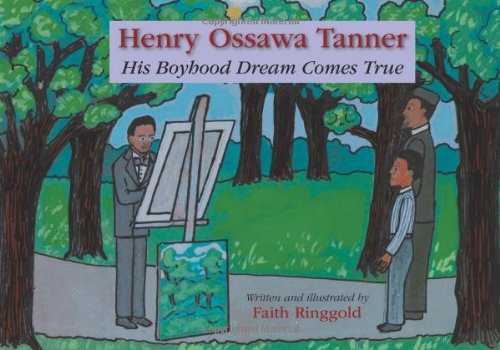
  • Henry Ossawa Tanner: His Boyhood Dream Comes True

    Bunker Hill Publishing
    2011-11-16
    32 pages
    7.3 x 10.3 x 0.4 inches
    ISBN-10: 1593730926
    ISBN-13: 978-1593730925

    Faith Ringgold

    Beautifully written and illustrated by Faith Ringgold, this children’s book accompanies the major exhibition Henry Ossawa Tanner: Modern Spirit.

    This is the story of Henry Ossawa Tanner (1859-1937), the first African American painter to achieve fame in both Europe and America. An inspiration for the Harlem Renaissance artists and later generations of American painters, his story is retold by Faith Ringgold, one of today’s leading African American artists, to inspire another

    Faith Ringgold’s depiction of Tanner’s struggle to achieve his dream and his success as a painter on the world stage will inspire and challenge young readers to look at the artist’s work and maybe go out and buy a few brushes and dry pigments (like Tanner did as a young boy in Philadelphia just 3 years after the Civil War) and set out to achieve their own dreams.

  • A Taste for Honey: Choreographing the Mulatta in the Hollywood Dance Film

    International Journal of Performing Arts and Digital Media
    Volume 5, Numbers 2 and 3 (December 2009)
    pages 141-153

    Melissa Blanco Borelli, Lecturer of Dance Studies
    University of Surrey

    This article examines the filmic representations of the mulatta body in the films Sparkle (1976), Flashdance (1983) and Honey (2003). More specifically, this article seeks to unravel how the Hollywood filmic apparatus engages with signifiers of raced sexuality and hierarchies of dance styles to enforce and reify mythic narratives about dance, dancing raced bodies and dance-making. By establishing a genealogy of the mulatta body in a US context through dance and/or performance films, these juxtapositions illustrate how the mulatta subject develops from a tragic figure (in Sparkle) to an independent and self-reliant one (in Honey). Critical dance studies provide the analytical framework by allowing a focus on particular choreographed and improvised dance sequences performed by each film’s respective mulatta protagonist.

    The figure of the mulatta colours many cultural imaginaries with her specific narratives. One such narrative, the trope of the ‘tragic mulatta’ appears prominently, often obfuscating any other type of representation possible. As Hazel Carby writes, ‘the figure of the mulatt[a] should be understood and analysed as a narrative device of mediation’(1987:88), mediating between the white and black worlds said figure straddles. Couched in Enlightenment ideologies of race, the mulatta emerges as a tragic figure in that her genesis occurs from a violent union between two races — a ‘dominant white’ one, and a ‘subservient black’ one. Werner Sollors explains the etymology of the word mulatto:

    of sixteenth century Spanish origin, documented in English since 1595, and designating a child of a black and a white parent, was long considered etymologically derived from ‘mule’; yet it may also come from the Arabic word muwallad (meaning “Mestizo” or mixed) (1999:128).

    Even with skin that approximates ‘whiteness,’ the proverbial ‘taint’ or ‘drop’ of impure African blood condemns her and her value to be less than human, despite the fascination with her representation of ambiguity and varying skin colour gradations. The undervalued ‘figment of [the concept of] pigment’(1998:16) as DeVere Brody calls it, conversely added to her value as a popular sexual commodity for heterosexual male desire. As a filmic presence, the mulatta first appeared in D.W. Griffith’s Birth of a Nation (1915). Lydia, the mulatta mistress of the white abolitionist carpetbagger, appears independent, powerful, threatening, yet desirable. Film historian Donald Bogle attributes this connection between ‘the light-skinned Negress’ (2001:15) and desirability to a closer proximity to a white aesthetic ideal which gave ‘cinnamon-colored gals’ (2001:15) a chance at lead parts. Other films such as Imitation of Life (1934; 1959), Pinky (1949), Shadows (1959), and Devil in a Blue Dress (1995) utilize the trope of the mulatta and render her full of regret, emotionally unfulfilled, or sad and alone due to each film’s respective circumstances. As Charles Scruggs states, ‘the mulatta is a visible expression of the broken taboo, a figure bearing witness to the interconnection of the races, and the “site of the hybridity of histories”’ (2004:327). Fraught between desire, melancholy, and despair, the mulatta usually encounters a tragic fate, unable to escape these pre-scripted choreographies of her race. These characterizations prevent more complex representations of this racialised and gendered body primarily by constricting the notion of mulatta into narratives based on textual discursive practices. As a result, the mulatta figure suffers from rather limited representations unable to acknowledge her potentiality as something other than tragic.

    In this article, I seek to vivify and corpo-realize mulatta representations by particularly focusing on films where mulattas use their bodies, specifically their hips in active mobilizations as performers, dancers, or choreographers. As I have argued elsewhere, my theory of hip(g)nosis exposes the contours of the hip as a site of cultural production, produced and deployed by historically racialized mulatta bodies in their negotiation of ‘blackness,’ ‘whiteness,’ the political economy of pleasure, and becoming. As a result, the excesses of the hip’s choreography, its existence as a product that can dazzle, dodge, divert and, of course, hip-notize locates it as/in a space where the enacting mulatta body achieves some agency through the different values imposed on it.

    Thinking through and moving with the mulatta’s hip, I will examine the filmic representations of the mulatta body in the Hollywood film Honey (2003) starring Jessica Alba. More specifically, this article aims to unravel how the Hollywood filmic apparatus engages with signifiers of raced sexuality and hierarchies of dance styles to enforce and reify mythic narratives about dance, dancing raced bodies, and dance-making. In order to frame the discussion of how the mulatta body operates through the visual economy, I will establish a genealogy of this body in a U.S. context through two other dance/performance films: Sparkle (1976) and Flashdance (1983). These juxtapositions illustrate how the mulatta subject develops from a tragic figure (in Sparkle) to independent and self-reliant (in Honey) with dance acting as the analytical framework by focusing on particular choreographed and ‘improvised’ dance sequences performed by each film’s respective mulatta protagonist…

    Read the entire article here.

  • Vogue Italia and Hoop Earrings

    Havana Barbie’s thought on the arts
    2011-08-23

    Melissa Blanco Borelli, Lecturer of Dance Studies
    University of Surrey

    I have always loved to wear hoop earrings. In fact, they are my earrings of choice. Big and silver, that’s how I like them. Imagine my surprise and shock when I saw earrings I have always called hoop earrings called “Slave Earrings” by Italian Vogue. Really? Slave earrings? Vogue wants to link an ornamental accessory, a mark of indulgent aestheticism to a historically denigrated body that did not have the choice or power to choose how to look, let alone what to do? Even more appalling was the text (which has since been removed so as “not to offend” and are now called “ethnic earrings” … sigh):
     
    “Jewellery has always flirted with circular shapes, especially for use in making earrings. The most classic models are the slave and creole styles in gold hoops. If the name brings to the mind the decorative traditions of the women of colour who were brought to the southern Unites States during the slave trade, the latest interpretation is pure freedom. Colored stones, symbolic pendants and multiple spheres. And the evolution goes on.”
     
    I want to focus on the phrase “the decorative traditions of the women of colour.” Woman of colour is a charged label, especially when connected to the legacy of slavery, miscegenation, and sexual peccadilloes not just in the US South, but in Cuba, Haiti, Jamaica and other parts of the Caribbean as well. Historically, in the eighteenth and nineteenth century woman of colour meant creole, métisse, passe-blanc, mulatta, or mulattresse, i.e., the mixed race woman who was black… but not quite. With her many names and pigments, the woman of colour and “her decorative traditions” in the southern United States is often problematically romanticized through the stories of the quadroon balls of New Orleans where wealthy white men attended in search of sexual relationships. These women of colour negotiated liaisons called plaçage which were economically beneficial for themselves and their extended, often matrilineal family. Many of these women of colour were free and some even owned slaves…

    Read the entire article here.

  • Jefferson’s Women

    The Humanist: A Magazine of Critical Inquiry and Social Concern
    March/April 2012

    Cleo Fellers Kocol

    Thomas Jefferson was a private man who kept his personal life to himself, and yet today 18,000 of his letters exist in the public forum. In them, this farmer, architect, inventor, philosopher, politician, attorney, and “man of letters”—learned in all disciplines, a true visionary—expounded upon everything but his love life. This we know of Jefferson: he was a deist, a moralist, and a revolutionary. He wrote the Declaration of Independence and, in a letter to James Madison from Paris, suggested adding a Bill of Rights to the U.S. Constitution. He held positions of prominence within the newly formed United States (secretary of state, vice president, and president). He also wrote the book, Notes on the State of Virginia, and edited the New Testament into a volume he considered more believable, leaving out all the miracles and keeping what he considered the moral teachings of Jesus. He was proudest of founding the University of Virginia. And like all of the Founding Fathers, he’s become an icon, above the hoi polloi. But historians have had to connect the dots to give us a real picture of Jefferson the man—one who has become the model, not only of our intellectual and democratic ideals, but, inadvertently, of the often subtle racism that exists today.

    In 1810, he listed his daily schedule in a letter to Thaddeus Kosciusko, the engineer from Poland responsible for the Colonies’ fortifications, “My mornings are devoted to correspondence, from breakfast to dinner I am in my shops, my garden, or on horseback among my farms. From dinner to dark I give to society and recreation with my neighbors and friends, and from candlelight to early bedtime, I read.” He got a bit closer to confiding more personal information to Dr. Vine Utley, of Lyme, Connecticut. In 1819 he wrote: “I have lived temperately, eating little animal food, and that not as an ailment but as a condiment for the vegetables which constitute my principal diet.” But despite this sharing of his personal life, he never wrote of the two women who were closest to him during his life—his wife and his slave mistress.

    What manner of a man was the undisclosed Thomas Jefferson? Of course we know he was born just east of the Blue Ridge Mountains, the frontier in those days. His parents were aristocrats; his mother, Jane, was a Randolph, and his father, Peter, was a planter and surveyor whose map of Virginia was universally used in the colonial era. The elder Jefferson had an extensive library that included William Shakespeare and Jonathan Swift among others. Peter Jefferson died when Thomas was fourteen. During his formative years Thomas was tutored by the extremely conservative Reverend James Maury, an Anglican clergyman. Jefferson’s ideas about morality and religion would later jell in a way his tutor would not have applauded…

    …Jefferson’s daughter, Patsy, had already been in Paris with him, and he now sent for his daughter Polly, asking that she be accompanied by a woman servant. Instead, one of the Hemings children, fourteen-year-old Sally, was sent. We don’t know when Jefferson and Sally became intimate, but we do know that she was pregnant when they returned to Monticello.

    Before a 1998 DNA analysis showed a match between the Jefferson male line and a Hemings descendant, scholars, historians, and the public denied that a romantic relationship between Jefferson and his slave could have happened. As Joseph Ellis notes in American Sphinx: The Character of Thomas Jefferson (1998), Jefferson had become not only an icon but a myth, larger than life. This thinking temporarily blinded people to reality. Today, however, we can look to other events and speculate how his relationship with Sally Hemings may have played a role. His beloved daughter, Patsy, for example, married just two months after returning home from Paris. There is no indication that she and her husband-to-be, Thomas Mann Randolph Jr., had been eager correspondents while she was away, and there is no indication that they had been anything more than friendly cousins before she went to France. Could she have been afraid of losing her number-one spot with her father? Or can we attribute her actions to shock and anger upon learning of her father’s affair with a slave she’d known her entire life?

    Such a reaction certainly would have echoed the hypocritical and confusing feelings the majority of Americans held about slavery during those colonial and post-revolutionary years. Abigail Adams, for example, was a devout abolitionist but, after seeing Othello, wrote that she was quite undone seeing a play about a marriage between a black man and a white woman. She felt horror and disgust every time she saw the Moor touch the gentle Desdemona. Abigail was no different than most of her peers. When she referred to Hemings as “the girl” rather than using her name, it was hardly seen as strange.

    At Monticello, Sally Hemings was known as “dashing Sally” and was said to have a pleasing disposition. Beautiful and extremely light-skinned, she bore a probable resemblance to her late half-sister, Martha, Jefferson’s beloved wife. Hemings could also read and write and had learned to speak French while in Paris…

    …Today, when African-American representatives of the government are spit upon and verbally assaulted, or when more subtle or more blatant acts erupt, the legacy of the past cannot be dismissed, and our most revered historical figures must bear some blame. We could say that Jefferson and the others reflected the social and economic mores of the times, and in a way that’s true. But their thinking had serious limitations and lasting implications. We see this thinking now, not in blatant violence like the lynching of black people or the violent reactions of some whites during the Civil Rights movement of the 1960s, but in less easily discernible ways, like the slow pace we took in eliminating “separate but equal,” in getting rid of poll taxes, or integrating neighborhoods. Today blacks are still paid less than whites in many instances. Discrimination in housing, schooling, and voting still takes place. As a society, we routinely deplore racial violence and say we are not prejudiced, but racism still exists. For instance, U.S. presidential candidates routinely speak at universities, schools, and public venues that discriminate against African Americans. Also, too often religion and bigotry go hand in hand. And when the main objective of a political party is to “make Barack Obama a one-term president,” few people protest, even those who support him. So if we’re being honest, we must contend that otherwise admirable historical figures like Jefferson, Madison, Washington, Monroe, and Abigail Adams contributed to the legacy of racism.

    It is now accepted as fact by most historians that Sally Hemings bore six of Jefferson’s children, four of whom survived to adulthood—Beverly, Harriet, Madison, and Eston, all named by Jefferson after his best friends. (Was James Madison amused, annoyed, or was it a habit friends indulged in even as they indulged their libidos?) Jefferson’s belief in racial superiority is evident in his theory about the offspring of mixed-race couples, including his own. He felt that an infusion of white blood could make a person half black, and another infusion would make their offspring one-fourth black. Sally Hemings was one-fourth black. Offspring of a so-called quadroon and a white man would, in Jefferson’s thinking, make them equal to whites. And yet his children by Sally were never treated as completely equal. The contradictions were rife…

    Read the entire article here.