• Her Majesty’s Other Children: Sketches of Racism from a Neocolonial Age

    Rowman & Littlefield
    288 pages
    August 1997
    Size: 6 1/4 x 9 1/4
    Hardback ISBN: 978-0-8476-8447-2
    eBook ISBN: 978-0-585-20172-6

    Lewis R. Gordon, Laura H. Carnell Professor of Philosophy, Director of the Institute for the Study of Race and Social Thought and Director of the Center for Afro-Jewish Studies
    Temple University

    Winner of the Gustavus Myers Outstanding Book Award for the Study of Human Rights in North America.

    In this exploration of race and racism, noted scholar Lewis R. Gordon offers a critique of recent scholarship in postcolonial Africana philosophy and critical race theory, and suggests alternative models that respond to what he calls our contemporary neocolonial age; an age in which cultural, intellectual, and economic forms of colonial domination persist. Through essays that address popular culture, the academy, literature, and politics, Gordon unsettles the notion of race and exposes the complexity of antiblack racism. An important book for philosophers, political theorists, sociologists, cultural critics, and anyone concerned with the overt and subtle ways of injustice.

    Table of Contents

    • Chapter 1 Foreword
    • Chapter 2 Introduction: Her Majesty’s Other Children
    • Part 1
      • Chapter 3 Philosophy, Race, and Racism in a Neocolonial World
      • Chapter 4 Context: Ruminations on Violence and Anonymity
      • Chapter 5 Fanon, Philosophy, and Racism
      • Chapter 6 Race, Biraciality, and Mixed Race—in Theory
      • Chapter 7 Sex, Race, and Matrices of Desire in an Antiblack World
      • Chapter 8 Uses and Abuses of Blackness: Postmodernism, Conservatism, Ideology
      • Chapter 9 In a Black Antiblack Philosophy
      • Chapter 10 African Philosophy’s Search for Identity: Existential Considerations of a Recent Effort
    • Part 2
      • Chapter 11 The Intellectuals
      • Chapter 12 Lorraine Hansberry’s Tragic Search for Postcoloniality: Les Blancs
      • Chapter 13 Tragic Intellectuals on the Neocolonial—Postcolonial Divide
      • Chapter 14 Exilic “Amateur” Speaking Truth to Power: Edward Said
      • Chapter 15 Black Intellectuals and Academic Activism: Cornel West’s “Dilemmas of the Black Intellectual.” Right-Wing Celebration, Left-Wing Nightmare: Thoughts on the Centennial of Plessy v. Ferguson
    • Part 3
      • Chapter 16 Aisthesis Demokrate
      • Chapter 17 Sketches of Jazz
      • Chapter 18 Aesthetico-Political Reflections on the AMTRAK: Rap, Hip-Hop, and Isaac Julien’s Fanon along the Northeast Line
    • Chapter 19 Epilogue: The Lion and the Spider (An Anticolonial Tale)
  • Vietnamese Amerasians: A Study Of Identity Construction

    University of Texas, Arlington
    December 2010
    78 pages

    Ky-Giao C. Nguyen

    Presented to the Faculty of the Graduate School of The University of Texas at Arlington in Partial Fulfillment of the Requirements for the Degree of Master of Arts in Sociology

    “We define who we are by defining who we are not” (Daniel 1996). What happens when we don’t know who we are not, how can we determine who we are? What if the markers of family connections, community alliances and citizenship are missing and there are no peers with whom to make comparisons? “What are you? Where are you from?” Hispanic, Filipino, sometimes even Native American rather than Asian, are ethnicities often ascribed to Vietnamese Amerasians (children of Vietnamese and American parents). Curiously, for such a personal question, the reaction from others to the response “Vietnamese Amerasian” is often rejection or disbelief. For years, Amerasians have struggled with their place in society, within the U.S. based Vietnamese-American community as well as in the larger U.S. and Vietnamese societies. The life of the Amerasian born and raised in Vietnam is an example of the identity construction and socialization of persons whose lives were marginalized times three through denial of citizenship by country, desertion by family, and rejection by community. Triple marginalization is defined for my purposes as lack of national, familial, and societal affirmation of self. This triple marginalization offers no tangible core of positively valued identity, thus forcing the Amerasian to either accept the labels assigned or forge on to create their own identity. Loss of family, lack of community, and statelessness continues to haunt Amerasians today. The quest for a place to belong, a family to come home to, and a country to acknowledge them still influences their decisions and actions, in ways both detrimental and advantageous to the preservation of an identity built without solid foundation.

    This project is a historically situated, qualitative research based look into the internal and external construction of identity of the Vietnamese Amerasians born during the Vietnam War, individually and as a group. For primary data collection, I utilized my membership in a local Amerasian organization to participate in regularly scheduled group discussions. I evaluated the transcripts of organized conversations among twenty subjects participating in group discussions sponsored through a local Amerasian organization, over five months, from March 2009 through July 2009. During the course of this research, I discovered that while individual participants’ lives were lived separately, there was a commonality to the experiences that helped each come to some definition of self. The members fell into three distinct groups: those who renounce any and all claim of their heritage, becoming wholly Americanized; those who completely immerse themselves in the Vietnamese communities, living much as they did prior to arriving in the U.S.; and those who learn to fluidly move between their two cultures, picking up nuances of themselves wherever they happen to exist, rarely clinging to just one identity.

    Read the entire thesis here.

  • ‘Amerasians’ in the Philippines fight for recognition

    Cable News Network (CNN)
    2012-03-03

    Sunshine Lichauco de Leon

    Manila, Philippines (CNN) — When Susie Lopez, 43, was a little girl she would run outside her home in Angeles City, near the U.S. Clark Airbase in the Philippines, every time she heard a plane fly by.

    “I would say ‘bye bye, Dad’ because the only thing I knew about my father was my dad was riding a plane,” she recalls.

    The daughter of an American naval pilot and a Filipino mother, Lopez is one of an estimated 52,000 “Amerasians” fathered by American military servicemen during the decades the U.S. Navy and Air Force had bases in the Philippines.

    The majority of their mothers worked as bar girls in the area’s thriving “rest and recreation” industry, where soldiers were their regular clients. When the American military left the bases in the early 1990s, these children were left behind.

    On March 4, in honor of International Amerasian Day, a group of 60 Filipino Amerasians from the cities surrounding former bases will celebrate in a special way. Their “100 Letters to our Fathers” campaign will see the group – whose members range from teenage to those in their 50s—reach out with messages of love and hope to fathers almost all of them never knew. Many of the handwritten letters will be read aloud and will be accompanied by their photos and a short video showing conditions Amerasians have faced…

    …They were stigmatized for being illegitimate and for being the children of prostitutes. Amerasians fathered by African American soldiers say they suffered the most extreme prejudice.

    Brenda Moreno, 44, does not know the name of her African-American father or her mother. She does not know where she belongs.

    She remembers a childhood where she hid at home because she looked different. “They see my color and my hair and they tease me ‘negra’. I am always crying because I don’t feel good. I tell them when I grow up I am going to change my blood so I am going to be white,” she recalls…

    Alex Magno, Professor of Political Science at University of the Philippines, explains that this racial prejudice is deeply-rooted, but was strengthened by the country’s colonial past.

    “We long ago considered the Malayo-Polynesian tribes superior and the Negrito tribes inferior,” he says. “Hispanic culture merely reinforced that prejudice with its Eurocentric paradigm. Superimpose Hollywood. The standard of beauty is fair skin, tall nose, straight hair.”

    Growing up with such a lack of acceptance and economic hardship has taken an emotional and psychological toll on many.

    According to a three-year study conducted by Dr. Peter Kutschera, Director of the Philippine Amerasian Research Institute in Angeles City, “we have a severely socioeconomically impaired population, especially among Africans, who contend with serious physical and mental stress issues, including homelessness, alcohol and drug abuse.”…

    Read the entire article here.

  • ‘all my Slaves, whether Negroes, Indians, Mustees, Or Molattoes.’: Towards a Thick Description of ‘Slave Religion’

    The American Religious Experience

    1999

    Patrick Neal Minges

    The time was in the late 1760’s and the place was Charleston, S.C. A young musician was on his way to a performance with his french horn tucked under his arm. As he passed by a large meetinghouse, he heard much commotion on account of a “crazy man was halloing there.” He might have ignored the event but his companion dared him to “blow the french horn among them” and disrupt the meeting. Thinking they might have some fun, John Marrant and his companion entered the meeting hall with the intent of mischief. As he lifted his horn to his lips, the crazy man — evangelist George Whitefield — cast an eye upon him, pointed his finger at John Marrant and uttered these words: “Prepare to Meet Thy God, O Israel!” Marrant was struck dead for some thirty minutes and when he was awakened, Reverend Whitefield declared “Jesus Christ has got thee at last.” After several days of ministrations by Reverend Whitefield, the Lord set John Marrant’s soul at liberty and he dedicated his life to the propagation of the gospel.

    Marrant first witnessed to members of his family and when they rejected his newfound evangelical spirit, he fled to the wilderness where he sought solace among the beasts of the woods. Marrant was not afraid for God hade made the beasts “friendly to me.” When Marrant happened upon a Cherokee deer hunter, they spent ten weeks together killing deer by day and preparing brush arbors by night to provide sanctuary for themselves in the wilderness. Becoming fast friends by the end of the hunting season, the Cherokee deer hunter and the African American missionary returned to the hunter’s village where they would continue their cultural exchange. However, when he attempted to pass the outer guard at the Cherokee village, the Cherokees were less than excited with Marrant and he was detained and placed in prison. It was not that Marrant was a black man that troubled the Cherokee, the peoples of the Southeastern United States had relations with Africans that stretched back perhaps as far as a thousand years. It was just that ever since black people had started showing up with their friends, the white people, that things had started going particularly bad for the Indians of the Southeastern United States.

    It seems that as soon as Europeans showed up on the coasts of the United States, they started reading from a formal document called the Requierimento that declared themselves to be Christians and by nature superior to the uncivilized heathens that they encountered. The indigenous people were then informed by the Requierimento that if they accepted Christianity they would become the Christian’s slaves in exchange for the gift of salvation; if they did not accept the gospel of Christianity, they would still become slaves but that their plight would be much worse.7 Everywhere that explorers such as Ponce De Leon, Vazquez De Ayllon, and Hernando De Soto went on their “explorations” throughout the American Southeast, they carried with them bloodhounds, chains, and iron collars for the acquisition and exportation of Indian slaves. A Cherokee from Oklahoma remembered his father’s tale of the Spanish slave trade, “At an early state the Spanish engaged in the slave trade on this continent and in so doing kidnapped hundreds of thousands of the Indians from the Atlantic and Gulf Coasts to work their mines in the West Indies…

    Read the entire article here.

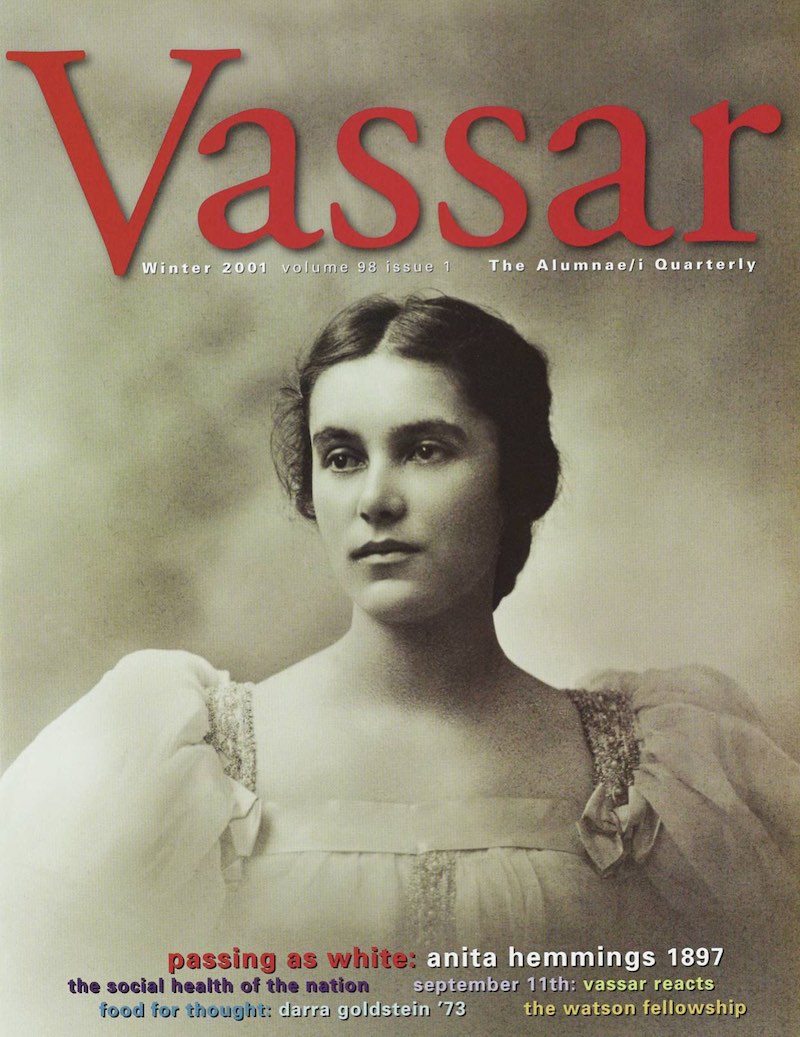
  • Passing as White: Anita Hemmings 1897

    Vassar Alumnae/i Quarterly
    Volume 98, Issue 1 (Winter 2001)
    Features

    Olivia Mancini ‘00

    When Anita Florence Hemmings applied to Vassar in 1893, there was nothing in her records to indicate that she would be any different from the 103 other girls who were entering the class of 1897. But by August 1897, the world as well as the college had discovered her secret: Anita Hemmings was Vassar’s first black graduate — more than 40 years before the college opened its doors to African Americans.

    In the late 19th century, Vassar’s atmosphere might have been best described as aristocratic. Since its opening in 1861, the prestigious women’s school had catered almost exclusively to the daughters of the nation’s elite. Had Hemmings marked her race as “colored” on her application, her admittance to the college most certainly would have been denied.

    “She has a clear olive complexion, heavy black hair and eyebrows and coal black eyes,” a Boston newspaper wrote of a 25-year-old Hemmings in August 1897. “The strength of her strain of white blood has so asserted itself that she could pass anywhere simply as a pronounced brunette of white race.”

    And pass she did, until her white roommate voiced suspicions about Hemmings’ background to her own father only a few weeks before the class was due to graduate.

    The father hired a private investigator to travel to Hemmings’ hometown of Boston. There it was discovered that homemaker Dora Logan and janitor Robert Williamson Hemmings had conspired with their daughter to keep her race a secret…

    Read the entire article here.

  • AIS 350 : Black-Indians in the Americas

    San Francisco State University
    Fall 2011

    In this course students will be introduced to some of the major sociological and historical factors that have given rise to multiracial cultural identities in American Indian communities throughout the Americas and the Caribbean with a specific focus on Black-Indians within American Indian and African American Studies. Students will explore the ways that mainstream society comes to understand American Indians and their location within the social, legal, political, and economic sphere of race relations in the West. Students will engage key concepts and theories regarding blood quantum, sovereignty, and land rights as they apply to Natives of mixed ancestry. We will begin with a comprehensive analysis of the notion of a fixed or essential monolithic American Indian identity and how this construction has influenced social, legal, and political understanding of mixed-race Native Americans today and their role within the greater American Indian community. Issues of authenticity, group and community membership, as well as cultural vs. racial formation will be addressed in our weekly readings, lectures, discussions, films, guest lectures, and projects.

  • Variations in Multiracial Identity Integration

    California State University, Los Angeles
    2012-02-10

    Patricia Y. Singim

    The purpose of this study was to explore how multiracial people integrate their racial identities and if this integration was related to well-being. Furthermore, differences based on type of mix (half White vs. mixed with groups of color), positive interactions with racial groups, and discrepancy between appearance and culture were also examined. Five hypotheses were tested: (1) Higher levels of integration and multiracial pride will predict better well-being; (2) Multiracial Whites will have lower integration, less positive interactions, and greater discrepancy compared to Multiracials of Color; (3) Participants with positive interactions will have higher identity integration; (4) Greater discrepancy between appearance and culture will predict lower identity integration; (5) Greater discrepancy will predict lower well-being. It was found that lower integration predicted negative affect, pride predicted positive affect, and discrepancy predicted lower integration. Encouraging multiracials to accept inconsistencies between appearance and culture may increase identity integration and well-being.

    Log-in to read the thesis here.

  • Population structure and admixture in Cerro Largo, Uruguay, based on blood markers and mitochondrial DNA polymorphisms

    American Journal of Human Biology
    Volume 18, Issue 4 (July/August 2006)
    pages 513–524
    DOI: 10.1002/ajhb.20520

    Mónica Sans
    Departamento de Antropología Biológica, Facultad de Humanidades y Ciencias de la Educación
    Universidad de la República

    D. Andrew Merriwether
    Department of Anthropology
    Binghamton University, Binghamton, New York

    Pedro C. Hidalgo
    Laboratorio de Inmunogenética e Histocompatibilidad
    Instituto Nacional de Donación y Trasplante de Células, Organos y Tejidos
    Hospital de Clínicas “Manuel Quintela”

    Nilo Bentancor
    Laboratorio de Inmunogenética e Histocompatibilidad
    Instituto Nacional de Donación y Trasplante de Células, Organos y Tejidos
    Hospital de Clínicas “Manuel Quintela”

    Tania A. Weimer
    Laboratório de Biotecnologia Veterinária
    Universidade Luterana do Brasil

    Maria Helena L.P. Franco
    Departamento de Genética, Instituto de Biociências
    Universidade Federal do Rio Grande do Sul

    Inés Alvarez
    Laboratorio de Inmunogenética e Histocompatibilidad
    Instituto Nacional de Donación y Trasplante de Células, Organos y Tejidos
    Hospital de Clínicas “Manuel Quintela”

    Brian M. Kemp
    Department of Anthropology
    University of California, Davis

    Francisco M. Salzano
    Departamento de Genética, Instituto de Biociências
    Universidade Federal do Rio Grande do Sul

    Recent studies of the Uruguayan population revealed different amounts of Amerindian and African genetic contributions. Our previous analysis of Afro-Uruguayans from the capital city of the Department of Cerro Largo showed a high proportion of African genes, and the effects of directional mating involving Amerindian women. In this paper, we extended the analysis to a sample of more than 100 individuals representing a random sample of the population of the whole Department. Based on 18 autosomal markers and one X-linked marker, we estimated 82% European, 8% Amerindian, and 10% African contributions to their ancestry, while from seven mitochondrial DNA site-specific polymorphic markers and sequences of hypervariable segment I, we determined 49% European, 30% Amerindian, and 21% African maternal contributions. Directional matings between Amerindian women and European men were detected, but differences involving Africans were not significant. Data about the specific origins of maternal lineages were also provided, and placed in a historical context.

    Read the entire article here.

  • Before state’s high court: role of race in identifying a face

    Seattle Times
    2012-03-03

    Ken Armstrong, Staff Reporter

    In a case out of Seattle’s University District, the Washington State Supreme Court is being asked to determine whether jurors should be told that eyewitnesses who identify strangers across racial lines — for example, a white man identifying a black man — are more likely to be mistaken.

    In State of Washington v. Bryan Edward Allen, two issues intersect that could hardly be of greater importance to the functioning of the criminal-justice system: the role of race, and the reliability of eyewitnesses.

    The case, argued Thursday before the state Supreme Court, is also about sunglasses. We’ll get to that later.

    On an August evening in 2009, in Seattle’s University District, Gerald Marcus Kovacs called 911 and said a stranger on the street had just threatened to kill him. Within minutes, police picked up Bryan Allen at a nearby bus stop. Officers took Kovacs to Allen and asked: Is this the guy? “Yeah, definitely, that is 100 percent him,” Kovacs told police.

    Two months later, Allen was convicted of felony harassment. He received a sentence of 14 months.

    Kovacs is white. Allen is black.

    Allen’s appeal argues that when the case was tried in King County Superior Court, the judge should have instructed jurors that when someone from one race identifies a stranger from another race, the chances of a mistake go up.

    An assemblage of professors and legal advocacy groups — including the Innocence Network, the Washington Association of Criminal Defense Lawyers, the American Civil Liberties Union of Washington Foundation, and the Fred T. Korematsu Center for Law and Equality — filed briefs in support, saying a wealth of research shows that people often struggle to distinguish faces outside their own racial group…

    …Arguing the other side, Deborah Dwyer, a King County prosecutor, did not challenge the science on cross-racial identifications. Instead, she took issue with having a trial judge tackle the matter rather than having an expert witness testify.

    The proposed instructions would not only violate the state’s constitution, Dwyer said, but invite all kinds of “practical difficulties.”

    “Our society now is increasingly made up of mixed-race people. Well, what race are they? To take an example we could all relate to: President Obama. He is of mixed racial heritage. If he’s an eyewitness to a crime, is he presumed to be able to identify white people and black people? Or, perhaps, neither?”

    Dwyer also asked: “Does race include ethnicity?” Some studies say Chinese people struggle to distinguish Japanese people, and vice versa. Would trial judges need to instruct jurors in cases like that? And if someone’s race isn’t entirely clear, how is a judge to figure that out?…

    Read the entire article here.

  • Race is a Social Construction

    Living Anthropologically
    2012-02-18

    Jason Antrosio, Associate Professor of Anthropology
    Hartwick College, Oneonta, New York

    I usually avoid the phrase “race is a social construction.” It’s become too much of a mantra, it’s too much of a shortcut, and it is wildly misunderstood and misinterpreted. A perhaps better phrase–still concise but more accurate, and hopefully less susceptible to misinterpretation, is from John H. Relethford: Race is a “culturally constructed label that crudely and imprecisely describes real variation” (Race and global patterns of phenotypic variation 2009:20).

    It is important to spell out what that means, and what people were after with the “race is a social construction” phrase. I am going to go out on an optimistic limb here and say that some recent posts on popular genetic-sorting blogs–Gene Expression and Dienekes–demonstrate these bloggers 1) acknowledge the genetic clustering data exhibits much more complexity and tells a much more complex story of human movement and mixing than is popularly understood; and 2) therefore acknowledge that the lived experience of racial classification can be much more real than the kinds of genetic clustering they are outlining; so that 3) correctly understood they are at least tacitly acknowledging that indeed “race is a social construction.”

    Now before any of these bloggers or the people who inhabit their comment streams jump in and crush me, I want to make clear that this is an optimistic reading of some recent posts; that these comments apply to the main bloggers and not necessarily the commenters; and that since I am not a regular reader of these blogs, this may not be a new development even as I am reading a difference in tone…

    Read the entire article here.