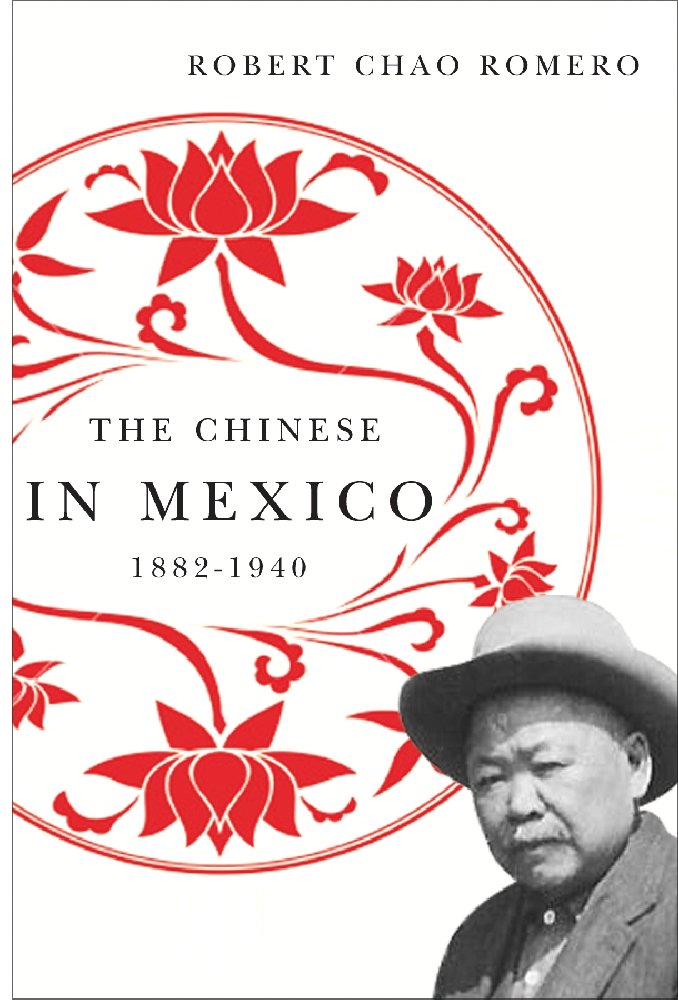
• The Chinese in Mexico, 1882-1940

    University of Arizona Press
    2010-07-22
    272 pages
    6.00 in x 9.00
    Paper (978-0-8165-1460-1)
    Cloth (978-0-8165-2772-4)

    Robert Chao Romero, Associate Professor of Chicana/o Studies and Asian American Studies
    University of California, Los Angeles

    An estimated 60,000 Chinese entered Mexico during the late nineteenth and early twentieth centuries, constituting Mexico’s second-largest foreign ethnic community at the time. The Chinese in Mexico provides a social history of Chinese immigration to and settlement in Mexico in the context of the global Chinese diaspora of the era.

    Robert Romero argues that Chinese immigrants turned to Mexico as a new land of economic opportunity after the passage of the U.S. Chinese Exclusion Act of 1882. As a consequence of this legislation, Romero claims, Chinese immigrants journeyed to Mexico in order to gain illicit entry into the United States and in search of employment opportunities within Mexico’s developing economy. Romero details the development, after 1882, of the “Chinese transnational commercial orbit,” a network encompassing China, Latin America, Canada, and the Caribbean, shaped and traveled by entrepreneurial Chinese pursuing commercial opportunities in human smuggling, labor contracting, wholesale merchandising, and small-scale trade.

    Romero’s study is based on a wide array of Mexican and U.S. archival sources. It draws from such quantitative and qualitative sources as oral histories, census records, consular reports, INS interviews, and legal documents. Two sources, used for the first time in this kind of study, provide a comprehensive sociological and historical window into the lives of Chinese immigrants in Mexico during these years: the Chinese Exclusion Act case files of the U.S. Immigration and Naturalization Service and the 1930 Mexican municipal census manuscripts. From these documents, Romero crafts a vividly personal and compelling story of individual lives caught in an extensive network of early transnationalism.

  • Mixed Race Studies with Steve Riley

    BlogtalkRadio: Is That Your Child?
    2012-01-20, 19:30 EST/16:30 PST; [2012-01-21, 00:30Z]

    Michelle McCrary, Host

    ITYC welcomes creator, founder and editor of the site Mixed Race Studies.org Steve Riley to the podcast this week. In his words, Riley began Mixed Race Studies in April of 2009 “in recognition of our family members and friends who are ‘mixed-race’ and/or raising ‘mixed-race’ children, in response the growing number self-identifying ‘mixed-race’ living here in the Washington, DC area, and finally in celebration of my interracial marriage to my loving wife of 16 years.”

     We’ll talk to him about the site, what he’s learned about issues of mixed identity over the last few years, and if his work  has revealed anything about his own interracial relationship.

  • HLA class I variation controlled for genetic admixture in the Gila River Indian Community of Arizona: A model for the Paleo-Indians

    Human Immunology
    Volume 33, Issue 1 (January 1992)
    Pages 39–46
    DOI: 10.1016/0198-8859(92)90050-W

    Robert C. Williams
    Histocompatibility Laboratory, Blood Systems, Inc., Scottsdale, Arizona
    Department of Anthropology, Arizona State University

    Joan E. McAuley
    Histocompatibility Laboratory, Blood Systems, Inc., Scottsdale, Arizona

    The genetic distribution of the HLA class I loci is presented for 619 “full blooded” Pima and Tohono O’odham Native Americans (Pimans) in the Gila River Indian Community. Variation in the Pimans is highly restricted. There are only three polymorphic alleles at the HLA-A locus, ∗A2, ∗A24, and ∗A31, and only 10 alleles with a frequency greater than 0.01 at HLA-B where ∗Bw48 (0.187), ∗B35 (0.173), and the new epitope ∗BN21 (0.143) have the highest frequencies. Two and three locus disequilibria values and haplotype frequencies are presented. Ten three-locus haplotypes account for more than 50% of the class I variation, with ∗A24 ∗BN21 ∗Cw3 (0.085) having the highest frequency. Gm allotypes demonstrate that little admixture from non-Indian populations has entered the Community since the 17th century when Europeans first came to this area. As a consequence many alleles commonly found in Europeans and European Americans are efficient markers for Caucasian admixture, while the “private” Indian alleles, ∗BN21 and ∗Bw48, can be used to measure Native American admixture in Caucasian populations. It is suggested that this distribution in “full blooded” Pimans approximates that of the Paleo-Indian migrants who first entered the Americas between 20,000 and 40,000 years ago.

    Purchase the article here.

  • Blood Is Thicker than Water: Policing Donor Insemination and the Reproduction of Whiteness

    Hypatia
    Volume 22, Issue 2 (May 2007): Special Issue: The Reproduction of Whiteness: Race and the Regulation of the Gendered Body
    pages 143–161
    DOI: 10.1111/j.1527-2001.2007.tb00986.x

    Seline Szkupinski Quiroga, Faculty Associate
    College of Nutrition and Health Promotion
    Arizona State University

    On the most general level, this essay addresses the ways race is deployed in biomedical solutions to infertility. Szkupinski Quiroga begins with general assertions about fertility technology. She then explores how fertility technology reinforces biological links between parents and children and argues that most options reflect and privilege white kinship patterns and fears about race mixing. She illustrates these observations with interviews she has collected.

    Read or purchase the article here.

  • Rethinking Race History: The Role of the Albino in the Frence Enlightenment Life Sciences

    History and Theory
    Volume 48, Issue 3 (October 2009)
    pages 151–179
    DOI: 10.1111/j.1468-2303.2009.00502.x

    Andrew Curran, Professor of Romance Languages & Literatures
    Wesleyan University

    The scholarly quest to recover the construction of racial difference in the Enlightenment-era life sciences generally overlooks a singular fact: the vast majority of eighteenth-century thinkers who were engaged in theorizing the human were often far more preoccupied with preserving a belief in an essential human sameness than they were in creating categories of essential difference. This article charts the problem of a potential human sameness as it related to questions of category, biological processes, and the human and non-human through an examination of a neglected and key construct in the eighteenth-century life sciences, the albino. The albino was absorbed into a scientific narrative in 1744 when Maupertuis used the concept to put forward a theory of shared origins or monogenesis. Positing that the nègre blanc—quite literally a “white Negro”—was a racial throwback, a reversion to a primitive whiteness, Maupertuis inspired a new generation of thinkers, most notably the great French naturalist Buffon, to assert categorically that blacks had degenerated from a prototype white variety. The significance of the concept nègre blanc, which has not been studied sufficiently, cannot be overestimated. In addition to the fact that the new role of the nègre blanc clearly said as much about whiteness as it did about blackness, the albino generated a new diagnostic chronology of the human species.

    Read or purchase the article here.

  • The mulatto is the chief factor in the negro problem; the problem is bound to increase, then, in geographic area, in number of discontented negroes, and in its intensity, hand in hand with the increased flow of Anglo-Saxon blood into the veins of this new American man. All forms of miscegenation between the two races should be made a felony, punishable for one offence; and the father of children born to one white and one negro parent should be held to support and educate such children.

    George Grant MacCurdy, “Anthropology at the Washington Meeting for 1911,” Science, Volume 35, Number 904, (April 26, 1912): 665-676. http://dx.doi.org/10.1126/science.35.904.665.

  • Anthropology at the Washington Meeting for 1911

    Science Magazine
    Volume 35, Number 904 (1912-04-26)
    pages 665-676
    DOI: 10.1126/science.35.904.665

    George Grant MacCurdy (1863-1947), Assistant Professor of Archæology
    Yale University

    The annual meeting of the American Anthropological Association was held in the United States National Museum, Washington, D. C., December 27-30, 1911, in affiliation with Section H of the American Association for the Advancement of Science and the American Folk-Lore Society. The attendance was good and the program exceptionally long and interesting. The most important features were the two symposia: (1) “The Problems of the Unity or Plurality and the Probable Place of Origin of the American Aborigines, ” discussed by J. W. Fewkes, A. Hrdlieka, W. H. Dall, J. W. Gidley, A. H. Clark, W. H. Holmes, Alice C. Fletcher, Walter Hough, Stansbury Hagar, A. F. Chamberlain and R. B. Dixon; and (2) “Culture and Environment,” discussed by J. W. Fewkes, Clark Wissler, Edward Sapir and Robert H. Lowie. The first of these two discussions is printed in full in the January-March issue of the Anthropologist, and the second will appear in the April-June issue. Dr. J. Walter Fewkes presided at the six sessions in charge of the American Anthropological Association; also at the single session of the American Folk-Lore Society, in the absence of Professor Henry M. Belden, president of that society. Professor George T. Ladd, vice president of Section H, was chairman of the single session in charge of the section. The social functions to which members of the affiliated societies were invited included: a reception by Dr. and Mrs. Robert S. Woodward at the Carnegie Institution, a reception at the New National Museum, and the opening of the Corcoran Gallery of Art…

    …Some Aspects of the Negro Problem: ALBERT ERNEST JENKS, University of Minnesota.

    Immigration.—Since we have a serious negro problem is it reasonable that this problem be made more difficult by admission into the United States each year of an increasing number of un-Americanized immigrant alien negroes.

    There are no United States laws against such immigration. Just short of 40,000 such persons have come to this country in the last ten years; in 1911 we received 6,721. They come from near at hand-three fourths coming from the West Indies. The West Indies have nearly 6,000,000 negroes, any of whom may come to the United States. America debars oriental peoples, not because they are inferior, but because they and their culture are so different from American people and culture. For the same reason we should exclude the “African black.” He should also be excluded because his admission is unfair to the white and also to the negro American-since he makes even more difficult one of America’s most perplexing problems.

    Miscegenation.—There are two forms of negro-white miscegenation: (1) Legal marriage, permitted permitted in twenty-three states where the unions are largely between negro men and white women; (2) illegal, more or less temporary unions, usually between white men and negro women. Investigation in a certain area shows that 65 per cent. of the white wives of negro men are foreign born girls—usually of Teutonic peoples. Over two per cent. of children are born to these marriages. The result of both these forms of miscegenation is an increasing number of mulattoes cemented by color and prejudice to the negro race, while by inheritance they are endowed to a considerable degree with Anglo-Saxon initiative, will, ideals and desire for a square-deal—which, because of their color, they can seldom get. These mulattoes are the migrants in the north and west of the United States; they are more migrant than the restless, foot-free white American. The mulatto is the chief factor in the negro problem; the problem is bound to increase, then, in geographic area, in number of discontented negroes, and in its intensity, hand in hand with the increased flow of Anglo-Saxon blood into the veins of this new American man. All forms of miscegenation between the two races should be made a felony, punishable for one offence; and the father of children born to one white and one negro parent should be held to support and educate such children.

    Who is a Negro?—The negro should be defined uniformly, so that there would be no question of the legal and racial status of any given person, no matter in what commonwealth he may be. To-day there is no such uniformity of laws.

    Murderous Race Riots.—The white man ‘s passion against the offending, or suspected, negro is often nothing short of blood vengeance against the negro race. This is seen in the fact that assault against the virtue of a white woman is only one of some three dozen offences for which negroes are annually lynched. In many of these lynchings and burnings murder is not committed in the frenzy of the moment; the mob starts out to lynch or burn-the crime is premeditated. If America is to train her annual armies of immigrant recruits into law-respecting and law-abiding citizens, she must punish to the limit necessary all participants in murderous race riots.

    Education.—Each negro child should have, so far as public and private schools are concerned, an equal opportunity with the white child to make of himself all that he is capable of being.

    Investigation.—A commission should be selected to study every aspect of the negro problem. This commission might well be financed by private funds so as to keep it from the almost certain bias of politics and sectionalism…

    Read the entire article here.
  • Johnny Otis, ‘Godfather of Rhythm and Blues,’ Dies at 90

    New York Times
    2012-01-19

    Ihsan Taylor

    Johnny Otis, the musician, bandleader, songwriter, impresario, disc jockey and talent scout often called “the godfather of rhythm and blues,” died on Tuesday at his home in Altadena, Calif. He was 90.

    His death was confirmed by his manager, Terry Gould.

    Leading a band in the late 1940s that combined the high musical standards of big-band jazz with the raw urgency of gospel music and the blues, Mr. Otis played a key role in creating a new sound for a new audience of young urban blacks, a sound that within a few years would form the foundation of rock ’n’ roll.

    With his uncanny ear for talent, he helped steer a long list of performers to stardom, among them Etta James, Jackie Wilson, Esther Phillips and Big Mama Thornton — whose hit recording of “Hound Dog,” made in 1952, four years before Elvis Presley’s, was produced by Mr. Otis and featured him on drums.

    …Despite being a mover and shaker in the world of black music, Mr. Otis was not black, a fact that as far as he was concerned was simply an accident of birth. He was immersed in African-American culture from an early age and considered himself, he said, “black by persuasion.”

    “Genetically, I’m pure Greek,” he told The San Jose Mercury News in 1994. “Psychologically, environmentally, culturally, by choice, I’m a member of the black community.”…

    Read the entire obituary here.

  • Science in the Service of the Far Right: Henry E. Garrett, the IAAEE, and the Liberty Lobby

    Journal of Social Issues
    Volume 54, Issue 1 (Spring 1998)
    pages 179–210
    DOI: 10.1111/j.1540-4560.1998.tb01212.x

    Andrew S. Winston, Professor of Psychology
    University of Guelph, Ontario, Canada

    Henry E. Garrett (1894–1973) was the President of the American Psychological Association in 1946 and Chair of Psychology at Columbia University from 1941 to 1955. In the 1950s Garrett helped organize an international group of scholars dedicated to preventing race mixing, preserving segregation, and promoting the principles of early 20th century eugenics and “race hygiene.” Garrett became a leader in the fight against integration and collaborated with those who sought to revitalize the ideology of National Socialism. I discuss the intertwined history the International Association for the Advancement of Ethnology and Eugenics (IAAEE), the journal Mankind Quarterly, the neofascist Northern League, and the ultra-right-wing political group, the Liberty Lobby. The use of psychological research and expertise in the promotion of neofascism is examined.

    Read or purchase the article here.

  • Racial Differences and Witch Hunting

    Science Magazine
    Volume 135, Number 3507 (1962-03-16)
    pages 982-984
    DOI: 10.1126/science.135.3507.982-a

    Henry E. Garrett

    In a recent issue of Science (1), Santiago Genovés of the University of Mexico discourses at some length concerning a paper of mine published in the Mankind Quarterly last year (2). Genovés objects to my criticism of Klineberg’s chapter “Race and psychology,” included in the UNESCO publication The Race Quesion in Modern Science (ed. 2, 1956). He confuses the issues through bad logic and too much vehemence What I actually did in my paper was to show, I think conclusively, that the evidence for no race differences presented by Klineberg is far too meager, too ambiguous, and too inconclusive to justify his sweeping assertion that “the scientist knows of no relation between race and psychology ” My paper would have been “unscientific racism” (Genovés’s term) only if its main purpose had been to support the doctrines of a “master race” or “chosen people.” As its aim was simply to point out the flimsy nature of Klineberg’s data, it is a legitimate enterprise,  unless one considers any criticism of equalitarianism to be morally untenable.

    Genovés is critical of my view that widespread Negro-white hybridization has in the past led to illiteracy, social and economic backwardness, and degeneracy. He assumes that I condemn all race mixing, which is untrue. Most racial hybrids are viable, and many are successful people, as witness the Hawaiian-Chinese and Japanese-American crosses in Hawaii. But one need go no farther afield than the West Indies. Central America, and parts of South America to be convinced of the bad effects of Negro-white crosses when these are numerous. My concern was…

    Read or purchase the article here.