• The Social Construction of Racial and Ethnic Identity Among Women of Color from Mixed Ancestry: Psychological Freedoms and Sociological Constraints

    City University of New York (CUNY)
    2009
    211 pages

    Laura Quiros

    A dissertation submitted to the Graduate Faculty in Social Welfare in partial fulfillment of the requirements for the degree of Doctor of Philosophy

    In the context of the 21st century, when an increasing number of people cannot be classified by an archaic system based on race, an awareness of the complexities of ethnic and racial identity is more important than ever. This study assists in the development of a critical understanding of the complexity of racial and ethnic identity by exploring the construction of racial and ethnic identity among women of color from mixed ancestry. These women are the offspring of parents from multiple racial and ethnic backgrounds. As a result, their identities—both internally and externally constructed—belie traditional racial and ethnic categories. This population faces unique struggles, as identified in the empirical literature and supported by the data analysis. Women of color from mixed heritages: have been assigned monolithic labels based primarily on their physical appearance; may feel pressured to adopt a single and predetermined ethnic or racial label; and are often researched as one ethnic or racial group. Furthermore, scholars agree that institutional racism has been a constricting force in the construction of identity and identification for ethnic groups of color in the United States. This study is important because women of color are not always comfortable with the ascribed identity, particularly when it is based on faulty characterizations and when their ethnicity is overlooked. Additionally, this study brings insight to the psychological and social impact of socially constructed identifications.

    This study regards race and ethnicity as social constructions, defined by human beings and given meaning in the context of family, community, and society. As such, women of color from mixed ancestry find themselves in the middle of the psychological freedoms and sociological constraints of identity construction within the dominant society. As a result, they develop management techniques for integrating components of self and for managing the freedoms and constraints in social constructions of race and ethnicity.

    This is a subject of pivotal importance to multiple fields of inquiry as well as one having significant educational, clinical, and programmatic implications. Among the implications for social work practice and pedagogy are the need for critical reflection, increased awareness, and cultural diversity.

    Read the entire dissertation here.

  • The Sigh of Triple Consciousness: Blacks Who Blurred the Color Line in Films from the 1930s through the 1950s

    City University of New York (CUNY)
    May 2019
    50 pages

    Audrey Phillips

    A master’s thesis submitted to the Graduate Faculty in Liberal Studies in partial fulfillment of the requirements for the degree of Master of Arts

    This thesis will identify an over looked subset of racial identity as seen through film narratives from the 1930’s through the 1950’s pre-Civil Rights era. The subcategory of racial identity is the necessity of passing for Black people then identified as Negro. The primary film narratives include Veiled Aristocrats (1932), Lost Boundaries (1949), Pinky (1949) and Imitation of Life (1934). These images will deploy the troupe of passing as a racialized historical image. These films depict the pain and anguish Passers endured while escaping their racial identity. Through these stories we identify, sympathize and understand the needs of Black people known as Passers, who elected a chosen exile in order to live in a world which offered opportunity to the White race. These films will also portray the social betrayal forced upon Black people for the need of survival. These films show the desperation for equality as seen through a new genre of film trail blazers, all of whom understood the need to expose this hidden truth. These films also demonstrate the imperativeness to adjust in all aspects of their lives including physical, mental, emotional and psychological. This constant demand for interchange puts tremendous pressure on the psyche of Passers.

    Through the cover of passing one life was denied while another was born, allowing Blacks to inconspicuously wear a mask of survival. This strategy was based on the prejudice of America, which judged people by the color of their skin and not the content of their character. The study of passing, which is an identified classification of being Black, is useful in courses about race and identity. Educators dealing with themes of race and identity in their classes would greatly benefit by incorporating these films on racial passing as part of their lessons. They will help students to better understand the connection between race and identity in American society, especially for those living under the yoke of government supported racism.

    Read the entire thesis here.

  • A Century of Times Dance Photos, Through the Lens of Misty Copeland

    The New York Times
    2019-04-13

    Remy Tumin


    The ballerina Misty Copeland reviewing photographs for the Past Tense: Dance section in The New York Times’s building. Karen Hanley/The New York Times

    Ms. Copeland, the American Ballet Theater’s first black principal ballerina, served as guest editor for a special section on dance photography.

    Times Insider explains who we are and what we do, and delivers behind-the-scenes insights into how our journalism comes together.

    There’s one photograph from The New York Times archives that stands out to Misty Copeland. It’s a black-and-white image of a group of young ballerinas, boys and girls, their dark skin accented by bright tights and tutus.

    “They look so uncomfortable,” Ms. Copeland said in a recent interview. “In ballet, we’ve never been told there was a place for us to fit in. You can see that within this image.”

    The “tension and awkwardness” that Ms. Copeland said she saw in the photo is familiar to her. She was the American Ballet Theater’s first black female principal dancer. Last month, when she visited The Times to serve as a guest editor of a special print section featuring dance images from our archives, she saw those threads throughout dance history.

    The section is the latest from Past Tense, which highlights stories and photographs from The Times’s archives. Veronica Chambers, who leads the team, said that of the six million photos in the archives, at least 5,000 are dance-related. A dedicated section was a natural fit, as was the choice of Ms. Copeland as its guest editor, Ms. Chambers said…

    Read the entire article here.

  • The Secret Album reveals how a powerful truth changed a family forever

    The Garage
    HP (Hewlett-Packard)
    2019-05-02

    Patrick Rodgers

    A novelist learns about her mother’s long-held secret by search for what’s missing from her family photo albums.

    The Secret Album is part of HP’s original documentary project, History of Memory, which celebrates the power of printed photos.

    We treasure family photos not only because they illuminate the past, but also because they can offer up an alternative narrative to the stories we tell — and retell — about our identities.

    This is true for author Gail Lukasik, who was just as captivated by what was left out of her parents’ snapshots as by the faces and stories they portrayed. Growing up in suburban Ohio, Lukasik puzzled over why there were so few pictures of her mother’s side of the family. In the stack of family photo albums, there were only a handful of black-and-white prints of relatives from New Orleans, where her mother, Alvera (Frederic) Kalina, had lived in the 1920s, 1930s and 1940s. “I felt very close to my mother, but she had a certain mystery,” she says. “When I used to ask her about that she’d say, ‘Oh I just don’t have any,’ which I thought was strange.” Her mother’s guardedness about her own family’s origins were yet another layer to their already complex relationship…

    …It took Lukasik two years to confront her mother, and the encounter didn’t go well. “I had never seen her so afraid,” says Lukasik, who tells the story in her memoir, White Like Her: My Family’s Story of Race and Racial Passing. “She said, ‘Promise me you won’t tell anyone until after I die.’”…

    Read the entire article and watch the video here.

  • “You’re Neither One Thing (N)or The Other”: Nella Larsen, Philip Roth, and The Passing Trope

    Philip Roth Studies
    Volume 8, Number 1, Spring 2012
    pages 45-61

    Donavan L. Ramon, Assistant Professor of Liberal Studies
    Kentucky State University

    Philip Roth has historically been situated in a male literary tradition, with critics assessing him alongside Saul Bellow, Bernard Malamud, and more recently, Charles Chesnutt and Ralph Ellison. Because of his problematic portrayals of women characters, Roth is not often discussed alongside women writers. My paper goes beyond this by situating Roth alongside a black woman writer, Nella Larsen. In fact, Larsen’s Passing (1929) and Roth’s The Human Stain (2000) share several thematic and structural similarities, such as the tropes of belated race learning, double consciousness, anonymous letter writing, taboo sexualities, and ambiguous deaths. My essay argues that these tropes underlie passing narratives and reveal the development of twentieth century passing texts.

    Read or purchase the article here.

  • University of California, Santa Barbara (UCSB) Special Research Collection

    UC Santa Barbara Library
    University of California, Santa Barbara
    May 2019

    G. Reginald Daniel, Professor of Sociology
    University of California, Santa Barbara

    G. Reginald Daniel, UCSB Professor of Sociology and member of the Advisory Board of MASC (Multiracial Americans of Southern California), and Paul Spickard, UCSB Professor of History, in coordination with Danelle Moon, Head of UCSB Library Special Research Collection, have been collecting primary documents from support and educational organizations involved in the multiracial movement, particularly from the late 1970s through the early 2000s. This period was the height of discussions surrounding changes in official data collection on race, as in the census, to make it possible for multiracial individuals to identify as such…

    Read the entire release here.

  • Mary Seacole, a Nurse and Heroine

    The History Guy: History Deserves to Be Remembered
    2017-05-10

    Lance Geiger, Historian
    O’Fallon, Illinois

    The History Guy celebrates National Nurses week with the forgotten history of Mary Seacole, who was a British nurse during the Crimean War.

  • Being black in Nazi Germany

    BBC News
    2019-05-21

    Damian Zane

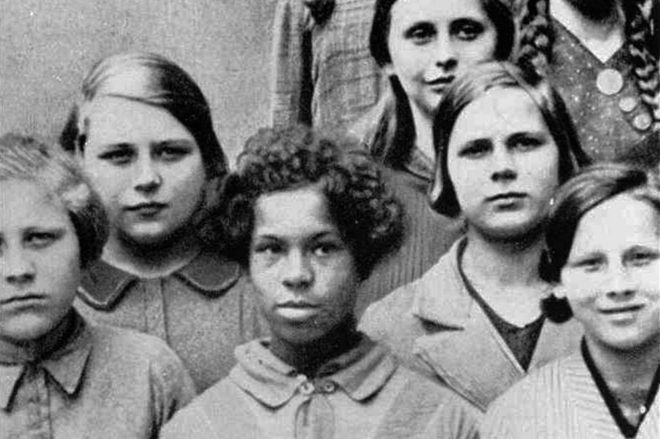
    A slide used on lectures on genetics at the State Academy for Race and Health in Dresden, Germany, 1936. Original caption: "Mulatte child of a German woman and a Negro of the French Rhineland garrison troops, among her German classmates
    This photo was used in genetics lectures at Germany’s State Academy for Race and Health Library of Congress

    Film director Amma Asante came across an old photograph taken in Nazi Germany of a black schoolgirl by chance.

    Standing among her white classmates, who stare straight into the camera, she enigmatically glances to the side.

    Curiosity about the photograph – who the girl was and what she was doing in Germany – set the award-winning film-maker off on a path that led to Where Hands Touch, a new movie starring Amandla Stenberg and George MacKay.

    It is an imagined account of a mixed-race teenager’s clandestine relationship with a Hitler Youth member, but it is based on historical record…

    Racist caricatures

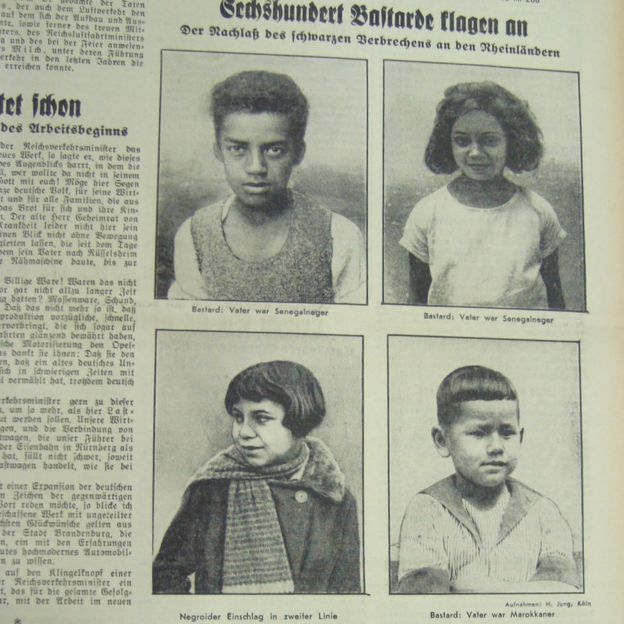
    The derogatory term “Rhineland bastards” was coined in the 1920s to refer to the 600-800 mixed-race children who were the result of those relationships.

    Newspaper cutting in the Frankfurter Volksblatt says "600 Bastards Accused, the legacy of black crimes against the Rhinelanders"
    The 1936 headline in the Frankfurter Volksblatt says: “600 Bastards Accused, the legacy of black crimes against the Rhinelanders” Robbie Aitken

    The term spoke to some people’s imagined fears of an impure race. Made-up stories and racist caricatures of sexually predatory African soldiers were circulated at the time, fuelling concern…

    Read the entire article here.

  • The Disturbing Resilience of Scientific Racism

    Smithsonian.com
    2019-05-20

    Ramin Skibba


    Nazi officials use calipers to measure an ethnic German’s nose on January 1, 1941. The Nazis developed a pseudoscientific system of facial measurement that was supposedly a way of determining racial descent. (Hulton-Deutsch Collection / CORBIS / Corbis via Getty Images)

    A new book explores how racist biases continue to maintain a foothold in research today

    Scientists, including those who study race, like to see themselves as objectively exploring the world, above the political fray. But such views of scientific neutrality are naive, as study findings, inevitably, are influenced by the biases of the people conducting the work.

    The American sociologist W. E. B. Du Bois once wrote, “The problem of the twentieth century is the problem of the color line.” His words were borne out, in part, by science. It was the century when the scientifically backed enterprise of eugenics—improving the genetic quality of white, European races by removing people deemed inferior—gained massive popularity, with advocates on both sides of the Atlantic. It would take the Holocaust to show the world the logical endpoint of such horrific ideology, discrediting much race-based science and forcing eugenics’ most hardline adherents into the shadows.

    The post-war era saw scientists on the right-wing fringe find ways to cloak their racist views in more palatable language and concepts. And as Angela Saini convincingly argues in her new book, Superior: The Return of Race Science, published May 21 by Beacon Press, the “problem of the color line” still survives today in 21st-century science.

    In her thoroughly researched book, Saini, a London-based science journalist, provides clear explanations of racist concepts while diving into the history of race science, from archaeology and anthropology to biology and genetics. Her work involved poring through technical papers, reports and books, and interviewing numerous scientists across various fields, sometimes asking uncomfortable questions about their research…

    Read the entire article here.

  • Superior: The Return of Race Science

    Beacon Press
    2019-05-21
    272 pages
    Size: 6 x 9 Inches
    Cloth ISBN: 978-080707691-0

    Angela Saini

    Superior tells the disturbing story of the persistent thread of belief in biological racial differences in the world of science.

    After the horrors of the Nazi regime in World War II, the mainstream scientific world turned its back on eugenics and the study of racial difference. But a worldwide network of intellectual racists and segregationists quietly founded journals and funded research, providing the kind of shoddy studies that were ultimately cited in Richard Herrnstein and Charles Murray’s 1994 title The Bell Curve, which purported to show differences in intelligence among races.

    If the vast majority of scientists and scholars disavowed these ideas and considered race a social construct, it was an idea that still managed to somehow survive in the way scientists thought about human variation and genetics. Dissecting the statements and work of contemporary scientists studying human biodiversity, most of whom claim to be just following the data, Angela Saini shows us how, again and again, even mainstream scientists cling to the idea that race is biologically real. As our understanding of complex traits like intelligence, and the effects of environmental and cultural influences on human beings, from the molecular level on up, grows, the hope of finding simple genetic differences between “races”—to explain differing rates of disease, to explain poverty or test scores, or to justify cultural assumptions—stubbornly persists.

    At a time when racialized nationalisms are a resurgent threat throughout the world, Superior is a rigorous, much-needed examination of the insidious and destructive nature of race science—and a powerful reminder that, biologically, we are all far more alike than different.