The Passer
Midwood/Tower
1962
189 pages
Catalog ID: F170
Sam Mervin Jr. (1910-1996)

Fred Williams had a secret—He was half negro passing as all white; but the many white women who vied for his arms made no secret of what they wanted.
Scholarly perspectives on the mixed race experience.
The Passer
Midwood/Tower
1962
189 pages
Catalog ID: F170
Sam Mervin Jr. (1910-1996)
Fred Williams had a secret—He was half negro passing as all white; but the many white women who vied for his arms made no secret of what they wanted.
Hapas: The Overlooked Minority Racial Group
Honolulu Civil Beat
2019-04-04

Mixed-race identity has always been in question, and the situation isn’t getting any better.
Stuck between a rock and a hard place. Unwelcomed. Invalidated both racially and culturally. These phrases can be used to sum up the experience of being “hapa” in the age of modern racial politics.
Stuck between a rock and a hard place. Unwelcomed. Invalidated both racially and culturally. These phrases can be used to sum up the experience of being “hapa” in the age of modern racial politics…
Read the entire article here.
Leitner Center for International Law and Justice
Fordham Law School
150 West 62nd Street
Room 3-09
New York, New York 10023
2019-04-09, 12:30-13:30 EDT (Local Time)
Contact: leitnercenter@law.fordham.edu
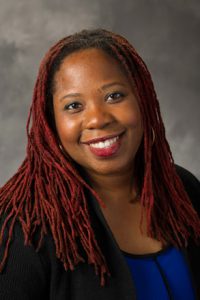
Chinyere Osuji is an Assistant Professor of Sociology at Rutgers University with affiliations in Africana Studies and Latin American and Latino studies. Before coming to Rutgers-Camden, she was a post-doctoral fellow at the University of Pennsylvania Center for Africana Studies.
Chinyere conducts research on the meaning that social actors give to racial and ethnic boundaries. Her first book, Boundaries of Love: Interracial Marriage and the Meaning of Race (April 2019, NYU Press) takes a novel approach to comparing race and ethnicity across societies by examining the experiences of interracial couples. Boundaries of Love relies on 103 qualitative interviews that she conducted with 52 black-white couples between 2008 and 2012 in Los Angeles and Rio de Janeiro (in Portuguese). Through using what she calls a critical constructionist approach, Boundaries of Love compares the experiences of couples involving black men and white women with those of black women with white men in these two diverse, multicultural settings. This book reveals how non-elites in these two post-Atlantic slavery societies employ cultural repertoires that push against, bridge over, blur, dismantle or reproduce ethnoracial boundaries.
Chinyere’s next project will employ the critical constructionist approach to nursing and healthcare. In addition, she will be examining the lives of African immigrants, focusing on how they form community without being spatially concentrated.
For more information, click here.
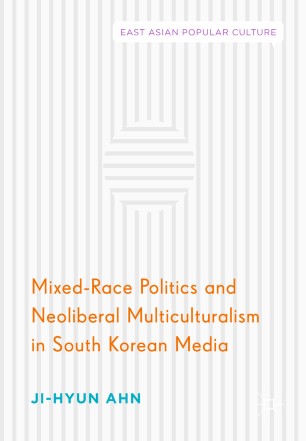
Mixed-Race Politics and Neoliberal Multiculturalism in South Korean Media
Palgrave Macmillan
2018
231 pages
Hardcover ISBN: 978-3-319-65773-8
Softcover ISBN: 978-3-319-88102-7
eBook ISBN: 978-3-319-65774-5
Ji-Hyun Ahn, Assistant Professor of Communication
University of Washington, Tacoma
This book studies how the increase of visual representation of mixed-race Koreans formulates a particular racial project in contemporary South Korean media. It explores the moments of ruptures and disjuncture that biracial bodies bring to the formation of neoliberal multiculturalism, a South Korean national racial project that re-aligns racial lines under the nation’s neoliberal transformation. Specifically, Ji-Hyun Ahn examines four televised racial moments that demonstrate particular aspects of neoliberal multiculturalism by demanding distinct ways of re-imagining what it means to be Korean in the contemporary era of globalization. Taking a critical media/cultural studies approach, Ahn engages with materials from archives, the popular press, policy documents, television commercials, and television programs as an inter-textual network that actively negotiates and formulates a new racialized national identity. In doing so, the book provides a rich analysis of the ongoing struggle over racial reconfiguration in South Korean popular media, advancing an emerging scholarly discussion on race as a leading factor of social change in South Korea.
Table of contents
These Photos Celebrate the Beauty of Panama’s Afro-Latinx Community
Vice
2019-03-27
Photographer Kayla Reefer’s new series, “Identidad,” explores her family’s roots in Panama.
Black people are everywhere, my mother once told me. I was sharing my anxieties about studying abroad in Europe, of sticking out like a sore thumb. In my head, blackness was something that began and ended in America. My history classes only ever talked about the slaves stolen and taken to the Deep South. But my mother was right. The African diaspora reaches far and wide: the Afro-Caribbean communities of London, Black Canadians, Afro-Brazilians, and on and on. The problem is how rarely the wide, far-reaching spectrum of blackness is taught, shown, celebrated, and acknowledged.
Photographer Kayla Reefer grapples with the ramifications of this everyday. She is Afro-Latina, the daughter of Panamanian immigrants. Growing up in California, Reefer talks about feeling the need to prove her heritage and identity to her black and Latinx friends. To show them she is not simply one or the other, but an amalgamation of histories. “Eventually, I learned to embrace both worlds,” she says. “Because they’re both me.”
Sadly, not all Panamanians take ownership of their Afro roots, Reefer says. She once saw a Panama census stating only 9 percent of the country was Afro-Latinx. The small statistic does not match up to Reefer’s reality, the people she sees riding the bus during her visits to the Central-American country, of her family and friends. “That statistic is absolutely not true,” she argues, anger in her voice. “It just feeds into the lack of awareness and knowledge of what an Afro-Latinx person is. There’s this erasure happening.”…
Read the entire article here.
Collapsing the Ethno-State: A Conversation with Keri Leigh Merritt
It’s Going Down
2019-03-27
Keri Leigh Merritt
Atlanta, Georgia

On this episode of the It’s Going Down podcast, we caught up with historian and author Keri Leigh Merritt out of Atlanta, Georgia. Merritt is the author of both the 2017 book, Masterless Men: Poor Whites and Slavery in the Antebellum South as well as the new essay, “War Happens in Dark Places, Too.” Merritt’s work focuses on labor history, slavery, and class tensions in the South, both before and after the civil war and the research work that she is producing, a long with a new wave of historians, is reshaping how we view the Confederacy, its collapse, and also whites supremacy within the United States.
Listen to the podcast (01:06:58) here. Download the podcast here.
Belgium apology for mixed-race kidnappings in colonial era
BBC News
2019-04-04
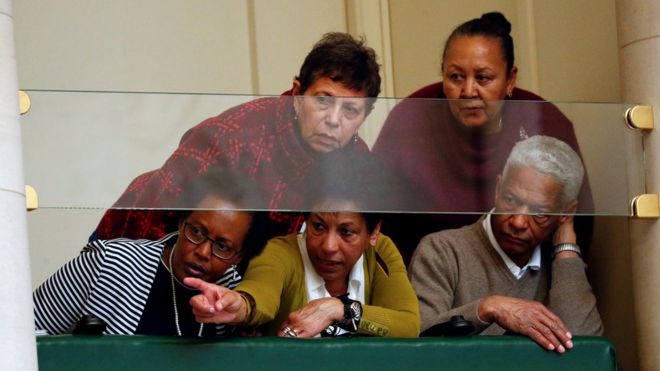 Many mixed-race people were in parliament to watch Mr Michel apologise |
Belgian Prime Minister Charles Michel has apologised for the kidnapping of thousands of children born to mixed-race couples during colonial rule in Burundi, DR Congo and Rwanda.
The “métis” children born to Belgian settlers and local women were forcibly taken to Belgium and fostered by Catholic orders and other institutions.
About 20,000 children are believed to have been affected.
Most fathers refused to acknowledge the paternity of their children.
The children were born in the 1940s and 1950s and taken to Belgium from 1959 until the independence of each of the three colonies.
Some of the children never received Belgian nationality and remained stateless.
Speaking in the Belgian parliament, Mr Michel said the country had breached the children’s basic human rights, seeing them as a threat to the colonial system.
It had, he said, stripped them of their identity, stigmatised them and split up siblings…
Read the entire article here.