Mixed Race Studies

Scholarly perspectives on the mixed race experience.

    • About This Site
    • Bibliography
    • Contact Information
    • Date and Time Formats
    • Forthcoming… (Updated 2021-09-01)
    • Likely Asked Questions
    • List of Book Publishers
    • List of Definitions and Terms
    • My Favorite Articles and Papers
    • My Favorite Posts
    • My Recent Activities
    • Praise for Mixed Race Studies
    • Tag Listing
      • Tag Listing (Ordered by Count)
    • US Census Race Categories, 1790-2010
    • 1661: The First ‘Mixed-Race’ Milestone
    • 2010 U.S. Census – Some Thoughts

recent posts

  • The Routledge International Handbook of Interracial and Intercultural Relationships and Mental Health
  • Loving Across Racial and Cultural Boundaries: Interracial and Intercultural Relationships and Mental Health Conference
  • Call for Proposals: 2026 Critical Mixed Race Studies Conference at UCLA
  • Participants Needed for a Paid Research Study: Up to $100
  • You were either Black or white. To claim whiteness as a mixed child was to deny and hide Blackness. Our families understood that the world we were growing into would seek to denigrate this part of us and we would need a community that was made up, always and already, of all shades of Blackness.

about

  • Twitter
  • Facebook
  • Instagram
  • Passing or Transracial?: Authority, Race, and Sex in the Rachel Dolezal Documentary

    2018-05-18

    Passing or Transracial?: Authority, Race, and Sex in the Rachel Dolezal Documentary

    Beacon Broadside: A Project of Beacon Press
    2018-05-10

    Lisa Page, Assistant Professor of English and Director of Creative Writing
    George Washington University, Washington, D.C.

    Rachel Dolezal
    Photo credit: YouTube/Dr. Phil

    For some of us, racial identity is elastic. We can pass. For white, for black, for Middle Eastern. For Latinx. I am one of those people. I know what it is to assimilate to a group you identify with, because I did it myself, against my white mother’s wishes. She hated me calling myself black.

    For this reason, my response to The Rachel Divide, Laura Brownson’s new documentary about Rachel Dolezal, is complicated. Dolezal famously passed for black, for years, before her white parents outed her in 2015. I feel two ways about this. I completely get the outrage that followed the reveal. But I also have sympathy for Dolezal. I know what it’s like to turn your back on the white side of your family.

    The film opens with clips of Dolezal’s activism, as president of the Spokane NAACP, which came to a screeching halt once she was revealed to be a white woman who darkened her complexion and wore a weave.

    Dolezal doesn’t call that passing.

    “Who’s the gatekeeper for blackness?” she asks, near the beginning of the film. “Do we have the right to live exactly how we feel?”…

    Read the entire article here.

  • A Hidden Caribbean Revolution? Race and Revolution in Venezuela, 1789-1817

    2018-05-16

    A Hidden Caribbean Revolution? Race and Revolution in Venezuela, 1789-1817

    Age of Revolutions
    2018-05-14

    Frédéric Spillemaeker, Researcher (Casa de Velázquez (École des Hautes Études Hispaniques et ibériques, EHEHI)) and Ph.D. Candidate
    École des Hautes des Hautes Études en Sciences Sociales (EHESS)


    Manuel Carlos Piar. Obra de Pablo W. Hernández.

    The wave of revolutionary sentiment from the 1790s to Independence questioned the social and racial inequalities that divided colonial Venezuela. The majority of the Venezuelan population was Pardo, a mixed-race people of African and European descent who were considered legally inferior to Europeans and Creoles. While pardos could bear arms and organize in militias, they only ascended to the grade of captain. Hence, most pardo militias remained under command of Mantuanos – white colonels and members of the landed ruling class. When colonial order was challenged by Amerindians seeking to recover their lands and slaves pursuing freedom, a large mass of armed pardos mobilized in demand of equality. The 1790s revolutions in the Greater Caribbean, and later, the Latin American Independence Wars beginning in 1810, scrambled the existing socio-racial structure of domination in Venezuela, at least in the domain of the army, with pardo leaders like Jean-Baptiste Bideau and Manuel Piar…

    In August 1793, the Revolution led by Toussaint Louverture, enabled the abolition of slavery in Saint Domingue.[1] A few months later, on 16 Pluviôse An II (February 4, 1794), the French Convention extended the abolition decree to all French colonies. By June 1794, when Victor Hugues took over Guadeloupe, former slaves had become soldiers in defense of revolutionary values. This was the beginning of a cycle of victories for the alliance between France, free people of color, and emancipated slaves.[2] In the island of Trinidad, formerly part of Venezuela, a battle confronted the alliance of French and Afro-Antilleans against the English on May 8-9, 1796. Among the French officers was Jean-Baptiste Bideau, a “mulâtre” from Sainte-Lucie.[3] In spite of the defeat and the English seizure of the island in February 1797, slave uprisings erupted throughout Venezuela. Armed slaves mobilized in Carupano and in Rio Caribe in 1798,[4] and a suspected pardo plot was unveiled in Barcelona in 1801.[5] Back in Saint Domingue, now named Haiti, the revolution resisted Napoleon’s slavery restoration attempt and ultimately declared its Independence in 1804…

    Read the entire article here.

  • The making of Meghan Markle

    2018-05-16

    The making of Meghan Markle

    The Washington Post
    2018-05-16

    Jessica Contrera, Features Writer


    Portraits of Meghan Markle from eighth, ninth and 12th grades. From her childhood in Los Angeles to her acting career, Markle has said her “ethnically ambiguous” appearance shaped her identity. (John Dlugolecki/Contact Press Images)

    What happens when a ‘confident mixed-race woman’ marries into the royal family

    Meghan Markle was glaring at her love interest. She leaned forward, fury clear in her expression as she asked the question: Was it so hard to believe one of her parents was black?

    “You think,” she spat, “this is just a year-round tan?”

    He stammered. She grimaced. The opening credits began to roll.

    It was just the scene of a television show, a few lines from the script of the law drama “Suits.” But Markle would later describe it as something more: the moment she was no longer playing the role of “ethnically ambiguous.” That was the description assigned to so many of the jobs for which she had auditioned. Others asked her to be white, like her father. Or black, like her mother…

    Read the entire article here.

  • “My Sister Tried to Kill Me”: Enactment and Foreclosure in a Mixed-Race Dyad

    2018-05-15

    “My Sister Tried to Kill Me”: Enactment and Foreclosure in a Mixed-Race Dyad

    Psychodynamic Psychiatry
    Volume 43, Number 2 (June 2015)
    pages 229-241
    DOI: 10.1521/pdps.2015.43.2.229

    Teresa Méndez, MSW, Clinical Social Worker
    The Retreat at Sheppard Pratt; Private Practice
    Washington, D.C. and Baltimore, Maryland

    How is treatment complicated when both patient and therapist bring into the room multiracial identities that stand in contrast to their visible race or ethnicity? Using relational psychoanalysis’s concepts of dissociation, enactment, and relational trauma, this article examines the way multiple racial realities, beyond the more familiar black/white binary, can coexist in the consulting room. The implications and potential pitfalls of a cross-cultural dyad, in which each participant carries a mixed-race identity, are considered through a clinical vignette.

    Read or purchase the article here.

  • “I definitely want to reach people who not only are of mixed ethnicity but who also identify as Black.”

    2018-05-14

    “We always hear people say there are no Black people in Vancouver, but there are. I identify as a Black woman. I know there was a larger Black community in Vancouver many years ago, but people have been displaced. I definitely want to reach people who not only are of mixed ethnicity but who also identify as Black.”

    “I’m writing this for the community that I wish were here now. So whether you are Black, of mixed race or can identify with the trauma parts of the book, I think there are different layers in the work where you can see something different every time. That’s what I like with the hybrid form, of poetry and prose.” —Chelene Knight

    Ryan B. Patrick, “Why Chelene Knight wrote letters to the current occupants of the houses she lived in growing up,” CBC Books, March 6, 2018. http://www.cbc.ca/books/why-chelene-knight-wrote-letters-to-the-current-occupants-of-the-houses-she-lived-in-growing-up-1.4533897.

  • I study biracial identity in America. Here’s why Meghan Markle is a big deal.

    2018-05-14

    I study biracial identity in America. Here’s why Meghan Markle is a big deal.

    Vox
    2018-05-14

    Sarah E. Gaither, Assistant Professor of Psychology
    Duke University


    Photos: Getty Images. Photo illustration: Christina Animashaun/Vox

    Biracial representation is sorely needed in a country with a fraught relationship with mixed-race people.

    Growing up in the late ’80s as a biracial girl, I never had a mixed-race princess whose image I could sport on my backpack or my lunchbox. There was little to no representation of my identity — almost no characters in movies or television shows, no musicians or celebrities who identified as mixed-race.

    For today’s biracial youth, Meghan Markle, the actress who is marrying into the British royal family — and who has defined herself publicly as “a strong, confident mixed-race woman” — represents the biracial role model I didn’t have growing up.

    My mother is white and my father is black, and as a social psychologist, I research mixed-race identity and perceptions of biracial people for a living. The history of biracial couplings and children in our country is fraught: The “one drop” rule that categorized people with any African ancestry as “colored” was legally codified in a couple of states in the early 1900s. Interracial marriage was illegal in some states starting in 1664 until 1967 with the famous Loving v. Virginia case, and it wasn’t until the year 2000 when the option to “check all that may apply” for race appeared on the census…

    Read the entire article here.

  • The Markle effect: black women see the royal wedding as workplace inspiration

    2018-05-12

    The Markle effect: black women see the royal wedding as workplace inspiration

    The Guardian
    2018-05-12

    Rory Carroll, Shenelle Wallace and Edward Helmore

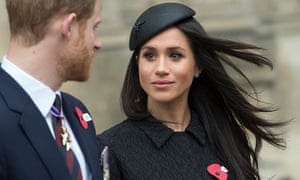
    Prince Harry and Meghan Markle at Westminster Abbey in London on 25 April.
    Prince Harry and Meghan Markle at Westminster Abbey in London on 25 April. Photograph: Eddie Mulholland/AFP/Getty Images

    As the royal wedding approaches, some are hoping it will lead to a greater acceptance of African American women in business

    As final arrangements are set for the wedding of the US actor Meghan Markle to Prince Harry Windsor, hopes are mounting among some that the Markle effect will have unexpected impacts, including improving opportunities for African American women in the workplace.

    “It’s exciting for black women, and I think it’s going to be inspirational,” said Camille Newman, a 38-year-old Brooklyn entrepreneur. Newman expressed deep-felt enthusiasm in the union as a symbolic marker for the acceptance of black or biracial women in society and said other women of color she knew felt the same way.

    “We’re claiming her for a black woman’s right to be in there like everybody else,” she said.

    One anticipated spin-off, she told the Guardian, could be the greater acceptance of black women across all sectors of society, including business. “As an entrepreneur I face so many challenges to find funding for my business. We’re going to claim her and look to her for inspiration as an African American entrepreneur,” she said…

    Read the entire article here.

  • What Meghan Markle means to black Brits

    2018-05-11

    What Meghan Markle means to black Brits

    The Washington Post
    2018-05-11

    Karla Adam, London correspondent covering the United Kingdom

    William Booth, London bureau chief

    Photos by Tori Ferenc


    Photo by Tori Ferenc

    After she marries Prince Harry, the royal family will look a bit more like modern Britain.

    LONDON—Jean Carter had never bothered to come out for a royal appearance before. But when Prince Harry and his fiancee, Meghan Markle, made a visit to Brixton this year, Carter bought a bouquet and weathered a chilly afternoon waiting for a glimpse of the couple.

    Carter was glad to see Harry, the happy-go-lucky, ginger-bearded son of the late Princess Diana. As an immigrant from Jamaica, though, Carter, 72, really wanted to lay eyes on Markle, a biracial American actress who is the subject of deep fascination here.

    Multiethnic Brixton is South London’s hub for a founding generation of Afro-Caribbean immigrants. It’s a crossroad so central to the story of the African diaspora that local historians call the neighborhood — with its jerk chicken grills, reggae dance halls and vibrant mural scene — the black capital of Europe. When South African President Nelson Mandela came to Britain in 1996 he went to Buckingham Palace — and Brixton.

    Carter characterized the royal couple’s visit to the neighborhood as “a big statement.”

    But what exactly will it mean to have a biracial member of the monarchy after Prince Harry and Markle exchange vows on May 19?…

    Read the entire article here.

  • Why Chelene Knight wrote letters to the current occupants of the houses she lived in growing up

    2018-05-10

    Why Chelene Knight wrote letters to the current occupants of the houses she lived in growing up

    CBC Books
    Canadian Broadcasting Corporation
    2018-03-06

    Ryan B. Patrick, Associate Producer


    Chelene Knight is an author based in Vancouver. (Chelene Knight/BookThug)

    Chelene Knight is a Vancouver-based writer and editor. Of Black and East Indian heritage, Knight’s Dear Current Occupant mixes poetry and prose to tell a story about home and belonging, set in the 1980s and 1990s of Vancouver’s Downtown Eastside.

    The book plays with genre by way of a series of letters addressed to the current occupants now living in the 20 different houses she moved in and out of with her mother and brother. Knight tells CBC Books how she wrote Dear Current Occupant.

    A bus ride beginning

    “The first draft was originally all poetry, but my publisher suggested I rewrite it as creative nonfiction. I tried to write this book in generic memoir form. I sat down wanting to write about some of my childhood experiences. But it couldn’t come out. I thought maybe it’s not the right time.

    “Then I was on the bus one snowy day and I passed by one of the houses that I lived in as a child and something sparked in me. I got off the bus and I stood in front of this house. I had a notebook with me and I started scribbling. The memories were coming back to me — flooding in — and it was this visceral thing where I needed to be in that place and then be transported back to those times.”…

    …Writing for others

    “We always hear people say there are no Black people in Vancouver, but there are. I identify as a Black woman. I know there was a larger Black community in Vancouver many years ago, but people have been displaced. I definitely want to reach people who not only are of mixed ethnicity but who also identify as Black.

    “I’m writing this for the community that I wish were here now. So whether you are Black, of mixed race or can identify with the trauma parts of the book, I think there are different layers in the work where you can see something different every time. That’s what I like with the hybrid form, of poetry and prose.”

    Read the entire article here.

  • Joseph Boyden Won’t Find Indigenous Identity In A Test Tube Of Spit

    2018-05-10

    Joseph Boyden Won’t Find Indigenous Identity In A Test Tube Of Spit

    Canadaland
    2017-08-04

    Robert Jago


    photo by Bryan McBurney

    To be First Nations, you must first belong to a nation.

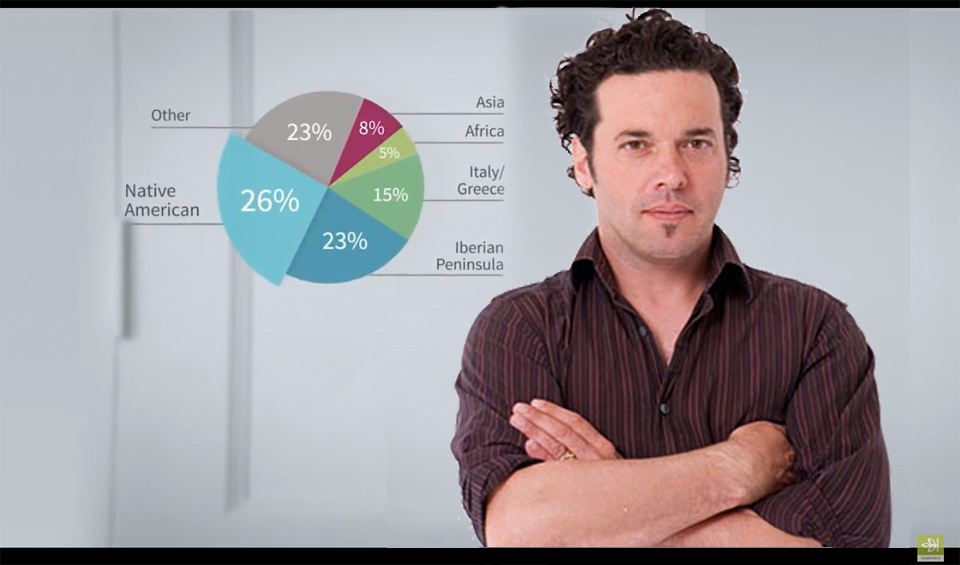
    In anticipation of a fall book tour for his new novel, Seven Matches, Joseph Boyden is back in the pages of Maclean’s magazine with an article restating his claim of First Nations ancestry, and anchoring that in the results of a DNA test.

    Boyden’s ancestry first came into question late last year when I, along with APTN and a number of other Indigenous activists, questioned Boyden’s right to speak on our behalf. We looked at his shifting claims of ancestry — covered here on CANADALAND — and his misuse of basic First Nations concepts like being “two-spirit,” and we presented the questions to the public for them to decide.

    Broadly speaking — though with many notable exceptions — Indigenous people on social media took the position that he was not Indigenous. And broadly speaking, non-Natives, especially those in the media, claimed that he was, and that we had no right as Indigenous people to determine who belonged to our communities…

    In his 4,000-word Maclean’s piece, “My name is Joseph Boyden,” Boyden presents several cases for his First Nations bona fides. The article is presented as being addressed to Indigenous critics — but the enthusiastic support of a dwindling number of media figures, like “Appropriation Prize” ring-leader Ken Whyte, perhaps reveals the real intended audience: white Canadians looking for an excuse to turn the page on this controversy and take Boyden back as the leading voice of Indigenous Canada…

    Read the entire article here.

Previous Page
1 … 210 211 212 213 214 … 1,428
Next Page

Designed with WordPress