• Frederick Douglass: a multi-racial trailblazer

    The Baltimore Sun
    2018-02-08

    Tanya Katerí Hernández, Professor of Law
    Fordham University School of Law


    Gregory Morton purchased Frederick Douglass’ home in Fells Point and makes it available to rent on Airbnb. (Barbara Haddock Taylor / Baltimore Sun)

    Last year President Trump made statements that left the impression he believed that abolitionist Frederick Douglass was still alive. In some respects, he still is. This month marks the 200th anniversary of Frederick Douglass’ birth, and his racial justice work continues to be relevant today. In fact, after President Trump was informed that Douglass died in 1895, the president signed into law the Frederick Douglass Bicentennial Commission Act to organize events to honor the bicentennial anniversary of Douglass’s birth.

    While slave records mark Douglass’ birth month as February — he was born in a plantation on the shores of the Chesapeake Bay in Talbot County — his status as a slave meant he had no information about the exact day he was born. As an adult he chose Feb. 14th for himself as a birth date. He was also never told who his father was, but circumstances lead him to conclude that it was his white slave owner.

    Despite his mixed-race heritage and likely connection to his owner, Douglass was separated from his mother at an early age and exposed to physical abuse from his owners…

    Read the entire article here.

  • When It Comes To Diversity, The Fashion and Beauty Industry Are The Absolute Worst

    Medium
    2018-02-09

    Ezinne Ukoha


    These are some of the top fashion magazine covers of 2017

    Including the sexy magazines that can’t stand dark-skinned models with puffy hair

    As a child — I endured the casual comments from family friends who couldn’t help expressing how much I looked like my mother with the exception of her lighter skin — which I unfortunately didn’t inherit. This practice of exaggerating how my dark-skin didn’t measure up continued with my boarding school mates — who once compared my looks to one of the popular girls — and concluded that even though we looked alike — she was prettier.

    We did sort of resemble each other — but she wasn’t prettier. She was just light-skinned. That same rhetoric was responsible for the infatuation and fascination assigned to the biracial students who almost always won beauty competitions and anything else that required the adulation of their prized features.

    Interestingly enough — I never pressured myself into sourcing ways to solve the issue of my dark skin — the way other Nigerian women have resolved to do — at the risk of their health. Skin bleaching was a dirty secret when I was growing up — because even though it was glaringly obvious that Mrs. Kalu was indulging in potent solutions that couldn’t quite penetrate her knuckles, elbows or feet — we had to act as if her new complexion wasn’t weird as fuck.

    My mother did an excellent job boosting my ego — and as a result there was hardly a time when I stared at the mirror and imagined how much more desirable I would be if the gods had been a little more miserly with the strokes of deep chocolate.

    However — when I moved to the States to pursue my college degree — I was greeted with hard truths of what it means to be a “regular Black girl” — during an era when such a disposition was guaranteed to get you nowhere — especially in industries that catered to fashion and entertainment…

    Read the entire article here.

  • I’m Afro-Boricua. I’m biracial—my mother is white and my father is black, both Puerto Rican. Sometimes people don’t know that I’m black, but I’m black. I was raised in a black family, by my father and grandmother, both unapologetically black and unapologetically Boricua. My sister and I look brown, and our brother looks white. Our white grandmother was racist and threw around the n-word even when referring to us, me and my sister, her grandchildren. She made us feel like we were not part of her white family. But my brother, with his blond hair and his blue eyes, she loved to claim.

    My whole life people have tried to tell me who I am or who I’m supposed to be. My whole life people have tried to measure my proximity to whiteness, always asking, What are you?

    Jaquira Díaz, “You Do Not Belong Here,” KR Online: Kenyon Review, September 2017. https://www.kenyonreview.org/kr-online-issue/resistance-change-survival/selections/jaquira-diaz-656342/.

  • …Many Hispanic families in New Mexico have long known that they had indigenous ancestry, even though some here still call themselves “Spanish” to emphasize their Iberian ties and to differentiate themselves from the state’s 23 federally recognized tribes, as well as from Mexican and other Latin American immigrants.

    But genetic testing is offering a glimpse into a more complex story. The DNA of Hispanic people from New Mexico is often in the range of 30 to 40 percent Native American, according to Miguel A. Tórrez, 42, a research technologist at Los Alamos National Laboratory and one of New Mexico’s most prominent genealogists.

    …“I have Navajo, Chippewa, Greek and Spanish blood lines,” said Mr. Tórrez, who calls himself a mestizo, a term referring to mixed ancestry. “I can’t say I’m indigenous any more than I can say I’m Greek, but it’s both fascinating and disturbing to see how various cultures came together in New Mexico.”…

    Simon Romero, “Indian Slavery Once Thrived in New Mexico. Latinos Are Finding Family Ties to It.The New York Times, January 28, 2018. https://www.nytimes.com/2018/01/28/us/indian-slaves-genizaros.html.

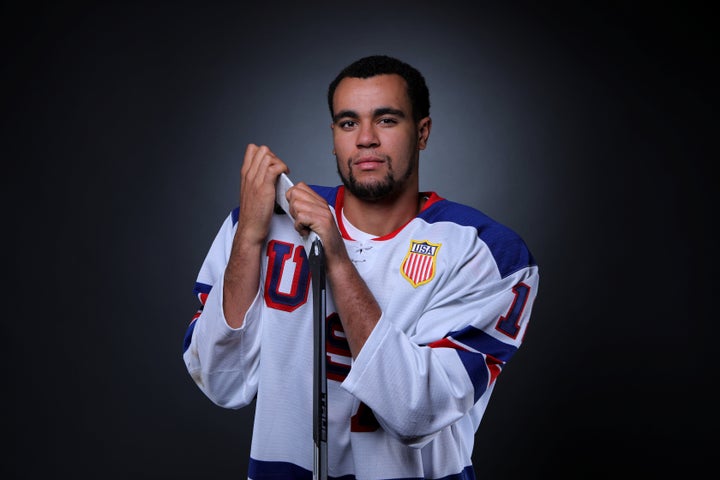
  • U.S. Men’s Olympic Hockey Team Includes First Black Player In 98-Year History

    The Huffington Post
    2018-02-09

    Andy McDonald


    Mike Blake / Reuters
    At 6 feet, 5 inches and 238 pounds, Jordan Greenway will be the biggest player on the U.S. men’s Olympic hockey team.

    “I just think I’m another kid going to play in the Olympics.”

    Boston University hockey player Jordan Greenway will make history in Pyeongchang, South Korea, becoming the first African-American ever to be selected for the U.S. men’s Olympic hockey team.

    Breaking that 98-year color barrier, which began in the 1920 Winter Games in Antwerp, Belgium, when men’s ice hockey was first included, is a significant achievement, but Greenway tells NBC Sports that he is just “another kid going to play in the Olympics.”

    Greenway says he’s happy to be first and hopes it will inspire young minorities to give hockey a shot.

    “I don’t think a lot of African-Americans play hockey at a high level,” said Greenway. “I’m just trying to get more and more of those kids to try and go out and do something different.”…

    Read the entire article here.

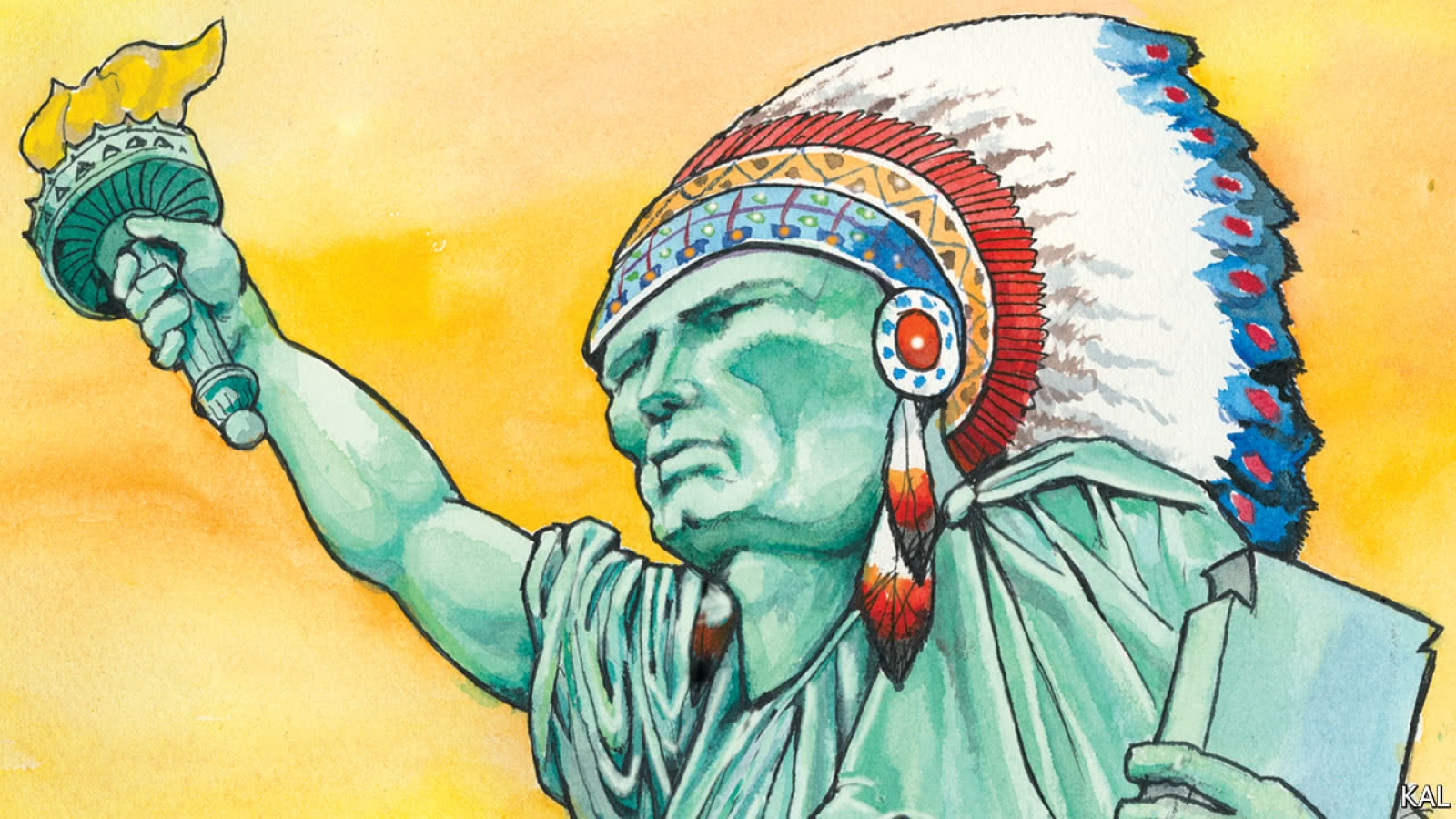
  • Looking at Indians, white Americans see themselves

    The Economist
    2018-02-10

    Thinking about natives in an era of nativism

    IN EARLY 1924 the blue-bloods of Virginia found themselves with a problem. To criminalise interracial marriage, the state had drafted a law that classified anyone possessing even “one drop” of non-white blood as “coloured”. Awkwardly, that would include many of the so-called First Families of Virginia, because they traced their descent to a native American woman, Pocahontas, who had been abducted and married by a member of the Jamestown colony three centuries before. This ancestry had been considered far from shameful. It was a mark of American aristocracy, the real-life Pocahontas having been reinvented (she probably did not save the life of a colonist called John Smith) as an “American princess”. To fix matters, a clause known as the “Pocahontas exception” was added to the racist law, to exempt anyone with no more than one-sixteenth Indian blood.

    This episode, documented in a new exhibition at the National Museum of the American Indian in Washington, DC, on Indian myths and reality, helps explain a cultural puzzle. It has become clear that the pre-Columbian Americas were much more densely populated, by more sophisticated civilisations, than was previously thought. By one estimate North America, the more sparsely populated continent, had 18m people when Columbus sailed, more than England and France combined. Yet in the popular imagination it remains a vast wilderness, peopled by a few buffalo-hunters. The reason for this gigantic misunderstanding, suggest the Smithsonian’s curators, goes beyond bad schooling…

    Read the entire article here.

  • Delia Graff Fara Explored a Philosophical Concept With a Heap of Sand

    The Lives They Lived
    The New York Times Magazine
    2017-12-28

    James Ryerson, Senior Story Editor


    Tackling a paradox: Fara in 2004. Credit Steve Pyke

    She philosophized about vagueness — and lived with it too

    The “paradox of the heap” seems at first like a trick, a brainteaser that must have some clever catch. But it reveals itself, as it defies easy understanding, to be a philosophical problem. You might approach it as a puzzle, only to end up devising a solution so deep that it would challenge our thinking about language, knowledge and the nature of reality. By the time of her death from brain cancer in July at 48, Delia Graff Fara, a philosopher at Princeton, had done just that.

    Start with a heap of sand. If you remove a single grain, it remains a heap. Repeat this process enough times, however, and you have a heap of sand that contains, say, one grain. This is absurd: One grain is not a heap. Something has gone wrong, but it is not obvious what. Either there is a precise number of grains at which point a heap becomes a nonheap, or there is no such thing as a heap, or classical logic is flawed (perhaps it is only ever sort of true that something is a heap). Which bullet to bite?…

    …When it came to racial diversity, an area in which philosophy is similarly lopsided, Fara was also a champion, if more circumspect. Her mother, who raised Fara as a single parent in New York, was African-American; her father, who died when she was a child, was of Irish and Jewish descent. Because of her appearance, Fara was often assumed to be white or queried clumsily about where she was “from.” She told her husband she hoped to avoid being defined by her race. But as much as she let misperceptions slide, or answered politely that she was “born in Queens,” it was an issue she could never fully escape…

    Read the entire article here.

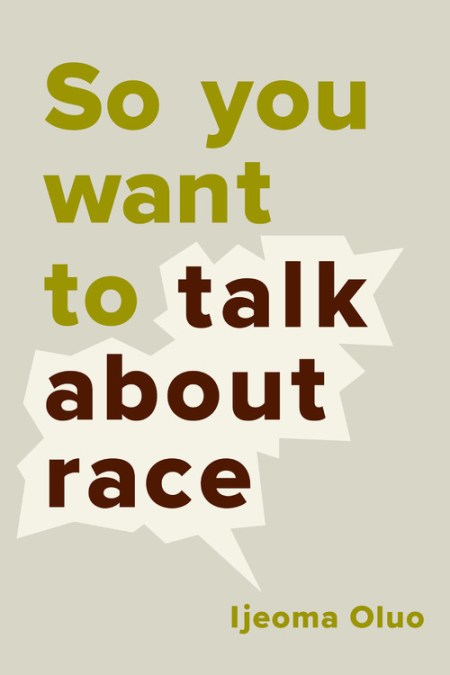
  • So You Want to Talk About Race
    Seal Press
    2018-01-16
    256 pages
    Hardcover ISBN-13: 9781580056779
    eBook ISBN-13: 9781580056786

    Ijeoma Oluo

    In this breakout book, Ijeoma Oluo explores the complex reality of today’s racial landscape–from white privilege and police brutality to systemic discrimination and the Black Lives Matter movement–offering straightforward clarity that readers need to contribute to the dismantling of the racial divide

    In So You Want to Talk About Race, Editor at Large of The Establishment Ijeoma Oluo offers a contemporary, accessible take on the racial landscape in America, addressing head-on such issues as privilege, police brutality, intersectionality, micro-aggressions, the Black Lives Matter movement, and the “N” word. Perfectly positioned to bridge the gap between people of color and white Americans struggling with race complexities, Oluo answers the questions readers don’t dare ask, and explains the concepts that continue to elude everyday Americans.

    Oluo is an exceptional writer with a rare ability to be straightforward, funny, and effective in her coverage of sensitive, hyper-charged issues in America. Her messages are passionate but finely tuned, and crystalize ideas that would otherwise be vague by empowering them with aha-moment clarity. Her writing brings to mind voices like Ta-Nehisi Coates and Roxane Gay, and Jessica Valenti in Full Frontal Feminism, and a young Gloria Naylor, particularly in Naylor’s seminal essay “The Meaning of a Word.”

  • Brit(ish): On Race, Identity and Belonging

    Jonathan Cape (an imprint of Penguin Random House UK)
    2018-02-01
    384 Pages
    15.6 x 3 x 24 cm
    ISBN-13: 978-1911214281

    Afua Hirsch

    Where are you really from?

    You’re British. Your parents are British. You were raised in Britain. Your partner, your children and most of your friends are British.

    So why do people keep asking you where you are from?

    Brit(ish) is about a search for identity. It is about the everyday racism that plagues British society. It is about our awkward, troubled relationship with our history. It is about why liberal attempts to be ‘colour-blind’ have caused more problems than they have solved. It is about why we continue to avoid talking about race.

    In this personal and provocative investigation, Afua Hirsch explores a very British crisis of identity. We are a nation in denial about our past and our present. We believe we are the nation of abolition, but forget we are the nation of slavery. We are convinced that fairness is one of our values, but that immigration is one of our problems. Brit(ish) is the story of how and why this came to be, and an urgent call for change.

  • You Do Not Belong Here

    KR Online
    Kenyon Review
    September 2017

    Jaquira Díaz
    Gambier, Ohio
    June 2017

    A few years ago, during a summer in Puerto Rico, I went back to my old neighborhood, El Caserío Padre Rivera. When I was a girl, El Caserío, one of the island’s government housing projects, was a world of men, of violence. A world that at times wasn’t safe for women or girls. There were shootouts in the streets, fourteen-year-old boys carrying guns as they rode their bikes to the candy store just outside the walls. We watched a guy get stabbed right in front of our building once, watched the cops come in and raid places for drugs and guns. Outsiders were not welcome. Outsiders meant trouble.

    What you didn’t know unless you lived there, unless you spent time there, was that most people in El Caserío were just trying to raise their families in peace, like anywhere else. The neighbors kept an eye on all the kids, fed them, took them to school, took them trick-or-treating on Halloween. All over the neighborhood, people told stories. El Caserío was where I learned about danger and violence and death, but it was also where I learned about community, where I learned to love stories, to imagine them, to dream. And it’s a place I love fiercely.

    That summer, I drove into El Caserío to look at our old apartment, my first elementary school, the basketball courts where my father taught me to shoot hoops. I’d been there less than five minutes when a boy on a bike approached the car, motioned for me to roll down my window.

    “What are you doing here?” he asked.

    “Just visiting,” I said. “I was born here.”

    He kept his hands on the handlebars, looked inside the car for a while, then gave me directions to the nearest exit, even though I hadn’t asked for them. He couldn’t have been more than sixteen.

    “I know my way around,” I said. “I used to live here.”

    “You do not belong here,” he said, then pedaled away, disappearing around the corner…

    Read the entire article here.