• Call for Essays: Shades of Prejudice: Asian American Women on Colorism in America from NYU Press, Edited by Nikki Khanna (Forthcoming 2018)

    Nikki Khanna, Associate Professor of Sociology
    University of Vermont
    Department of Sociology
    31 South Prospect Street
    Burlington, Vermont 05405
    Telephone: (802) 656-2162

    2017-07-06

    DEADLINE: Manuscripts will be accepted on a rolling basis, though the final deadline is OCTOBER 31, 2017.

    I am pleased to announce an open submission call for my forthcoming anthology from New York University Press, SHADES OF PREJUDICE, a collection of essays written by Asian American women about their personal experiences with colorism.

    Colorism is the practice of discrimination whereby light skin is privileged over dark, and is a global issue affecting racial groups worldwide. Colorism exists is just about every part of Asia and affects Asian diasporas, including most Asian American communities—including those descended from Southeast Asia (e.g., India, Pakistan, Cambodia, Singapore, Thailand, Philippines, Vietnam, and Indonesia), but also those from Japan, China, and other parts of Eastern Asia.

    I am looking for Asian American women (including multiracial American women with Asian ancestry) to share their personal experiences with colorismhow has your skin shade (and other “racialized” physical features like eye color, eye shape, and other facial features) influenced your life?

    SUBMISSION GUIDELINES:

    • Submissions should be sent to: nkhanna@uvm.edu (in the subject heading, please type in all-caps: SHADES OF PREJUDICE SUBMISSION)
    • Please send your personal narrative as a Microsoft® Word document and label your document: “LASTNAME_FIRSTNAME.doc.”
    • Essays should be approximately 1,000-2,500 words, double-spaced, and Times New Roman font.

    ABOUT THE AUTHOR:

    Nikki Khanna is an associate professor of Sociology at the University of Vermont and has written extensively on issues regarding race. You can read more about the author here: www.nikkikhanna.com and http://www.uvm.edu/sociology/faculty/faculty_bios/Khanna/.

    HERE ARE SOME IDEAS OF QUESTIONS THAT YOU MAY WANT TO ADDRESS:

    • What do you consider (physically) beautiful and why? Where does your image of beauty come from? (family, friends, media, or somewhere else?)
    • What is the importance of skin shade in your Asian ethnic community and how has this affected your life? For example, has it had an effect on dating or finding a mate? Has it influenced your interactions or relationships with family members or others? Has it affected any of your life opportunities? (job, education, etc.?).
    • How did you learn that light skin was preferred over dark skin in your Asian ethnic community? Can you provide specific examples?
    • Have you personally benefitted from having light skin? If so, how so? Is there a particular experience that you can share?
    • How have your family, community, peers, friends, media or others reinforced the stereotype that light skin is somehow more desirable than dark skin?
    • Have you felt pressure to use products designed to lighten or whiten your skin? If yes, why and what types of products? What has your experiences been with these products? How do you feel about whitening products?
    • Have you tried any other means to lighten or change the shade of your skin?
    • Have you felt pressure from your ethnic community or larger American society to conform to particular beauty standards? How so? Explain.
    • Have you struggled with, resisted, or actively challenged the “light is beautiful” message? How so?
    • Have other physical/facial characteristics (those that are often related to race) had an influence on your life (e.g., your eye color, eye shape, nose shape)?
    • Have you felt pressure to surgically alter any of your physical features to conform to a particular beauty standard in your Asian ethnic community or in larger American society (e.g., eyelid surgery)? Explain.
    • Do you think light skin is seen as desirable because some people desire to look/be white, because light skin is related to social class or caste, or to something else? Why? What in your personal life has informed the way you explain why light skin is considered more desirable than dark?
    • Do you think the impact of your skin color on your life is influenced by other factors – such as your gender, social class/caste, ethnic group, generation, or other factors? For example, do you think skin color more so affects women than men? Why or why not? Do you think that your experiences are similar or different to male family members or men in your Asian ethnic community? Do you think your generation (whether you are 1st, 2nd, 3rd or later generation Asian American) has influenced the importance of skin color in your life?
    • Did growing up in America challenge or reinforce the idea that light skin is better than dark? How so? Could you share a particular example? Relatedly, how have American beauty standards affected your vision of what is considered beautiful and how does this related to beauty standards in your ethnic community? Are those standards complementary or contradictory?

    For more information, click here.

  • We Wear the Mask: 15 Stories about Passing in America

    Beacon Press
    2017-10-10
    224 Pages
    Paperback ISBN: 978-080707898-3
    Ebook ISBN 978-080707899-0
    Size: 5.5 x 8.5 Inches

    Edited by:

    Brando Skyhorse, Associate Professor of English
    Indiana University, Bloomington

    Lisa Page, Acting Director of Creative Writing
    George Washington University, Washington, D.C.

    Fifteen writers reveal their diverse experiences with passing, including racial, ethnic, sexual orientation, gender, and economic.

    American history is filled with innumerable examples of “passing.” Why do people pass? The reasons are manifold: opportunity, access, safety, adventure, agency, fear, trauma, shame. Some pass to advance themselves or their loved ones to what they perceive is a better quality of life.

    Edited by authors Brando Skyhorse and Lisa Page, We Wear the Mask is a groundbreaking anthology featuring fifteen essays—fourteen of them original—that examine passing in multifaceted ways. Skyhorse, a Mexican American, writes about how his mother passed him as an American Indian before he gradually learned and accepted who—and what—he really is. Page writes about her mother passing as a white woman without a black ex-husband or biracial children. The anthology also includes essays by Marc Fitten, whose grandfather, a Chinese Jamaican, wanted to hide his name and ethnicity and for his children to pass as “colored” in the Caribbean; Achy Obejas, a queer Jewish Cuban woman who discovers that in Hawaii she is considered white. There’s M. G. Lord, who passes for heterosexual after her lesbian lover is killed; Patrick Rosal, who, without meaning to, “passes” as a waiter at the National Book Awards ceremony; and Sergio Troncoso, a Latino man, who passes for white at an internship on Capitol Hill. These and other compelling essays reveal the complex reality of passing in America.

    Other contributors include:

    • Teresa Wiltz, who portrays how she navigated racial ambiguity while growing up in Staten Island, NY
    • Trey Ellis, the author of “The New Black Aesthetic,” who recollects his diverse experiences with passing in school settings
    • Margo Jefferson, whose parents invite her uncle, a light-complexioned black man, to dinner after he stops passing as white
    • Dolen Perkins-Valdez, who explores how the glorification of the Confederacy in the United States is an act of “historical passing”
    • Gabrielle Bellot, who feels the disquieting truths of passing as a woman in the world after coming out as trans
    • Clarence Page, who interrogates the phenomenon of “economic passing” in the context of race
    • Susan Golomb, a Jewish woman who reflects on the dilemma of having an identity that is often invisible
    • Rafia Zakaria, a woman who hides her Muslim American identity as a strategy to avoid surveillance at the airport
  • Mixed Family Life in the UK: An Ethnographic Study of Japanese-British Families

    Palgrave Macmillan
    2017-09-08
    158 Pages
    Hardcover ISBN: ISBN-13: 978-3319577555
    eBook ISBN: 978-3-319-57756-2
    DOI: 10.1007/978-3-319-57756-2

    M. Nakamura Lopez, Sociologist and Freelance writer

    • Explores the challenges and rewards associated with the intergenerational transmission of culture in mixed families
    • Covers a range of topics including food, language and friendship
    • Captures mixed families’ everyday experiences

    This book offers a nuanced picture of mixed family life in the UK. Specifically, the book explores how parents from different backgrounds create a place of belonging for their children, while also negotiating difference and attempting to transmit various aspects of their cultures, including religion, hobbies, language and food to their mixed children. Based on data collected from 26 months of fieldwork, the author concludes that the intergenerational transmission of culture, instead of being tied to the idea of “national culture”, is actually more organic and fluid, allowing individuals to share their “cultures”, from traditions and customs to preferences and habits, with the next generation.

    As mixedness increasingly becomes the norm in our global society, the book will be of interest to students and scholars of race, ethnicity and family studies, as well as social workers, school teachers, counsellors, and parents and kin of mixed children.

  • We should have seen Trump coming

    The Guardian
    2017-09-29

    Ta-Nehisi Coates

    Obama’s rise felt like a new chapter in American history. But the original sin of white supremacy was not so easily erased.

    I have often wondered how I missed the coming tragedy. It is not so much that I should have predicted that Americans would elect Donald Trump. It’s just that I shouldn’t have put it past us. It was tough to keep track of the currents of politics and pageantry swirling at once. All my life I had seen myself, and my people, backed into a corner. Had I been wrong? Watching the crowds at county fairs cheer for Michelle Obama in 2008, or flipping through the enchanting photo spreads of the glamorous incoming administration, it was easy to believe that I had been.

    And it was more than symbolic. Barack Obama’s victory meant not just a black president but also that Democrats, the party supported by most black people, enjoyed majorities in Congress. Prominent intellectuals were predicting that modern conservatism – a movement steeped in white resentment – was at its end and that a demographic wave of Asians, Latinos and blacks would sink the Republican party.

    Back in the summer of 2008, as Obama closed out the primary and closed in on history, vendors in Harlem hawked T-shirts emblazoned with his face and posters placing him in the black Valhalla where Martin, Malcolm and Harriet were throned. It is hard to remember the excitement of that time, because I now know that the sense we had that summer, the sense that we were approaching an end-of-history moment, proved to be wrong.

    It is not so much that I logically reasoned out that Obama’s election would author a post-racist age. But it now seemed possible that white supremacy, the scourge of American history, might well be banished in my lifetime. In those days I imagined racism as a tumour that could be isolated and removed from the body of America, not as a pervasive system both native and essential to that body. From that perspective, it seemed possible that the success of one man really could alter history, or even end it…

    Read the entire article here.

  • Study Participants Needed: Multiracial Identity Development and Integration: Family Socialization and Group Heterogeneity

    Sean C. Pereira, M.S., Clinical Psychology Doctoral Candidate
    Pacific Graduate School of Psychology
    Palo Alto University, Palo Alto, California

    2017-09-24

    Research is currently being conducted at Palo Alto University on racial identity, heritage, and development. If you are between the ages of 18 to 45, know your parents’ racial identity, and are a United States resident, please consider participating in this anonymous study by clicking on the link below and taking the 20- to 25-minute survey.

    You are welcome to direct any questions to spereira@paloaltou.edu.

    To take the survey, click here.

    Thank you in advance for your time.

  • Visibly white but legally designated as black, my mother did what the 1924 Virginia state law, the Act to Preserve Racial Integrity, was determined to prevent. In an effort to preserve the “purity” of the white race, this law enshrined the one-drop rule, legally designating anyone with even one drop of African blood as black. A eugenicist at the time expressed the fear emblazoned in the law: “Many thousands of white Negros … were quietly and persistently passing over the line.” My mother was one of them.

    Gail Lukasik, “My mother passed for white for most of her life. Here’s what that taught me about racial identity.Mic, September 12, 2017. https://mic.com/articles/184393/my-mother-passed-for-white-for-most-of-her-life-heres-what-that-taught-me-about-racial-identity.

  • My mother passed for white for most of her life. Here’s what that taught me about racial identity.

    Mic
    2017-09-12

    Gail Lukasik


    Gail’s grandfather’s family that she never knew
    Source: Gail Lukasik

    Gail Lukasik, Ph.D. is a professional speaker, mystery novelist, and the author of the upcoming memoir, White Like Her: My Family’s Story of Race and Racial Passing (Skyhorse; Oct. 17).

    For the majority of my life, I believed I was a white woman. I had no reason to question my race or my racial heritage. Why would I? I had only to look in the mirror to know the veracity of my whiteness — or so I thought.

    In 1995, while scrolling through the 1900 Louisiana census records looking for my mother’s father, Azemar Frederic of New Orleans, I made a startling discovery. Azemar Frederic and his entire family were classified as black. In that split second, everything I knew about myself changed. When I walked into the Illinois family history center, I was a white woman. When I left I didn’t know who I was. My sense of identity was shattered…

    Read the entire article here.

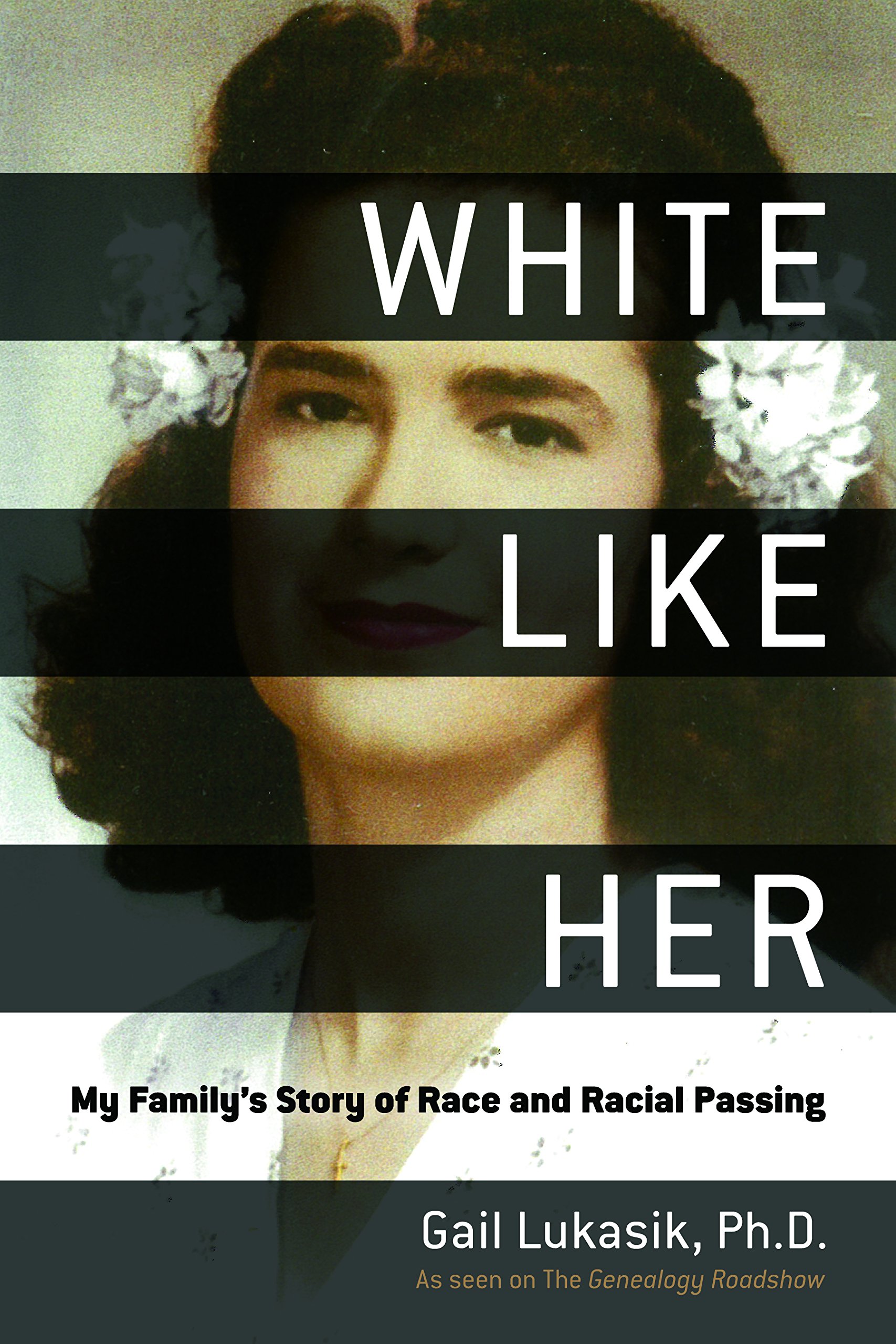
  • White Like Her: My Family’s Story of Race and Racial Passing

    Skyhorse Publishing
    2017-10-03
    304 pages
    Hardcover ISBN-13: 978-1510724129

    Gail Lukasik, Ph.D.

    Kenyatta D. Berry (foreword)

    White Like Her: My Family’s Story of Race and Racial Passing is the story of Gail Lukasik’s mother’s “passing,” Gail’s struggle with the shame of her mother’s choice, and her subsequent journey of self-discovery and redemption.

    In the historical context of the Jim Crow South, Gail explores her mother’s decision to pass, how she hid her secret even from her own husband, and the price she paid for choosing whiteness. Haunted by her mother’s fear and shame, Gail embarks on a quest to uncover her mother’s racial lineage, tracing her family back to eighteenth-century colonial Louisiana. In coming to terms with her decision to publicly out her mother, Gail changed how she looks at race and heritage.

    With a foreword written by Kenyatta Berry, host of PBS’s Genealogy Roadshow, this unique and fascinating story of coming to terms with oneself breaks down barriers.

  • We Were Eight Years in Power: An American Tragedy

    One World (An imprint of PenguinRandomHouse)
    2017-10-03
    400 pages
    6-1/8 x 9-1/4
    Hardcover ISBN: ISBN 9780399590566
    Paperback ISBN: 9780525624516
    Ebook ISBN: 9780399590580

    Ta-Nehisi Coates

    In these “urgently relevant essays,”* the National Book Award–winning author of Between the World and Me “reflects on race, Barack Obama’s presidency and its jarring aftermath”*—including the election of Donald Trump.

    “We were eight years in power” was the lament of Reconstruction-era black politicians as the American experiment in multiracial democracy ended with the return of white supremacist rule in the South. In this sweeping collection of new and selected essays, Ta-Nehisi Coates explores the tragic echoes of that history in our own time: the unprecedented election of a black president followed by a vicious backlash that fueled the election of the man Coates argues is America’s “first white president.”

    But the story of these present-day eight years is not just about presidential politics. This book also examines the new voices, ideas, and movements for justice that emerged over this period—and the effects of the persistent, haunting shadow of our nation’s old and unreconciled history. Coates powerfully examines the events of the Obama era from his intimate and revealing perspective—the point of view of a young writer who begins the journey in an unemployment office in Harlem and ends it in the Oval Office, interviewing a president.

    We Were Eight Years in Power features Coates’s iconic essays first published in The Atlantic, including “Fear of a Black President,” “The Case for Reparations,” and “The Black Family in the Age of Mass Incarceration,” along with eight fresh essays that revisit each year of the Obama administration through Coates’s own experiences, observations, and intellectual development, capped by a bracingly original assessment of the election that fully illuminated the tragedy of the Obama era. We Were Eight Years in Power is a vital account of modern America, from one of the definitive voices of this historic moment.

  • Still Processing: Being Biracial

    Still Processing
    The New York Times
    2017-10-05

    Wesley Morris and Jenna Wortham


    Rashida Jones as Santamonica, the sister of Tracee Ellis Ross’s character on ABC’s “Black-ish.”
    Credit Kelsey McNeal/Getty Images

    For months, the two of us have been trying to figure out a way to have a conversation about the experience of being biracial. This week we just go for it. First, we talk about the cultural and historical suspicion America still has of black-white interracial romantic relationships. It gives us an excuse to revisit the reason “Get Out” has been one of the year’s major movies: It articulates the previously inarticulable about race. Then we consider the offspring of interracial coupling — whether the possibility of occupying two identities (or more) is a choice, a luxury or a delusion; and what fears, doubts or envy nonbiracial black Americans might feel about biracial black Americans. We drop in on Spike Lee’sSchool Daze” and the sitcom “Black-ish.” We consider our feelings about Rashida Jones, Drake and Vin Diesel. We unpack the writings of Zadie Smith and Barack Obama. And we kind of have to ask: Aren’t we all a little bit mixed?

    Read the entire article here.