Mixed Race Studies

Scholarly perspectives on the mixed race experience.

    • About This Site
    • Bibliography
    • Contact Information
    • Date and Time Formats
    • Forthcoming… (Updated 2021-09-01)
    • Likely Asked Questions
    • List of Book Publishers
    • List of Definitions and Terms
    • My Favorite Articles and Papers
    • My Favorite Posts
    • My Recent Activities
    • Praise for Mixed Race Studies
    • Tag Listing
      • Tag Listing (Ordered by Count)
    • US Census Race Categories, 1790-2010
    • 1661: The First ‘Mixed-Race’ Milestone
    • 2010 U.S. Census – Some Thoughts

recent posts

  • The Routledge International Handbook of Interracial and Intercultural Relationships and Mental Health
  • Loving Across Racial and Cultural Boundaries: Interracial and Intercultural Relationships and Mental Health Conference
  • Call for Proposals: 2026 Critical Mixed Race Studies Conference at UCLA
  • Participants Needed for a Paid Research Study: Up to $100
  • You were either Black or white. To claim whiteness as a mixed child was to deny and hide Blackness. Our families understood that the world we were growing into would seek to denigrate this part of us and we would need a community that was made up, always and already, of all shades of Blackness.

about

  • Twitter
  • Facebook
  • Instagram
  • Mixed Art Conference

    2017-06-02

    Mixed Art Conference

    Toronto Central Grosvenor St. YMCA Centre
    20 Grosvenor Street
    Toronto, ON M4Y 2V5, Canada
    2017-06-03

    “The aim of this multidisciplinary biennial art conference is to co-create an inclusive dialogue about racialized mixed identities and lived realities through an intersectional lens.”

    For more information, click here.

  • A Chosen Exile: A History of Racial Passing in American Life, by Allyson Hobbs [Eggers Review]

    2017-05-29

    A Chosen Exile: A History of Racial Passing in American Life, by Allyson Hobbs

    The Black Scholar: Journal of Black Studies and Research
    Volume 47, 2017 – Issue 2: After Madiba: Black Studies in South Africa
    Pages 73-76
    DOI: 10.1080/00064246.2017.1295355

    Fabian Eggers, MA candidate of North American Studies
    John F. Kennedy Institute at Freie Universität, Berlin, Germany

    Allyson Hobbs, A Chosen Exile: History of Racial Passing in American Life (Cambridge: Harvard University Press, 2014)

    Read or purchase the review here.

  • SISS 2017: Race as Kink: Reading Transracial Fetishism – Public Lecture by Dr. Trish Salah

    2017-05-29

    SISS 2017: Race as Kink: Reading Transracial Fetishism – Public Lecture by Dr. Trish Salah

    Centre for Feminist Research at York University
    Keele Campus
    DB0014 (Victor Phillip Dahdaleh Building, formerly Technology Enhanced Learning [TEL] Building)
    4700 Keele Street
    Toronto, Ontario, Canada M3J 1P3
    Telephone: 416-736-2100
    Tuesday, 2017-06-06, 10:00-11:30 EDT (Local Time)

    Dr. Trish Salah, Assistant Professor
    Department of Gender Studies
    Queen’s University, Kingston, Ontario, Canada

    Introduced by Dr. John Greyson

    In what sense might we speak or think about race as libidinally charged? How do we understand racial identity as erotically invested and in what ways do we see object choice as racially inflected? To what extent are such libidinal economies of identity formation and object choice both ubiquitously alluded to and routinely disavowed? And what are the circumstances under which they present themselves as an occasion for scandal, crisis and conflict?

    Drawing upon Freud’s discussion of the place of disavowal in the constitution of desire, this talk is an attempt to think about the persistence, and affective charge, with which analogies between transgender identities and forms of racial passing or cross-identification, increasingly named as “transracialism,” are made.

    Dr. Trish Salah is Assistant Professor in the Department of Gender Studies at Queen’s University and the author of two poetry collections, the Lambda award-winning Wanting in Arabic and Lyric Sexology, Vol. 1…

    For more information, click here.

  • Australia’s ‘Stolen Generations’ Tell Their Stories

    2017-05-28

    Australia’s ‘Stolen Generations’ Tell Their Stories

    Lens: Photography, Video and Visual Journalism
    The New York Times
    2017-05-24

    Evelyn Nieves


    Margaret Furber was born in Alice Springs, Australia, in 1947. She was placed in St. Mary’s Hostel on the outskirts of town because her mother was not able to take care of her. Her siblings were all sent to the Tiwi Islands. “We were all taken and separated in different ways,” she told the photographer. Nov. 6, 2015.
    Matthew Sherwood

    Alfred Calma was 4 years old when the police snatched him from his mother, never to live with her again. Joyce Napurrula-Schroeder was not quite 2 when it happened to her. Luke Morcom was a newborn, barely a week on this earth.

    All had the bad luck of being born “half caste” during Australia’s disastrous experiment with forced assimilation. For 60 years, until 1970, government policies rounded up Aboriginal and Torres Strait Islander children deemed to be part-white and sent them to boarding schools and church-run missions. Like the Canadian First Nations’ and the United States’ Indian boarding schools that served as its model, Australia’s program aimed to beat out all traces of indigenous culture, often literally.

    Run more like penal colonies than schools, these institutions scarred their young wards and their communities for life.

    Decades later, when Matthew Sherwood, a Canadian photojournalist, began documenting survivors of the boarding schools — the “stolen generations,” as Australia calls them — they unleashed hellish memories where neglect was the best it ever got…

    Read the entire article here.

  • As a white supremacist society, the United States privileges Dolezal’s challenging ethnoracial boundaries.

    2017-05-28

    As a white supremacist society, the United States privileges [Rachel] Dolezal’s challenging ethnoracial boundaries. This is so unlike the thousands of blacks who quietly dissolved into the white population a century ago. A media stir would have cost them their lives. Even Anatole Broyard, the New York Times film critic who passed away in 1990 took his hidden blackness to the grave to be taken seriously in his career as a writer. At the same time, unlike the acceptance that many Afro-Brazilians have for their negra frustradas, many Afro-Americans find her problematic at best. Their relatives and ancestors who passed as white (or do so now) do not receive the same rewards. Instead, it has to be quiet without any fuss, for fear of upsetting the status quo.

    Chinyere Osuji, Ph.D., “Rachel Dolezal: ‘Negra Frustrada’ (Frustrated Black Woman),” Rutgers, The State University of New Jersey, May 24, 2017. http://chinyereosuji.camden.rutgers.edu/2017/05/24/rachel-dolezal-negra-frustrada-frustrated-black-woman/.

  • Children of black American GIs, Going on holiday with mum, Salome at the National Theatre

    2017-05-28

    Children of black American GIs, Going on holiday with mum, Salome at the National Theatre

    Woman’s Hour
    BBC Radio 4
    2017-05-19

    Jenni Murray, Presenter
    Beverley Purcell, Producer

    Carole Travers from Poole in Dorset is one of a number of mixed heritage children born to African-American fathers who were stationed in the UK during World War II. With their husbands away fighting the war, some women had relationships and children with them. Fiona Clampin talks to Carole who’s been trying to trace her father the whole of her adult life, and to John who is still deeply affected by his early experiences.

    With the Election looming, we’re in Sunderland talking to some women about the issue that most concern them. The South African playwright and theatre director Yael Farber discusses her new play Salome, at The National Theatre, a radical revision of the biblical tale. And the joys and pitfalls of going on holiday with your mum no matter what age you are.

    Listen to episode here.

  • After the first African slaves arrived at Jamestown, Virginia, a population of mixed-race blacks emerged. Their masters and fellow slaves celebrated their exotic features – not quite African, but not exactly white.

    2017-05-28

    After the first African slaves arrived at Jamestown, Virginia, a population of mixed-race blacks emerged. Their masters and fellow slaves celebrated their exotic features – not quite African, but not exactly white. The women were called “fancy girls” and paraded at quadroon balls, events for wealthy white men to meet and mingle with them. Lighter-skinned black men, meanwhile, were dubbed “run ‘round men” because, with their fairer skin, they could supposedly have their pick of any woman in the black community.

    Ronald Hall, “Too pretty to play? Stephen Curry and the light-skinned black athlete,” The Conversation, April 30, 2017. http://theconversation.com/too-pretty-to-play-stephen-curry-and-the-light-skinned-black-athlete-76638.

  • Open auditions being held to find someone to play Phil Lynott on the big screen

    2017-05-28

    Open auditions being held to find someone to play Phil Lynott on the big screen

    TheJournal.ie
    Dublin, Ireland
    2017-05-27


    Image: PA Archive/PA Images

    Jim Sheridan is working on the documentary about his rise to stardom.

    PRODUCERS ARE LOOKING for someone to play the part of Phil Lynott on the big screen.

    An open casting is being held in Dublin this afternoon for an actor/musician/singer, aged 18 – 35, to play the part of Lynott in a feature documentary about his rise to stardom.

    Six-time Oscar nominee Jim Sheridan and award winning documentary maker Colm Quinn are working together on the documentary. Sheridan said:

    “Having known Phil, and loving his music from the very start, it’s a great honour to celebrate his life and work on the big screen…

    Read the entire article here.

  • Rachel Dolezal: ‘Negra Frustrada’ (Frustrated Black Woman)

    2017-05-25

    Rachel Dolezal: ‘Negra Frustrada’ (Frustrated Black Woman)

    Chinyere Osuji
    Rutgers, The State University of New Jersey
    2017-05-24

    Chinyere Osuji, Ph.D., Assistant Professor of Sociology
    Rutgers University, Camden


    Rachel Dolezal

    Race is a social construction. We have heard that phrase over and over again to the point that it has become a bit hackneyed. When I teach my sociology students, I tell them, “Sociologists study what people do together: we create families, schools, economic systems.” All of these things are social constructions that are produced, reproduced, and even demolished because people together make it so.

    And then Rachel Dolezal comes along…

    Read the entire article here.

  • The struggles of war babies fathered by black GIs

    2017-05-24

    The struggles of war babies fathered by black GIs

    BBC News Magazine
    2017-05-21
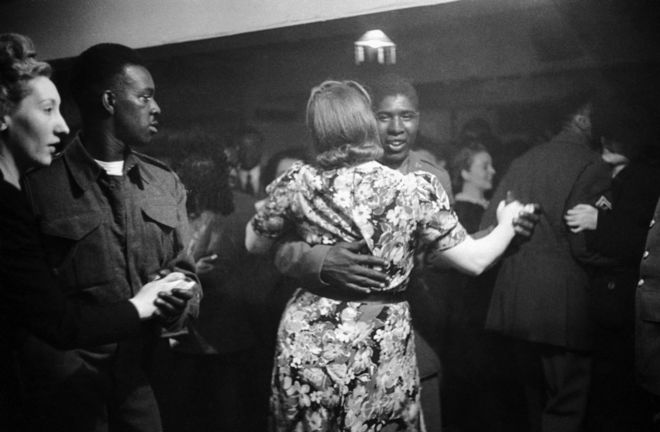

    Getty Images

    About 100,000 black GIs were stationed in the UK during the war. Inevitably there were love affairs, but US laws usually prevented black servicemen from marrying. So what happened to the children they fathered? Fiona Clampin met two such children in Dorset, now in their seventies, who have not given up hope of tracing their fathers.

    A bottle of champagne has sat on a shelf in Carole Travers’s wardrobe for the past 20 years. Wedged between boxes and covered with clothes, it’ll be opened only when Carole finds her father. “There’s an outside chance he might still be alive,” she reflects. “I’ve got so many bits of information, but to know the real truth would mean the world to me – to know that I did belong to somebody.”

    The possibility of Carole tracking down her father becomes more and more remote by the day. Born towards the end of World War Two, Carole, now 72, was the result of a relationship between her white mother and a married African-American or mixed-race soldier stationed in Poole, in Dorset.

    Whereas some “brown babies” (as the children of black GIs were known in the press) were put up for adoption, Carole’s mother, Eleanor Reid, decided to keep her child. The only problem was, she was already married, with a daughter, to a Scot with pale skin and red hair.

    “I had black hair and dark skin,” says Carole. “Something obviously wasn’t right.”…

    Read the entire article here.

Previous Page
1 … 279 280 281 282 283 … 1,428
Next Page

Designed with WordPress