Mixed Race Studies

Scholarly perspectives on the mixed race experience.

    • About This Site
    • Bibliography
    • Contact Information
    • Date and Time Formats
    • Forthcoming… (Updated 2021-09-01)
    • Likely Asked Questions
    • List of Book Publishers
    • List of Definitions and Terms
    • My Favorite Articles and Papers
    • My Favorite Posts
    • My Recent Activities
    • Praise for Mixed Race Studies
    • Tag Listing
      • Tag Listing (Ordered by Count)
    • US Census Race Categories, 1790-2010
    • 1661: The First ‘Mixed-Race’ Milestone
    • 2010 U.S. Census – Some Thoughts

recent posts

  • The Routledge International Handbook of Interracial and Intercultural Relationships and Mental Health
  • Loving Across Racial and Cultural Boundaries: Interracial and Intercultural Relationships and Mental Health Conference
  • Call for Proposals: 2026 Critical Mixed Race Studies Conference at UCLA
  • Participants Needed for a Paid Research Study: Up to $100
  • You were either Black or white. To claim whiteness as a mixed child was to deny and hide Blackness. Our families understood that the world we were growing into would seek to denigrate this part of us and we would need a community that was made up, always and already, of all shades of Blackness.

about

  • Twitter
  • Facebook
  • Instagram
  • A Good Fellow and a Wise Guy

    2017-03-13

    A Good Fellow and a Wise Guy

    The New York Sun
    2006-08-09

    William Bryk

    Book Review
    A Pickpocket’s Tale: The Underworld of Nineteenth-Century New York
    by Timothy J. Gilfoyle

    George Washington Appo, the once notorious Asian-Irish-American petty criminal who flourished during the last quarter of the 19th century as a pickpocket and swindler, had pretty much faded into obscurity at his death in 1930, aged 73. Even the street where he lived, Donovan’s Lane (better known as Murderer’s Alley) is gone, buried with the infamous Five Points slum beneath the federal courthouses in Foley Square.

    Appo resurfaced in Luc Sante’s 1991 best seller, “Low Life,” which briefly presents him as a buffoon, incompetent even as a crook. If Timothy J. Gilfoyle’s “A Pickpocket’s Tale” (W.W. Norton, 460 pages,$27.95) serves any purpose, it corrects this slur on Appo’s reputation. Appo practiced pick-pocketing as others practice dentistry or law: He was a thorough professional who picked thousands, if not tens of thousands, of pockets during his career, usually making as much money in a day as the average workingman then made in a year. He was imprisoned four times for pickpocketing, all while still relatively young. He apparently accepted jail as an inevitable cost of doing business…

    Read the entire review here.

  • Before “Hidden Figures,” There Was a Rock Opera About NASA’s Human Computers

    2017-03-13

    Before “Hidden Figures,” There Was a Rock Opera About NASA’s Human Computers

    Air & Space Magazine
    2017-02-03

    Linda Billings, Senior Editor

    Katherine Johnson’s inspirational story came to the Baltimore stage in 2015, thanks to another space scientist.

    “Hidden Figures,” the story of three African-American women whose mathematical skill helped NASA launch astronauts into space and back in the early 1960s, has been both a critical and box office success. With more than $100 million in ticket sales and a stack of award nominations, the movie has inspired audiences with a true story made even more powerful by virtue of the fact that it was largely untold for 50 years. And still mostly unknown is the story of another NASA scientist who beat Hollywood to the punch by putting “human computer” Katherine Johnson’s saga on stage almost two years ago.

    Heather Graham is an astrobiologist at NASA’s Goddard Space Flight Center outside Washington, D.C. She’s also a gamer, a feminist, and a member of the Baltimore Rock Opera Society. In May 2015, the society staged Graham’s one-act rock opera, “Determination of Azimuth,” which portrays how Johnson and her colleagues Mary Jackson and Dorothy Vaughan, were ignored and demeaned on the job at NASA’s Langley Research Center in Virginia, because they were black and female. The story has a happy ending: Their work was validated, their expertise accepted. But they had to endure racism and sexism along the way…

    Read the entire article here.

  • Mixed Race Privilege?

    2017-03-12

    Mixed Race Privilege?

    KQED Radio
    San Francisco, California
    2017-03-09

    Sierra Fang-Horvath
    Oakland, California

    My mom is Chinese, with black hair and tan skin. My dad is white, with light eyes and skin the color of office paper. I, on the other hand, am an awkward midway point: dark skin, but not super dark; black hair, but not super black.

    It used to be that I never thought about my mixed race. But as I’ve gotten older, and now that I attend a predominantly white suburban school, race is constantly on my mind.

    Recently, my classmates and I participated in a survey calculating our privilege…

    Read the story here. Listen to the story (00:02:20) here.

  • News from our Graduate Students: PhD candidate Kristina Pilz

    2017-03-12

    News from our Graduate Students: PhD candidate Kristina Pilz

    University of Washington
    Department of Germanics
    2017-03-08

    Kristina Pilz


    Kristina Pilz

    BlackWhite — Experiences and Writing Practices in Contemporary Afro-German Literature

    I am excited to continue working on my dissertation that describes innovative writing practices in contemporary Afro-German literature. My project focuses on rhetorical, intertextual and aesthetic strategies as creative devices for a diasporic literary history. My analysis includes fictional/non-fictional texts comprised of Afro-German poetry and autobiographies…

    Read the entire article here.

  • Let’s Stop This Offensive Term From Making A Comeback

    2017-03-12

    Let’s Stop This Offensive Term From Making A Comeback

    Refinery 29
    2017-03-09

    Anna Jay & Rebecca Gonsalves

    The other night I was out with a friend, and her friends, and their friends. You know, one of those evenings where you walk into the pub and realise you don’t know anyone. But seeing as this isn’t the first day of primary school and you can’t wail and cling to your mum’s leg, you have to suck it up, get a drink and start mingling.

    The evening progressed and it seemed to be going well: small talk was made, jokes (and shots) were shared. On the dance floor, a new acquaintance leaned in all conspiratorial to tell me something about having slept with a guy at the bar. “Over there,” she said. “The half-caste guy.” The music was loud but there was no mistaking that ugly, old-fashioned phrase. I felt physically jarred, the blood rushing to my face. I usually hate confrontation – who doesn’t – but get a drink or two in me and I become altogether more argumentative…

    Read the entire article here.

  • Biracial composer seeks her ‘true name’ through piece for North Corner Chamber Orchestra

    2017-03-12

    Biracial composer seeks her ‘true name’ through piece for North Corner Chamber Orchestra

    The Seattle Times
    2017-02-16

    Jason Victor Serinus, Special to The Seattle Times


    Composer Hanna Benn

    NOCCO’s Feb. 18-19 concerts will feature a work by local composer Hanna Benn; works by Davida Ingram, Alex Guy and Rick Benjamin, rooted in Scott Joplin’s opera, “Treemonisha”; and works by Alvin Singleton and George Walker.

    It is the very subject of “Resonance,” North Corner Chamber Orchestra’s concert “Celebrating Black American Composers,” that left Seattle-based composer Hanna Benn, 29, in a bit of quandary. As much as she was delighted to work with one of the world’s few conductorless chamber orchestras, her commission to honor black American composers left her pondering the fact that she is biracial, and does not see herself as either black or white.

    “For the last couple of years, I’ve been trying to understand where I come from, and my responsibility as a biracial person,” she explained by phone and email. “I want to completely embrace my blackness / my whiteness.”…

    Read the entire article here.

  • Critical Mixed Race Studies w Steven F. Riley

    2017-03-12

    Critical Mixed Race Studies w Steven F. Riley

    iMiXWHATiLiKE!
    2017-03-05

    Jared A. Ball, Host and Associate Professor of Communication Studies
    Morgan State University, Baltimore, Maryland

    Steven F. Riley, curator of MixedRaceStudies.org, joined us for this discussion of mixed race studies, popular culture and the shifting terrain of race and identity.

    Watch the entire interview (00:21:02) here.

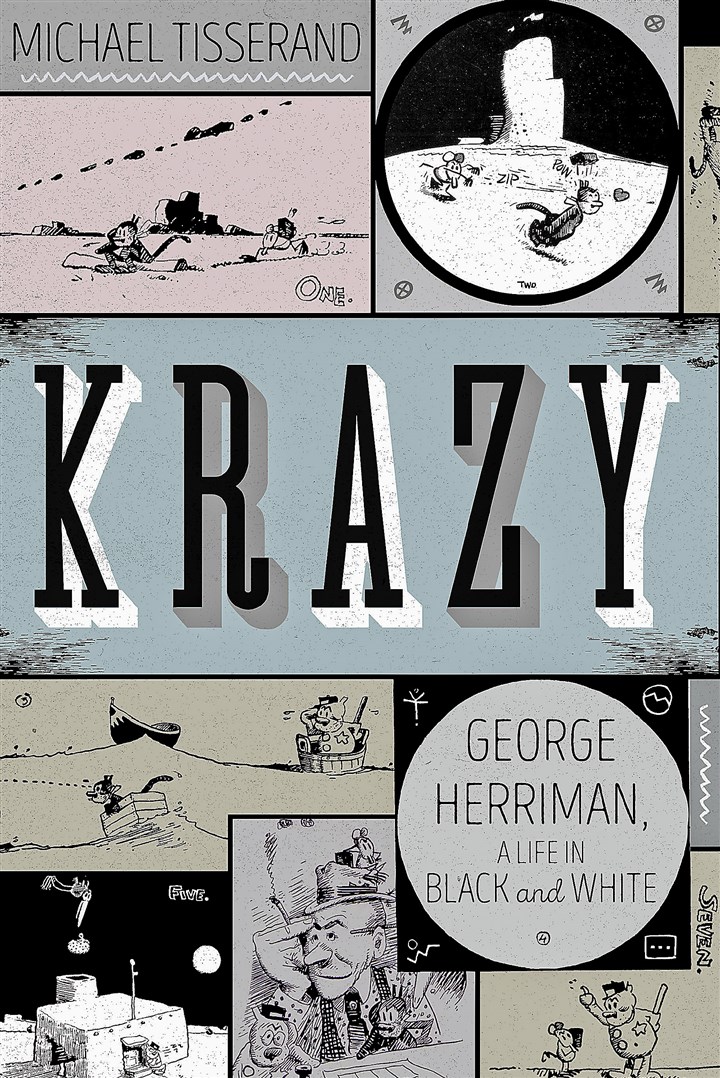
  • ‘Krazy: George Herriman, a Life in Black and White’: A life as unorthodox as his comic strip

    2017-03-12

    ‘Krazy: George Herriman, a Life in Black and White’: A life as unorthodox as his comic strip

    Pittsburgh Post-Gazette
    2017-02-19

    Wayne Wise


    “Krazy: George Herriman, A Life in Black and White” by Michael Tisserand.

    Ignatz Mouse: “Hey, this isn’t black coffee!!!”

    Krazy Kat: “Sure it is. Look unda the milk.”

    “Krazy Kat,” created by George Herriman, is one of the most influential comic strips of all time. Centered around the iconic love triangle of Krazy, Ignatz Mouse and Offisa Pupp, the feature ran as a syndicated newspaper strip from 1913 to 1944. To a modern audience the strip can be difficult to understand, if not impenetrable. The pacing and sense of humor of 100 years ago feel foreign to current trends. There are references that were common at the time that are lost to us now. The language used is an idiosyncratic patois of nonsense poetry.

    The backgrounds, while beautifully rendered, are a constantly changing surreal backdrop. Characters frequently broke the fourth wall, commenting directly on their status as cartoons. The title character, Krazy Kat, was of indeterminate gender, referred to with shifting pronouns, sometimes within the same sentence. As a whole, Krazy Kat was an ongoing challenge to the reader’s perception of definitions and boundaries.

    Creator George Herriman was born in New Orleans in 1880. In the latter part of the 19th century his family moved to Los Angeles where his father worked as a tailor and George began his art career, eventually becoming one of the most famous and celebrated cartoonists in history. This is a distinction that would not have been possible if the truth of his life had been known at the time.

    In 1971, while researching Mr. Herriman for an entry in the Dictionary of American Biography, professor Arthur Berger discovered a previously unknown fact. On his birth certificate Mr. Herriman was listed as “colored.” It had always been assumed that he was a white man. Mr. Herriman, to use the terminology of the time, “passed for white” his entire life, at a time when his color would have prevented him from many, if not all, of the achievements he is known for…

    Read the entire article here.

  • The Strange Career of William Ellis: Texas Slave to Mexican Millionaire

    2017-03-12

    The Strange Career of William Ellis: Texas Slave to Mexican Millionaire

    Columbia News: Office of Communications and Public Affairs
    Columbia University, New York, New York
    2016-06-28


    Karl Jacoby

    The odds were certainly against William Henry Ellis, who was born into slavery on a Texas cotton plantation near the Mexico border.

    But a combination of sheer moxie, an ability to speak Spanish and an olive skin allowed Ellis to reinvent himself. By the turn of the 20th century, he was Guillermo Enrique Eliseo, a successful Mexican entrepreneur with an office on Wall Street, an apartment on Central Park West and business dealings with companies and corporations halfway around the world.

    His unusual life story is told in a new book titled The Strange Career of William Ellis: The Texas Slave Who Became a Mexican Millionaire by Karl Jacoby, a professor in the history department and the Center for the Study of Ethnicity and Race. Ellis “learned how to be what people wanted him to be, and how to be sure that people would see what they want to see,” Jacoby said…

    Read the entire article here.

  • Lost Boundaries (1949)

    2017-03-11

    Lost Boundaries (1949)

    Visual Parables: A leading resource for faith-and-film reviews and study guides
    2014-05-24

    Ed McNulty

    Not Rated. Running time: 1 hour 39 min.

    Our content rating (1-10): V 0; L 1; S/N 1.

    Our star rating (1-5): 4

    Philip Roth’s novel and the film made from it, The Human Stain, were both very much on my mind when I came across at a Hollywood Video store the video of this 1949 film about a “Negro” man and his wife who pass for white for twenty years. Seeing that its producer also was the producer for Martin Luther, I felt that I was led to this discovery, and so purchased it. Turns out this is a good film, based on “a true story” from Reader’s Digest. Made in the same year as the other film exploring the same theme, Pinky, Lost Boundaries is not as well known, possibly because the former boasts a better-known director (Elia Kazan) than Alfred L. Werker and a far more star-studded cast (Jeanne Crain, Ethel Barrymore, Ethel Waters and William Lundigan. The star of Lost Boundaries was the debut film of an actor who would go on to renown, Mel Ferrer. Like Jeanne Craine, Ferrer was a white playing a Negro, standard Hollywood procedure, even for major Asian roles, as in The Good Earth or Shangri La…

    Read the entire review here.

Previous Page
1 … 305 306 307 308 309 … 1,428
Next Page

Designed with WordPress