• Native American Tribal Disenrollment Reaching Epidemic Levels

    VOA News
    2017-03-03
    Cecily Hilleary


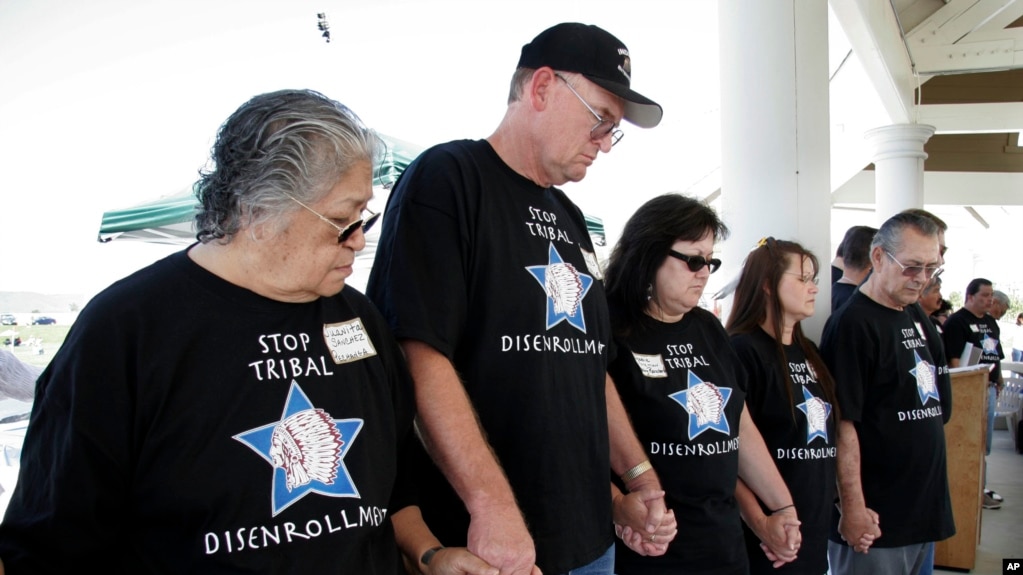
    FILE – Protesters hold hands in prayer in Temecula, Calif., at a rally protesting the disenrollment of tribal members, Saturday, May 21, 2005. More than a hundred ousted members of tribes from California and five other states gathered to denounce being disenrolled.

    All across Indian Country, Native Americans are being evicted from their tribes, with little warning and little legal recourse.

    Take, for example, the Pechanga Band of Luiseno Mission Indians, a federally-recognized tribe of Luiseno Indians living on a reservation in Temecula, California, part of the territory where their ancestors lived for 10,000 years.

    If you want to be a member, you must prove direct lineage to one or more of the original ancestors forced onto the reservation in the early 1880s.

    Pechanga Indian Rick Cuevas traces his ancestry to a woman named Paulina Hunter, who was granted a lot of land on the Pechanga reservation in the late 1800s. He and his family have lived on the reservation as full tribal members for decades.

    But in the early 2000s, the tribal council decided to posthumously disenroll Hunter and, by extension, about 180 of her descendants…

    An alien concept

    Disenrollment is not native to indigenous cultures, who Galanda said traditionally understood “belonging” in terms of kinship and personal choice, not “blood quantum,” a measurement introduced by the U.S. government.

    “The U.S. introduced its concept of who’s an Indian by declaring, under the Indian Reorganization Act of 1934, that an Indian must be in residence in a reservation likely established by the treaties of the 1800s and be of one-quarter Indian blood,” he said. “The challenge today is that many tribes, if not most tribes, use the Federal government’s criteria for who’s an Indian.”…

    Read the entire article here.

  • I Thought I Was Prepared to Marry a Black Man, But I Had NO Idea

    For Every Mom
    2017-03-05

    Chelsie Dort

    I had no idea what racism was until I married a black man.

    It was a little over two and a half years ago, right before I was about to be married that I was asked the question, “Are you prepared for what you and your family will experience seeing as how you are marrying a black man?” Being a white girl raised in Salt Lake City, Utah I was offended. The man I was speaking with took notice to my offense and simply said “I don’t mean to hurt you, I just wanted to make sure that you were aware that things will be different than I think you are expecting. Things will be harder.” I explained that I was fine and that things were going to be great.

    Two and a half wonderful years later, our son is now 5 and our youngest is almost 2 and the woman that I am now often looks back at that day and wishes I could have understood what he meant. I wish I would have understood that my husband would be pulled from his car and handcuffed, placed face down on the ground and arrested while I watched his helpless face, all because he had recently expired tags on his car. I wish I would have known that people would accuse my husband of kidnapping our oldest son because he’s white while simultaneously praising me for being a saint who graciously adopted a little black boy. I wish I would have understood the mean words that can escape someone’s lips when speaking about our mixed little family and the heartache that follows. I wish I would have used that time to consider how I would explain to my boys why people weren’t always nice…

    Read the entire article here.

  • Get Out Perfectly Captures the Terrifying Truth About White Women

    Cosmopolitan
    2017-02-28

    Kendra James
    New York, New York


    Blumhouse Productions

    There are many scary things about the movie, but scariest of all is its realistic depiction of racism.

    Major spoilers ahead.

    In Get Out, writer-director Jordan Peele takes 90 minutes to meditate on a lesson Kim Kardashian once spelled out for America via snake emojis and Taylor Swift: White women are not to be trusted.

    I’ll let you decide how offended you want to be by that thesis while I spoil the hell out of this movie.

    Get Out draws on the terrifying elements you might expect to find in your typical February horror movie release. There’s hypnotism, multiple jump-scares, a Deliverance-style redneck, and an illicit basement surgery where a doctor operates on people’s brains without their consent. As scary as any of these things are, they’re tropes we can all recognize as pure fiction, for the most part. They’re things we’re still more likely to run into in film, books, or television rather than in our everyday lives.

    Unfortunately, the horrors of racism and white womanhood aren’t confined to imagination and pop culture. In using both realities in his movie, Peele brings Get Out to a higher level of horror, at least for any person of color in the audience. We’re all keenly aware of how possible it is…

    …Jordan Peele is married to and expecting a child with a white woman, Brooklyn Nine-Nine’s Chelsea Peretti. He’s also biracial; his mother is white. But as he reaffirms in his latest Nerdist interview with Chris Hardwick, Peele sees himself — and experiences the world — as a black man. American history is littered with the bodies of black men jailed, beaten, and killed due to the simple words of white women. “A few months later… two negro boys, ages 8 and 9 were arrested, tried, and sent to reform school for allegedly kissing or allowing themselves to be kissed by a neighborhood playmate, a 7-year-old white girl!” Langston Hughes wrote in 1962. ..

    Read the entire review here.

  • The invention of ‘Hispanics’ created a political force of 27 million strong

    Timeline
    2017-03-02

    Heather Gilligan, Senior Editor


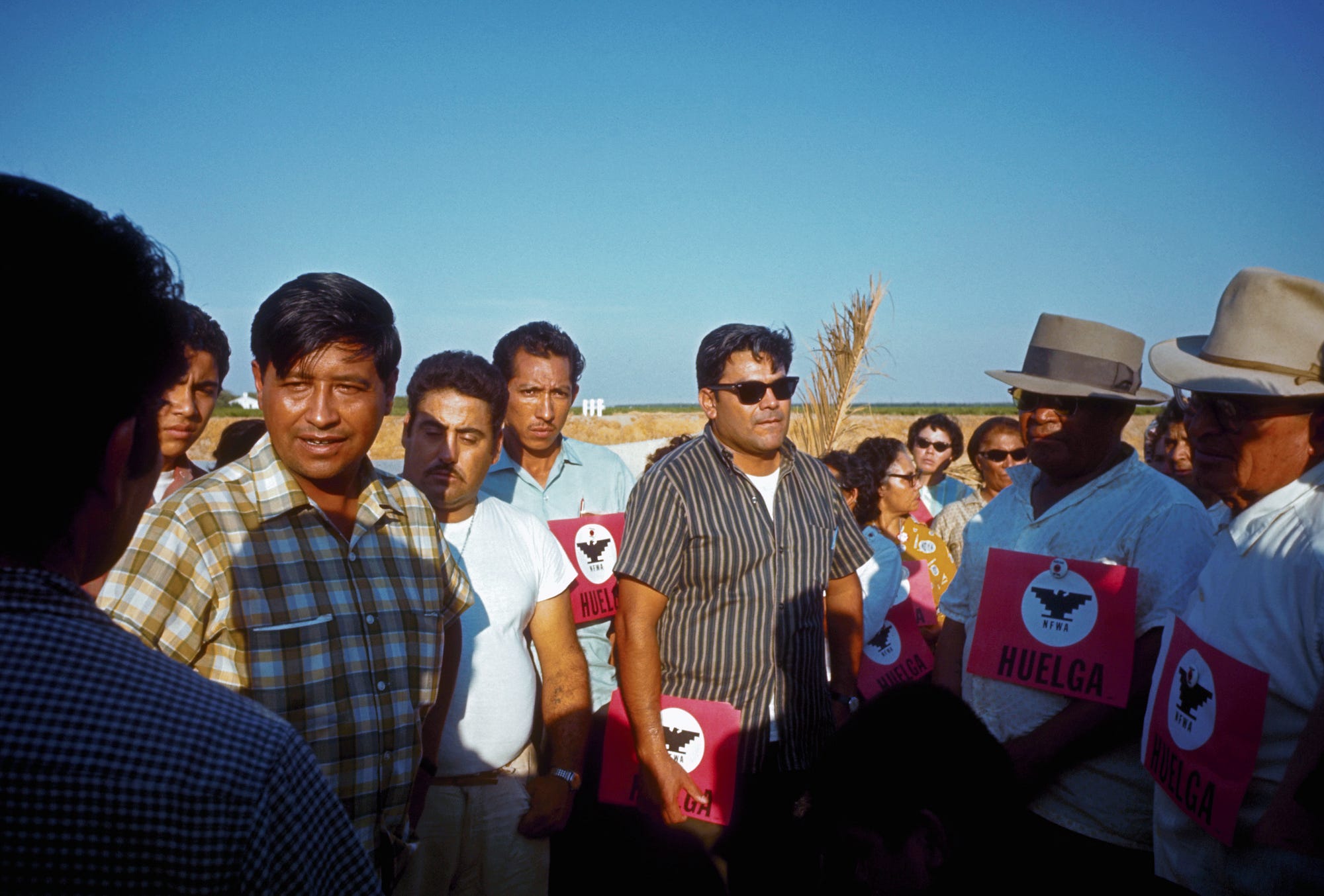
    Cesar Chavez (left), leader of the National Farm Workers Association, stands with a group of striking workers in Delano, California, in 1975. (Ted Streshinsky/Getty Images)

    Before 1970, they were considered white by the government

    On a California morning in 1969, as dawn outlined the nearby mountain ridges in purple, a pickup truck bounced down a dirt road in the Coachella Valley, filled with activists urging farmhands still picking grapes to join a statewide strike for higher wages. “These workers are so afraid of their employers,” labor organizer Dolores Huerta explained to The New York Times.

    Meanwhile, on the East Coast, against a backdrop of overcrowded tenements in Spanish Harlem, a radical group of 20-something Puerto Ricans protested unsanitary living conditions by blocking Third Avenue with a garbage fire. The trash they burned had sat on the curb for days, creating a veritable rat-topia, as garbage trucks rumbled along, cleaning up regularly in richer, whiter neighborhoods.

    Puerto Ricans and Mexicans like these faced many of the same hardships—including the high rates of poverty that went hand in hand with their experience employment discrimination, dilapidated housing, and substandard schools that were ill-equipped to deal with Spanish-speaking students—but what they lacked was a cohesive political identity, an identifiable voting bloc…

    Read the entire article here.

  • 2017 PEN/Joyce Osterweil Award For Poetry

    PEN America
    2017-01-18

    Winner

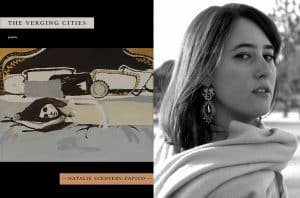
    Natalie Scenters-ZapicoThe Verging Cities (Center For Literary Publishing/Colorado State University)

    The PEN/Joyce Osterweil Award for Poetry of $5,000 is given in odd-numbered years and recognizes the high literary character of the published work to date of a new and emerging American poet of any age and the promise of further literary achievement…

    Read the entire article here.

  • ARMOR: Biracial in the Deep South – a documentary about biracial life in the American South with filmmaker Sarah Gambles, Ep. 107

    Multiracial Family Man
    2017-03-05

    Alex Barnett, Host

    Ep. 107: Sarah Gambles is a Hawaiian-born, Biracial (Black-White), filmmaker with family ties in her current home state of Alabama.  After years of teaching, Sarah returned to her creative roots, launching her own production company, SarahFinah Films.  Under the umbrella of that production company, she has now created a new film ARMOR: Biracial in the Deep South – a look at the Biracial population in America’s South, the fastest growing, yet most underrepresented demographic in that region.

    Listen as Sarah speaks with Alex about her own life and experience.  Her journey from creative pursuits into teaching and back to filmmaking.  And, her hopes and expectations about the role her film can play in educating people about the Multiracial experience.  Don’t miss it!

    Listen to the episode here. Download the episode here.

  • What Biracial People Know

    Sunday Review
    The New York Times
    2017-03-04

    Moises Velasquez-Manoff


    Lynnie Z.

    After the nation’s first black president, we now have a white president with the whitest and malest cabinet since Ronald Reagan’s. His administration immediately made it a priority to deport undocumented immigrants and to deny people from certain Muslim-majority nations entry into the United States, decisions that caused tremendous blowback.

    What President Trump doesn’t seem to have considered is that diversity doesn’t just sound nice, it has tangible value. Social scientists find that homogeneous groups like his cabinet can be less creative and insightful than diverse ones. They are more prone to groupthink and less likely to question faulty assumptions.

    What’s true of groups is also true for individuals. A small but growing body of research suggests that multiracial people are more open-minded and creative. Here, it’s worth remembering that Barack Obama, son of a Kenyan father and a white Kansan mother, wasn’t only the nation’s first black president, he was also its first biracial president. His multitudinous self was, I like to think, part of what made him great — part of what inspired him when he proclaimed that there wasn’t a red or blue America, but a United States of America.

    As a multiethnic person myself — the son of a Jewish dad of Eastern European descent and a Puerto Rican mom — I can attest that being mixed makes it harder to fall back on the tribal identities that have guided so much of human history, and that are now resurgent. Your background pushes you to construct a worldview that transcends the tribal…

    …Consider this: By 3 months of age, biracial infants recognize faces more quickly than their monoracial peers, suggesting that their facial perception abilities are more developed. Kristin Pauker, a psychologist at the University of Hawaii at Manoa and one of the researchers who performed this study, likens this flexibility to bilingualism…

    Early on, infants who hear only Japanese, say, will lose the ability to distinguish L’s from R’s. But if they also hear English, they’ll continue to hear the sounds as separate. So it is with recognizing faces, Dr. Pauker says. Kids naturally learn to recognize kin from non-kin, in-group from out-group. But because they’re exposed to more human variation, the in-group for multiracial children seems to be larger.

    This may pay off in important ways later. In a 2015 study, Sarah Gaither, an assistant professor at Duke, found that when she reminded multiracial participants of their mixed heritage, they scored higher in a series of word association games and other tests that measure creative problem solving. When she reminded monoracial people about their heritage, however, their performance didn’t improve. Somehow, having multiple selves enhanced mental flexibility…

    Read the entire article here.

  • Why You Can’t Ever Call an Enslaved Woman a “Mistress”

    Teen Vogue
    2017-02-27

    Lincoln Blades

    This is an important Black History Month PSA.

    In the black community, many different opinions abound regarding the usefulness of Black History Month. For some, it is viewed as a necessary and critical tool for cultural celebration and propagating the importance of our collective historical achievements, which otherwise would go unnoticed. For others, it feels like a reductive display of forced lip service conducted during the shortest and coldest month of the year, in lieu of providing us with a more sustained and inclusive role in the everyday curriculum. But what we all can agree on is that presenting our history in a wholly accurate and factual manner delivered with the correct context is of the utmost importance, which is why we react so strongly to inaccurate and/or misrepresentative claims.

    That irritation was inflamed this past weekend when The Washington Post published an article about a restoration that would be occurring at Monticello, the plantation of America’s third president, Thomas Jefferson, which is operated as a museum. The restoration to be completed will involve unmasking a bathroom installed in 1941 just steps from Jefferson’s bedroom to reveal what the room really was: Sally Hemings’s bedroom…

    Read the entire article here.

  • For decades they hid Jefferson’s relationship with her. Now Monticello is making room for Sally Hemings.

    The Washington Post
    2017-02-19

    Krissah Thompson


    By excavating and restoring areas where the slave community lived and worked, Monticello is trying to more fully integrate their stories at the historic plantation. A special focus will be placed on Sally Hemings, whose room in the house will soon be on display for the first time.

    CHARLOTTESVILLE — The room where historians believe Sally Hemings slept was just steps away from Thomas Jefferson’s bedroom. But in 1941, the caretakers of Monticello turned it into a restroom.

    The floor tiles and bathroom stalls covered over the story of the enslaved woman, who was owned by Jefferson and had a long-term relationship with him. Their involvement was a scandal during his life and was denied for decades by his descendants. But many historians now believe the third president of the United States was the father of her six children.

    Time, and perhaps shame, erased all physical evidence of her presence at Jefferson’s home here, a building so famous that it is depicted on the back of the nickel.

    Now the floor tiles have been pulled up and the room is under restoration — and Hemings’s life is poised to become a larger part of the story told at Monticello…

    Read the entire article here.

  • Like many mixed race kids I felt that I didn’t belong anywhere, but I wasn’t really an outsider: I was full of the invisible tensions of inside, hyper-aware of the contradictions and tensions my friends and peers ignored or never saw in the first place. I couldn’t put a name to any of it then, it was just this intuitive sense of the anger and hatred that pulse through modern life, how America in all of its contradictions hates itself and how that hatred is everywhere and nowhere to see, layered over with sanctioned forms of like and dislike, but never love, that spiritual love Mimi was drawing always closer to — never love because love is too close to hate for America to allow it into daylight.

    Lawrence-Minh Bùi Davis, “Dispatch from the Floor of the Model Minority Factory,” The Offing, September 8, 2015. https://theoffingmag.com/essay/dispatch-from-the-floor-of-the-model-minority-factory/.