Mixed Race Studies

Scholarly perspectives on the mixed race experience.

    • About This Site
    • Bibliography
    • Contact Information
    • Date and Time Formats
    • Forthcoming… (Updated 2021-09-01)
    • Likely Asked Questions
    • List of Book Publishers
    • List of Definitions and Terms
    • My Favorite Articles and Papers
    • My Favorite Posts
    • My Recent Activities
    • Praise for Mixed Race Studies
    • Tag Listing
      • Tag Listing (Ordered by Count)
    • US Census Race Categories, 1790-2010
    • 1661: The First ‘Mixed-Race’ Milestone
    • 2010 U.S. Census – Some Thoughts

recent posts

  • The Routledge International Handbook of Interracial and Intercultural Relationships and Mental Health
  • Loving Across Racial and Cultural Boundaries: Interracial and Intercultural Relationships and Mental Health Conference
  • Call for Proposals: 2026 Critical Mixed Race Studies Conference at UCLA
  • Participants Needed for a Paid Research Study: Up to $100
  • You were either Black or white. To claim whiteness as a mixed child was to deny and hide Blackness. Our families understood that the world we were growing into would seek to denigrate this part of us and we would need a community that was made up, always and already, of all shades of Blackness.

about

  • Twitter
  • Facebook
  • Instagram
  • Hollywood has long shown discomfort with interracial couples, but change is happening

    2016-11-11

    Hollywood has long shown discomfort with interracial couples, but change is happening

    The Los Angeles Times
    2016-11-10

    Lewis Beale


    Katherine Houghton puts a flower in Sidney Poitier’s hair in a scene from the film “Guess Who’s Coming To Dinner.” (Getty Images)

    In 1967, the same year the Supreme Court case Loving vs. Virginia struck down laws banning miscegenation, Sidney Poitier starred in “Guess Who’s Coming to Dinner” as a black man romantically involved with blond Katherine Houghton.

    Yet in both real and reel life, black-white romantic relationships were problematic, fraught with legal and social taboos. In the case of Loving, that meant rural Virginia couple Richard and Mildred Loving, who married in Washington, D.C., in 1958, were arrested in their home state, forced to move away or be jailed, and spent years fighting the racist law that affected them until the Supreme Court unanimously overturned it.

    “The fact any miscegenation laws even existed, these are vestiges of slavery,” says Jeff Nichols, director of “Loving,” a new film based on the famous case starring Joel Edgerton and Ruth Negga. “All of this speaks to the institutionalized racism in the South.”

    “Guess,” which was released six months after the Loving decision, was, in its own way, meant to be a liberal antidote to situations like this. In director Stanley Kramer’s film,  parents and friends of the romantic couple discuss the pros and cons of their romance in a civilized manner until the woman’s father (played by Spencer Tracy) gives his blessing to the relationship…

    Read the entire article here.

  • Black Like Us

    2016-11-11

    Black Like Us

    Original Works Publishing
    2016-11-08
    102 pages
    Paperback ISBN: 978-1630920944

    Rachel Atkins

    Foreword by Allyson Hobbs, Ph.D

    Family secrets ripple through time when three present-day sisters discover the truth about a young African-American woman passing for white sixty years before. What happens in between is a frank and funny look at the shifting boundaries of tolerance and what identity really means.

  • BrownBox Theatre and Sound Theatre Company to Present Encore Reading of BLACK LIKE US

    2016-11-10

    BrownBox Theatre and Sound Theatre Company to Present Encore Reading of BLACK LIKE US

    Broadway World
    2016-11-05

    BWW News Desk

    To celebrate the publication of the play Black Like Us, BrownBox Theatre joins forces with Sound Theatre Company to present an “encore” staged reading of the Gregory Award Winning Play at the Langston Hughes Performing Arts Institute. Black Like Us is a funny, poignant, and deeply relevant story about the bonds of family, the struggles of identity, and the far-reaching effects of one woman’s decision. The play is set in Seattle’s Central District neighborhood, not far from the location of the Langston Hughes Performing Arts Institute, and spans decades of change that have impacted that community.

    In their second collaboration, BrownBox Theatre and Sound Theatre Company present the staged reading of Gregory Award winning play

    Black Like Us at the Langston Hughes Performing Arts Institute. Performances are Saturday, November 19 at 2:00pm and at 7:00 pm and free and open to the public. There is a reception between the performances to celebrate the publication of this script and the work of playwright Rachel Atkins and the companies of artists who helped to develop this multi-award-winning play.

    Sound Theatre Company and BrownBox Theatre last collaborated on the 2015 production of Marcus Gardley’s visionary and poetic play, …And Jesus Moonwalks the Mississippi at the Center Theatre at the Seattle Center Armory.

    In 1958, a young African-American woman makes the life-changing decision to start passing for white, creating a ripple effect through multiple generations. In 2013, her granddaughters accidentally discover her secret and seek out the family she left behind. Moving back and forth through time, what happens in between is a frank and funny look at the shifting boundaries of tolerance, as they are all faced with the many questions of what identity really means…

    Read the entire article here.

  • ‘Loving’ inspires a DIY Film Festival of miscegenation films and shows you need to see…

    2016-11-10

    ‘Loving’ inspires a DIY Film Festival of miscegenation films and shows you need to see…

    CinemaInMind: Thinking about film… and other stuff
    2016-11-03

    Tim Cogshell, Critic At Large
    Alt Film Guide

    You don’t need to wait for the local art house to put on a themed film festival. Tim Cogshell, film critic for KPCC’s Filmweek and Alt Film Guide, and who blogs at CinemaInMind, is producing a series of DIY Film Festivals for Off-Ramp listeners to throw in the comfort of their own homes…

    Read the entire article here.

  • From Raised Eyebrows To Raised Curtains: Rachel Atkins Tackles Racial Identity

    2016-11-10

    From Raised Eyebrows To Raised Curtains: Rachel Atkins Tackles Racial Identity

    KUOW.org 94.9 FM: Seattle News & Information
    Seattle, Washington
    2014-02-27

    Marcie Sillman, Arts and Culture Reporter


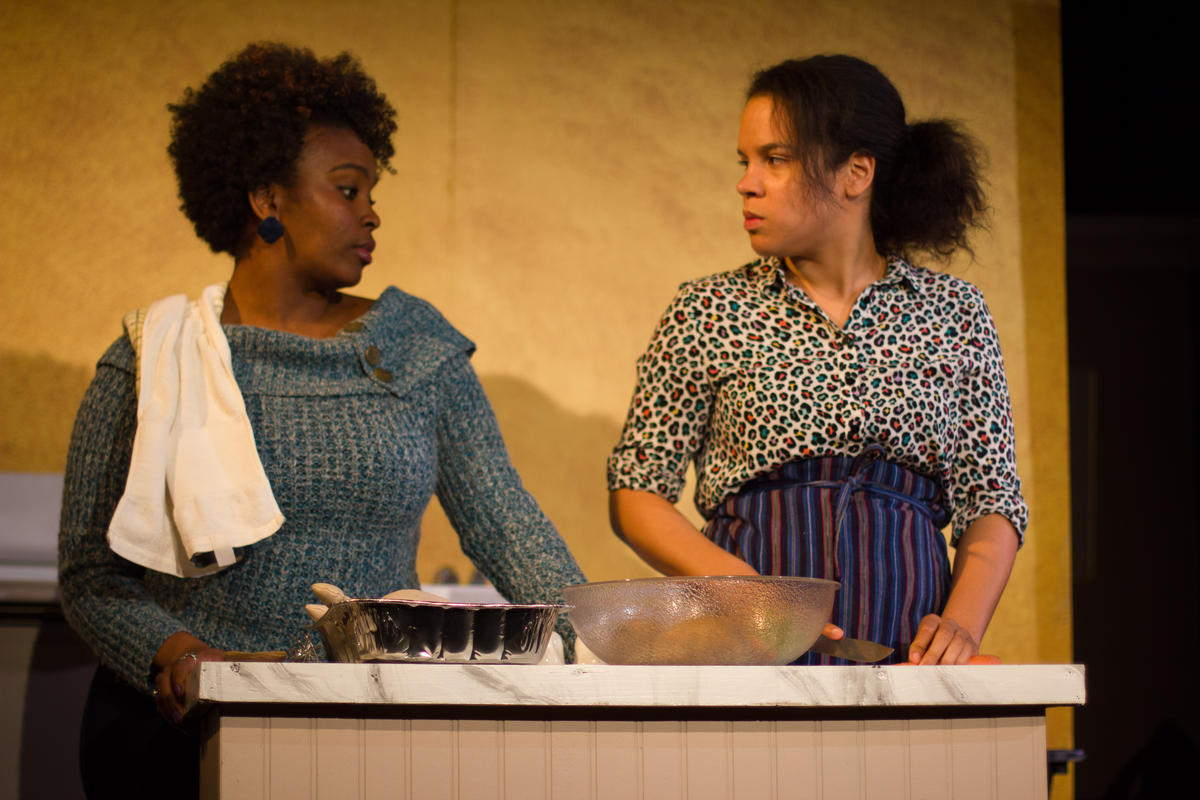
    Actresses Kia Pierce and Marquicia Dominguez in Rachel Atkins’ play, “Black Like Us.”
    Credit Courtesy of Annex Theatre/Shane Regan

    When Rachel Atkins was 7, she and her sisters got a new stepfather. Atkins loved this man, but when she and her family went out in public, they raised a lot of eyebrows.

    “My stepdad, who raised me, was black,” says Atkins. “We were three little white Jewish girls in New Jersey, when multi-racial families were not that common. We would get asked all the time, ‘Who’s that guy with your family?’ And we’d say, ‘That’s our dad.’”

    Decades later, Atkins’ experience was part of the impetus behind her new play “Black Like Us,” currently having its world premiere production at Seattle’s Annex Theater.

    “Black Like Us” is about two black sisters in 1950s Seattle. Feisty Maxine is attracted to the nascent Civil Rights movement; lighter-skinned Florence is in love with a white man. Following her heart, Florence passes herself off as white and estranges herself from her entire family…

    Read the entire article here. Listen to the interview here.

  • Reclaiming heritage in modern America

    2016-11-10

    Reclaiming heritage in modern America

    Somona State Star
    Sonoma State University, Rohnert Park, California
    2016-11-08

    Jahred Nunes, Staff Writer

    Virginia natives Mildred Loving, a black woman, and Richard Loving, a white man, were sentenced to a year in state prison after being married in the spring of 1958.

    The couple was arrested in their bedroom, after police received an anonymous tip that the Lovings may be an interracial couple. Their marriage violated the state’s anti-miscegenation statute, the Racial Integrity Act of 1924, which prohibited marriage between people classified as “white” and people classified as “colored.”

    After taking their case to the Supreme Court in 1967, Loving v. Virginia became a landmark civil rights decision invalidating all laws prohibiting interracial marriage.

    Nearly 50 years later, the Pew Research Center found that multiracial Americans are one of the fastest growing communities in America, growing at three times the rate as the American population as a whole.

    However, with the lines between race and culture being blurred in the modern era, where does multiculturalism fit in?…

    Read the entire here.

  • What must it feel like to be President Obama today?

    2016-11-10

    What must it feel like to be President Obama today?

    Salon
    2016-11-10

    Sophia Tesfaye


    Barack Obama and Donald Trump meet in the Oval Office, Nov. 10, 2016. (Credit: AP/Pablo Martinez Monsivais)

    President Obama and Donald Trump meet for their first face-to-face meeting in the White House Thursday

    While at least a quarter of the country begins to shrug off their shell shock from waking up on Wednesday to news that their fellow Americans had just elected an authoritarian reality-TV star to be the 45th president of the United States, the current president, his family and staff had to quickly snap back to patriotic professionalism in order to welcome Donald J. Trump to the White House on Thursday.

    I, for one, can’t even begin to imagine what that must feel like — to welcome a man who reached the political prominence he had flirted with for years, in part by insisting that the first African-American president is illegitimate. To realize that Trump’s birther campaign succeeded not only in forcing a sitting president to show his papers to a white man who derives his only sense of authority from his wealth but then to also watch as he serves the ultimate humiliation by dismantling your legacy.

    What must President Barack Obama feel like today?…

    Read the entire article here.

  • Whitening, Mixing, Darkening, and Developing: Everything but Indigenous

    2016-11-10

    Whitening, Mixing, Darkening, and Developing: Everything but Indigenous

    Latin American Research Review
    Volume 51, Number 3, 2016
    pages 142-160
    DOI: 10.1353/lar.2016.0038

    Juliana Luna Freire, Assistant Professor of Spanish/Portuguese
    Framingham State University, Framingham, Massachusetts

    This article analyzes the image of Brazilian Indigenous minority groups as a figurehead in media discourse, which is based on racializing logics that celebrate historical performances of Indigeneity but minimize attention to the political activity and grassroots movements of the existing population. Using cultural studies as a starting point, this study draws on Diana Taylor’s understanding of identity and on postcolonial thinker Homi Bhabha’s theorizing on nation to conduct a reading of discourses and performances of Indigeneity as part of cultural memory. I propose an analysis of the limited scenarios allowed in this construction of a nation in Brazilian media outlets, which often claim there is political motivation for identity and are incapable of dealing with contemporary Indigenous groups. Overall, this analysis highlights the need to rethink the way we discuss ethnic identity so as to foster a larger dialogue about identity, heritage, and minority cultures in such a way that we avoid falling into a paradigm of modernization and acculturation when discussing ethnicity, and to promote better understanding of the different ongoing political and cultural movements in contemporary Brazil.

  • Black Brits And Afropeans

    2016-11-08

    Black Brits And Afropeans

    The Norwich Radical
    2016-11-03

    Candice Nembhard

    The black British existence is inherently unique. It not only samples cultural flavours or practices from Africa and the Caribbean but seemingly blends those influences into standardised British behaviour. For many black children in modern Britain, the divide between our race and nationality somehow leaves a gap for white or even non-black people of colour to make assumptions as to who we are.

    Our social identity is affected by colonial academic spaces and texts, and our history is overshadowed by that of the great black American struggle. Every October, our heroes are sourced further and further away from our own history and we are left unsatisfied. That’s not to say there isn’t great merit in the discussion of black Americans, nor is it to rule out the overlap. It is to simply state that ‘African-American’ does not equal ‘Afro-Caribbean’, nor does it pander to the identity of black British people.

    In recent years, the discussion of political blackness has risen to the surface. In layman’s terms, the unionising of a struggle. ‘Black’ has become the pigeonhole for uniting a worldwide issue of systemic racism that falls into different structures, depending on one’s heritage and nationality. Although the concept of political blackness is understandable, its practice often eradicates the personal day-to-day hardships of being black and what is central to exhibiting positive displays of blackness. By that stripe, we have allowed the black British moniker to be represented as fighting for a history most individuals were never inaugurated into. Furthermore, these individuals are then vilified for suggesting their allegiance lies with an alternative past…

    Read the entire article here.

  • Multiracial college students’ experiences with multiracial microaggressions

    2016-11-08

    Multiracial college students’ experiences with multiracial microaggressions

    Race Ethnicity and Education
    Published online 2016-11-07
    pages 1-17
    DOI: 10.1080/13613324.2016.1248836

    Jessica C. Harris, Multi-Term Lecturer
    Department of Educational Leadership and Policy Studies
    University of Kansas

    While research on monoracial college students’ experiences with racial microaggressions increases, minimal, if any, research focuses on multiracial college students’ experiences with racial microaggressions. This manuscript addresses the gap in the literature by focusing on multiracial college students’ experiences with multiracial microaggressions, a type of racial microaggression. Utilizing qualitative data, this study explored 3 different multiracial microaggressions that 10 multiracial women experienced at a historically white institution including, Denial of a Multiracial Reality, Assumption of a Monoracial Identity, and Not (Monoracial)Enough to ‘Fit In.’

    Read or purchase the article here.

Previous Page
1 … 352 353 354 355 356 … 1,428
Next Page

Designed with WordPress