Race Forward
2015-05-13
Rinku Sen President of Race Forward & Publisher of Colorlines introduces the “What Is Systemic Racism?” video series featuring our very own Jay Smooth.
Watch the entire video series here.
Scholarly perspectives on the mixed race experience.
Being ‘Mixed Race’: Kira Lea Dargin and Annina Chirade
BBC World Service
The Conversation
2015-05-11
Kim Chakanetsa, Presenter
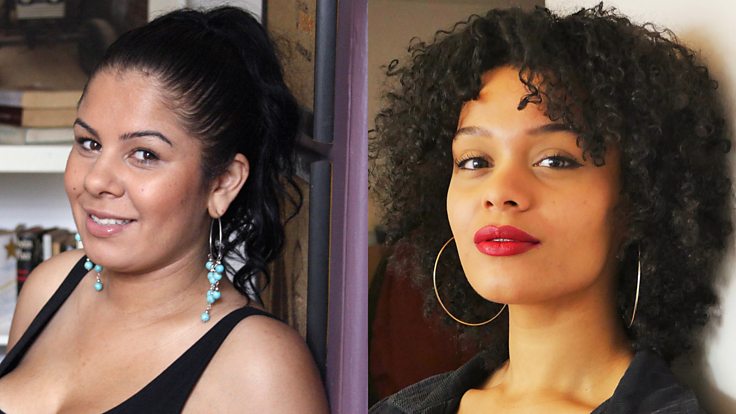 Left: Kira Lea Dargin. Credit: Claire Mahjoub, SSH. Right: Annina Chirade. Credit: Adu Lalouschek |
Kira Lea Dargin’s parents met at church. Her mother is white from a Russian family who emigrated to Australia in the 1950s, and her father is Aboriginal Australian. Being “mixed” Kira says, means constantly having to explain how you came about or how your family manages to blend. Having come through some difficult times as a teenager Kira now happily identifies with both of her cultural backgrounds. As the director of ‘Aboriginal Model Management Australia‘, her mission is to help broaden how Australian beauty is defined.
Annina Chirade describes herself as Ghanaian Austrian. She is the founder and editor of Rooted In magazine. When she was growing up, between London and Vienna, people would often question whether she was related to her fair, straight-haired mother. After many years obsessively straightening her own “kinky, curly, Afro-” hair as a teenager, she found her own style – inspired by the confident styles of black female singers like Erykah Badu. Annina says that when you are ‘mixed-race’ people make assumptions about your identity and consider it to be “up for debate”, but she is clear that “whiteness is not something I’m a part of.”
Listen to the interview here. Download the episode (00:26:55) here.
No Charges for Wisconsin Officer in Killing of Unarmed Black Teenager
The New York Times
2015-05-12
Richard Pérez-Peña (@perezpena), National Desk
A Madison, Wis., police officer who killed an unarmed black man in March, in one of a spate of similar incidents that have set off protests around the country, will not face criminal charges, a prosecutor said Tuesday.
The shooting of the man, Anthony Robinson Jr., had led to protests in Madison and raised concerns of potential unrest if the officer, Matt Kenny, who is white, was not charged, particularly after rioting in Baltimore recently following the death of an unarmed black man from a severe spinal injury sustained while in police custody.
Walking through the case in detail for a room full of reporters at the Public Safety Building, the Dane County district attorney, Ismael Ozanne, repeatedly stressed that on the day he died, March 6, Mr. Robinson was behaving erratically and violently, assaulting several people — apparently including Officer Kenny. He left the room without taking questions
“My decision will not bring Tony Robinson Jr. back,” he said. “My decision will not end the racial disparities that exist in the justice system, in our justice system. My decision is not based on emotion. Rather, this decision is based on the facts as they have been reported to me.
Although Mr. Ozanne did not mention either man’s race, he discussed his own identity at some length — the biracial son of a black woman from Anniston, Ala., who, he said, worries that his skin color puts him at risk…
Read the entire interview (00:26:30) here.
“People that look like me that break windows, flip cars, and light things on fire are protected by infantilizing comments that state: “boys will be boys,” absolving them of any responsibility. Whereas people that look like my father are shot in the back as they run away, choked to death, or have their necks broken.”
Maliq Hunsberger, “The Blue Eyes of a Black Nationalist,” Meduim, The Secret History of America: Writings and Revelations from an American Studies Seminar at UC Berkeley, May 6, 2015. https://medium.com/the-secret-history-of-america/the-blue-eyes-of-a-black-nationalist-a04ef17e394e.
New Bill Would Let New Yorkers Identify As Multiracial On Official City Forms
The Huffington Post
2015-05-12
Christopher Mathias (@letsgomathias), New York Reporter
New York City has the largest population in the United States of people who identify as multiracial. Even its mayor, Bill de Blasio, and its first lady, Chirlane McCray, have two multiracial children.
And yet, on the various official city documents New Yorkers often have to fill out, there are only five racial categories: “white, not of Hispanic origin”; “black, not of Hispanic origin”; “Hispanic”; “Asian or Pacific Islander”; and “American Indian or Alaskan Native.”
In testimony submitted at a City Council hearing Monday, a New Yorker named Daniel Reckart explained why this can be a problem.
“You see, my mother is half Jamaican and half British-Caucasian,” he said. “My father is half Mexican, half German.”
“My siblings and I — as siblings do — look both alike and, at the same time, a spectrum of our multiple races,” he continued. “Some of us look more Latino and some of us look more white and some look more black. But the fact is that we have all always identified proudly as multiracial, and to ask us to choose just one box is like asking us to choose allegiance with just one of our grandparents.”
Reckart is one of more than 325,000 New Yorkers who identify as multiracial. His testimony Monday was submitted in support of a piece of legislation that would require “city agencies to amend their official forms and databases to accommodate multiracial identification where racial identification is required.”
Those forms include applications for after-school programs, public housing and taxi licenses, as well as discrimination complaint forms and registration with the Department of Small Business Services — not to mention all the paperwork filled out by the 300,000 or so city employees.
The new multiracial designation, say the bill’s supporters, would help the city collect more accurate demographic data. Such information is important for crafting legislation and policy, and for keeping track of how various policies affect people of different races. In some cases, that data can also help determine how much state or federal funding the city will receive.
Council member Margaret Chin, lead sponsor of the bill, told The Huffington Post that it’s “important for government to recognize multicultural heritage.”
“We wanted to allow individuals to celebrate their heritage and be able to identify themselves as they want to,” she said…
Read the entire article here.
‘Typical American Families’ photo exhibit to be unveiled at Emory
Emory News Center
Emory University, Atlanta, Georgia
2015-05-04
Kimber Williams
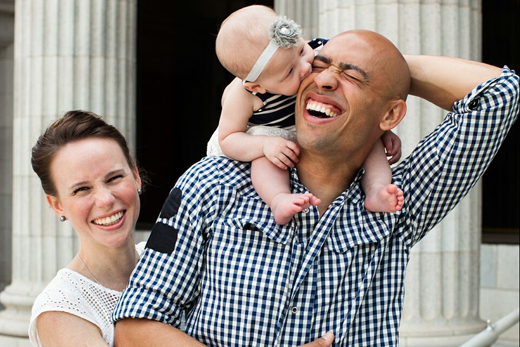 “Typical American Families” highlights the many configurations that family life can take in America. Photos in the exhibit will be unveiled at a public reception at the Center for Ethics on May 7. Photo by Ross Oscar Knight. |
“Typical American Families,” a new photographic exhibit that explores a wider view of American families, will be unveiled Thursday, May 7, from 6:30-8:30 p.m. at the Emory Center for Ethics, 1531 Dickey Drive.
Conceived by Carlton Mackey, director of Emory’s Ethics and the Arts Program, the exhibit offers a photographic glimpse into the lives of 15 Atlanta-area families, celebrating “the vast landscape of manifestations of family” across spectrums of culture, faith and ability, Mackey says.
The event includes a public reception and formal unveiling of the exhibit. Guests will also have a chance to meet families that participated in the community project, which showcases the diversity of the American family through the lens of international photographer/photoculturalist Ross Oscar Knight, Mackey’s creative partner.
The families — who haven’t yet seen their photographs — will share stories and insights into how they bridge faith, culture and difference in Atlanta, Mackey says…
…”Typical American Families” was inspired by Mackey’s ongoing work on “Beautiful in Every Shade,” an empowerment campaign that celebrates the breadth and depth of beauty in every human being.
That campaign grew out of “50 Shades of Black,” a multi-media art project launched by Mackey in 2013 — and funded in part by a grant from Emory’s Center for Creativity & Arts — that explores the intersection of skin tone and sexuality in the shaping of identity through images and personal narrative…
Read the entire article here.
DNA survey finds all humans are 99.9pc the same
The Telegraph
2002-12-20
Roger Highfield, Science Editor
Whether you hail from Surbiton, Ulan Bator or Nairobi, your genetic make-up is strikingly similar to that of every other person on Earth, an analysis concludes today.
Although scientists have long recognised that, despite physical differences, all human populations are genetically similar, the new work concludes that populations from different parts of the world share even more genetic similarities than previously assumed.
All humans are 99.9 per cent identical and, of that tiny 0.1 per cent difference, 94 per cent of the variation is among individuals from the same populations and only six per cent between individuals from different populations….
Read the entire article here.
The Color Factor: The Economics of African-American Well-Being in the Nineteenth-Century South
Oxford University Press
June 2015
336 Pages
6-1/8 x 9-1/4 inches
Hardcover ISBN: 9780199383092
Howard Bodenhorn, Professor of Economics
Clemson University, Clemson, South Carolina
also Research Associate at the National Bureau of Economic Research
Despite the many advances that the United States has made in racial equality over the past half century, numerous events within the past several years have proven prejudice to be alive and well in modern-day America. In one such example, Governor Nikki Haley of South Carolina dismissed one of her principal advisors in 2013 when his membership in the ultra-conservative Council of Conservative Citizens (CCC) came to light. According to the Southern Poverty Law Center, in 2001 the CCC website included a message that read “God is the one who divided mankind into different races…. Mixing the races is rebelliousness against God.” This episode reveals America’s continuing struggle with race, racial integration, and race mixing-a problem that has plagued the United States since its earliest days as a nation.
The Color Factor: The Economics of African-American Well-Being in the Nineteenth-Century South demonstrates that the emergent twenty-first-century recognition of race mixing and the relative advantages of light-skinned, mixed-race people represent a re-emergence of one salient feature of race in America that dates to its founding. Economist Howard Bodenhorn presents the first full-length study of the ways in which skin color intersected with policy, society, and economy in the nineteenth-century South. With empirical and statistical rigor, the investigation confirms that individuals of mixed race experienced advantages over African Americans in multiple dimensions – in occupations, family formation and family size, wealth, health, and access to freedom, among other criteria.
The Color Factor concludes that we will not really understand race until we understand how American attitudes toward race were shaped by race mixing. The text is an ideal resource for students, social scientists, and historians, and anyone hoping to gain a deeper understanding of the historical roots of modern race dynamics in America.
Table of Contents
The Somatechnics of Whiteness and Race: Colonialism and Mestiza Privilege
Ashgate
May 2015
186 pages
234 x 156 mm
Hardback ISBN: 978-1-4724-5307-5
eBook PDF ISBN: 978-1-4724-5308-2
eBook ePUB ISBN: 978-1-4724-5309-9
Elaine Marie Carbonell Laforteza, Lecturer in Cultural Studies
Macquarie University, Australia

Investigating the emergence of a specific mestiza/mestizo whiteness that facilitates relations between the Philippines and Western nations, this book examines the ways in which the construction of a particular form of Philippine whiteness serves to deploy positions of exclusion, privilege and solidarity.
Through Filipino, Filipino-Australian, and Filipino-American experiences, the author explores the operation of whiteness, showing how a mixed-race identity becomes the means through which racialised privileges, authority and power are embodied in the Philippine context, and examines the ways in which colonial and imperial technologies of the past frame contemporary practices such as skin-bleaching, the use of different languages, discourses of bilateral relations, secularism, development, and the movement of Filipino, Australian and American bodies between and within nations.
Drawing on key ideas expressed in critical race and whiteness studies, together with the theoretical concepts of somatechnics, biopolitics and governmentality, The Somatechnics of Whiteness and Race sheds light on the impact of colonial and imperial histories on contemporary international relations, and calls for a ‘queering’ or resignification of whiteness, which acknowledges permutations of whiteness fostered within national boundaries, as well as through various nation-state alliances and fractures. As such, it will appeal to scholars of cultural studies, sociology and politics with interests in whiteness, postcolonialism and race.
Contents