• Edward Brooke, Pioneering U.S. Senator in Massachusetts, Dies at 95

    The New York Times
    2015-01-03

    Douglas Martin

    Edward W. Brooke III, who in 1966 became the first African-American elected to the United States Senate by popular vote, winning as a Republican in overwhelmingly Democratic Massachusetts, died on Saturday at his home in Coral Gables, Fla. He was 95.

    His death was confirmed by Ralph Neas, a family spokesman, who said Mr. Brooke was surrounded by members of his family.

    He won his Senate seat by nearly a half-million votes in 1966 and was re-elected in 1972. He remains the only black senator ever to have been returned to office.

    A skilled coalition builder at a time when Congress was less partisan and ideologically divided than it is today, Mr. Brooke shunned labels, but he was seen as a centrist. His positions and votes were consistently more liberal than those of his increasingly conservative Republican colleagues.

    He opposed the expansion of nuclear arsenals, pushed for improved relations with China and championed civil rights, the legalization of abortion and fair-housing policies. He urged Republicans to match the Democrats in coming up with programs to aid cities and the poor…

    Read the entire obituary here.

  • A Tale of Two Plantations: Slave Life and Labor in Jamaica and Virginia

    Harvard University Press
    November 2014
    522 pages
    6-1/8 x 9-1/4 inches
    9 line illustrations, 31 tables
    Hardcover ISBN: 9780674735361

    Richard S. Dunn, Roy F. and Jeannette P. Nichols Professor Emeritus of American History
    University of Pennsylvania

    Forty years ago, after publication of his pathbreaking book Sugar and Slaves, Richard Dunn began an intensive investigation of two thousand slaves living on two plantations, one in North America and one in the Caribbean. Digging deeply into the archives, he has reconstructed the individual lives and collective experiences of three generations of slaves on the Mesopotamia sugar estate in Jamaica and the Mount Airy plantation in tidewater Virginia, to understand the starkly different forms slavery could take. Dunn’s stunning achievement is a rich and compelling history of bondage in two very different Atlantic world settings.

    From the mid-eighteenth century to emancipation in 1834, life in Mesopotamia was shaped and stunted by deadly work regimens, rampant disease, and dependence on the slave trade for new laborers. At Mount Airy, where the population continually expanded until emancipation in 1865, the “surplus” slaves were sold or moved to distant work sites, and families were routinely broken up. Over two hundred of these Virginia slaves were sent eight hundred miles to the Cotton South.

    In the genealogies that Dunn has painstakingly assembled, we can trace a Mesopotamia fieldhand through every stage of her bondage, and contrast her harsh treatment with the fortunes of her rebellious mulatto son and clever quadroon granddaughter. We track a Mount Airy craftworker through a stormy life of interracial sex, escape, and family breakup. The details of individuals’ lives enable us to grasp the full experience of both slave communities as they labored and loved, and ultimately became free.

    Visit the interactive website about the enslaved families here.

  • Our real police/race problem: Diverse forces, white resentment, and America’s persistent divides

    Salon
    2015-01-02

    Jim Sleeper

    Why diverse police forces can’t seem to trump the economics of racism, or the twisted politics of white resentment

    Nearly two decades before last month’s murders of New York police officers Rafael Ramos and Wenjian Liu by a black man, the murder of a black NYPD officer, Charles Davis, anticipated claims we’re hearing that police-community problems aren’t really “black and white” and the only color that really counts is blue.

    Yet the problems do remain “black and white” for reasons of economic exploitation and isolation that run deeper than race itself and that are gathering force, despite rising numbers of white/Asian and white/Hispanic marriages and of multiracial children, even in the families of police officers themselves. Unless we can face the reasons why more “diversity” in police ranks is a far-from-sufficient condition of justice, American society will remain more racist than many others, and thereby hangs my tale…

    Read the entire article here.

  • Of Many Colors: Portraits of Multiracial Families

    University of Massachusetts Press
    1997-11-21
    160 pages
    0.5 x 8 x 10.5 inches
    ISBN (paper): 978-1-55849-101-4
    ISBN (cloth): 978-1-55849-100-7 (out of print)

    Gigi Kaeser, Co-director
    Family Diversity Projects, Inc., Amherst, Massachusetts

    Peggy Gillespie, Co-director
    Family Diversity Projects, Inc., Amherst, Massachusetts

    Photographs by Gigi Kaeser. Interviews by Peggy Gillespie.

    Based on an award-winning photo exhibit, this book documents the feelings and experiences of Americans who live in multiracial families. Of Many Colors tells the stories of thirty-nine families who have bridged the racial divide through interracial marriage or adoption. In these pages, parents and children speak candidly about their lives, their relationships, and the ways in which they have dealt with issues of race.

    Although the number of mixed-race families in America is steadily rising, this trend remains controversial. For centuries, America has depended on distinct racial categories for its social, political, and economic organization. The current debate over the inclusion of a “multiracial” category on census forms illustrates the extent to which the deeply embedded construct of race continues to divide our society.

    Transracial adoption has also generated fierce controversy and debate. As in the case of racial categories, the discussion of transracial adoption reflects ever-changing social standards. As recently as 1987, thirty-five states had laws prohibiting the adoption of black children by white families. In 1996, however, President Clinton signed a bill making it illegal to prohibit adoptions based on race.

    The interviews in this book provide the reader with a clear understanding of how mixed-race families contradict stereotypes, challenge racism, and demonstrate that people of different races can indeed live together in harmony. Family members also have much to say about the most intimate form of integration, familial love, and this love is made visible in the superb photographs by Gigi Kaeser.

  • Revealing Racial Purity Ideology: Fear of Black–White Intimacy as a Framework for Understanding School Discipline in Post-Brown Schools

    Educational Administration Quarterly
    Volume 50, Number 5 (December 2014)
    pages 783-795
    DOI: 10.1177/0013161X14549958

    Decoteau J. Irby, Assistant Professor
    School of Education
    University of Wisconsin, Milwaukee

    Purpose: In this article, I explore White racial purity desire as an underexamined ideology that might help us understand the compulsion of disciplinary violence against Black boys in U.S. public schools. By pointing to the dearth of research on sexual desire as a site of racial conflict and through revisiting Civil Rights–era fears about interracial intimacy between Black men and White women, I encourage readers to consider if and to what extent fears about sexual desires remain in the fabric of our school and social lives.

    Proposed Conceptual Argument: I argue that in schools, White-supremacist patriarchy reproduces normative Whiteness through the continual surveillance, punishment, distancing, and removal of primarily heteronormative Black male bodies, locating its justification in protecting the bodily safety and academic achievement of heteronormative White girls. I suggest that in predominantly White desegregated schools, disciplining heteronormative Black boys represents a new policy-based campaign of institutionalized violence and intimidation that reflects a subtle, but nonetheless pernicious, White male segregationist agenda.

    Implications: Considering fear/desire of interracial intimacy as a lens, alongside economic and political explanations of resistance to desegregation, provides a more complete analytical framework to comprehend racial conflict and segregationism in contemporary school settings. Our collective failure to acknowledge and interrogate the ways schools produce Whiteness by seeking to protect White girls from Black boys ensures Black boys’ bodies and minds will continue to be unfairly subjected to the violence of harsh and disproportionate disciplinary measures.

    Read or purchase the article here.

  • Professor Jared Ball on Ferguson and the Media

    Truthout
    2014-12-29

    Dan Falcone

    At the recent “Shrouded Narrative teach-in” at American University, Dan Falcone met Jared A. Ball, a professor of communication studies at Morgan State University in Baltimore, Maryland, who discussed, “Propaganda and Media.” In this interview, father and husband, author of I MiX What I Like: A MiXtape Manifesto and coeditor of A Lie of Reinvention: Correcting Manning Marable’s Malcolm X, Ball talks about the construction of Black identity, colonialism and what is needed to stop the police killings of a Black person every 28 hours.

    Dan Falcone for Truthout.org: Professor Ball, could you tell the readers about your teaching, academic interests, and how they relate to activism and democratic participation?

    Jared Ball: Thank you. My academic interests and teaching are very much tied to my personal political passions – all of which revolve around Black or Africana studies, political struggles, cultural production and how that all intersects or interacts with the political and “libidinal” (thanks to the work of Frank Wilderson and Jared Sexton) economies of media, communication and journalism.

    This primarily works out to be a focus on the political function of mass media within the context of ongoing power (national, racial, class) struggles. I generally look to extend or tailor deep traditions of radical political, economic and cultural analyses and media criticism to our time and hope that I can make them relevant to students today. To better connect traditions of political activism to the immediate work of my classes, I’ve increasingly infused the work of political prisoners into our own course work, which allows me to tap an almost endless reservoir of knowledge and experience – while exposing students to a more realistic political context for our own studies.

    Additionally, this approach infuses into our classes, ideas of political struggle and activism while challenging the limitations of conventional approaches to such study, including notions of “American democracy.”…

    Read the entire interview here.

  • Section of Creative Media lecturer to speak at Global Mixed Race conference in Chicago

    Dundalk Institute of Technology
    Dundalk, County Louth, Ireland
    2014-11-10

    Kathryn Moley
    Communications Office

    Dundalk Institute of Technology is incredibly proud to announce that Joint Programme Director of Video and Film in the Institute, Zélie Asava, is travelling to Chicago, to participate in a ‘Global Mixed Race’ conference.

    The conference will be held at DePaul University’s Lincoln Park Campus and will focus on critical mixed race studies with discussions by scholars, filmmakers and performers at this international conference across November 13th-15th. The DkIT lecturer will join nearly two hundred presenters from the United States, Canada, United Kingdom, Ireland, Japan and Australia who will participate in 45 panels during this third biennial conference, which was founded in 2010…

    Read the entire article here. Watch the keynote address here.

  • Dr. Rebecca King O’Riain gives opening keynote address

    Maynooth University
    Maynooth University Department of Sociology
    Maynooth, County Kildare, Ireland
    2014-11-27

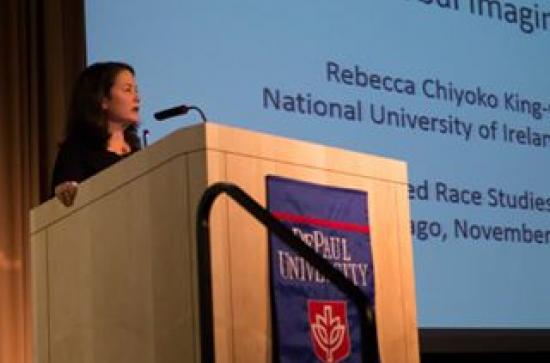
    Dr. Rebecca King-O’Riain gave the opening keynote address on “mixed race, transconnectivity and the global imagination” at the critical mixed race studies conference on 13 November, 2014 at DePaul, University on Chicago, USA.

    Her talk examined two key questions – ‘Is there such a thing as Global Mixed Race? If so, what is it, where did it come from and is it a good thing?’. Below is the abstract for her talk.

    If race gains meaning through the process of racialization, this meaning only makes sense within very specific local contexts entwined with complex local histories, which in turn shape local political, economic and social arrangements. Mixed-race studies started primarily in the United States and has been deeply shaped by the politics of race in that context, with strong racial boundaries and the legacy of the ‘one drop rule’. How then do we make sense of mixed race as a global phenomenon across the globe without losing the specificity of local context from which it derives its meaning?

    Drawing on our recent edited volume Global Mixed Race, I use empirical research from Kazakhstan, Okinawa, Zambia, Trinidad and Tobago, Australia, New Zealand, and Mexico, as well as the UK, Germany, and Canada, to ask what happens when we take mixed race on the road? Because as Mahtani (2014) keenly observes, it is not just about asking ‘what are you?’ but also about asking ‘where (in the world) are you?’…

    Read the entire article here watch the keynote here. [MixedRaceStuides.org is mentioned from 00:35:41 to 00:36:07 in the video].

  • Racial Fluidity and Inequality in the United States

    American Journal of Sociology
    Volume 118, Number 3, November 2012
    pages 676–727
    DOI: 10.1086/667722

    Aliya Saperstein, Assistant Professor of Sociology
    Stanford University

    Andrew M. Penner, Associate Professor of Sociology
    University of California, Irvine

    The authors link the literature on racial fluidity and inequality in the United States and offer new evidence of the reciprocal relationship between the two processes. Using two decades of longitudinal data from a national survey, they demonstrate that not only does an individual’s race change over time, it changes in response to myriad changes in social position, and the patterns are similar for both self-identification and classification by others. These findings suggest that, in the contemporary United States, microlevel racial fluidity serves to reinforce existing disparities by redefining successful or high-status people as white (or not black) and unsuccessful or low-status people as black (or not white). Thus, racial differences are both an input and an output in stratification processes; this relationship has implications for theorizing and measuring race in research, as well as for crafting policies that attempt to address racialized inequality.

    Read the entire article here or here.

  • The fluidity of race

    Rutgers, The State University of New Jersey
    May 2012
    221 pages
    DOI: 10.7282/T3FN154X

    Nicholas Trajano Molnar, Assistant Professor
    Department of History, Philosophy, and Religious Studies
    Community College of Philadelphia, Philadelphia, Pennsylvania

    This study is an examination of the American mestizos who lived in the Philippines from 1900 to 1955. No scholarly studies exist that analyze and historicize this group, but this is understandable, as the population of the American mestizos compared to the overall Filipino population is miniscule, never exceeding 20,000 individuals at any one time. Despite their small numbers, the American mestizos were a matter of social concern for the Philippine state and the expatriate Americans and Filipino nationalists who resided there. Various actors in the Philippines carried their own imposed racializations of the group that changed over time, ranging from American expatriates who emphasized the group’s “American” blood to Filipino nationalists who embraced them as Filipinos.

    This study will demonstrate that the boundaries of race have been constantly shifting, with no single imposed or self-ascribed American mestizo identity coalescing. American mestizo racial definitions and constructs are historically and regionally specific, complicating conventional scholarly assumptions and requiring a historically grounded approach to the understanding of race and ethnicity. This study makes theoretical contributions to the study of race in the United States and its former colonies. Contemporary literature seeks to explain by what means racial identity is created and maintained. My study, however, seeks to explore racial formation from another angle, exploring why a distinct group identity never coalesced among the American mestizos despite the presence of similar economic, historical, and social forces that have clearly led to racial formation in other groups.

    The concept of the American mestizo and the fluid Philippine racial framework challenged static American notions of race. I argue that contact with the Philippines led to an assimilation of Filipino racial ideas among American expatriates, who in turn created their own colonialized concepts of race and nationality, demonstrating that under certain historical conditions, American concepts of race had room to bend. Tracking the transmittal of these hybridized ideas, and their transformations and various interpretations at each venue, allows us to gain insight into the malleability of Philippine and American notions of nation and race, and into the larger processes of racial construction overall.

    Request a copy of the dissertation here.