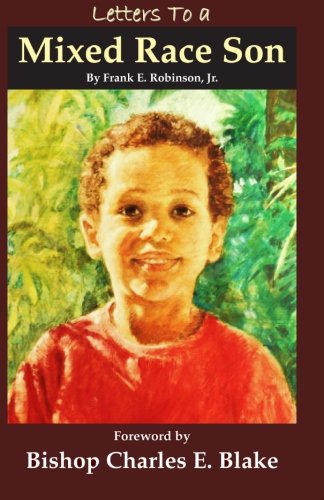
• Letters To a Mixed Race Son

    CreateSpace
    2012-01-06
    152 pages
    5.5 x 0.4 x 8.5 inches
    Paperback ISBN-10: 1468184024; ISBN-13: 978-1468184020

    Frank E. Robinson, Jr.

    Foreword by Bishop Charles E. Blake

    In a world that continues to grapple with notions of race, a loving father writes a series of letters that speak into the life of his biracial son. In the book’s foreword, Bishop Charles Blake introduces us to Frank Robinson and these Letters To a Mixed Race Son. In 1984, Frank Robinson was a young minister serving in southern Alabama, when word got out that he was engaged. It would be an interracial marriage, which quickly became a local controversy, both scandalous and dangerous. This marriage was announced not long after a lynching in one of the neighboring areas. For safety, their first child was born across the state line. Frank began to understand that if he did not survive, his wife would be left a widow and his son without a father. With this in mind, he began to write letters that would survive in a book. He intended to say the things a father should say and to equip his son to live a meaningful life. Further, even when this son was so young, the letters were written as to a man, so that when the boy became a man, he could have this book. This father writes about identity, character and the timeless responsibility of men and fathers. He speaks of courage as one faces life, hardship and injustice. He tells his son of perseverance, humility and faith, of how to deal with disappointment, criticism, and so much more. These letters were written over years and through seasons of difficulty. The author reminds his son to never forget what struggle is like. These are love letters and wisdom writings, powerful, profound, and infused with a sense of eternity and mortality, of hope and purpose. There is a moment of humor and insight when the little boy came home from kindergarten and earnestly asked, “Is someone in our family white?” Responded to in the affirmative, he demanded, “Who is it?” This book tells of a unique and interesting journey. The mixed race son has grown up, is now married, a new father and a military officer, who serves his country during a time of war. In 2011, about twenty five years after the project started, Frank Robinson gave the hand written original book of letters to his son, who has already begun to write letters to his own child. The author has read a few of these letters to some scarred and damaged people. He found the words he wrote to his own son, were medicating to the sons and daughters of others. Further, these letters may help the reader to see the world a little differently and possibly to find a better self. This work is heartfelt, moving and refreshing, ultimately a rich, deep and encouraging piece of literature.

  • ‘Who We Be,’ by Jeff Chang

    Sunday Book Review
    The New York Times
    2014-12-12

    Tricia Rose, Director
    Center for the Study of Race and Ethnicity in America
    Brown ­University, Providence, Rhode Island

    Who We Be: The Colorization of America. By Jeff Chang. Illustrated. 403 pp. St. Martin’s Press. $32.99.

    The dramatic changes spurred by the civil rights ­movement and other 1960s social upheavals are often chronicled as a time line of catalytic legal victories that ended anti-black segregation. Jeff Chang’sWho We Be: The Colorization of America” claims that cultural changes were equally important in transforming American society, and that both the legal and cultural forms of desegregation faced a sustained hostile response that continues today.

    According to Chang, the author of “Can’t Stop Won’t Stop: A History of the Hip-Hop Generation,” multiculturalism challenged who and what defined America, going straight to the heart of who “we” thought we were and who “we” aspired to be. Attacks on exclusions by multicultural scholars and artists were taking place everywhere. University battles raged over whether the Western literature canon should continue to be elevated, or imagined ­outside the politics of racial hierarchies. Artists confronted the nearly all-white and all-male elite art world. Chang even ­describes Coca-Cola’s influential 1971 “I’d like to teach the world to sing” advertisement as a signal of how profitable a “harmonious” multicultural marketing plan could be. But over the next several decades, all the way through Obama’s elections, powerful counterattacks were launched, increasingly in racially oblique language. “Both sides understood that battles over culture were high-stakes,” Chang writes. “The struggle between restoration and transformation, retrenchment and change, began in culture.”…

    …Surely our national fabric is more racially diverse than ever before, and a few more people of color have access to powerful cultural institutions. At the same time, “Who We Be” left me wondering about the resilience of power. It is possible but not inevitable that multiculturalism will fuel the creation of an anti-racist and fully inclusive society. But it is also possible that we could ­become the kind of multiracial society that keeps its darker-skinned people at the bottom to provide cultural raw material to a powerful white elite that celebrates the diversity on which it depends…

    Read the entire review here.

  • ‘Pelo Malo’ Is A Rare Look Into Latin American Race Relations

    Morning Edition
    National Public Radio
    2014-12-10

    Jasmine Garsd, Reporter and Host
    NPR Music’s Alt.Latino


    Actor Samuel Lange Zambrano plays Junior, a boy who becomes obsessed with relaxing his hair. Courtesy of the artist

    “Pelo Malo” means “bad hair” in Spanish. It’s a term that is commonly used in Latin America, and it’s also the title of a new Venezuelan film that tackles racism and homophobia.

    Junior is a 9-year-old living in a poor neighborhood in Caracas. School is about to start, and he has to have his picture taken. Junior, like many Venezuelans, has European, indigenous and African ancestry, which gives him thick, tightly curled hair. He becomes obsessed with straightening it, trying everything from blow-drying to applying gobs of mayonnaise. That last attempt drives his mother, a struggling widow, insane; she threatens to “cortarle el pelo,” just cut all his hair off.

    Pelo Malo is a rare look into identity politics among Latin Americans, where racism is often a taboo topic. Despite the taboo, director Mariana Rondón says, the term “pelo malo” is common currency. “The origin of the term is very offensive. It’s very racist. But it’s also true that in Venezuela, we are so mixed, that in every single family there is someone with … ‘bad hair.’ We joke that the second most profitable industry, after oil, is hair straightening. Because everyone here wants to have straight hair.”…

    …The film is very Venezuelan, but many Latin Americans can relate to it. Bianca Laureano is the founder of The LatiNegr@s Project, a virtual space that aims to discuss history and current events in the Afro-Latino community. She says the battles over hair are very much present in her own life: “I have family members who I have never even met. And I meet them, and part of the conversation will be, ‘I don’t like your hair the way that it is.’ ”

    Laureano says while she wishes the movie had dealt with its issues in more depth, she thinks it’s representative of a sea change in the way Latinos discuss race. “What I definitely see an increase of is people who identify as Afro-Latino. This is who I am, this is my story. We take part in this as well.”…

    Read the entire article here. Listen to the story here. Download the story here.

  • Who We Be: The Colorization of America

    St. Martin’s Press (an imprint of Macmillan)
    October 2014
    416 pages
    7.81 x 9.33 inches
    Hardcover ISBN: 9780312571290; ISBN10: 0312571291

    Jeff Chang, Executive Director
    Institute for Diversity in the Arts
    Stanford University, Palo Alto, California

    Race. A four-letter word. The greatest social divide in American life, a half-century ago and today.During that time, the U.S. has seen the most dramatic demographic and cultural shifts in its history, what can be called the colorization of America. But the same nation that elected its first Black president on a wave of hope—another four-letter word—is still plunged into endless culture wars. How do Americans see race now? How has that changed—and not changed—over the half-century? After eras framed by words like “multicultural” and “post-racial,” do we see each other any more clearly? Who We Be remixes comic strips and contemporary art, campus protests and corporate marketing campaigns, Martin Luther King, Jr. and Trayvon Martin into a powerful, unusual, and timely cultural history of the idea of racial progress. In this follow-up to the award-winning classic Can’t Stop Won’t Stop: A History of the Hip-Hop Generation, Jeff Chang brings fresh energy, style, and sweep to the essential American story.

  • Racecraft: Stories of Racial Passing

    Los Angeles Review of Books
    2014-12-05

    Lucy McKeon, Writer and Photographer
    New York, New York

    THE VERY NOTION of racial “passing” implies a test. Those who believed clear racial categorization was possible might test for race by measuring physical traits to indicate “blood purity”: slight physical traits that could be identified, such as the half-moon of a nail bed or the whites of ones eyes. In apartheid South Africa, the “pencil test” was devised: categorizing people based on whether a pencil would remain or fall from their hair. Physical markers were used to fix and control whole futures.

    “White people were so stupid about such things,” says Irene, the narrator of Nella Larsen’s Passing (1929). “They usually asserted that they were able to tell; and by the most ridiculous means, finger-nails, palms of hands, shapes of ears, teeth.”

    To pass the faulty test of white scrutiny is not difficult; Larsen’s Passing, and other 18th to 20th century fiction and 20th century film, work to demonstrate that categorization by race relies on arbitrary rules and unsound logic — proving, in other words, the falsely naturalized or socially constructed nature of “race” itself. As Stanford historian Allyson Hobbs reminds us in her recent cultural history A Chosen Exile: A History of Racial Passing in American Life, the gains and losses of racial passing — when someone from one racial group “passes,” or is accepted, as another — were historically contingent, like “race” itself. Indeed, one’s semblance could rarely be taken as trustworthy evidence. “Skin color and physical appearance were usually the least reliable factors,” writes Hobbs, “whereas one’s associations and relationships were more predictive” of who was deemed white and who was not. If white people can’t actually tell who is white and who isn’t, whiteness is exposed as simply the external perception of being white — the privilege, power, and civic membership afforded to someone recognized as such. This is white supremacy in practice.

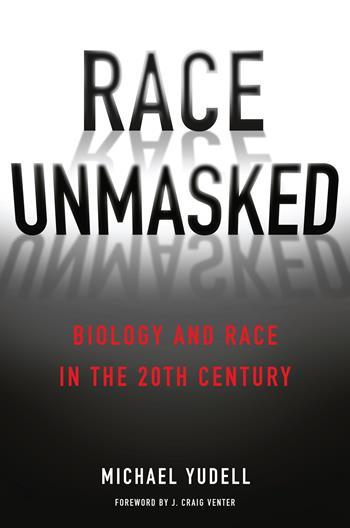
    Michael Yudell’s Race Unmasked examines the history of the concept of biological race — in large part tied to the history of genetics, which “at its founding was inseparable from eugenics theories” — in order to show that race is “neither a static biological certainty nor a reflection of our genes. Instead, race is a historical and cultural phenomenon.” We’ve known this, of course. But Yudell’s recent book provides scientific documentation of the process of “racecraft,” a term coined by Karen Fields and Barbara Fields in their 2012 book by the same name: the “mental terrain” where our deep and pervasive belief in race as meaningful is conjured, then ritualized into reality. “Race” comes to explain social effects like poverty, as witchcraft might explain failing crops. What’s real is not “race,” but the ideology of racism: the belief in “race” as a tool with which to rationalize cause and consequence.

    In this way, while both fictive and biographical representations of passing demonstrate the absurdity of “race,” they also emphasize the very real effects of racial categorization. From the point of view of those passing, Hobbs writes,

    race was neither strictly a social construction nor a biological fact. The line between black and white was by no means imaginary; crossing it had profound, life-changing consequences. Race was quite real to those who lived with it, not because of skin color or essentialist notions about biology, but because it was social and experiential, because it involved one’s closest relationships and one’s most intimate communities.

    Passing, in other words, demonstrates how “race” is both socially constructed and, as experienced, extremely meaningful.

    Hobbs focuses on the experience of great loss in her cultural history of passing. As she points out, “Historians and literary scholars have paid far more attention to what was gained by passing as white than to what was lost by rejecting a black racial identity.” But “racial passing is an exile, sometimes chosen, sometimes not.”…

    Read the entire article here.

  • Race Unmasked: Biology and Race in the Twentieth Century

    Columbia University Press
    September 2014
    304 pages
    Hardcover ISBN: 9780231168748
    E-book ISBN: 9780231537995

    Michael Yudell, Associate Professor, Interim Chair, Community Health and Prevention
    Drexel University School of Public Health, Philadelphia, Pennsylvania

    Foreword by J. Craig Venter

    Race, while drawn from the visual cues of human diversity, is an idea with a measurable past, an identifiable present, and an uncertain future. The concept of race has been at the center of both triumphs and tragedies in American history and has had a profound effect on the human experience. Race Unmasked revisits the origins of commonly held beliefs about the scientific nature of racial differences, examines the roots of the modern idea of race, and explains why race continues to generate controversy as a tool of classification even in our genomic age.

    Surveying the work of some of the twentieth century’s most notable scientists, Race Unmasked reveals how genetics and related biological disciplines formed and preserved ideas of race and, at times, racism. A gripping history of science and scientists, Race Unmasked elucidates the limitations of a racial worldview and throws the contours of our current and evolving understanding of human diversity into sharp relief.

    Contents

    • Foreword by J. Craig Venter
    • Acknowledgments
    • Introduction
    • 1. A Eugenic Foundation
    • 2. Charles Davenport and the Biology of Blackness
    • 3. Eugenics in the Public’s Eye
    • 4. The National Research Council and the Scientific Study of Race
    • 5. Coloring Race Difference
    • 6. Biology and the Problem of the Color Line
    • 7. Race and the Evolutionary Synthesis
    • 8. Consolidating the Race Concept in Biology
    • 9. Challenges to the Race Concept
    • 10. Naturalizing Racism: The Controversy Over Sociobiology
    • 11. Race in the Genomic Age
    • Epilogue: Dobzhansky’s Paradox and the Future of Racial Research
    • Notes
    • Bibliography
    • Index
  • How Racists and Partisans Exploit the Age of Obama

    The Atlantic
    2014-12-11

    Norm Ornstein

    Since 2008, the Democratic Party has increasingly become the home of minorities, while the Republican Party draws its support from whites.

    One of my fondest memories was spending four days in February 1977 as a staffer sitting on the Senate floor, mostly wedged between Gaylord Nelson and Russell Long as the Senate debated a resolution to reform its committee system. They were good friends, lovely people, and great storytellers, and I mostly sat there taking their conversation in, occasionally earning my pay by letting them know what a particular provision of the resolution did or what an amendment would do.

    At my request, Long opened up his Senate desk so I could see the signatures of all the senators who had used the same desk over many previous decades. The signature of Theodore Bilbo just jumped out at me. Bilbo was a legend—and not in a good way. In his two Senate terms representing Mississippi, from 1935 to 1947, he stood out as a mean and vicious racist, not shy about spouting ugly bile on the floor or elsewhere.

    He wanted pure segregation and ultimately to send black Americans to Africa. He said, “The experiences and history of thousands of years prove that whenever and wherever the white and black man have tried to live side by side, the result has been mongrelization, which has destroyed both races and left a brown mongrel people.” When he filibustered an antilynching bill in 1938, he called its supporters “mulattoes, octoroons, and quadroons.” He use the “N” word incessantly, in and out of the Senate. Among a large collection of segregationists, he stood out for his ugly rhetoric and incitement of white Southerners to violence. As I sat on the Senate floor 37 years ago, I thought, “Well, we have at least come a long way.”

    And we have. After Bilbo, and despite a set of Southern Democratic senators who were more civil than he was but still tenaciously segregationist, Congress passed civil-rights bills in 1957 and 1964, and the landmark Voting Rights Act in 1965—thanks in large part to the efforts of Republican heroes like Bill McCulloch and Everett Dirksen. We have seen a sharp decline in racist attitudes, a widespread acceptance of interracial marriage, and many other salutary changes. But we are seeing vividly now that race remains a defining gulf in our society, despite remarkable progress over the past five decades…

    …Americans of all stripes were justifiably proud when the country elected its first black president in 2008, and again when he was reelected in 2012. The fact is that no other comparable democracy, in Europe or elsewhere, was then or would now be prepared to elect a leader from a minority group. But even as I watched the celebrations on election night in November 2008, I felt an undercurrent of unease. Heartening as it was, this was not a sign that we had broken the back of racism or of racially driven divisions in the country. The election of an African-American president could be seen by racists in America as a sign that they could be more blunt in expressing their views. After all, who could now say America is racist? And the same mindset could lead others to enable statements or actions that would otherwise be seen as over the line. And, of course, the inevitable harsh criticism of a president by partisans on the other side, something that comes with the territory, could easily take on a racial dimension for Barack Obama

    Read the entire article here.

  • Rethinking 21st Century Racism on the Way Home

    GeneWatch
    Council for Responsible Genetics
    Volume 27, Issue 2 (May-July 2014)

    Victoria Massie, Ph.D. Candidate
    Department of Anthropology
    University of California, Berkeley

    Returning home from fieldwork can be difficult when you find yourself caught between an unintended call back to your project and the impending reality that home has lost its capacity to act as sanctuary. That was at least the situated liminality I encountered in the John F. Kennedy International Airport on July 16, 2013. Fresh off of a flight from Belgium after leaving Cameroon, I met America at a crossroads. It had been a little over 48 hours since the news had circulated around the country, and the world, that self-proclaimed neighborhood watchman-turned-vigilante George Zimmerman was found not guilty for stalking and shooting in the chest at point-blank range a young 17 year-old boy, Trayvon Martin, who was simply returning home after buying some skittles and iced tea.

    Indeed, since I had left it in May, America had proven itself audacious and arrogant in ways that I could not stomach. To think it had only been a few days earlier that I met with a young Cameroonian woman at a café in downtown Douala to inform her that, despite the election of Barack Obama, America still has yet to fully confront the legacy of racism. That it still haunts those bodies whose skin does not prove bright enough to mirror the clouds. That despite her dreams of changing the world through medicine, America was not necessarily likely to welcome her, at least not with open arms. That she, like me, like my family, like many of my friends, would come to find herself engaging in the fight of her life in the pursuit of her happiness away from home.

    As I sat in the waiting area, anxious to board my final flight to San Francisco, I doubted my advice had been marked by anything more than naïveté. After all, surrounded by television screens in every direction, all of which seemed to be tuned in to the same program on CNN, I listened as one of the jurors, protected by the veil of anonymity in a world marked by surveillance, echoed the President’s official statement that the verdict was justice served.

    I was not thirsty enough to swallow the audacious idea that one could condone the possibility that it could ever be rational to consume black life, my life, with all of its innocent willingness to exist, with impunity…

    …Much work has been done to discuss the problematic ways American racial categories are, without even a second thought, being re-inscribed into the genome through what has come to be called genetic “ancestry.” And though its applications were first limited to the field of biomedicine, the burgeoning field of direct-to-consumer DNA tests has turned ancestry testing into the latest American pastime. From spit-parties at New York fashion week to Baptist church services and family reunion backyard barbeques, it seems most Americans know someone who has taken a genetic ancestry test, or have done so themselves. While I was working at the Center for Genetics and Society in Berkeley this summer, the director, Marcy Darnovsky, shared with me her recent encounter with a woman in a checkout line in Trader Joe’s. With a voice that carried across the aisles, the woman standing in front of her announced to a friend – and, unintentionally, the rest of the grocery store – the various percentages of African, European, Asian and Native American ancestry seamlessly replicating within her…

    Read the entire article here.

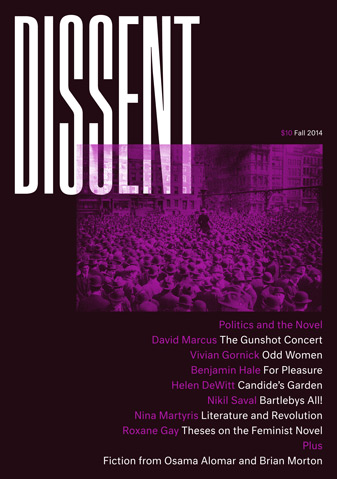
  • Brute Ideology

    Dissent
    Fall 2014

    Walter Johnson, Winthrop Professor of History; Professor of African and African American Studies; Director, Charles Warren Center for the Study of American History
    Harvard University
    Racecraft: The Soul of Inequality in American Life by Barbara J. Fields and Karen E. Fields. Verso, 2012, 310 pp.

    The Problem of Slavery in the Age of Emancipation by David Brion Davis. Knopf, 2014, 448 pp.

    The field of U.S. history today is characterized by a mania for management. The “new” history of capitalism has focused its attention on the creation and daily reanimation of the grand abstraction from which it draws its title: the mid-level market makers who take capital and transform it into capitalism. In the aftermath of the 2008 financial crisis, increasing numbers of historians have turned their attention to the histories of powerful historical actors we have too long ignored or dismissed as “dead white men” unworthy of the attention of the properly progressive historian: financiers, bankers, and businessmen of all kinds. Despite the obvious importance of the task and the avowedly critical purpose of the turn towards the study of the mechanisms of market practice, however, some of the bolder claims that have been used to mark out the novelty of this “new” history seem unwarranted, perhaps even misguided. Can historians really set aside the study of racial and sexual domination now that they have discovered the economic exploitation underlying all other history? Can they really write a better history of capitalism by simply replacing the history of the marginal with the history of the powerful? Amidst the end-of-historiography enthusiasm for the “new” history of capitalism, two recent books remind us of the enduring importance of some of the questions posed by the old history of capitalism: questions of determination, ideology, and hegemony, and of collective action, resistance, and (even) revolutionary social change.

    Bringing together previously published and new essays treating U.S. history from the time of the American Revolution to the eve of the Occupy movement in 2011, Racecraft reminds us that, at the very least, the “new” history of capitalism has some very distinguished antecedents. Taken together, the writing of the historian Barbara J. Fields and the sociologist Karen E. Fields (sisters; hereafter “Fields and Fields”) provides a sustained and brilliant exposition of the history and practice of race-marking in America. If race is “socially constructed,” as virtually every educated person in the United States knows it officially to be, then why do we believe we can determine the race of the person on the other end of the line as soon as we pick up the phone?

    As the title’s invocation of witchcraft suggests, the book is framed by the idea that there is something occult about such everyday practices of divination. For the authors, race is a kind of magical thinking, a way of isolating a few of the surface features of near-infinite human diversity and over-generalizing them into an architecture of biological, social, and even metaphysical difference. Race thinking, they suggest, is a sort of transubstantiation that adduces essence out of circumstance, made up of turns of phrase and ways of thinking so familiar and yet so powerful as to persistently remake the material world in their own image.

    Fields and Fields illustrate and expose this sort of magic through a close reading of the printed matter of our times: newspaper accounts of proudly segregated high-school proms and white supremacists carrying guns to Obama campaign rallies; peer-reviewed articles published in scholarly journals and the bureaucratic memos that established the “multiracial” category in the U.S. census. They juxtapose the “troglodyte racism” of the crypto-Klan birthers to the breathless intonations of historical transcendence (“the end of racism??!!”) common among twenty-first-century white liberals. The main argument of the book is with the latter’s sometimes unwitting, sometimes self-congratulatory engagement with the dark magic of racial difference itself.

    Take the “multiracial” moment—the idea that the bad old days of “black” and “white” may finally be giving way to an embrace of “mixture” and “difference.” But wait: “mixture” of what with what? According to Racecraft, the Census Bureau defines a “multiracial” person as “someone with two monoracial parents.” Through the heart of the celebration of the new multiracialism circulates a notion of blood purity worthy of The Birth of a Nation. For Fields and Fields, any invocation of “race” as an explanatory or even descriptive category is in and of itself racist. The use of “race” to explain anything from ancestry to economic inequality unwittingly reinforces the false belief in deep-rooted biological differences between black and white people. “Ancestry,” according to the authors, should be understood as a way that individuals are linked across generations without being thickened into “race.” Heredity, whether responsible for visible traits like curly hair or hidden ones like the sickle cell, is just that and nothing more: “‘genetic’ is not equivalent to ‘racial.’”

    If we had only to worry about a mediascape where relevance is measured by the ability to attach ideas to beginnings and endings (the “post-racial” election of the “first black president”) things would be bad enough. “Racecraft,” however, has infiltrated even the hallowed ground of academia. Precisely and compellingly, Fields and Fields demonstrate that scientists use “racial” causes to explain what are in fact social effects. A recent scientific study of high asthma rates among schoolchildren in the South Bronx, for example, concluded that—in addition to heavy traffic, dense population, poor housing, and lack of preventative health care—the neighborhood was characterized by “a large population of blacks and Hispanics, two groups with very high rates of asthma.”…

    Read the entire review of both books here.
  • Racecraft: The Soul of Inequality in American Life

    Verso Books
    October 2012
    310 pages
    Paperback ISBN: 9781781683132
    Ebook ISBN: 9781844679959
    Hardback ISBN: 9781844679942

    Karen E. Fields, Independent Scholar

    Barbara J. Fields, Professor of History
    Columbia University, New York, New York

    Tackling the myth of a post-racial society.

    Most people assume that racism grows from a perception of human difference: the fact of race gives rise to the practice of racism. Sociologist Karen E. Fields and historian Barbara J. Fields argue otherwise: the practice of racism produces the illusion of race, through what they call “racecraft.” And this phenomenon is intimately entwined with other forms of inequality in American life. So pervasive are the devices of racecraft in American history, economic doctrine, politics, and everyday thinking that the presence of racecraft itself goes unnoticed.

    That the promised post-racial age has not dawned, the authors argue, reflects the failure of Americans to develop a legitimate language for thinking about and discussing inequality. That failure should worry everyone who cares about democratic institutions.