• Call for Submissions: “Black and White: Parenting on the Colorline,” an anthology edited by Caroline Berz, Jessie Scanlon and Kim DaCosta

    When General Mills aired a Cheerios commercial featuring a family with a white mother, a black father and a biracial child, many viewers reacted positively, but the ad’s YouTube page was filled with so much vitriol that the company disabled comments. A white woman calling in to the black comedian D.L. Hughley’s radio show summed up the disgust: “Cereal is white. That has no place at the breakfast table. It’s offensive.” The Cheerios marketing team doubled down, spending $4 million to run a second ad with the family during the Super Bowl, yet many people are still uncomfortable with the very idea of a black/white family. As Washington Post columnist Richard Cohen put it, “people with conventional views must repress a gag reflex when considering the mayor-elect of New York—a white man married to a black woman with two biracial children.” These are the stories of mixed race families that gain national attention. The anger, suspicion, and ignorance they reflect can also be felt in our most mundane daily interactions. Last year, a white man shopping at Walmart with his biracial children was suspected of kidnapping. Black fathers of lighter-skinned children often draw questioning stares, while darker-skinned mothers are often mistaken for “the nanny.”

    As a nation we are increasingly multiracial, but mixed race individuals and families are still perceived as an anomaly. For those of us living—and parenting—on the colorline, events like the Cheerios controversy are urgent reminders that the society we are raising our children in is far from “post-racial,” regardless of the election of the first African American/white president. Indeed, since Barack Obama moved into the White House, we’ve seen an increase in violence targeting those of African descent.

    How do these issues affect the day-to-day lives of our families? How do they inform the many ways we parent our children, our hopes and dreams—and fears—for them? How do we go about the daily tasks of building and supporting our families, loving our partners, and growing into our own identities as parents when racism continues to be a defining issue in our schools, on our streets, in our government’s policies and sometimes in our own homes?

    The essays anthologized in Black and White: Parenting on the Colorline will explore the multiple and complex experiences of parenting children of African and European heritage, and of families formed by transracial adoption. The collection will pay close attention to the ways in which the mixed race identities of children and parents alike are informed by gender, class, sexuality, language and citizenship. The writing will be humorous and lyrical, insightful and critical, and most of all personal, reflecting the joys and challenges of mixed-race parenting.

    Topics can include (but are not limited to): pregnancy and birth; adoption; LGBTQ families; interfaith and interracial families; divorce; single-parenting; grandparenting mixed children; racial implications of different parenting philosophies; specifics of parenting mixed girls and boys; gender-nonconforming children and families; special rights children and families; experiences at playgrounds and in mothers’/parents’ groups; schools and education; notions of beauty; bullying; policing; questions of multiculturalism and diversity; individual and family identities that push the boundaries of the black/white binary.

    Please send the editors a brief description of your proposed essay (250-300 words), a bio (200-250 words), and a list of previous publications. The essays can range in length and tone, though all should be accessible to a broad audience. Pieces are due on January 15 [2015], and acceptance will depend upon the strength and fit of the completed essay.

    Editor Bios:

    Born and raised in Memphis, Tennessee, Caroline Berz has been engaged in active dialogue around issues of “race” and identity for as long as she can remember. She has worked closely with Facing History and Ourselves for over fifteen years first as an intern, then as a full-time staff member and most recently as a member of the National Teacher Advisory Board and adjunct online facilitator. She has piloted new material on the American eugenics movement, South Africa and Rwanda. She spent a decade as a high school history teacher in Boston area public schools teaching a variety of courses ranging from Modern European History to Modern World History to her personal favorite, a junior/senior elective on Race and Membership. In 2008, she transitioned from being in the classroom full-time to curriculum writing, film education and outreach. Helping schools and communities to become “fluent” in multiculturalism is one of her passions so she enjoys leading diversity workshops in schools for teachers, students and parents. She has a BA in US History from Tufts University and a Masters in Education from Harvard University and is mom to two young children, ages 2 and 6.

    Jessie Scanlon has worked as a writer, editor, and journalist for 20 years. After graduating with honors from Brown University, she earned an internship at Wired magazine and worked her way up the masthead to become a senior editor. Along the way she co-authored Wired Style: Principles of English Usage in the Digital Age. After ten years on staff, she became a contributing writer for the magazine. In addition to her pieces for Wired, she has written for national magazines and newspapers including The New York Times, Slate, Popular Science, ID, Dwell, Men’s Journal, and TED.com. After four years on staff at BusinessWeek, where she spearheaded its online coverage of innovation and design, she shifted to working primarily in books. Most recently, she helped write Leading the Life You Want, a Wall Street Journal best seller. Jessie lives in Cambridge, MA, with her husband and two children.

    Kim DaCosta, a sociologist, is especially interested in the contemporary production of racial boundaries. Born in Boston and raised in two of its suburbs—both largely white and blue collar—she is the fourth of her Irish mother and Black father’s six children. The experience of growing up in metropolitan Boston of the 1970s and 80s, a time and place uncomfortable with when not outright hostile to interracial families, first sparked her academic interests. Kim’s book, Making Multiracials: State, Family, and Market in the Redrawing of the Color Line (Stanford 2007), explores the cultural and social underpinnings of the movement to create multiracial collective identity in the United States. She graduated magna cum laude from Harvard University and holds a PhD in sociology from Berkeley. Kim is currently a professor and dean at New York University and is the mother of three children.
  • Why Latinos won’t become white

    Al Jazeera America
    2014-10-22

    Gabriel Arana

    Assuming Latinos will join the white majority ignores the stark divisions in a racially diverse group

    In the lead-up to the midterms, President Barack Obama has been parroting the conventional wisdom about the GOP’s future: Republicans are doomed if they keep up their opposition to immigration reform and continue the inflammatory anti-immigrant rhetoric. “It’s anybody’s guess how Republicans are thinking about this,” he said during a town hall event in Santa Monica, California. “If they were thinking long term politically, it is suicide for them not to do this.”

    Latinos make up 14 percent of the population, and their share is projected to grow to 29 percent by 2050. This demographic traditionally identifies with the Democratic Party; the toxic immigration debate in Washington, fueled by xenophobes in the GOP, will only increase that tendency. In 2006, 49 percent of Latino eligible voters identified as or leaned Democratic. By 2011, that number jumped to 67 percent. With the United States projected to become a majority-minority country by 2043, Republicans’ chances of winning the White House on the backs of white voters will grow ever slimmer.

    But a counternarrative, one that would put Latino votes back in contention for the GOP, has begun to emerge. In the coming decades, Latinos could become “white” — a process in which cultural assimilation would presumably be followed by political realignment — opening them up to affiliation with the Republican Party. It’s a theory espoused most prominently by Slate political writer Jamelle Bouie, who argues in the winter issue of Democracy that “the future won’t be majority-minority; it will be a white majority, where Spanish last names are common.” But this vision of complete assimilation ignores the stark racial divisions in Latin American societies, in which socioeconomic status and skin color, as in the U.S., tend to fall along parallel lines.

    Ethnic attrition

    The idea of Latinos becoming white in the American sense — a vision of racial and cultural assimilation independent of self-identified race — isn’t a new one. Economists Brian Duncan at the University of Colorado and Stephen Trejo at the University of Texas at Austin call it ethnic attrition. As Latinos intermarry and climb the socioeconomic ladder, the theory goes, they are less likely to self-identify as Hispanic. Duncan and Trejo’s research shows (PDF) that while virtually all first- and second-generation Hispanic immigrants identify as Hispanic, in the third generation, those of mixed heritage start to self-select out of this group. Among third-generation immigrants with only two Hispanic grandparents, 79 percent identify as Hispanic. Among those with only one Hispanic grandparent, the number falls to 58 percent. Think of Republican Sen. Ted Cruz, whose father is Cuban and whose mother is white, or comedian Louis C.K., whose grandmother is Mexican and whose other grandparents are Irish and Hungarian…

    Read the entire article here.

  • Today’s Irish Dancers Step Away From Stereotype

    Code Switch: Frontiers of Race, Culture and Ethnicity
    National Public Radio
    2014-10-27

    S. J. Velasquez


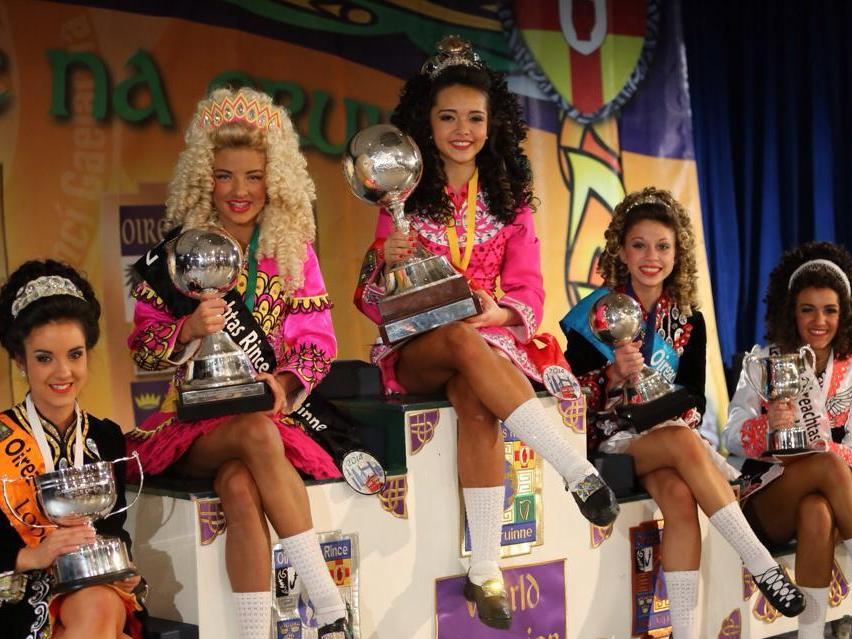
    Julia O’Rourke (center) wins the 2014 World Irish Dancing Championships. Here, she poses with the top five performers in her age group.
    Jimmy McNulty/FeisPix

    When Riverdance debuted 20 years ago, Irish step dancers — whether citizens of Ireland or any other country — looked, well, stereotypically Irish. The red-haired, freckle-faced lass doing a jumpy jig still comes to mind for many. But the All Ireland Dancing Championships, currently underway in Dublin, will show how that image no longer reflects the reality.

    Take the current Irish dance “it” girl, Julia O’Rourke. She was born in New York, and has Filipino and Irish ancestry. At age 15, she is a two-time world champion and star of the Irish dance documentary Jig. That film follows dancers from around the world who are training for and traveling to the 2010 World Irish Dancing Championships.

    “I really hope that I helped change that stereotype,” O’Rourke says. “[Ethnicity] really doesn’t matter anymore. It’s how you dance.” She points to the success of her friend and dance classmate Melanie Valdes, whose father is Cuban-American. “There have been so many dancers to join the community who are only part Irish or not Irish at all,” O’Rourke says, “and they’ve really made an impact.”

    “I don’t think the judges even react to it anymore,” says Valdes, who has also swept titles at major competitions, capturing gold at the world championships twice. “It’s all about the dancing.”

    For the most part, O’Rourke agrees, insisting that she has never been treated badly because of what she looks like. If anything, it has helped. “Because my look is different, my face doesn’t look like a typical Irish girl, it might pop out a little more to the judges,” she explains.

    But diversity wasn’t always so welcome…

    …Brown Skin, Spray Tans And Hot Pink Shorts

    Now, some members of the Irish dance community see a distinctive look as an advantage. Drew Lovejoy, a now retired two-time world champion, is biracial and identifies as African-American. Nineteen-year-old Lovejoy, known for sporting hot pink shirts in competition, says his unique appearance gave him confidence on stage because it set him apart. He jokes that his skin tone allows him to pull off a different color palette completely…

    Read the entire article here.

  • Historical Origins of the One-Drop Racial Rule in the United States

    Journal of Critical Mixed Race Studies
    Volume 1, Issue 1 (2014)
    pages 98-132

    Winthrop D. Jordan (1931-2007), Emeritus Professor of History and African-American Studies
    University of Mississippi

    Edited by:

    Paul Spickard, Professor of History; Professor of Asian American Studies
    University of California, Santa Barbara

    Issue cover

    Winthrop Jordan, one of the most honored of US historians, wrote about racial mixing a generation before there was a field of mixed race studies. At the time of his death, he left an unfinished manuscript: “Historical Origins of the One-Drop Racial Rule in the United States.” For this inaugural issue of the JCMRS, Jordan’s former student Paul Spickard, himself a foundational scholar of multiracial studies from the first wave of scholarship in the late 1980s and early 1990s, has edited Jordan’s final article.

    The One-Drop Rule: The US Anomaly and Its Fateful Consequences

    Historians and scholars in other disciplines have generated a huge corpus of studies about the concept of race while ignoring, for the most part, one of the most important features of race relations in the United States. In this country, the social standard for individuals is superficially simple: if a person of whatever age or gender is believed to have any African ancestry, that person is regarded as black. Basically, by this social rule, a person was, and is, either black or not. Any person of racially or ethnically mixed descent who has some “Negro blood” has been or still is regarded as “colored,” or “African,” or “Negro,” or “black,” or “Afro-American,” or “African American”—whatever designation has prevailed by convention at the time. This social rule has been easy to overlook because it is so close to home, often in a personal way, and because it involves self-identification as well as identification of others. Almost all people in the United States tend to operate perceptually and conceptually according to this simple social rule concerning race without stopping to question its logic. Why question the way the world works when that way is so obvious? And far from questioning the rule, many Americans seem almost resistant to acknowledging its existence, and some of those who have thought about the rule angrily assign blame to some nefarious group for promoting it.

    When it comes to race, Americans see themselves, and many overseas people as well, in a bicolored fashion—either/or—black or white. Surely this is an interesting chromometric assessment of skin complexion. We should ask ourselves why nearly all the people playing on basketball courts are said to be one of the same two colors as piano keys. For one thing, no human being has a complexion that is fully black or completely white. And all these players, whether white or black, have a light and dark side of their hands. In addition, bifurcating these or any people subtly negates the underlying unity of humankind and its common genetic and historical roots.

    In the United States some medical geneticists have blithely ignored the one-drop rule while urging genetic profiles of different races as they relate to susceptibility to different diseases. These proposals have been strongly denounced by some geneticists and by scholars in other disciplines who point to the obvious fact that a great many socially defined African Americans have a genetic background that is far less than even fifty percent African. Historians have been less prone to disagreement among themselves, but they have simply been neglectful about asking how and why this social rule developed. The focus in this inquiry is on the social aspects of the rule, and thus the definition of the rule used here is somewhat broader than is necessary when discussing the genetics of its operation.

    The term “one-drop rule” has its own rather curious history. It was used repeatedly in scholarly works on race relations more than a generation ago. Today, it can be found in a wide variety of publications that deal with race relations in the United States. Yet the lexical community has been either negligent or resistant about the term, for as of a very few years ago, all the purportedly unabridged dictionaries of the English language and their updated collegiate versions did not include it. These dictionaries have begun to catch up as dictionaries and facsimiles like Wikipedia have become ubiquitous online. Even the venerable Oxford English Dictionary, which is supposedly based on historical principles, has an online version that now includes the term. The phrase currently appears in many books, magazines, and on the Internet, firmly supported by its conciseness in referring to a powerful social rule…

    Read the entire article here.

  • “I am on the Coloured Side”: The Roles of the White Suitor and the Black Mother in the Tragic Mulatta Narrative

    University of Massachusetts at Amherst
    2013

    Shannon D. Luders Manuel

    What I propose to add to the already established dialogue regarding the tragic mulatta narrative is an investigation into the commonalities of the genre’s endings, as well as to assert that the tragic mulatta genre is present even at the turn of the 21st century with such works as Danzy Senna’s Caucasia. While my investigation by no means covers an exhaustive list of tragic mulatta narratives, the readings provide an overview of the ways in which the narrative has both evolved over time and stayed consistent during the antebellum, post-bellum, Harlem Renaissance, and the present day. I present each author as both building from previous authors’ works and as limited to the time period in which he or she pens the novel(s).

    The tragic mulatta of the post-bellum rejected white male suitors as a larger and more crucial rejection of sexual slavery and depravity, as well as attempting to shield the suitors from experiencing rejection from their own white contemporaries, as Angela does at the end of Plum Bun: “But I want you to know that from now on, so far as sides are concerned, I am on the coloured side. And I don’t want you to come over on that side” (373). However, the tragic mulattas continue to reject white male suitors even into the 21st century, and I assert that this repetition is limiting both to the characters themselves and to the narrative lives of contemporary mulatta readers. I further assert that the genre continues to pair rejection of the white male suitor with a reappropriation of true “blackness” and maternal domesticity. Through observing the tragic mulatta’s need to gain identity and sense of place through her darker mother or sister and the rejection of a white male suitor, tragic mulatta scholars—as well as critical race theorists in general—become more aware of the unique position the genre holds in identity formation as seen through what I believe are critical fictional texts for an interracial nation.

    Login to read the dissertation here.

  • Black Is, Black Ain’t: Biracials, Middle-Class Blacks, and the Social Construction of Blackness

    Sociological Spectrum
    Volume 30,  Issue 6, 2010
    pages 639-670
    DOI: 10.1080/02732173.2010.510057

    Cherise A. Harris, Associate Professor of Sociology
    Connecticut College, New London, Connecticut

    Nikki Khanna, Associate Professor of Sociology
    University of Vermont

    Several scholars claim that group cohesion among black Americans is necessary for black advancement. Our research examines the extent to which group cohesion is possible given the increasing diversity of Black America, particularly with regard to race and class. Drawing on in-depth interviews with 33 middle-class blacks and 40 black-white biracials, we explore (1) the similarities and differences in the experiences of both groups, (2) their encounters with marginalization, (3) how they negotiate perceived marginalization, and (4) the extent to which all of the above are shaped by socially constructed ideas of blackness. We find that narrow notions of “authentic” blackness challenge group cohesion and threaten to splinter the black community along class and ethnic/racial lines. However, we find evidence of greater tolerance for the community’s racial diversity than its class diversity. Nevertheless, the data presented here suggest that the increasing heterogeneity of Black America poses significant challenges to group cohesion.

    Read or purchase the article here.

  • “What Are You?” Multiracial Identity and the Persistence of Racism in a “Post-Racial” Society

    University of Virginia
    2014

    Hephzibah Virginia Strmic-Pawl

    In 2000, and for the first time, the U.S. Census allowed individuals to “mark one or more” races, and now the U.S. Census projects that those who choose two or more races will triple by 2050. The occurrence of the “biracial baby boom,” a new post-racial ideology, and the election of the first Black (or biracial depending on one’s categorization) U.S. president have led to great hopes for a nation where race no longer matters.

    On the other hand, there is persistent discrimination including wide disparities in education, wealth, and employment. Thus, does multiracialism signify that society’s race relations are improving and that we are deconstructing racial categories and racism? Or, does multiracialism naively overlook the continuing vestiges of race and racism and merely reify “race” in efforts to defend the recognition and experiences of those who are “mixed race?”

    Through a study of 70 people of mixed-race descent, I seek an answer to this debate. I ask: how does multiracial identity manifest itself and align with and/or contest the current racial hierarchy? I find 67 of the 70 respondents do prefer a multiracial identity, a preference that reveals the coherence of multiracialism and its ability to challenge the racial hierarchy. Yet, much of this dissertation is dedicated to the differences in experiences of Asian-Whites and Black-Whites. The majority of the Asian-Whites have close White friends and networks, have few experiences and perceptions of racism, and have a color-blind approach to racism. By comparison, BlackWhites are more likely to be aligned with Black networks and Blackness, experience and perceive racism to be a significant problem, and expend significant effort navigating their race.

    This project, then, has two main findings: 1) those of mixed-race descent are choosing to identify with both races and 2) the continuing significance of race and racism leads to markedly different narratives for those of Asian and White descent compared to those of Black and White descent. Thus, multiracialism has validity yet is limited in its ability to move the discussion forward on race, for it relies on race in order to defy race.

  • The Black, British Atlantic: Blackness in Victorian Literature

    University of Illinois at Urbana-Champaign
    2014

    Donghee Om

    My dissertation is about transnational aspects of the Victorian era from the vantage point of what Paul Gilroy described more than two decades ago as the “black Atlantic.” Looking at various ways in which the black Atlantic was at times a British Atlantic, my dissertation aims to complicate a flow of discussion that Gilroy’s Americanist successors have interpreted largely in light of U.S. slavery and its discursive contexts. Specifically, I explore how some nineteenth-century British authors such as Jane Austen, Elizabeth Barrett Browning, Mary Seacole, and Wilkie Collins rejected popular notions of blackness as a racial marker of African slavery with its implied negative qualities. Instead, their works convey a different idea about blackness as a pliable marker of cultural agency that not only constitutes a part of English culture, but is performed by people regardless of racial affiliation. This notion of blackness as performative signifier goes beyond the slavery metaphor in Victorian literature to frame an interpretive paradigm that allows us to read blackness in broader socio-political contexts.

    As I show how canonical and non-canonical nineteenth-century British literature used various kinds of black performativity to undo essentialist notions of blackness, race, and identity itself, I demonstrate the integral status of blackness in Victorian literature. This in turn points to nineteenth-century English culture not as an isolated entity that imposed itself on Africans and on slave-owning colonies of the British Empire, but as participant in a larger cultural network called the black Atlantic. The black Atlantic thus invites us to revise British literature and culture by questioning the assumed homogeneity of white-centrism and even the stability of whiteness itself as foundational for English identity.

    In the first chapter, I look at how Jane Austen’s Mansfield Park (1814) and Persuasion (1818) engage blackness without featuring a single black or mixed-race character. Reading this absence as literary strategy, I argue that the two novels reject the popular view of blackness as too restrictively applied to oppression and marginalization, and associate it instead with women’s autonomy and social participation in an era of heightened debate over slavery following the 1807 Slave Trade Act. Here blackness comes to represent an ethically viable form of women’s autonomy that doesn’t necessarily unsettle the established social order even as it challenges the mercantile logic of sexual hierarchy represented by the corrupt marriage market. In fact, by validating women’s autonomy in the context of middle-class ethics, Austen suggests that such autonomy is a prerequisite of social stability.

    Chapter two explores how Elizabeth Barrett Browning’s three antislavery poems—“The Runaway Slave at Pilgrim’s Point” (1847/1848), “Hiram Powers’ Greek Slave” (1850), and “A Curse for a Nation” (1855/1866)—extend beyond the issue of American slavery to address British racism. Representing blackness as a signifier of artistic creativity, the poems aesthetically challenge essentialist notions of black inferiority in a mid-Victorian society troubled by post-abolition economic decline and colonial unrest in the British West Indies. EBB’s antislavery poems thus work to liberate blackness from the chains of racial essentialism and draw on black performativity to expand the language of the poet’s social criticism.

    Chapter three investigates Mary Seacole’s performative identity in her travel narrative, Wonderful Adventures of Mrs. Seacole in Many Lands (1857). Knowing her Victorian readers will be predisposed to read her mixed-race body as a marker of otherness, Seacole plays with their belief in ways that de-essentialize race: first, she disrupts whiteness as a racial signifier ontologically grounded in skin color by portraying her successful performance of the idealized English mother in the Crimea. Seacole then represents her physical “blackness” as a marker of life-saving hybrid medicine, a cultural signifier that revises racist notions of identity. In the process, she exposes Englishness as an unstable marker of identity that can be performed by people of different races.

    Chapter four considers how Wilkie Collins problematizes binaristic notions of race in Armadale (1866), Miss or Mrs? (1873), and The Guilty River (1886). Collins’s radical reevaluations of racial others vis-à-vis Englishness and Britishness come at a time when a series of colonial uprisings like the Indian “Mutiny” and the Morant Bay rebellion exacerbated the growing acceptance of permanent racial hierarchies (as opposed to the older notion of eventual human universality). Armadale emphasizes blackness as a marker of sympathy—the essential element of English morality seldom seen in the author’s time. Affirming blackness as the moral essence of Englishness, Miss or Mrs? and The Guilty River reflect Collins’s growing frustration with the way a kind of binaristic thinking he challenged in Armadale continued to thrive in English society. These texts ultimately call for understanding English identity as an ongoing expression of inter-racial, inter-cultural reciprocity.

    Login to read the dissertation here.

  • Are Biracial Children Damaged?

    HERS Magazine
    November/December 2014
    page 36

    Cherrye S. Vasquez

    Approximately seven years ago, I was engaged in what I thought was a friendly conversation with a group of ladies at my work. As mothers, we often talked about our daily activities our children were engaged in. Our conversations were personal, easy stress relievers, and generally ended with much laughter among the group.

    When I ended my “story of the day” on the subject of my daughter’s latest activity, one of the ladies turned and said, “Well she’s going to have psychological problems anyway.”

    I looked at her, startled, and asked what she meant by that. “Well, she’s biracial,” she continued, “and all biracial children end up with psychological problems.”

    This woman was the first person who’d ever made such an asinine statement to me, but unfortunately not the last. What she claimed never crossed my mind. Why would it?

    Read the entire article here.

  • The 3rd Biennial Critical Mixed Race Studies Conference “Global Mixed Race”

    DePaul University
    DePaul Student Center
    2550 North Shefield
    Chicago, Illinois 60614
    2014-11-13 through 2014-11-15

    Free and open to the public!

    Global Mixed Race, the third biennial Critical Mixed Race Studies Conference, will be hosted at DePaul University in Chicago, November 13th-15th, 2014. It will bring together scholars from a variety of disciplines around the world to facilitate a conversation about the transnational, transdisciplinary, and transracial field of Critical Mixed Race Studies.

    The 2014 conference is organized in partnership with DePaul’s Department for Latin American and Latino Studies and the Center for Intercultural Programs, and the non-profit organization Mixed Roots Stories. CMRS 2014 is also co-sponsored by DePaul’s Office of Institutional Diversity and Equity, African Black Diaspora Studies, Art, Media, & Design, Center for Latino Research, Critical Ethnic Studies, Global Asian Studies, Irish Studies, LGBTQ Studies, and Women’s and Gender Studies.

    View the final schedule here.

    Website: www.criticalmixedracestudies.org
    E-Mail: cmrs@depaul.edu
    Telephone: 773-325-4994
    Facebook: criticalmixedracestudies
    Twitter: @CMRSmixedrace #CMRS2014