• Black & Jewish in New Orleans

    BrassyBrown.com: where women of color are first in line
    2014-04-01

    Marian Moore, Guest Blogger

    December of 2013 found me in San Diego, California this year, attending the fiftieth Biennial of the Women of Reform Judaism. Although, this was the organization’s centennial, WRJ actually began at my synagogue in 1900 as “the Sisterhood”, the name still used by most members. When I look at our official history, I find that the Sisterhood began as a ladies auxiliary. In 1900, they took on the task of selecting the furnishings for the synagogue and maintaining the new synagogue building. In later years, they did everything from comforting the sick, funding the purchase of an organ, preparing holiday synagogue meals, and sponsoring scholarships at the rabbinical college in Cincinnati. WRJ, The Sisterhood, is still the critical heart of the synagogue. They ensure that things get done. The President of each synagogue chapter is responsible for representing the chapter on the synagogue board and responsible for defining what tasks the chapter will accept.

    This was my third biennial but my first as the President of my synagogue chapter. Each time that I’ve attended these national gatherings, there are more jews of color (JOC) participants than the prior time. I attended many small panel discussions where I was the only non-white woman in the room, but when I attended the group discussions with more than one hundred attendees that was never the case. Many of our blended identities were present, from Jewish and African-American, Jewish and Asian-American, Jewish and Latina, et. al. While I was there to find out how to increase membership in my own synagogue Sisterhood, I was interested to listen as the hierarchy of both the women’s organization and the Reform movement wrestled with the recognition of the diversity of Reform Judaism and jewish life in general. I see evidence of that struggle in my life in New Orleans…

    Read the entire article here.
  • Interview with Carole Brennan from Mixed Race Irish

    Een Vlaming in Ierland/ A Fleming in Ireland
    2014-03-28

    Roos Demol

    It has been quite a week in Ireland, with the new problems for Mr Shatter, the news that over 2000 phone calls were taped in Garda offices around the country, which could bring a lot of current and old court cases in jeopardy,the press had a busy time and mr. Shatter is very troubled.

    But that hasn’t affected our normal every day lives.

    However, since I started my (voluntay) job with the online radio, Irish Radio International, where I have my own show, The New Rebels, aimed at the immigrant society here and their families abroad and since I have touched the problem of racism, I am regularly confronted with some very difficult truths.

    It is of course easy to ignore all that and keep on blogging about all the good things in Ireland (of which there are many), but I think we all have a repsonsibiloity in revealing truth, however unpleasant that truth may be.

    I connected with a lady from London, Carole Brennan, who is a co-founder of the recently established Mixed Race Irish group, an association of Irish people with African dads and Irish mothers, born in the 50s, 60s and 70s, and often raised in industrial schools here in Ireland, where they were often psychologically, physically and even sexually abused…

    Listen to the interview here.

  • The Robbins Family at War with Marvin Jones

    Research at the National Archives and Beyond
    BlogTalk Radio
    Thursday, 2014-04-03, 21:00 EDT, (Friday, 2014-04-04, 01:00Z)

    Bernice Bennett, Host

    Marvin T. Jones, Executive Director
    Chowan Discovery Group

    “The Robbins Family at War” – it is about a Native American family who lived through colonial wars of the 17th and 18th centuries, and finally emerged victorious in the Civil War as a part of the mixed-race community. Five members served in the U.S. Colored Troops. Three fought from Suffolk, Virginia to Richmond and helped enforce Juneteenth. Two served in Florida and South Carolina. After the war, they served in North Carolina legislature, invented and founded schools and churches.

    Marvin T. Jones is the executive director of the Chowan Discovery Group, whose mission is to research, document, preserve and present the history of the mixed-race land-owning people of the Hertford County area in northeast North Carolina. The CDG has produced many articles, lectures, historical markers, a stage production and several video documentaries. Marvin lives in Washington, D.C. and is a native of Cofield, North Carolina.

    For more information, click here.

  • David Walker & Color of Film + In The Mix doc on mixed-race artists

    Stage & Studio
    KMZE 107.1 FM
    Gresham, Oregon
    2014-03-25

    Dmae Roberts, Host

    [At 00:28:46] “In The Mix: Conversations with Artists…Between Races” by Dmae Roberts is a radio exploration of Mixed Race with novelist Lisa See, Playwright Heather Raffo, Writer/Conceptual Artist damali ayo, Playwright Velina Hasu Houston, and three actors from the Oregon Shakespeare Festival, Juan Rivera LaBron, Soneela Nankani and Joshua Wolf Coleman.

    Listen to the interview here. Download the interview here.

  • Register Now for the 3rd Biennial Critical Mixed Race Studies Conference “Global Mixed Race” at DePaul University in Chicago

    Critical Mixed Race Studies
    2014-04-02

    Mark your calendars, book your flights and hotels, and be sure to register (it’s free!) for the 3rd biennial Critical Mixed Race Studies Conference “Global Mixed Race” November 13-15, 2014 at DePaul University in Chicago.

    Rebecca Chiyoko King-O’Riain, Senior Lecturer, Department of Sociology, National University Ireland Maynooth and coeditor of Global Mixed Race (forthcoming New York University Press, 2014) will be our featured CMRS keynote.

    Also from Ireland, Zélie Asava will be our featured Mixed Roots Stories keynote. She is the author of The Black Irish Onscreen: Representing Black and Mixed-Race Irish Identities on Film and TV (Peter Lang, 2013).

    Join us for three days of scholarly panels plus an exciting line up of arts and cultural programming organized in conjunction with Mixed Roots Stories including: feature film screenings, an evening of short films, a live performance evening, and arts and culture panels and workshops across the three conference days. CMRS 2014 will also include an info fair and caucus meetings. This conference is open to the public and all are welcome. CMRS creates a dynamic environment where senior and junior scholars, students, activists, artists, community, non-profit and student organizations, and the general public can network and share.

    For more information, click here.

  • Bung Mokhtar: Mixed-race Malaysians will benefit from racial voting

    Malay Mail Online
    Petaling Jaya, Malaysia
    2014-04-01

    Zurairi AR

    UALA LUMPUR, Apr 1 — Malaysians with mixed-race parentage will benefit the most from voting along racial lines as they will have more than one representative, Kinabatangan MP Datuk Bung Mokhtar Radin said today.

    The Barisan Nasional (BN) MP also claimed that the system suggested by Minister in the Prime Minister’s Department Datuk Seri Shahidan Kassim yesterday will ensure justice for every ethnic group in Malaysia.

    “For those who may have two or three ancestries, they can choose which one they prefer… They can be in both worlds,” Bung said in Parliament here.

    “For me that is really good. At least, for me who has both Sungai and Malay ancestries, I can then get two or three representatives. Now, I can only get one.”

    Sungai is the name of one of the many official tribes in Sabah.

    Bung also refuted claims that Shahidan’s remarks is alike the now-abolished apartheid regime in South Africa, in which people voted for representatives from their own ethnic communities…

    Read the entire article here.

  • “Hiding in Plain Sight: Mixed Blood Families and Race in the 19th-Century United States West”

    Public Radio Tulsa
    Studio Tulsa
    Tulsa, Oklahoma
    2014-03-25

    Rich Fisher, General Manager & Host

    Our guest on ST is Anne Hyde, the William R. Hochman Professor of History at Colorado College. She’ll be giving the 2014 H.G. Barnard Distinguished Lecture, which is presented annually by the TU Department of History, tonight (Tuesday the 25th) at the Gilcrease Museum Auditorium here in Tulsa. The lecture begins at the 7pm and is free to the public. Prof. Hyde, who mainly teaches courses on the history of Native America as well as that of North America, received her A.B. degree in American Studies from Mount Holyoke College and her M.A. and Ph.D. in History from the University of California at Berkeley. She has published widely on the history of the American West, has served on editorial boards for the Pacific Historical Review and the Western Historical Quarterly, and has been elected to the Councils of the Western Historical Association and the American Historical Association. Her address at Gilcrease tonight is entitled “Hiding in Plain Sight: Mixed Blood Families and Race in the 19th-Century United States West” — and it’s derived from her book, “Empires, Nations, and Families: A New History of the North American West, 1800-1860.” A reviewer for the Western Quarterly Review has called this text: “Ingenious. A magnificent scholarly achievement. A sweeping new narrative account of [western] history. A book to ponder and plunder.”

    Listen to or download the interview (00:28:58) here.

  • Where Did “Hispanics” Come From?

    Sociological Images: Inspiring Sociological Imaginations Everywhere
    2014-03-29

    Claude S. Fischer, Professor of Sociology
    University of California, Berkeley

    One may well wonder where the term “Hispanic,” and for that matter, “Latino,” came from. The press and pundits are all abuzz about the Hispanic vote, Hispanic organizations, and Hispanic cultural influences. Back in the mid-twentieth century, however, they wrote about Mexicans or Puerto Ricans or Guatemalans, not about Hispanics. Of course, people of Latin American origin have become far more numerous in the United States since then and the immigration itself brings more attention. Nonetheless, the labels have changed. Starting in the 1970s, the media rapidly adopted the “pan-ethnic” term Hispanic, and to a lesser degree, Latino, and slowed down their use of specific national labels.* So did, organizations, agencies, businesses, and “Hispanics” themselves.

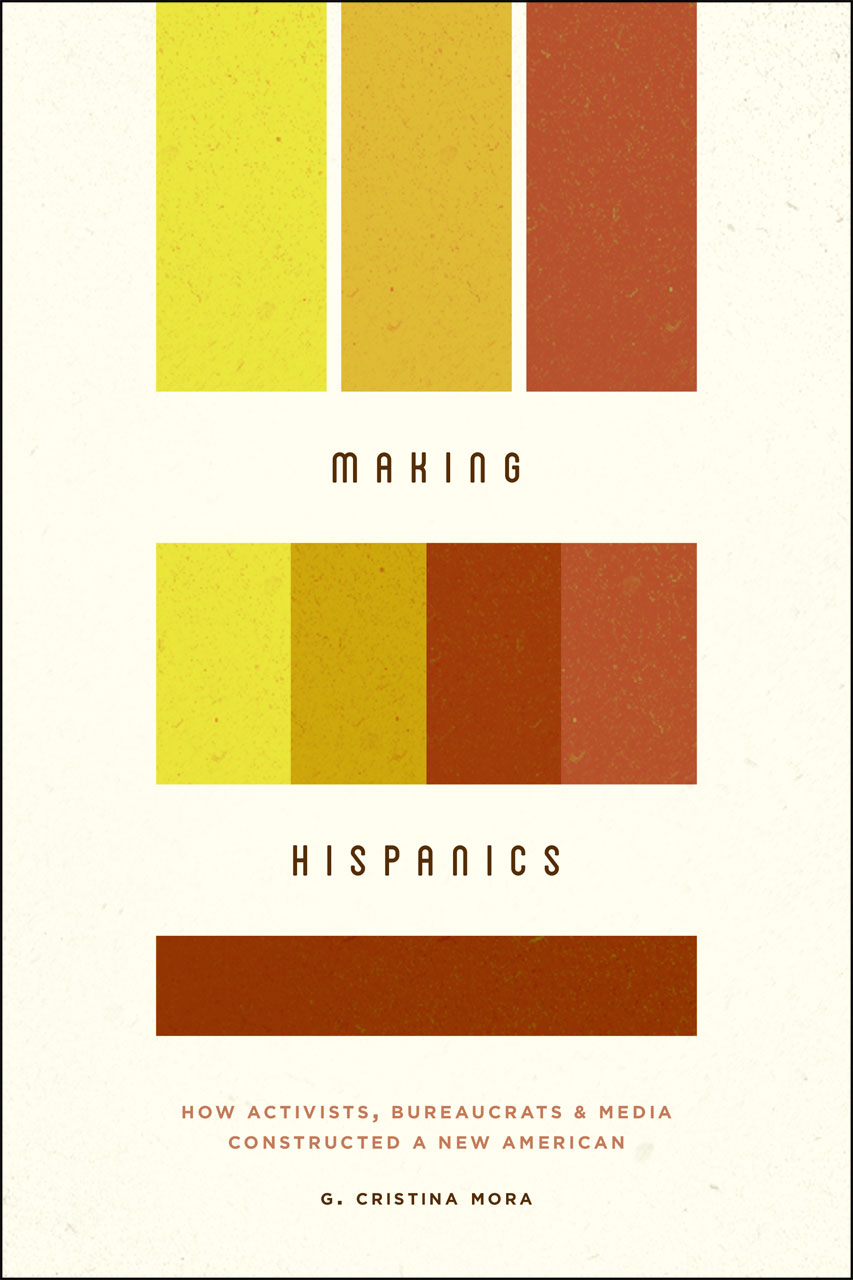
    As recounted in her important new book, Making Hispanics, sociologist (and my colleague) G. Cristina Mora tells the story of how people as diverse as Cuban-born businessmen in Miami, undocumented Mexican farm workers in California, and third-generation part-Puerto Ricans in New York who do not even understand Spanish were brought together into one social category: Hispanic-Americans…

    Read the entire article here.

  • Making Hispanics: How Activists, Bureaucrats, and Media Constructed a New American

    University of Chicago Press
    March 2014
    256 pages
    1 halftone, 5 line drawings, 3 tables
    6 x 9
    Cloth ISBN: 9780226033662
    Paper ISBN: 9780226033839
    E-book ISBN: 9780226033976

    G. Cristina Mora, Assistant Professor of Sociology
    University of California, Berkeley

    How did Puerto Ricans, Mexicans, and Cubans become known as “Hispanics” and “Latinos” in the United States? How did several distinct cultures and nationalities become portrayed as one? Cristina Mora answers both these questions and details the scope of this phenomenon in Making Hispanics. She uses an organizational lens and traces how activists, bureaucrats, and media executives in the 1970s and ’80s created a new identity category—and by doing so, permanently changed the racial and political landscape of the nation.

    Some argue that these cultures are fundamentally similar and that the Spanish language is a natural basis for a unified Hispanic identity. But Mora shows very clearly that the idea of ethnic grouping was historically constructed and institutionalized in the United States. During the 1960 census, reports classified Latin American immigrants as “white,” grouping them with European Americans. Not only was this decision controversial, but also Latino activists claimed that this classification hindered their ability to portray their constituents as underrepresented minorities. Therefore, they called for a separate classification: Hispanic. Once these populations could be quantified, businesses saw opportunities and the media responded. Spanish-language television began to expand its reach to serve the now large, and newly unified, Hispanic community with news and entertainment programming. Through archival research, oral histories, and interviews, Mora reveals the broad, national-level process that led to the emergence of Hispanicity in America.

    Contents

    • List of Illustrations
    • Preface
    • Acknowledgments
    • List of Organizations
    • Introduction: Making Hispanics: Classification and the Politics of Ambiguity
    • One: Civil Rights, Brown Power, and the “Spanish-Speaking” Vote: The Development of the Cabinet Committee on Opportunities for Spanish Speaking People
    • Two: The Rise of a Hispanic Lobby: The National Council of La Raza
    • Three: “The Toughest Question”: The US Census Bureau and the Making of Hispanic Data
    • Four: Broadcasting Panethnicity: Univision and the Rise of Hispanic Television
    • Conclusion: The Hispanic Category and the Development of a New Identity Politics in America
    • Notes
    • Index
  • Empires, Nations, and Families: A History of the North American West, 1800-1860

    University of Nebraska Press
    2011
    648 pages
    Hardcover ISBN: 978-0-8032-2405-6

    Anne F. Hyde, William R. Hochman Professor of History
    Colorado College

    • Winner of the 2012 Bancroft Prize
    • 2012 Pulitzer Prize Finalist

    To most people living in the West, the Louisiana Purchase made little difference: the United States was just another imperial overlord to be assessed and manipulated. This was not, as Empires, Nations, and Families makes clear, virgin wilderness discovered by virtuous Anglo entrepreneurs. Rather, the United States was a newcomer in a place already complicated by vying empires. This book documents the broad family associations that crossed national and ethnic lines and that, along with the river systems of the trans-Mississippi West, formed the basis for a global trade in furs that had operated for hundreds of years before the land became part of the United States.

    Empires, Nations, and Families shows how the world of river and maritime trade effectively shifted political power away from military and diplomatic circles into the hands of local people. Tracing family stories from the Canadian North to the Spanish and Mexican borderlands and from the Pacific Coast to the Missouri and Mississippi rivers, Anne F. Hyde’s narrative moves from the earliest years of the Indian trade to the Mexican War and the gold rush era. Her work reveals how, in the 1850s, immigrants to these newest regions of the United States violently wrested control from Native and other powers, and how conquest and competing demands for land and resources brought about a volatile frontier culture—not at all the peace and prosperity that the new power had promised.

    Table of Contents

    • List of Illustrations
    • List of Maps
    • Acknowledgments: Adventures in the Land of the Dead
    • Introduction: The Geography of Empire in 1804
    • Part I: Replacing a State: The Continental Web of Family Trade
      • Chapter 1: Families and Fur: The Personal World of the Early
      • Chapter 2: Fort Vancouver’s Families: The Custom of the Country
      • Chapter 3: Three Western Places: Regional Communities
    • Part II: Americans All: The Mixed World of Indian Country
      • Chapter 4: The Early West: The Many Faces of Indian Country
      • Chapter 5: Empires in Transition: Indian Country at Midcentury, 1825–1860
    • Part III: From Nations to Nation: Imposing a State, 1840–1865
      • Chapter 6: Unintended Consequences: Families, Nations, and the Mexican War
      • Chapter 7: Border Wars: Disorder and Disaster in the 1850s
      • Chapter 8: The State and Its Handmaidens: Imposing Order
    • Epilogue: How It All Turned Out
    • Notes
    • Bibliography
    • Index

    Read an excerpt here.