• Diverse Millennial Students in College: Implications for Faculty and Student Affairs ed. by Fred Bonner II, Aretha F. Marbley, and Mary F. Howard-Hamilton (review)

    The Review of Higher Education
    Volume 37, Number 1, Fall 2013
    pages 122-124
    DOI: 10.1353/rhe.2013.0074

    John A. Mueller

    Scott E. Miller

    Bonner II, Fred A., Aretha F. Marbley, and Mary F. Howard-Hamilton, eds., Diverse Millennial Students in College: Implications for Faculty and Student Affairs (Sterling, Virginia: Stylus Publishing, LLC., 2011).

    In a pithy and direct manner, the introduction to Diverse Millennial Students in College makes it clear that the book “eschews the tendency to force students into constraining frameworks” (p. 1) that overly simplify college populations. In doing so, the editors challenge the utility and relevance of the defining traits of millennial students (Howe & Strauss, 2000) in describing students of color, multiracial students, and LGBTQ students. The editors and chapter authors also analyze how the Howe and Strauss “generational framework underestimates the potential of these students” (p. 113). After nearly a decade of the ubiquitous “millennials” in student affairs literature, conferences, and coursework, along comes a book that critically examines how diversity impacts generational status.

    This book is structured around paired chapters that address particular diverse constituencies of millennial college students: African American, Asian American, Latino/a, Native American, LGBTQs, and bi/multiracials. While this is a fitting approach, the editors do not provide a rationale for their choice of chapter topics, nor do they forecast for the reader the content of each chapter in light of the book’s objective.

    Chapter 1 is an extension of the introduction and, as the title suggests, tests our assumptions about generational cohorts. The author points out similarities among all millennials, such as the defining moments that have shaped their lives, their increased focus on social justice and service, and a significant increase in parental influence, among others. The author also identifies ways in which millennial students may experience college differently based on generation status and identity.

    Part 2 focuses on African American millennials. Chapter 2 presents data on the differences between today’s African American students and previous generations of African American students with respect to enrollment, financial affluence, and levels of academic achievement. Taking a less quantitative approach, the authors of Chapter 3 provide a narrative analysis of an African American male who grew up in a small, rural town in Georgia from elementary school through graduate school. This narrative illustrates the challenges faced by African American students of rural backgrounds attending a predominantly White institution in a larger city.

    Part 3 examines Asian American millennial college students. Chapter 4 presents research that compares Asian American millennial students to both their millennial counterparts and to Asian American students from previous generations. The author also outlines a number of current social and political trends in the United States that are likely to have an impact on Asian American millennials and their experience in higher education.

    Chapter 5 expands on the previous chapter and homes in on three specific trends with respect to Asian American millennials: an increase in the diversity of Asian Americans in higher education (i.e., diversification); an increase in the use of technology, particularly among Asian American millennials (i.e., digitization); and the degree to which Asian American millennials are connected to national and global events and to Asian American and Asian communities (i.e., globalization).

    The authors in Part 4 examine the Latino/a experience in higher education. In Chapter 6, the authors provide demographic data regarding the increase in the Latina/o population in the United States and compare and contrast this generation of students with those before it across different categories, such as enrollment, parents’ education, family structure and size, religion, technology, motivation, goals and aspirations, career objectives, and civic engagement.

    In Chapter 7, the authors use the Howe and Strauss (2000) framework to demonstrate how findings from two studies on Latino/o college students parallel and diverge from the seven characteristics of millennials. In addition, they offer useful insights on how generation status (from an immigrant perspective) can be more useful than generational theory as a predictive theory.

    Part 5 focuses on Native American millennial college students. Chapter 8 documents the challenges that Indigenous students face in higher education: a lack of academic preparation, inadequate finances, few higher education faculty as role models, cultural differences between their native home and the university setting, and institutional barriers. Chapter 9 places the millennial generation of Native American college students in a historical context. Examined in some depth are the boarding school era, tribal colleges, and Native American students’ entrance into predominantly White institutions. Complementing this history are…
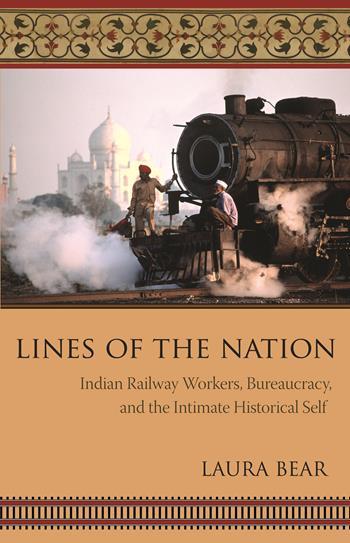
  • Lines of the Nation: Indian Railway Workers, Bureaucracy, and the Intimate Historical Self

    Columbia University Press
    June 2007
    360 pages
    Cloth ISBN: 978-0-231-14002-7

    Laura Bear
    Department of Anthropology
    The London School of Economics

    Lines of the Nation radically recasts the history of the Indian railways, which have long been regarded as vectors of modernity and economic prosperity. From the design of carriages to the architecture of stations, employment hierarchies, and the construction of employee housing, Laura Bear explores the new public spaces and social relationships created by the railway bureaucracy. She then traces their influence on the formation of contemporary Indian nationalism, personal sentiments, and popular memory. Her probing study challenges entrenched beliefs concerning the institutions of modernity and capitalism by showing that these rework older idioms of social distinction and are legitimized by forms of intimate, affective politics.

    Drawing on historical and ethnographic research in the company town at Kharagpur and at the Eastern Railway headquarters in Kolkata (Calcutta), Bear focuses on how political and domestic practices among workers became entangled with the moralities and archival technologies of the railway bureaucracy and illuminates the impact of this history today. The bureaucracy has played a pivotal role in the creation of idioms of family history, kinship, and ethics, and its special categorization of Anglo-Indian workers still resonates. Anglo-Indians were formed as a separate railway caste by Raj-era racial employment and housing policies, and other railway workers continue to see them as remnants of the colonial past and as a polluting influence.

    The experiences of Anglo-Indians, who are at the core of the ethnography, reveal the consequences of attempts to make political communities legitimate in family lines and sentiments. Their situation also compels us to rethink the importance of documentary practices and nationalism to all family histories and senses of relatedness. This interdisciplinary anthropological history throws new light not only on the imperial and national past of South Asia but also on the moral life of present technologies and economic institutions.

  • Public genealogies: Documents, bodies and nations in Anglo-Indian railway family histories

    Contributions to Indian Sociology
    Volume 35, Number 3 (October 2001)
    pages 355-388
    DOI: 10.1177/006996670103500303

    Laura Bear
    Department of Anthropology
    The London School of Economics

    This article argues for an approach to archives and documents that focusses on their material effects. It traces the impact of the East Indian Railway Nationality Files on the intimate stories of family genealogies among Anglo-Indian railway workers. The procedures of proof and record-keeping associated with these files (kept from 1927-50) displaced Anglo-Indian family histories into a public realm of state documents and archives, making these the final arbiters and guardians of their origins. Anglo-Indian workers often protested their assigned status by writing to the bureaucracy, especially as family members were regularly classed differently by distinct institutions. They sought a continuous public genealogy for themselves. Their interest in doing this and the practices of the nationality archive reveal the new conjunctions between political rights and family origins in Indian civil society. Increasingly, both the jati of nationalists and the enumerable community of colonial bureaucrats rested on a genealogical imperative, which excluded Anglo-Indians because of their ‘mixed’ origins from belonging to either India or Britain. The material effects of this historical moment and the archive are visible in contemporary conversations with Anglo-Indian railway families. They tell stories of disappearing documents, of ghosts disturbed by lack of an archive, of their bodies as treacherous records of identity and of the impossibilities of being an Indian community.

    Read or purchase the article here.

  • Review: The United States of the United Races: A Utopian History of Racial Mixing

    The College Dropout: Book blog and occasional wisdom on paleo, making money, and life
    2013-10-10

    Charles Franklin

    The United States of the United Races: A Utopian History of Racial Mixing by Greg Carter

    • My rating: 4 of 5 stars
    • Pros: Historical scholarship, Intriguing content, Great historical insight
    • Cons: Some parts remind me of college history textbook (though this book is a little more interesting!)

    Carter’s book delves into a topic that American history and society has a hard time understanding racial mixing. In this book, he confronts our (well most of us) limited view of the history of people of mixed race in the United States. It was not all tragic as commonly depicted, nor was it all optimistic (we have only to point to miscegenation laws for that), but it was as complicated as all human relations tend to be. Carter explores the complexity of race both in individuals and in society as a whole…

    Read the entire review here.

  • My racial composition and my position in the world are realities which I alone may determine… I do not expect to be told what I should consider myself to be.

    Jean Toomer to his publisher Horace Liveright (September 5, 1923)

  • Continuing this discussion of terminology, I prefer mixed race over multiracial, to distance myself from those who wanted to create a new category for racially mixed people. Coverage of the 2000 census gave the impression that all within the Multiracial Movement wanted this. In reality, most wanted some useful identifier of mixed heritage, and the decision to implement multiple checking was satisfactory to them. The faction that did want a new category tended to believe that there was a true, singular, multiracial consciousness that united racially mixed people across race, class, gender, and geography. Because mixed-race experiences are so varied, I reject this notion. Similarly, I avoid labels that connote specific configurations of mixing, for example, hapa or biracial. The former hails from the native Hawaiian term hapa haole and often refers to mixed Asian and white individuals. It is a term popular with racially mixed Asian Americans to express pride in their mixture. At the hands of scholars of mixed race, Multiracial Movement activists, and journalists, the latter term often refers to mixed black and white individuals. Although the word is indeterminate, its use reinforces the notion that race in the United States is only about blacks and whites.

    Greg Carter, The United States of the United Races: A Utopian History of Racial Mixing, (New York: New York University Press, 2013), 9.

  • What’s History Got to Do with It? Evolving Classifications of Race

    Brooklyn Historical Society
    Crossing Borders, Bridging Generations
    Othmer Library
    Saturday, 2014-01-25, 15:00-18:00 EST (Local Time)

    Part Three of the reading series Quantifying Bloodlines

    • How did historical distinctions emerge, such as: mulatto, quadroon, octoroon, creole, 1/16th Native American…?
    • What is the one-drop rule?
    • Why do we talk about our backgrounds, bloodlines, ethnic and racial make-ups in terms of percentages and fractions?
    • Does race-mixing mean racial harmony?
    • Do people still “pass” to blend in in order to be accepted?

    Join in an engaging discussion about the formation of racial classifications, privilege and pedigree. As a focus, we will read and review a historical novel, based on the real-life family history of Creole society in Central Louisiana. Cane River by Lalita Tademy describes this family and society as experienced through more than four generations of women’s lives.

    Please plan to have read the book prior to our meeting.

    Session is limited to 15 participants. Active participation is key. 

    This reading and discussion group is co-sponsored by MixedRaceStudies.org

    For more information, click here.

  • What’s Purity Got to Do with It? Searching Family History and Genealogy

    Brooklyn Historical Society
    Crossing Borders, Bridging Generations
    Othmer Library
    Saturday, 2013-12-07, 15:00-18:00 EST (Local Time)

    Part Two of the reading series Quantifying Bloodlines

    How do stories help us to understand the ways in which we dissect lineage?

    Bring in your own family tree, genealogical research, family photos, or family name origins, while we take a close look at The Fiddler on Pantico Run: An African Warrior, His White Descendants, A Search for Family by Joe Mozingo.  Short multi-media pieces will be screened detailing more about Joe Mozingo’s search for family history through a surname that both haunts, confuses and intrigues him, and unlocks hidden histories about migration and genealogy.

    If you are just beginning a search for your family history or have searched for many years, this discussion session with Jennifer Scott, anthropologist and public historian at the New School, will help to illuminate the discovery process about lineage, identity and race.

    Please plan to have read the book prior to our meeting.

    Session is limited to 15 participants. Active participation is key.

    This reading and discussion group is co-sponsored by MixedRaceStudies.org

    For more information, click here.

  • Black Seminoles and The Underground Railroad

    AC Bilbrew Library
    150 E. El Segundo Blvd.
    Los Angeles, California 90061
    310-538-3350
    Saturday, 2013-11-23, 14:30 PST (Local Time)

    Phil Wilkes Fixico

    Celebrate Native American Heritage Month by exploring the history of free Blacks and fugitive slaves who escaped to Florida between the 1600s and 1800s, forging alliances with the Seminole Nation and establishing their own autonomous communities and unique culture.

    Phil Wilkes “Pompey” Fixico is a Seminole Maroon descendant , member of the L.A. chapter of the Buffalo Soldiers and Dept. of Interior/National Park Service/ National Underground Railroad/ Network to Freedom Private-Sector Partner (Semiroon Historical Society). He is also the honorary spokesman for John Horse Band of the Texas Seminoles.

    For more information, click here.

  • Afternoon Talk: Dr. Zélie Asava (Free Event)

    Irish Film Institute
    6 Eustace Street
    Temple Bar
    Dublin, Ireland

    2013-10-11, 16:30 IST (Local Time)

    Zélie Asava, Lecturer and Programme Director of Video and Film
    Dundalk Institute of Technology, Louth, Ireland

    In our Afternoon Talk on October 11th (16.30), Dr. Zélie Asava, Programme Director of Video and Film at Dundalk Institute of Technology will discuss aspects of the research in her recently published book The Black Irish Onscreen: Representing Black and Mixed-Race Irish Identities on Film and TV (Peter Lang, 2013) which is available at the IFI Film Shop.

    For more information, click here.