• Adopting the wisdom of Pearl S. Buck

    gbtimes: The Third Angle Chinese news and video reports on China today
    2013-03-26

    Asa Butcher

    When listing an author’s life achievements, it is rare for their Nobel Prize for Literature and Pulitzer Prize to be overshadowed. However, Pearl S. Buck’s humanitarian work with children leaves those awards in the dark.

    A pioneer in mixed race adoption, Pearl S. Buck was ahead of her time in many issues considered unpopular in 1950’s America, all of which contributed to her being counted as one of the 20th century’s greatest women.

    In the second part of our interview with Mrs. Janet Mintzer, CEO and President of Pearl S. Buck International, we talk to her about the adoption legacy and how it all began.

    Part one of the interview is available here.

    Match a child

    The Welcome House Child Adoption Program, created by Pearl S. Buck in 1949, currently have adoption programs in China, Colombia, Costa Rica, Kazakhstan, Korea, and the Philippines. They have found families for more than 7,000 children that, six decades ago, were ‘considered unadoptable’.

    If you were bi-racial in the United States in the late-‘40s you were considered unadoptable – that was the mentality of the time period. Adoption was secretive and they would match parents that had blond hair with blond-haired kids or blue eyes with blue-eyed kids because that’s just the way it was done back then,” begins Mrs. Mintzer.

    She explains that there were no mixed race parents able to adopt, so officials were unable to ‘match’ a child, so they were left to languish in the orphanage. Pearl S. Buck was well-known in adoption circles, having written about the issue and also having adopted several orphans, including two bi-racial children…

    Read the entire article here.

  • “Fatal Invention: How Science, Politics, and Big Business Re-create Race in the Twenty-First Century,” talk by Dorothy Roberts

    University of Michigan
    Hatcher Library Gallery, Room 100
    913 S. University Avenue
    Ann Arbor, Michigan
    2013-04-04, 16:00-17:30 CDT (Local Time)

    Dorothy E. Roberts, George A. Weiss University Professor of Law and Sociology; Raymond Pace and Sadie Tanner Mossell Alexander Professor of Civil Rights
    University of Pennsylvania

    Professor Roberts will be discussing her latest project in connection with the “Understanding Race” theme semester. In “Fatal Invention: How Science, Politics, and Big Business Re-create Race in the Twenty-First Century” she argues that America is experiencing a dangerous resurgence of classifying populations into biological races. By searching for differences at the molecular level, a new race-based science is obscuring racism in our society and legitimizing state brutality against communities of color at a time when many claim that the United States is “post-racial.” Moving from an account of the evolution of the concept of race—proving that it has always been a mutable and socially defined political division supported by mainstream science—Roberts delves deeply into the current debates, interrogating cutting-edge genomic science and biotechnology, interviewing its researchers, and exposing the political consequences of the focus on race-based genetic difference. Fatal Invention is a powerful call for us to affirm our common humanity by eliminating the social inequities preserved by the political system of race…

    For more information, click here.

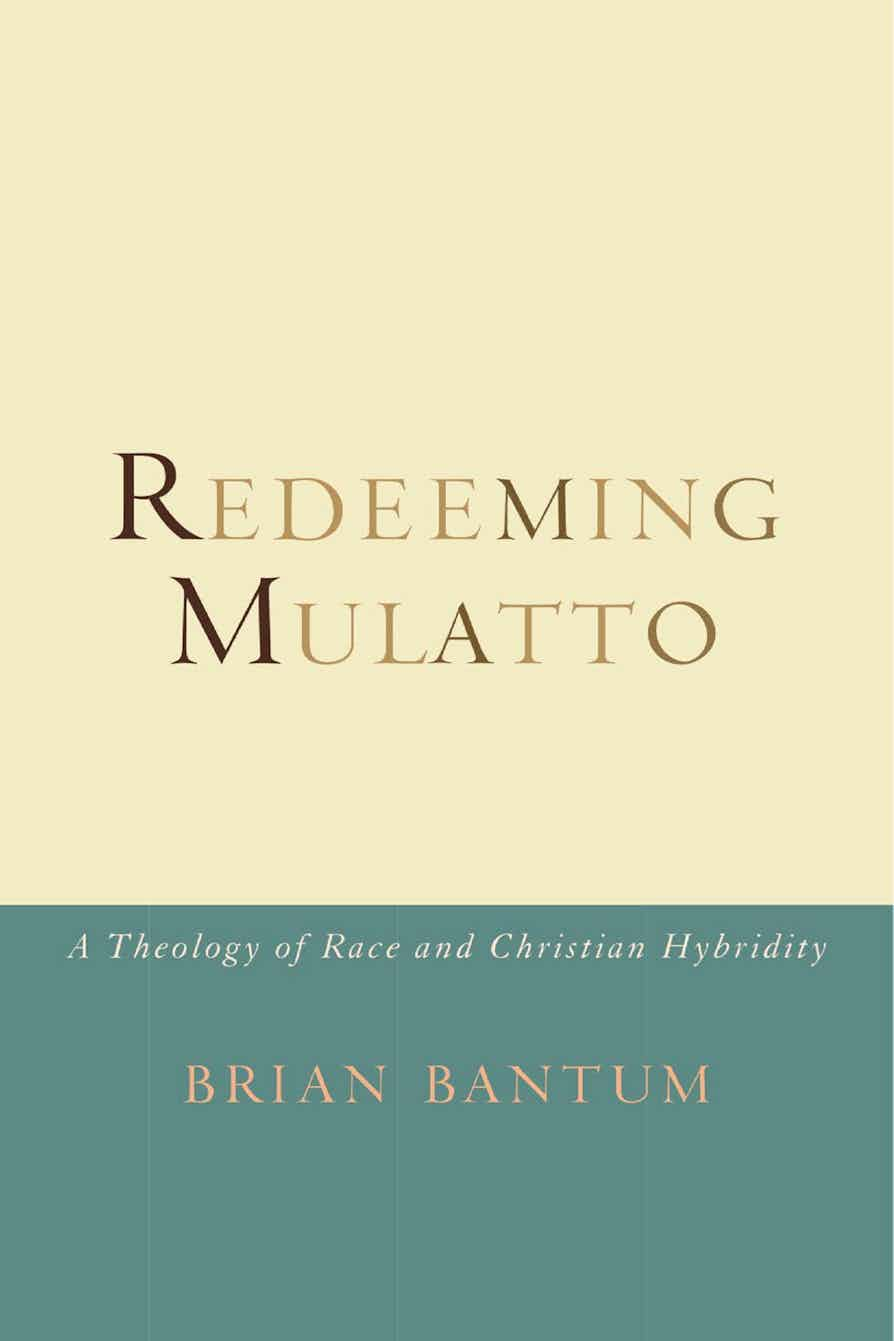
  • Redeeming Mulatto: A Theology of Race and Christian Hybridity

    Baylor University Press
    2010-10-01
    260 pages
    9in x 6in
    Hardback ISBN: 9781602582934

    Brian Bantum, Neil F. and Ila A. Professor of Theology
    Garrett-Evangelical Theological Seminary, Evanston, Illinois

    How mulatto identity challenges racial religiosity and existence

    The theological attempts to understand Christ’s body have either focused on “philosophical” claims about Jesus’ identity or on “contextual” rebuttals—on a culturally transcendent, disembodied Jesus of the creeds or on a Jesus of color who rescues and saves a particular people because of embodied particularity.

    But neither of these two attempts has accounted for the world as it is, a world of mixed race, of hybridity, of cultural and racial intermixing. By not understanding the true theological problem, that we live in a mulatto world, the right question has not been posed: How can Christ save this mixed world? The answer, Brian Bantum shows, is in the mulattoness of Jesus’ own body, which is simultaneously fully God and fully human.

    In Redeeming Mulatto, Bantum reconciles the particular with the transcendent to account for the world as it is: mixed. He constructs a remarkable new Christological vision of Christ as tragic mulatto—one who confronts the contrived delusions of racial purity and the violence of self-assertion and emerges from a “hybridity” of flesh and spirit, human and divine, calling humanity to a mulattic rebirth. Bantum offers a theology that challenges people to imagine themselves inside their bodies, changed and something new, but also not without remnants of the old. His theology is one for all people, offered through the lens of a particular people, not for individual possession but for redemption and transformation into something new.

    Table of Contents

    • Introduction
    • Part I: Renunciation: Racial Discipleship and the Religiosity of Race
      • 1. I Am Your Son, White Man! The Mulatto/a and the Tragic
      • 2. Neither Fish nor Fowl: Presence as Politics
    • Part II: Confession: Christ, the Tragic Mulatto
      • 3. Unto Us a Child Is Born or “How can this be?” The Mulatto Christ
      • 4. I Am the Way: Mulatto/a Redemption and the Politics of Identification
    • Part III: Immersion: Christian Discipleship or the New Discipline of the Body
      • 5. You Must Be Reborn: Baptism and Mulatto/a ReBirth
      • 6. The Politics of Presence: Prayer and Discipleship
    • Benediction
    • Notes

    Redeeming Mulatto: Race, Culture, and Ethnic Plurality from Quest Church on Vimeo.

  • Appo Will Serve Six Months

    The Brooklyn Daily Eagle
    Thursday, 1895-10-03
    page 12, column 2
    Source: Brooklyn Public Library’s Brooklyn Collection

    George Appo, the Chinese half-bred, who obtained notoriety especially through his testimony before the Lexow senate investigating committee, and who pleaded guilty to assault in the third degree in the stabbing of Policeman Michael J. Rein of the West Thirtieth street station on April 9, was this morning sentenced to six months in the penitentiary by Judge Cowing in Part II, New York general sessions.

  • The Urban Underworld in Late Nineteenth-Century New York: The Autobiography of George Appo

    Bedford/St. Martin’s
    2013
    208 pages
    Paper ISBN-10: 0-312-60762-8; ISBN-13: 978-0-312-60762-3

    George Appo (1856-1930)

    Edited with an Introduction by:

    Timothy J. Gilfoyle, Professor of History
    Loyola University, Chicago

    Through the colorful autobiography of pickpocket and con man George Appo, Timothy Gilfoyle brings to life the opium dens, organized criminals, and prisons that comprised the rapidly changing criminal underworld of late nineteenth-century America. The book’s introduction and supporting documents, which include investigative reports and descriptions of Appo and his world, connect Appo’s memoir to the larger story of urban New York and how and why crime changed during this period. It also explores factors of race and class that led some to a life of crime, the experience of criminal justice and incarceration, and the masculine codes of honor that marked the emergence of the nation’s criminal subculture. Document headnotes, a chronology, questions for consideration, and a selected bibliography offer additional pedagogical support.

  • A Pickpocket’s Tale: The Underworld of Nineteenth-Century New York

    W. W. Norton & Company
    2006
    480 pages
    5.5 × 8.2 in
    Paperback ISBN: 978-0-393-32989-6

    Timothy J. Gilfoyle, Professor of History
    Loyola University, Chicago

    In George Appo’s world, child pickpockets swarmed the crowded streets, addicts drifted in furtive opium dens, and expert swindlers worked the lucrative green-goods game. On a good night Appo made as much as a skilled laborer made in a year. Bad nights left him with more than a dozen scars and over a decade in prisons from the Tombs and Sing Sing to the Matteawan State Hospital for the Criminally Insane, where he reunited with another inmate, his father. The child of Irish and Chinese immigrants, Appo grew up in the notorious Five Points and Chinatown neighborhoods. He rose as an exemplar of the “good fellow,” a criminal who relied on wile, who followed a code of loyalty even in his world of deception. Here is the underworld of the New York that gave us Edith Wharton, Boss Tweed, Central Park, and the Brooklyn Bridge.

    Preface

    In 1840 New York City had no professional police force, a low murder rate, and no bank robberies. Within decades, however, this changed; serious crime proliferated and modern law enforcement was born. By 1890 Gotham’s police budget had grown more than sixteenfold and became New York City’s single largest annual expenditure. Detective work was transformed into a public and private specialty. The murder rate had doubled, and larceny comprised one-hall to one-third of all prosecuted crime in the state. Newspapers regularly reported that illegal activities were rampant, the courts and police powerless. New York City had become “the evillest [sic] spot in America.” For the first time, observers complained about “organized crime.”

    A new criminal world was born in this period. It was a hidden universe with informal but complex networks of pickpockets, fences, opium addicts, and confidence men who organized their daily lives around shared illegal behaviors. Such activities, one judge observed, embodied an innovative lawlessness based on extravagance, greed, and the pursuit of great riches. A new “class of criminals” now existed. Many of these illicit enterprises were national in scope, facilitated by new technologies like the railroad and the telegraph, economic innovations like uniform paper money, and new havens for intoxication like “dives” and opium dens. For the first time both criminals and police referred to certain lawbreakers as professionals.

    George Appo was one such professional criminal. At first glance Appo hardly seemed a candidate for any criminal activity; his diminutive size and physical appearance evoked little fear. By age eighteen he stood less than five feet five inches in height and weighed a slight 120 pounds. Everything about him seemed small: his narrow forehead, short nose, compact chin, and tiny ears that sat low on his head. Although Appo’s face displayed features of his mother’s Irish ancestry, his copper-colored skin reminded some of his father’s Chinese origins. Appo s brown eyes were less noticeable than his pitch-black hair and eyebrows, the latter meeting over his nose. The tattoos E.D. and J.M. were inscribed on his left and right forearms, respectively.

    But Appo was one of New York’s most significant nineteenth-century criminals. A pickpocket, confidence man, and opium addict, he lived off his criminal activities during his teenage years and much of his adult life. On successful nights during the 1870s and 1880s, he earned in excess of six hundred dollars pilfering the pockets of those around him. equivalent to the annual salary of a skilled manual laborer. Even more lucrative was the elaborate confidence scheme known as the “green goods game.” The most successful operators—”gilt-edged swindlers” according to one—accumulated fortunes in excess of one hundred thousand dollars. By 1884 America’s most famous detective, Allan Pinkerton, identified the green goods game as “the most remunerative of all the swindles,” “the boss racket of the whole confidence business.

    Appo made money, but his life was hardly a Horatio Alger tale of self-taught frugality and upward mobility. The offspring of a racially mixed, immigrant marriage, Appo was separated from his parents as a small child. Effectively orphaned, the young boy grew up in the impoverished Five Points and Chinatown neighborhoods of New York. He never attended school a day in his life. Appo literally raised himself on Gotham’s streets, becoming a newsboy and eventually a pickpocket and opium addict. This new child culture of newsboys, bootblacks, and pick-pockets, fed by foreign immigration and native-born rural migration, mocked the ascendant Victorian morality ol the era. New York needed no Charles Dickens to create Oliver Twist or Victor Hugo to invent Jean Valjean. Gotham had George Appo.

    Appos youthful adventures persisted into adulthood. For more than three decades he survived by exploiting his criminal skills. Appo patronized the first opium dens in New York, participated in the first medical research on opium smoking, and appeared in one of Americas first the theatrical productions popularizing crime. On at least ten occasions he was tried by judge or jury. As a result he spent more than a decade in prisons and jails. Therein he experienced New York’s first experiment in juvenile reform with the school ship Mercury, as well as the lockstep, dark cells, and industrial discipline of American penitentiaries. He personally witnessed the lunacy found in the Matteawan State Hospital for the Criminally Insane, the easy escapes from the Blackwell’s Island Penitentiary, and the corruption associated with the nation’s largest jail: New York’s “Tombs.” During various incarcerations Appo’s teeth were knocked out, and he encountered a wide array of prison tortures. Life outside prison was even bloodier. On the street Appo was physically assaulted at least nine times, shot twice, and stabbed in the throat once. More than a dozen scars decorated his body.

    Above all George Appo was a “good fellow,” a character type he identified and wrote about. A good fellow engaged in criminal activities while displaying courage and bravery, “a nervy crook,” in Appo’s words. Good fellows like Appo did not rely on strong-arm tactics to gel their way Instead they avoided violence, employing wit and wile to make a living. Theirs was a world of artifice and deception. When successful, a good fellow lavished his profits on others. He was “a money getter and spender.” Such mettle, pluck, and camaraderie implied a level of trustworthiness, mutuality, and dependability. Above all a good fellow was loyal, willing to withstand, in Appo’s words, “the consequences and punishment of an arrest for some other fellow’s evil doings both inside and outside of prison.”…

    Read the entire Preface here.
  • Show Boat: Performing Race in an American Musical [Review by Alan Gomberg]

    Talkin’ Broadway
    2013-03-27

    Alan Gomberg

    Much of Todd Decker’s Show Boat: Performing Race in an American Musical should prove fascinating to readers who have a deep interest in the creation and performance history of this classic, much-revived and -revised musical. Many of those Show Boat devotees probably already have Miles Kreuger’s superb 1977 book, Show Boat: The Story of a Classic American Musical, but Decker goes into more detail on many matters (while going into less detail on some others) so his book is far from being a rehash of Kreuger’s.

    Also, the performance history of Show Boat since 1977 has been (to put it mildly) extensive and complex, giving Decker much new history to relate. Still, the most rewarding parts of the book are those that cover earlier productions and the 1936 film version. There is much information here on the major productions from 1927 through the late 1940s that is likely to be new even to those who already know a good deal about Show Boat.

    One thing that separates Decker’s book from Kreuger’s is his focus on a sociological theme, as suggested by the book’s subtitle: Performing Race in an American Musical. He writes in his introduction, “My emphasis on race rests equally on definitions of whiteness and blackness. Magnolia and Ravenal perform their whiteness every bit as much as Joe performs his blackness and any actress playing Julie must perform that character’s mixed-race identity, whatever that has meant in particular times and places.” Part of the way in which Decker examines these matters is by discussing in detail the unique contributions of some of the performers in each major production. This extends beyond those who played the characters mentioned above…

    Read the entire article here.

  • Show Boat: Performing Race in an American Musical

    Oxford University Press
    October 2012
    328 pages
    ISBN13: 9780199759378; ISBN10: 0199759375

    Todd Decker, Assistant Professor, Musicology
    Washington University in St. Louis

    Show Boat: Performing Race in an American Musical tells the full story of the making and remaking of the most important musical in Broadway history. Drawing on exhaustive archival research and including much new information from early draft scripts and scores, this book reveals how Oscar Hammerstein II and Jerome Kern created Show Boat in the crucible of the Jazz Age to fit the talents of the show’s original 1927 cast. After showing how major figures such as Paul Robeson and Helen Morgan defined the content of the show, the book goes on to detail how Show Boat was altered by later directors, choreographers, and performers up to the end of the twentieth century. All the major New York productions are covered, as are five important London productions and four Hollywood versions.

    Again and again, the story of Show Boat circles back to the power of performers to remake the show, winning appreciative audiences for over seven decades. Unlike most Broadway musicals, Show Boat put black and white performers side by side. This book is the first to take Show Boat’s innovative interracial cast as the defining feature of the show. From its beginnings, Show Boat juxtaposed the talents of black and white performers and mixed the conventions of white-cast operetta and the black-cast musical. Bringing black and white onto the same stage—revealing the mixed-race roots of musical comedy—Show Boat stimulated creative artists and performers to renegotiate the color line as expressed in the American musical. This tremendous longevity allowed Show Boat to enter a creative dialogue with the full span of Broadway history. Show Boat’s voyage through the twentieth century offers a vantage point on more than just the Broadway musical. It tells a complex tale of interracial encounter performed in popular music and dance on the national stage during a century of profound transformations.

    Features

    • First book to look at the complete history of this landmark work of the Broadway stage through the prism of race.
    • Uses exhaustive archival research conducted in Hollywood, New York, London, and elsewhere
    • Draws on previously unknown sources, including scripts and scores from the earliest productions, rejected draft scripts for all three Show Boat films, and a musical source for Jerome Kern’s famous melody for “Ol’ Man River.”
    • Moves important historical figures such as Paul Robeson to the center of the story of how Show Boat was made.
    • Based on over twenty stage productions of Show Boat—including those in London’s West End—and four Hollywood film versions
  • Race is defined not by its purity but rather by the impurity conferred upon it by a system of domination. Bastard and mixed-blood are the true names of race.

    Gilles Deleuze and Félix Guattari, A Thousand Plateaus: Capitalism and Schizophrenia, (Minneapolis: University of Minnesota Press, Minneapolis, 1980).

  • Some commentators predict that ethnoracial distinctions in the United States will disappear in the twenty-first century.  Perhaps they are right, but there is ample cause to doubt it. And a glance at the history of Brazil, where physical mixing even of blacks and whites has magnificently failed to achieve social justice and to eliminate a color hierarchy, should chasten those who expect too much from mixture alone. Moreover, inequalities by descent group are not the only kind of inequalities. In an epoch of diminished economic opportunities and of apparent hardening of class lines, the diminution of racism may leave many members of historically disadvantaged ethnoracial groups in deeply unequal relation to whites simply by virtue of class position.  Even the end of racism at this point in history would not necessarily ensure a society of equals.

    David A. Hollinger, “Amalgamation and Hypodescent: The Question of Ethnoracial Mixture in the History of the United States,” The American Historical Review, Volume 108, Number 5, December 2003. http://www.historycooperative.org/journals/ahr/108.5/hollinger.html.