• Examining ‘Latinidad’ in Latin America: Race, ‘Latinidad’ and the Decolonial Option

    Critical Race and Whiteness Studies
    Australian Critical Race and Whiteness Studies Association
    Volume 8, Number 2, (2012) Directions and Intersections
    11 pages

    Eugenia Demuro, Visiting Fellow
    School of Language Studies, College of Arts and Social Sciences
    Australian National University

    This article provides a critical account of the idea of race, conceived of and derived from European colonisers in the New World. The paper argues that race became a crucial category to the colonising projects of the New World, and in particular in the distribution of power during colonialism. The paper further examines how the notion of Latinidad (Latinity), entrenched in the term Latin America, continued to enact a discourse of racial superiority/inferiority even after the battles for Independence had taken place. Employing the critical vocabulary and framework of Decolonial theory, the paper introduces key arguments against Western European universality, and calls for a re-reading of the processes that structure privilege across racial and ethnic lines.

    Introduction

    Following the conquest and colonisation of the Americas, the concept of race, as a category, became instrumental to social organisation and, significantly, continues to be a powerful stratagem today. This is clearly evident in the idea of Latinidad (Latinity) that underscores the nomenclature ‘Latin America’, which continues to elevate European heritage to the detriment of all other racial or ethnic groups. We can see this, for example, in the fact that whilst an Aymaran Amerindian from Bolivia may not share much with an Afro-Cuban from Santiago, or with a porteño from Buenos Aires, or a Mexican from Tijuana, each is deemed to be Latin American. Given the cultural heterogeneity of the region, it seems imprecise to speak of Latin America as though there were no marked differences between the nations, regions, cultures and peoples of the huge landmass that extends from the south of Río Grande to Tierra del Fuego. It is difficult to employ the term Latin America with any validity for a number of reasons: to reiterate, it is the referent of an incredibly vast and heterogeneous region; additionally, the term emerged as the result of conflicts between imperial nations and was hence applied to the region from outside (see Mignolo 2005); and, most importantly, the very idea of Latinidad functions to define Latin American identity in relation to the European heritages, and erases and marginalises the racial and cultural diversity of people residing in Latin America. For these reasons, the term Latin America and its continued usage must be seen as part of a larger program of coloniality that began with the inception of the Americas as the New World in the 15th century, and that continues today through global, Western capitalism and its accompanying epistemology. In Latin America, the colonial project that began with the arrival of Europeans did not end with the cessation of Spanish and Portuguese colonial rule. In fact, coloniality persists today and is evident in the distribution of wealth and resources across the region and the globe…

    …The Emergence of Race

    For Europe, the so-called discovery of America opened vast territories to be appropriated, riches to be extracted, and inhabitants to be indoctrinated into European culture and Catholicism. For the indigenous peoples of the New World, the conquest and colonisation meant complete domination, and went hand-in-hand with slavery, serfdom, genocide and the overall destruction of previously existing social formations. It goes without saying that the destruction of culture also meant the destruction of knowledge/s and worldviews that differed from that of the Europeans. The legitimizing discourse of this enterprise, based on the supposed superiority of the European colonisers and the supposed inferiority of the dominated, rested on a newly emergent notion of race.

    The classification Indio to refer to the vast numbers of societies and civilisations not only obscured the differences between the groups which inhabited the region, it served as the construction of an identity whose main purpose was to differentiate the indigenous from the colonisers. The term summarised a category that was entirely negative and inferior. The same process was repeated when it came to the people transported as slaves from Africa, although they came from different regions and belonged to different groups—Ashantis, Yorubas, Congos, etc.—in the colonial period they became Negros (Quijano 2000: 551-2). Both Indios and Negros were conceived as inferior identities to their European counterparts, and this inferiority was defined specifically in terms of their race. These identities became configured in asymmetrical relations of power within the new colonial system; they had a corresponding place within the colonial hierarchies, the organisation of labour, and corresponding social roles. Both Indios and Negros existed outside the domain of civilised society, as a repository of labour to be exploited for the advantage of Europeans. Interestingly, race became associated with colour, perhaps as one of the most salient differences of phenotype, and social organisation and privilege can be traced to a gradient of colour: the darker the subject the lesser freedom they exercised and possessed. In this way, the concept of race was instrumental to conquest and colonisation: there is a direct link between the idea of race that emerged at the onset of the conquest of the Americas—and that was later spread around the world—and the division and organisation of labour. From the beginning, the distribution of wealth, power, domination and resources was established in terms of the newly invented categories of identity that the concept of race facilitated—Indio, Negro, Mestizo, Spanish, Portuguese, European. It is difficult to overstate the significance of this emergence of race as a new mode of power, efficiently employed as a means to codify the relationship between the conquerors and the conquered, and to justify the atrocities, and the violence, that the conquest and colonial enterprise entailed…

    Read the entire article here.
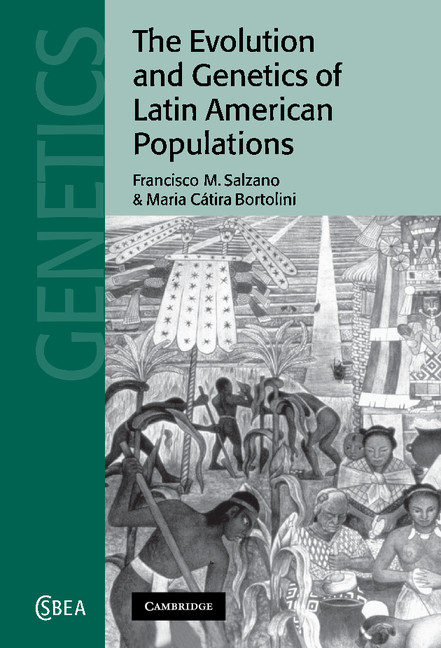
  • The Evolution and Genetics of Latin American Populations

    Cambridge University Press
    December 2001
    528 pages
    12 b/w illus. 128 tables
    228 x 152 mm
    Hardback ISBN: 9780521652759
    Paperback ISBN: ISBN:9780521022392
    eBook ISBN: 9780511837128

    Francisco M. Salzano
    Departamento de Genética, Instituto de Biociências
    Universidade Federal do Rio Grande do Sul, Brazil

    Maria C. Bortolini
    Universidade Federal do Rio Grande do Sul, Brazil

    The human genetic make-up of Latin America is a reflection of successive waves of colonization and immigration. There have been few works dealing with the biology of human populations at a continental scale, and while much data is available on the genetics of Latin American populations, most information remains scattered throughout the literature. This volume examines Latin American human populations in relation to their origins, environment, history, demography and genetics, drawing on aspects of nutrition, physiology, and morphology for an integrated and multidisciplinary approach. The result is a fascinating account of a people characterized by a turbulent history, marked heterogeneity, and unique genetic traits.

    Table of Contents

    • Preface
    • 1. Origins
    • 2. Environment and history
    • 3. Socioeconomic indices, demography, and population structure
    • 4. Ecology, nutrition, and physiological adaptation
    • 5. Morphology
    • 6. Health and disease
    • 7. Haemoglobin types and haemoglobinopathies
    • 8. Normal genetic variation at the protein, glycoconjugate, and DNA levels
    • 9. Gene dynamics
    • 10. Synthesis.
  • Sweet Liberty: The Final Days of Slavery in Martinique (Review)

    French History
    Volume 27, Issue 1 (2013)
    pages 135-137
    DOI: 10.1093/fh/crs158

    Emily Musil Church, Assistant Professor of History
    Lafayette College, Easton, Pennsylvania

    Sweet Liberty: The Final Days of Slavery in Martinique. By Rebecca Hartkopf Schloss. Philadelphia: University of Pennsylvania Press. 2009. 312 pp. ISBN: 978 0 8122 4172 3.

    Rebecca Hartkopf Scholss’ investigation of the end of slavery in the French Caribbean island of Martinique is a welcome addition to the growing scholarship on the history of the Francophone Black Atlantic world. Schloss’ book builds on existing works by exploring the complex dynamics that existed amidst and between the various racial and economic groups in Martinique, as well as between the metropole and colony. The author’s writing style makes a long, complicated colonial history with a complex cast of characters both engaging and accessible. She uses a wide variety of sources—ranging from court proceedings to diaries to demographic statistics—to reconstruct how Martinique, and the French empire more broadly, defined and redefined racial categories and their meanings. Although she uses class and racial categories to describe the social framework, Schloss is careful to reinforce that the categories she describes—such elite Creoles, poor whites, free mixed-race persons, enslaved Africans, and so on—were fluid designations and not united, cohesive groups. The…

    Read or purchase the article here.

  • The Myth of Post-Racialism: Hegemonic and Counterhegemonic Stories About Race and Racism in the United States

    Critical Race and Whiteness Studies
    Australian Critical Race and Whiteness Studies Association
    Volume 7, Issue 1 (2011) (Special Issue: Post-Racial States)
    pages 2-25

    Babacar M’Baye, Associate Professor of Pan-African Literature and Culture
    Kent State University

    In the United States, hegemonic narratives reproduce post-racial ideals by developing popular myths that either minimise the prevalence of racial inequalities or blame their persistence on African Americans, who are represented as dysfunctional and resistant to mainstream American culture. Hegemonic narratives are not only racist and prejudiced but also deceptive because they move race away from the unequal policies that produce structural-level inequities for lower and working class African Americans, putting the latter at a greater disadvantage in relationships to middle and upper class white Americans and African Americans. Hegemonic stories are misleading since they claim that racial equality is possible even when the majority of white Americans have a claim to socioeconomic and political privilege and have a vested interest in maintaining that advantage at the expense of others. Using both past and recent critical race theories, this article critically analyses the major differences between hegemonic stories which accept the myth of post-racialism in the United States and counterhegemonic stories which contest this myth. By analysing these stories, the essay reveals the racially disadvantageous conditions the majority of blacks in the United States continue to face despite the 2008 election of a black president. The essay identifies persistent structural racism that the myth of post-racialism seeks to efface. It also suggests that American social and economic institutions work to entrap African Americans and other non-white minorities into a racist prison industrial complex, limited education and health facilities and rampant poverty which drastically reduce their opportunities in the United States.

    Read the entire article here.

  • Walking a Tightrope: Towards a Social History of the Coloured Community of Zimbabwe [Review]

    H-net Reviews
    H-SAfrica
    April 2007

    Elizabeth Schmidt, Professor of History
    Loyola University Maryland

    James Muzondidya. Walking a Tightrope: Towards a Social History of the Coloured Community of Zimbabwe. Trenton: Africa World Press, 2005. xviii + 323 pp. (cloth), ISBN 978-1-59221-246-0.

    Based on a wide range of archival sources and more than two dozen interviews, James Muzondidya’s book provides a major historical reassessment of Zimbabwe’s colored community from the early twentieth century to 1980. This small community has largely been ignored in Southern African historiography. The few works focusing on the colored population generally have perpetuated a distorted view, arguing that the mixed-race community had no authentic identity. Rather, they posit that “colored” was a state-imposed category without roots in popular experience or consciousness. According to this view, coloreds were merely a product of the colonial state’s divide-and-rule tactics. While Africans viewed them as dupes, collaborators, and beneficiaries of the colonial system, Europeans dismissed them as a marginal population that was more African than European and, as such, unworthy of European rights and privileges.

    In this important contribution to the historical literature, Muzondidya reassesses the construction of colored identity, rejecting the proposition that colored social and political identities were solely state-imposed. He argues instead that these complex and contested identities were the product of colored historical agency and the political, economic, and social structures in which the actors operated. He disaggregates the mixed-race category, too often viewed as homogeneous, in terms of gender, generation, class, culture, and historical background. In a particularly fascinating section, he explores the deep divisions between South African-born Cape Coloreds (or Cape Afrikanders) and the indigenous “EurAfrican” population. Cape Colored immigrants to colonial Zimbabwe were predominantly Muslim, Afrikaans-speaking descendants of African and Asian slaves, the Cape’s original Khoikhoi inhabitants, and Afrikaner settlers. Generations removed from their exclusively African or European past, they belonged to the Western-educated middle and professional classes…

    Read the entire review here.

  • Ben-Ur awarded study grant by Hadassah-Brandeis Institute

    In the Loop: News for Staff and Faculty
    University of Massachusetts, Amherst
    2012-12-13

    Associate professor Aviva Ben-Ur of the Department of Judaic and Near Eastern Studies has been awarded a Senior Grant in History from the Hadassah-Brandeis Institute for her book project “Eurafrican Identity in a Jewish Society: Suriname, 1660-1863.”
     
    Ben-Ur’s book project focuses on slave society in the former Dutch colony of Suriname in South America, where Jews of Iberian origin were among the earliest colonists. She examines the ever-shifting boundaries and bridges of Jewish communal belonging in Suriname and focuses on the special role enslaved and free Eurafrican women played in expanding the definition of Jewishness and collapsing the social hierarchies that distinguished whites from non-whites. Ben-Ur argues that from the start of Jewish settlement in the colony in the 1650s, females of African descent were key to both Jewish community building and the transformative adaptation of Jewish culture to a multi-ethnic slave society

    Read the entire article here.

  • Referential Ambiguity in the Calculus of Brazilian Racial Identity

    Southwestern Journal of Anthropology
    Volume 26, Number 1 (Spring, 1970)
    pages 1-14

    Marvin Harris (1927-2001)

    Categorizations elicited from 100 Brazilian informants through the use of a standardized deck of facial drawings suggests that the cognitive domain of racial identity in Brazil is characterized by a high degree of referential ambiguity. The Brazilian calculus of racial identity departs from the model of other cognitive domains in which a finite shared code, complementary distribution, and intersubjectivity are assumed. Structurally adaptive consequences adhere to the maximization of noise and ambiguity as well as to the maximization of shared cognitive order.

    THE COMPARATIVE STUDY OF RACE RELATIONS in Brazil and the United States has brought to light important differences in culturally controlled systems of “racial” identity. Many observers have pointed out the partial subordination of “racial” to class identity in Brazil exemplified in the tendency for individuals of approximately equal socio-economic rank to be categorized by similar “racial” terms regardless of phenotypic contrasts, and by the adage, “money whitens” (Pierson 1942, 1955; Wagley 1952; Harris 1956; Azevedo 1955). Other aspects of the Brazilian calculus of “racial” identity lead to categorizations that are inconceivable in the cognitive frame of the descent rule which underlies the bifurcation of the United States population into “whites” and “negroes” (now, more politely, “blacks”). Experimental evidence indicates that phenotypically heterogeneous full siblings are identified by heterogeneous “racial” terms. Children of racially heterogeneous Brazilian marriages are not subject to the effects of hypodescent; where the phenotypes are sharply contrastive, full siblings may be assigned to contrastive categories (Harris and Kottak 1963). It has also long been observed that the inventory of terms which defines the Brazilian domain of “racial” types exceeds the number of terms in the analogous domain used by whites in the United States (and probably by blacks as well).

    The suggestion has been made that the most distinctive attribute of the Brazilian “racial” calculus is its uncertain, indeterminate, and ambiguous output. Subordination of race to class, absence of descent rule, and terminological efflorescence all contribute to this result (Harris 1964a, 1964b). Several different indications of the absence of a common shared calculus should be noted: ego lacks a single socio-centric racial identity; the repertory of racial terms varies widely from one person to another (holding region and community constant); the referential meaning of a given term varies widely (i.e., the occasions in which one term rather than another will be used); and the abstract meaning of a given term (i.e., its elicited contrasts with respect to other terms) also varies over a broad range even within a single community.

    Clarification of the nature of the ambiguity in the Brazilian “racial” calculus awaits the development of cross-culturally valid methods of cognitive analysis. In this essay I report on a preliminary attempt to employ a test instrument to elicit the Brazilian lexicon of “racial” categories and to provide a measure of referential ambiguity and consensus with respect to the elicited terms…

    Read the entire article here.

  • Racial Identity in Brazil

    Luso-Brazilian Review
    Volume 1, Number 2 (Winter, 1964)
    pages 21-28

    Marvin Harris (1927-2001)

    According to the 1950 census, the population of Brazil consisted of 61.66% brancos, 26.54% pardos, and 10.6% pretos. In the I.B.G.E.’s 1961 review of these facts, the following caution is registered:

    In order to avoid erroneous interpretation, it must be remembered that there is no barrier of racial prejudices in Brazil which divides whites from non-whites as in the United States and that in Rio the label “white” is bestowed with a liberality that would be inconceivable in Washington. One must presume that a study made in conformity with objective criteria would show the proportion of whites to be inferior to that indicated by the census. However, it would be extremely difficult to clearly separate brancos morenos from pardos de matiz claro and pardos de matiz escuro from pretos. (IBGE 1961:169).

    The unreliability of Brazilian racial statistics has nothing to do with the alleged absence of “barriers of racial prejudice.” The myth that Brazilians have no racial prejudices has been exposed by numerous studies carried out in both northeastern and southern portions of the country (Bastide and Fernandes 1959; Costa Pinto 1953; Wagley 1951; Harris 1956; Hutchinson 1958, etc.). It has by now been convincingly demonstrated that Negroes throughout Brazil are abstractly regarded as innately inferior in intelligence, honesty and dependability; that negroid features are universally (even by Negroes themselves) believed to be less desirable, less handsome or beautiful than caucasoid features; that in most of their evaluations of the Negro as an abstract type, the whites are inclined to deride and slander; and that prejudiced stereotyped opinions about people of intermediate physical appearance are also common. One may speak in other words of an ideal or abstract racial ranking gradient in Brazil in which the white physical type occupies the favorable extreme, the Negro type the unfavorable extreme, and the mulatto type the various intermediate positions…

  • Pigmentocracy in the Americas: How is Educational Attainment Related to Skin Color?

    Latin American Pubic Opinion Project
    AmericasBarometer Insights
    Number 73 (2012)
    Vanderbilt University
    2012-02-20
    Number 73 (2012)
    9 pages

    Edward Telles, Professor of Sociology
    Princeton University

    Liza Steele
    Department of Sociology
    Princeton University

    Executive Summary: This Insights report addresses the question of whether educational attainment, a key indicator of socioeconomic status, is related to skin color in Latin America and the Caribbean. Based on data from the 2010 AmericasBarometer, our analysis shows that persons with lighter skin color tend to have higher levels of schooling than those with dark skin color throughout the region, with few exceptions. Moreover , these differences are statistically significant in most cases and, as we show in a test of several multiracial countries, the negative relation between skin color and educational attainment occurs independently of class origin and other variables known to affect socioeconomic status. Thus, we find that skin color, a central measure of race, is an important source of social stratification throughout the Americas today.

    Read the entire report here.

  • Ethnicity and Earnings in a Mixed-Race Labor Market

    Economic Development and Cultural Change
    Volume 55, Number 4 (July 2007)
    pages 709-734

    Hugo Ñopo
    Inter-Amerian Development Bank

    Jaime Saavedra
    World Bank

    Máximo Torero
    International Food Policy Research Institute

    This study examines the relationship between earnings and racial differences in a context in which various races have coexisted and mixed during several centuries, as is true in many parts of the postcolonial world and specifically urban Peru. Coarse indicators of racial differences do not suffice in capturing this relationship; therefore, we introduce a score-based procedure of white and indigenous racial intensities that allows us to approximate these mixed racial heritages. We introduce a score-based procedure of white and indigenous racial intensities that allows us to approximate the heterogeneity within the mestizo population. We construct two types of indicators of racial intensities using a score-based procedure: a single-dimensional indicator of degrees of whiteness and a two-dimensional indicator combining degrees of both whiteness and indigenousness. This second indicator allows us to study nonlinearities in earning differences across mixed white and indigenous racial characteristics. Our estimates from a semiparametric model show evidence of a race premium for whiteness on earnings, statistically significant among wage earners but not among the self-employed. These results may be consistent with a story of employer discrimination.