• Outlawry in Robeson County, North Carolina

    The Atlanta Weekly Sun
    For the Week Ending 1872-03-27
    page 5, columns 3-5

    Source: Georgia Historic Newspapers

    The Lowerys

    The extraordinary persistence of the Lowery gang in their bloody work, in Robeson county, North Carolina, demands an outline sketch of their career, for the information of many who have not kept themselves posted in regard to the so-called “Mulatto War” that for several years past has been waged in the swamps and vicinity of Lumber River.

    THE SCENE OF THE OUTRAGES referred to is Robeson county, which borders on the State of South Carolina. Lumberton is the County Seat. The present voting population is about three thousand, of which about fifteen hundred are men of mixed breeds, (some, part Indian, and some mulattoes), who were enfranchised since the surrender of the Confederate Armies.

    The ancestors of the leaders of this motley crew of mulattoes and mustees were resident there in colonial times, and were never slaves.  Prior to 1835 they were entitled to vote. At that time, as was generally the case throughout the South, all free negroes were dis-franchised, owing to the alarm created by the aggressive abolitionism of mischievous agitators at the North.

    At the close of the War of Independence many of these motley people were rich in the ownership of numerous slaves. But owing to prodigal living and indulgence in the grosser forms of dissipation, many years ago, they had become comparatively impoverished. Before the late war between the States they had become, in general, so degraded as to be regarded with great disfavor by most of their neighbors.

    They reside for the most part near SCUFFLETOWN, on the line-of the Railroad, about half way between Florence, South Carolina, and Newbern, North Carolina. At the former place, it will be remembered, the Confederates had a prison, in which, during the war, many Federal prisoners were confined. Newbern was the scene of active operations on the part of the Federal armies.

    This motley crew occupy a region of about ten miles square, much of which is swamp, interspersed with islands of fertile soil, and intersected by numerous bayous, called by the resident population bays. Much of it is thick set forest, impenetrable with safety by strangers save when accompanied by a trusty guide.

    HENRY BERRY LOWRY, the chief of the outlaws, is said to be a cross upon the Cherokee and white man, though the negroes of North Carolina, feeling considerable pride in his reputation for courage, claim that he is mulatto. He is a very young man, and is said to have been only eighteen years of age when he commenced his career of bloodthirsty outlawry. The length of time, during which he has been able to baffle every attempt at capture, together with the shrewdness and boldness of his strategy, and the unerring aim of his rifle, stamp, him as a man of no ordinary ability, which, if exerted in the direction of law and good order, would rank him high among his fellows.

    During the late civil war many of these free colored people—the Berrys, the Strongs, and the Oxendines, and their associates and neighbors—were impressed to WORK UPON THE CONFEDERATE FORTIFICATIONS, which provoked a spirit of resistance to the authorities, with whose cause they were not in sympathy. Many of them deserted. Federal prisoners, escaped from Florence, were harbored among them. Together, these prisoners and their motley hosts, followed a predatory life, robbing their neighbors, and sometimes extending their excursions far off from home, robbing and murdering defenseless people.

    After the close of the war THE FREEDMEN’s BUREAU inaugurated its deviltry in Robeson county; and this motley gang of marauders, though none of them, fes far as has been ascertained, were ever slaves, became its especial pets. Carpet-bag Radicals had use for their votes. To the Freedmen’s Bureau agents and these conscienceless adventurers much censure is due for the aid and comfort given the outlaws, whose hands are so deeply stained in the blood of many innocent victims. By the secret of co-operation of such confederates, whatever occurs or is proposed in Wilmington affecting the outlaws, is known in less than fifteen hours on the islands and in the dense forests of Scuffletown.

    On February the 8th, 1872, the Legislature of North Carolina offered a reward of ten thousand dollars for the capture of Henry Berry Lowery, and five thousand each for Stephen Lowery, Boss Strong, Andrew Strong, George Applewhite and Thomas Lowery. Several Republicans, among them the chief black members, voted against these rewards. Two colored members, to their credit be it remembered, voted for and made speeches advocating them. Mills, (colored), proposed increasing them. Mabs, (colored), opposed, and Page, (colored), proposed to give the outlaws thirty days to leave the State.

    To such straits have the ba&ed people of the vicinity been driven, that it was suggested, (and we believe the suggestion was in part acted upon), that they might be driven away by operating upon their superstitious fears, by means of charms, so much dreaded by the believers in Fetischism.

    In proof that the outlaws are believers in Fetisch, the fact is recalled that on the person of Henderson Oxendine, who was hanged for murder, was found A HUMAN BONE, probably taken  from a hand, together with a mixture of herbs.   But it seems that the charms proposed did not have the desired effect.

    It is supposed that these well-armed outlaws are supplied with ammunition by the country merchants of their vicinity, who, through fear or for the sake of filthy lucre (most probably the latter) traffic with them.

    The feud between the Lowery gang and their neighbors, began in 1863, growing out of the relations of the parties during the war. In 1864 the outlaws banded themselves together to rob. Yet after the war, as above stated, the Freed man’s Bureau took them under their esspecial guardianship.

    The following is a brief recapitulation of some of the outrages committed by them, for all the details of which we have not the space to spare. These will, no doubt, some day furnish material of a volume which will be read with interest by the admirers of “Dick Turpin” and others of his ilk.

    No better proof of the inefficiency of the Federal authorities in Robeson county, and of the direction of their sympathies, is needed, than the simple statement of the fact that of the eighteen or twenty men, who have been killed in cold blood in this war of the Lowerys, (so-called), only two have been Republicans in politics, and these two had been impressed to hunt Henry Berry Lowery.

    In December, 1864, a man by the name of Barnes, was murdered by the outlaws, and in February, 1865, Brant Harris was also killed by them. The Freedman’s Bureau agent and the Radicals indicated  sympathy for them in these two murders, because they grew out of provocations alleged to have occurred during the war.

    Thus emboldened they robbed and murdered Sheriff King January 25th, 1869. The persons said to have been present and participating in this murder were John Dial, Stephen Lowery, Geo. Applewhite, Henderson Oxendine, and Calvin Oxendine, Henry Berry Lowery, and Boss Strong. Steve Lowery and Geo. Applewhite were condemned to be hanged. They, together with a majority of the prisoners, escaped jail before the day set for their execution. It was for this murder that Henderson Oxendine was hanged.

    The murderers when they went to Sheriff King’s house were disguised, having their faces blackened.

    Owen C. Norment was killed in April, 1871, because he endeavored boldly to arouse the people against the Lowerys on account of their robberies and murders. He was shot in his own yard, into which he had stepped from his house to investigate an unusual noise. The physician sent for to attend him was fired upon while on his way to Norment’s. One of his mules was killed, and the Doctor and his driver forced to take to the woods for safety. On the same night, Archie Graham and Ben. McMillan, neighbors of Norment, were shot. Graham was dangerously wounded. The home of a Mr. Jackson was also fired into and his dog was killed.

    Norment’s wound were in his lower extremities. One leg was amputated, he, however, died in a couple of days.

    Some time prior to the killing of Norment, the Lowery gang shot and killed a negro belonging to one Joe Thompson, because they believed he was cognizant of their having robbed Thompson.

    The Lowerys profess great contempt for coal black negroes.

    ZACK M’LAUGHLIN, who is said to have inflicted the mortal wound upon Norment, was a native of Scotland. He and another renegade white man named Biggs were accustomed to consort with the mulatto gang, and spent their low energies in seducing mulatto girls. One evening this couple met at the shanty of a mulatto siren, where, in an altercation no doubt growing out of long standing enmity, Biggs killed McLaughlin, for which he received a reward of $400. McLaughlin was a meaner specimen of mankind than the Lowerys or Strongs.

    On the 3d of October, 1870, the Lowery band robbed, the house o£ one Angus Leach, where was stored a considerable amount of brandy distilled from native fruits.  In the melee that occurred, (for resistance was made,) old Angus Leach was struck over the head with a gunstock, seriously injuring him. A negro man was tied up and whipped with a wagon-trace and his ears slit with a knife. The liquor they did not destroythey removed out of the reach of revenue officers.

    Next night parties, whose fruit had been placed at Leach’s, went in pursuit of the party of robbers, whom they found at George Applewhite’s, (a thick-lipped, deep-browed, woolly-headed African,) and fired upon them, and wounded nearly every man in the party. Boss Strong was shot in the forehead, Henderson Oxendine in the arm, and George Applewhite in the thigh.

    Steve O. Davis, a fine, brave youth, rushed ahead of the attacking party as the outlaws fled to the swamp. Henry Berry Lowery turning, took deliberate aim at him, and shot him through the head, killing him instantly.

    In addition to these murders, detective Sanders was killed in 1870, and Taylor, Sanderson, the McLains, Archie Brown, Ben Betha and Henry Revels in 1871.

    THE MURDER OF SANDERS is a most notable one among the many chargeable to the Scuffletown outlaws. John Saunders was a native of Nova Scotia, and a detective from Boston, who came to Robeson county to try his hand at earning rewards offered for the outlaws. He wired himself among them as a schoolmaster, and the swamps of Scuffletown. To offset the suspicions of the whites, which his extraordinary behavior aroused, it is said that he joined a so-called Ku-KIux band and participated in several alleged outrages. In the middle of December, 1870, he established himself in a bay near Moss Neck, near William McNeill’s. The McNeill’s were good citizens, and had engaged in some conflicts with the outlaws, whose suspicions after a time became aroused. They watched Sanders very closely. Saunders too, became much demoralized by his intimacy with mulatto sirens.

    The outlaws having determined to kill Saunders, they subjected him to the most cruel tortures, lasting through three or four days. They fired over his head in derision, bruised him by beating him with their gun stocks or any other handy implements, administered arsenic to him, and opened veins in his arms. Steve Lowery finally killed him. They permitted him to write to his family, and when they buried his body they placed his wife’s daguerreotype upon his breast. That some of these outlaws still live and terrify the people in their vicinity, as the telegraph daily informs us, is a disgrace to Government that claims to protect its people. The encouragement that has been given them, directly and indirectly, by the emissaries of the party in power, should damn it forever in the estimation of all lovers of peace and good order everywhere.

    P.S.—Since writing the foregoing we have received the Robesonian of the 21st inst., which says it may be accepted as true, that Henry Barry Lowery is not now with the band; that he is either dead as reported, or has left the country, and that Boss Strong too has disappeared, and has not been seen since he was reported to have shot and killed McQueen.

    An item of late news, in the same paper, says there is great excitement in Scuffletown and some great event has evidently happened among the mulattoes. An unusual amount of running, strange stories afloat—some asserting that H. B. Lowery is certainly dead—that he fell by the accidental discharge of his own gun, and others that he had only gone over the swamp to look after Boss Strong.

  • Your Great-Great Grandmother Wasn’t a Cherokee

    Indian Country Today Media Network
    2013-01-25

    Jay Daniels

    Once, at a tribal consultation meeting, Larry Echo Hawk, Assistant Secretary of Indian Affairs, asked me to join him for lunch. Upon learning that I was a member of the Cherokee Nation of Oklahoma, he asked about my opinion of the Freedmen issue. I said “as a Bureau of Indian Affair’s employee, I can’t state my opinion.” Everyone laughed. He asked me again and I responded in the same manner. Everyone laughed again. Mr. Echo Hawk’s staff member reminded me that he was the Assistant Secretary and “you can answer his question.”

    I have always been proud to be a member of the Cherokee Nation of Oklahoma. I wasn’t looking for benefits, or because it was trendy, I’ve received no other tribal perks other than health services, attending Haskell Indian Junior College and eventually a career with the BIA. But, it gave me a purpose and identity of who and what I am – part of a people who respect life and others. What else is there?

    Native Americans have always been a people who made room for others. We didn’t embrace these ways, but we made room for it. Making room in our homes for family and friends when necessary isn’t always easy, but it’s what we do. I grew up in north Tulsa, Oklahoma, and it wasn’t your normal little white picket fence neighborhood. There were Indians, blacks, some of this and some of that. Racism to me didn’t exist. We made room for everyone. The Cherokees are part of the Five Civilized Tribes not because we turned from our cultural and religious ways, but we made room for those who came to our land. We couldn’t use all of it so we made room for others. But, a house has only so much space, and when it’s full, we either have to add on, or shut the door on others. We never shut the door on those who belong in the house. Tribal sovereignty refers to the fact that each tribe has the inherent right to govern itself. Each tribe has the right to shape the course of its future that will ensure the continued and ongoing general welfare of its people without outside interference. What is an Indian? That is the question that divides us. Who is an Indian is better left up to the individual and the path they have chosen to follow…

    Read the entire article here.

  • The Original Slave Colony: Barbados and Andrea Stuart’s ‘Sugar in the Blood’

    The Daily Beast
    2013-01-24

    Eric Herschthal
    Columbia University

    Barbados provided the blueprint for all future British slave settlements in the American South. Andrea Stuart talks to Eric Herschthal about how her family was entwined in the island’s tormented history.

    On the face of it, what happened in the tiny island of Barbados 400 years ago seems irrelevant to Americans today. Even now, the island matters to Americans for perhaps one reason: the weather—it’s a popular tourist getaway. But in her exceptional new book, Sugar in the Blood: A Family’s Story of Slavery and Empire, Andrea Stuart insists Barbados, with its long history of slavery, matters more than we know.

    “I wanted to take slavery out of its niche,” she said. “It’s not a black story, it’s not a white story. I want to remind people that this story belongs to us all.” Slavery and its legacy—race—still shape our world. But more specifically, the creation of Barbados, the British empire’s earliest, most profitable settlement in the New World, provided the blueprint for all its future slave colonies: South Carolina, North Carolina, Virginia, Georgia, you name it.

    The island’s first settlers, like Stuart’s white ancestor George Ashby, arrived in the early-1600s. Spain was raking in huge profits with their New World colonies, mainly by extracting gold and silver. The British wanted to catch up, but when they arrived in the Caribbean, no precious metals were found. Within a few decades, however, they discovered they could make money by cultivating another precious commodity: sugar, or as it was called by many at the time, “white gold.”

    That demanded workers, and the British quickly found a cheap labor source: African slaves. By century’s end, 80 percent of Barbados’s 85,000 inhabitants were Africans, giving rise to a rigid racial hierarchy: a small elite of whites on top; the masses of black workers on bottom; and, somewhere in between, a small caste of illegitimate mixed-race children, born to masters and their preyed-upon female slaves.

    Given how small the island was, many of the whites who couldn’t establish a large plantation moved on to other British colonies. Many went to places that would become part of the United States. They replicated the Barbadian plantation model, growing mainly rice and tobacco, and had an outsized impact on early America. In colonies like South Carolina, six of the governors were Barbadians between 1670 and 1730. Other Barbadian émigrés, like George Ashby’s Quaker brother, helped settle Pennsylvania. Barbados was so important to the British colonial system that even George Washington, who only left North America once in his life, made that stop on the island, to help his sick brother recover from an illness…

    …The “small people” she chose to focus on are her own descendants: George Ashby; his descendants like the wealthy plantation owner Robert Cooper; and several of Cooper’s slave concubines and their black children. Stuart’s mixed racial heritage helped her paint such a ruthlessly honest portrait of slavery, where she can both admire and revile slave-owners like Cooper—even wonder whether some of the slaves he slept with may have loved him.

    “The reality is that most blacks have mixed blood,” she said. “When I was doing research on George Ashby, I felt some empathy. There’s something brave about leaving the world you know. If you can make that empathetic journey, you can show a more complicated picture.”…

    Read the entire article here.

  • Sugar in the Blood: A Family’s Story of Slavery and Empire

    Knopf
    2013-01-22
    384 pages
    Hardback ISBN: 978-0-307-27283-6
    eBook ISBN: 978-0-307-96115-0

    Andrea Stuart

    In the late 1630s, lured by the promise of the New World, Andrea Stuart’s earliest known maternal ancestor, George Ashby, set sail from England to settle in Barbados. He fell into the life of a sugar plantation owner by mere chance, but by the time he harvested his first crop, a revolution was fully under way: the farming of sugar cane, and the swiftly increasing demands for sugar worldwide, would not only lift George Ashby from abject poverty and shape the lives of his descendants, but it would also bind together ambitious white entrepreneurs and enslaved black workers in a strangling embrace. Stuart uses her own family story—from the seventeenth century through the present—as the pivot for this epic tale of migration, settlement, survival, slavery and the making of the Americas.

     As it grew, the sugar trade enriched Europe as never before, financing the Industrial Revolution and fuelling the Enlightenment. And, as well, it became the basis of many economies in South America, played an important part in the evolution of the United States as a world power and transformed the Caribbean into an archipelago of riches. But this sweet and hugely profitable trade—“white gold,” as it was known—had profoundly less palatable consequences in its precipitation of the enslavement of Africans to work the fields on the islands and, ultimately, throughout the American continents. Interspersing the tectonic shifts of colonial history with her family’s experience, Stuart explores the interconnected themes of settlement, sugar and slavery with extraordinary subtlety and sensitivity. In examining how these forces shaped her own family—its genealogy, intimate relationships, circumstances of birth, varying hues of skin—she illuminates how her family, among millions of others like it, in turn transformed the society in which they lived, and how that interchange continues to this day. Shifting between personal and global history, Stuart gives us a deepened understanding of the connections between continents, between black and white, between men and women, between the free and the enslaved. It is a story brought to life with riveting and unparalleled immediacy, a story of fundamental importance to the making of our world.

  • Betwixt and Between: Embracing the Borderlands of My Mixed Heritage

    Discover Nikkei
    2013-01-23

    Mari L’Esperance

    For weeks I resisted beginning work on this essay. Then, synchronistically, I encountered two pieces at Discover Nikkei that helped me get started. The first was Nancy Matsumoto’s excellent review (December 26, 2012) of Nikkei/Hapa psychologist Stephen Murphy-Shigematsu’s latest book When Half is Whole: Multiethnic Asian American Identities, and the second was a first-person essay (January 3, 2013) by Los Angeles-based food writer, soba maker/purveyor, and Common Grains founder Sonoko Sakai.

    In her review, Matsumoto writes that Murphy-Shigematsu’s lifework explores “the complex issue of identity among mixed-race Asians… With subtleness and great empathy he guides us through what he calls ‘the borderlands’ where transnational and multiethnic identities are formed”. Eureka! The symbolism and psychology of “borderlands”—both internal and external—have been my own preoccupation for years, as a poet, writer, and woman of mixed Japanese ancestry.

    I was similarly inspired by, and felt a kinship with, Sakai through her account of her experience as a woman born in New York to Japanese parents and raised in several different places in the West and Japan, including my mother’s hometown of Kamakura. Eventually Sakai settled in Los Angeles, where she leads workshops and writes about food as a source of constancy, connection, and physical and spiritual sustenance. Reading these two pieces helped me to integrate the threads of my own history and my struggle over the years to define my identity in the world…

    …I am the daughter of a Japanese mother and a New Englander father of French Canadian and Abenaki Missisquoi Indian ancestry. Months after I was born in Kobe in the 1960s, my father moved us to Southern California and then on to Santa Barbara, Guam, and Tokyo. This regular uprooting, combined with my bicultural upbringing, contributed to my feelings of otherness…

    Read the entire article here.

  • Clearly Invisible, by Marcia Alesan Dawkins

    The Christian Century: Thinking Critically. Living Faithfully.
    2013-01-23

    Rachel Stone

    The one time I visited my maternal grandfather’s house, we had planned to stay four days. I was ten and had seen my grandfather just once before in my life. I don’t recall if he ever spoke to me, but my mother and I are fairly certain that he never called me by my name. That was probably a matter of principle for him—Rachel being a Hebrew name and he being an active anti-Semite.

    In the spaces around his desk where family photos might have hung were portraits of Hitler, Goebbels and Himmler. When I put my summer shorts and T-shirts in the creaky oak dresser of the guest room, there was a red, white and black swastika armband in the drawer. We stayed for the night but left the next morning. I never saw him again.

    As strange as that story is, the stranger part is this: my grandfather was Jewish, a fact that seems to have been unknown or ignored by the white supremacist groups to which he belonged. He was a Jew passing as a white Christian separatist.

    But what about me? My mother became a Christian in her teens after a thoroughly secular upbringing, and my dad was raised Catholic and is now a Baptist pastor. I’m told I don’t look Jewish, or at least that I don’t have a “Jewish nose.” So am I Jewish? Am I passing? Does it matter?

    In Clearly Invisible, Marcia Alesan Dawkins explores passing—presenting oneself as a member of a racial group to which one does not belong. Dawkins argues that passing is a rhetorical act that “forces us to think and rethink what, exactly, makes a person black, white or ‘other,’ and why we care.” She articulates a critical vocabulary of 13 “passwords” that can help us understand passing as “a form of rhetoric that is racially sincere, compatible with reasoned deliberative discourse, and expresses what fits rightly when people do not fit rightly with the world around them.”…

    Read the entire review here.

  • The liberation of Barack Obama

    The Washington Post
    2013-01-20

    E. J. Dionne Jr., Opinion Writer

    Barack Hussein Obama can begin his second term liberated by the confidence that he is already a landmark figure in American history. His task is not to manufacture a legacy but to leave his successors a nation that is more tranquil because it finally resolved arguments that roiled it for decades.

    Whatever happens in the next four years, Obama will forever be our first African American president, and our first biracial president. He has won two successive popular-vote majorities. Andrew Jackson and Franklin Roosevelt, both of them icons, are the only other Democrats who managed this.

    Obama fought for and signed a sweeping health-care law, an accomplishment matched only by Lyndon Johnson’s Medicare. He led the country out of the worst economic calamity since the Great Depression. Restoring growth will count for more on the historical scales than petty arguments over what his stimulus program achieved. He ended one unpopular war and is preparing to close another…

    Read the entire opinion piece here.

    http://en.wikipedia.org/wiki/Andrew_Jackson
  • Michael Jeffries on the Cultural Significance of President Obama

    Wellesley College News
    Wellesley College, Wellesley, Massachusetts
    2013-01-18

    New Book by Wellesley American Studies Professor Tackles Race in America

    Michael Jeffries, Knafel Assistant Professor of Social Sciences and Assistant Professor of American Studies, studies race, gender, politics, identity, and popular culture. His new book, Paint the White House Black: Barack Obama and the Meaning of Race in America, looks at how race relies on other social forces, like gender and class, for its meaning and impact.

    The book features discussions of race and nationhood, discourses of “biracialism” and Obama’s mixed heritage, the purported emergence of a “post-racial society,” and popular symbols of Michelle Obama as a modern black woman; we asked him about some of those themes.

    Your book focuses on “an understanding of how race works in America” rather than emphasizing the details of President Obama’s political career; why is it important for the reader to think about the topic this way?

    We need to move away from “great man” or “great woman” explanations for historical change. President Obama is a supremely talented politician, and an important thinker and speaker in many ways, but he operates within all sorts of constraints. Likewise, our impressions of the president are constrained by our cultural context—the language we use, the images we see, and the stories that are amplified by media outlets become the raw material for building our own personal models of Barack Obama. The way we talk and think about race is obviously a major factor in all this, but race is such a contentious and taboo topic that racial discussion is fraught with missteps and misunderstandings. The only way to get a grip on Obama-mania and effectively counteract racism is to force ourselves to think about race in concert with other ideas, like class and gender…

    Read the entire interview here.

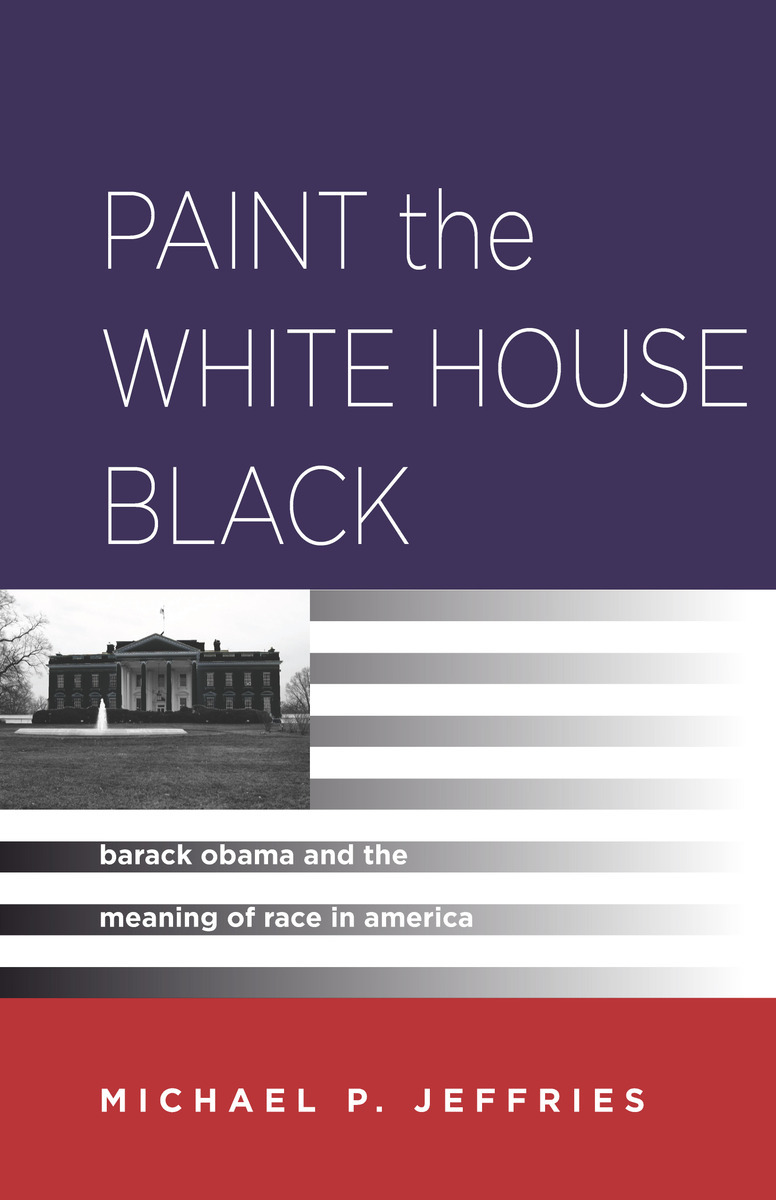
  • Paint the White House Black: Barack Obama and the Meaning of Race in America

    Stanford University Press
    2013
    224 pages
    2 tables
    Cloth ISBN: 9780804780957
    Paper ISBN: 9780804780964
    E-book ISBN: 9780804785570

    Michael P. Jeffries, Sidney R. Knafel Assistant Professor of American Studies
    Wellesley College, Wellesley, Massachusetts

    Barack Obama’s election as the first black president in American history forced a reconsideration of racial reality and possibility. It also incited an outpouring of discussion and analysis of Obama’s personal and political exploits. Paint the White House Black fills a significant void in Obama-themed debate, shifting the emphasis from the details of Obama’s political career to an understanding of how race works in America. In this groundbreaking book, race, rather than Obama, is the central focus.

    Michael P. Jeffries approaches Obama’s election and administration as common cultural ground for thinking about race. He uncovers contemporary stereotypes and anxieties by examining historically rooted conceptions of race and nationhood, discourses of “biracialism” and Obama’s mixed heritage, the purported emergence of a “post-racial society,” and popular symbols of Michelle Obama as a modern black woman. In so doing, Jeffries casts new light on how we think about race and enables us to see how race, in turn, operates within our daily lives.

    Race is a difficult concept to grasp, with outbursts and silences that disguise its relationships with a host of other phenomena. Using Barack Obama as its point of departure, Paint the White House Black boldly aims to understand race by tracing the web of interactions that bind it to other social and historical forces.

    Contents

    • Acknowledgments
    • CHAPTER 1: THROUGH THE FOG
    • CHAPTER 2: MY (FOUNDING) FATHER’S SON: Race, Nation, and the Politics of Inheritance
    • CHAPTER 3: “MUTTS LIKE Me”: Barack Obama, Tragic Mulattos, and Cool Mixed-Race Millennial
    • CHAPTER 4: POSTRACIALISM RECONSIDERED: Class, the Black Counterpublic, and the End of Black Politics
    • CHAPTER 5: THE PERILS OF BEING SUPERWOMAN: Michelle Obama’s Public Image
    • CHAPTER 6: A PLACE CALLED “OBAMA”
    • Appendix I. A Discussion of Racial Inequality
    • Appendix II. Interviewing Multiracial Students
    • Notes
    • Index
  • Hybrid Identity: Family, Photography and History in Colonial Indonesia

    Undergraduate Journal of Gender and Women’s Studies
    Volume 1, Issue 1 (2012)
    15 pages

    Sani Montclair
    Department of Gender and Women’s Studies
    University of California, Berkeley

    As members of my family lose memories and pass away, I desire to take an even tighter grip on their narrative and the recollection of their story; their distant past has become my present exploration. I travel daily to the Indies, searching through black and white photographic albums, tracing the history of my great-grandparents and grandparents. What are these photographs conveying? Whose eyes were they for and most importantly, what story are they telling?

    My Grandmother, Catherine Noordraven (or Omi) was born in Chimahi, Java in 1916. Her mother (Hubertina Samson) was an Indonesian nurse and her father (Otto Noordraven), who was born in Holland, was a Dutch soldier in the military. Omi had a middle/upper class childhood upbringing and had a brother who, like his father, served in the Dutch military. The photographic albums tell the story of their travels throughout many different places in Sumatra and Indonesia, due to Otto’s military post. The photographs of the women in the albums depict a life of leisure, showing bicycle riding, swimming and posed portraits in the yard. The photographs of the men usually illustrate militarization; the men are customarily in uniform or standing in front of government buildings. These photographs represent a highly gendered, racialized and performative colonial history.

    My grandfather, Bob Jan vanderSpek (or Opi) was a Dutchman born in Bondowoso, Java in 1924. His father, Johannes Antonius Maria vanderSpek was an electrical engineer and mother, Cornelia Ann Maria vanLeuween was a stay at home mother. All of the photographs I have from his life are from the 1920s-30s and were sent to Holland before World War Two. The War left Opi with nothing; both his parents were killed and he was left with no belongings.

    History depends on memory (as orally recounted or documented) as the only way through which actual experience can be retrieved. On the other hand, memory is constantly subject to change, influenced by later experiences (Cote 12).

    The lines in this paper will move between history and memory, recalling a time in the Dutch East Indies when European identities and performances signified relations of power. The Dutch colonized the Indonesian islands and for two hundred years took Javanese and Indonesian women as their servants, sexual partners and wives. By the 1940s, there were numerous families of mixed racial backgrounds living in Java who were performing within the structures of a European identity. Uncovering the intersectional politics of hybrid identity is the primary focus of this paper. These mixed identities are revealed through a history of photographs in my family photo albums from the 1920s to the 1930s. The photographic albums in my possession document my family’s story during colonial rule. They narrate pieces of history and concurrently situate their racial and gendered position in the Dutch East Indies. The albums and interviews tell stories of my grandparents’ childhoods and simultaneously explore the complexities of state and homeland. Marrying a white European man was common for indigenous women, in high colonial times, and along with my great-grandmother and grandmother, my mother also married a European white man. The ruling class globally and specifically in Indonesia was white, and the whitening of my relatives’ bloodlines gave the women of color in my family higher class and racialized status. The family photo albums in my possession, along with interviews, allow me to expose these identities from the colonial model to the post-colonial. Structured through the complexities and intersectionality of performance, race, class and gender, these albums and interviews will be used as my primary source in crafting a story about citizenship and belonging…

    Read the entire article here.