• Forging People: Race, Ethnicity, and Nationality in Hispanic American and Latino/a Thought

    University of Notre Dame Press
    2011
    376 pages
    ISBN 10: 0-268-02982-2
    ISBN 13: 978-0-268-02982-1

    Edited by:

    Jorge J. E. Gracia, Samuel P. Capen Chair; SUNY Distinguished Professor of Philosophy and Comparative Literature
    State University of New York, Buffalo

    Forging People explores the way in which Hispanic American thinkers in Latin America and Latino/a philosophers in the United States have posed and thought about questions of race, ethnicity, and nationality, and how they have interpreted the most significant racial and ethnic labels used in Hispanic America in connection with issues of rights, nationalism, power, and identity. Following the first introductory chapter, each of the essays addresses one or more influential thinkers, ranging from Bartolomé de Las Casas on race and the rights of Amerindians; to Simón Bolívar’s struggle with questions of how to forge a nation from disparate populations; to modern and contemporary thinkers on issues of race, unity, assimilation, and diversity. Each essay carefully and clearly presents the views of key authors in their historical and philosophical context and provides brief biographical sketches and reading lists, as aids to students and other readers.

    Contents

    • Contributors
      Preface
    • 1. Race, Ethnicity, and Nationality in Hispanic A merican and Latino/a ThoughtJorge J. E. Gracia
    • Part I. The Colony and Scholasticism
      • 2. The New Black Legend of Bartolomé de Las Casas: Race and Personhood—Janet Burke and Ted Humphrey
    • Part II. Independence and the Enlightenment
      • 3. Men or Citizens? The Making of Bolívar’s Patria—José Antonio Aguilar Rivera
      • 4. Andrés Bello: Race and National Political Culture—Iván Jaksica
      • 5. Undoing “Race”: Martí’s Historical Predicament—Ofelia Schutte
    • Part III. New Nations and Positivism
      • 6. Sarmiento on Barbarism, Race, and Nation Building—Janet Burke and Ted Humphrey
      • 7. Justo Sierra and the Forging of a Mexican Nation—Oscar R. Martí
    • Part IV. Challenges in the Twentieth Century
      • 8. Rodó, Race, and Morality—Arleen Salles
      • 9. Zarathustra Criollo: Vasconcelos on Race—Diego von Vacano
      • 10. The Amauta’s Ambivalence: Mariátegui on Race—Renzo Llorente
      • 11. Mestizaje, mexicanidad, and Assimilation: Zea on Race, Ethnicity, and Nationality—Amy A. Oliver
    • Part V. Latinos/as in the United States
      • 12. Latino/a Identity and the Search for Unity: Alcoff, Corlett, and Gracia—Elizabeth Millán and Ernesto Rosen Velásquez
      • Bibliography
      • Index

    Preface

    The discussion of race in the United States reflects to a great extent the situation in the country. The adoption of the one-drop rule, according to which anyone who has a drop of black blood is considered black, has too often been taken for granted, resulting in a polarization that characterizes both the formulation of problems related to race and the purported solutions to those problems: a person is either black or white but not both; there is no in between. It also has tended to move to the background the visible dimensions of race and to pay undue attention to biological and genetic conceptions of it; heredity, rather than appearance, has often been regarded as most significant. Finally, it has contributed to the widespread use of the metaphor of purity associated with whites and of impurity associated with blacks: to be white is to be uncontaminated, whereas to be black is to be contaminated. That a mixture is generally different from the elements that compose it but partakes of them, that races involve gradation and fuzzy boundaries, and that visible appearance plays an important role in racial classifications are facts too often neglected.

    This model of race takes insufficient note of what much of the world thinks and illustrates the insularity that characterizes some segments of the U.S. community. Indeed, it is seldom that proper attention is paid to the views of other societies. Although the views on race of some European philosophers, such as Kant and Hume, have been studied in some detail, treatments by Latin Americans or Africans, for example, are generally ignored by North American philosophers concerned with race.

    The inadequacy of this parochial approach becomes clear when one considers how conceptions of race vary from place to place. In Cuba, for example, to be black entails a certain kind of appearance. A person who appears to have mixed black-white ancestry is not usually considered black or white but mulatto. In the United States, according to the one-drop rule, to be black requires only one black ancestor, even if physical appearance tells another story. But in Cuba persons of mixed black and white ancestry who look white are generally taken as white, whereas those who appear black are considered black. Clearly the criteria of racial classification used in the United States and Cuba are different. Similar differences can be found between the views of race in the United States and elsewhere in the world.

    This neglect of points of view in other parts of the world also applies to ethnicity and nationality. Societies differ substantially in how they establish and think about ethnicity or nationality. Some societies use skin color and physical appearance to establish ethnic and national distinctions; others use lineage or culture. Indian is a racial term generally associated with ancestry in the United States, but in some contexts in South America it is used to refer to culture: to be an Indian indicates that one has not adopted the ways of Europeans, thus carrying with it the disparaging connotations that this entails in the eyes of those who are European or have adopted European culture. Nationality is taken in some cases to be a legal marker—whether involving birthplace or ancestry—and in others to be an indicator of kinship, race, or culture. As in the United States, in some parts of Latin America blacks and mulattoes were denied citizenship because of their race or racial mixture, whereas in other parts of that region it was denied on other grounds, including culture.

    Considering these differences in conception, it would seem to make sense that theories of race, ethnicity, and nationality need to take into account as many of the various ways in which different societies use these notions as possible. But the tendency in the United States has been to concentrate on Western European views. This has resulted in inadequate theories, based on cultural and social biases. If U.S. thinking is to make any progress toward an understanding of these phenomena, it needs to go beyond parochial boundaries and consider other societies where race, ethnicity, and nationality also play important roles. How are these notions used in the East, the Middle East, Africa, and Latin America?

    Latin America is especially important because it is the place where Africans, Amerindians, and Europeans first came together in substantial numbers. Indeed, some scholars have made the argument that the concept of race in particular developed in the context of the encounters between these peoples in the sixteenth century. The details of the story have still to be worked out, but one thing is clear: Latin America is significant in this development. And the significance is not restricted to the fact that Latin America is a meeting place of Europeans, Amerindians, and Africans; it involves also the complex subsequent history of racial, ethnic, and national mixture in the region. Scholars who have studied the pertinent populations do not tire of repeating that Latin America is one of the places in the world where mixing has been most prevalent…

    Read the Preface and Chapter 1 here.

  • The Moment of Theory: Race as Myth and Medium

    W. E. B. Du Bois Lecture Series
    W.E.B. Du Bois Institute for African and African American Research
    Harvard University
    2010-04-20

    W. J. T. Mitchell, Gaylord Donnelley Distinguished Service Professor of English and Art History
    University of Chicago

    Watch the lecture here.

  • Cogewea, The Half Blood: A Depiction of the Great Montana Cattle Range

    University of Nebraska Press
    1981 (originally published in 1927)
    302 pages
    Paperback ISBN: 978-0-8032-8110-3
    Hardback ISBN: 978-0-8032-3069-9

    Mourning Dove (Humishuma) (1888-1936)
    Introduction by Dexter Fisher (Cirillo)

    One of the first known novels by a Native American woman, Cogewea (1927) is the story of a half-blood girl caught between the worlds of Anglo ranchers and full-blood reservation Indians; between the craven and false-hearted easterner Alfred Densmore and James LaGrinder, a half-blood cowboy and the best rider on the Flathead; between book learning and the folk wisdom of her full-blood grandmother. The book combines authentic Indian lore with the circumstance and dialogue of a popular romance; in its language, it shows a self-taught writer attempting to come to terms with the rift between formal written style and the comfort-able rhythms and slang of familiar speech.

  • Changing Families

    Sh’ma: A Journal of Jewish Ideas
    December 2007

    Caryn Aviv, Senior Instructor in Secular Jewish Society & Civilization
    University of Colorado, Boulder

    A Different Sexual Revolution

    The Colors of Jews: Racial Politics and Radical Diasporism, by Melanie Kaye/Kantrowitz, Indiana University Press, 2007. 320 pages

    The Family Flamboyant: Race Politics, Queer Families, Jewish Lives, by Marla Brettschneider, SUNY Press, 2006. 232 pages

    Two new books provide food for thought about contemporary Jewish identities in the United States. The Family Flamboyant: Race Politics, Queer Families, Jewish Lives by Marla Brettschneider, and The Colors of Jews: Racial Politics and Radical Diasporism, by Melanie Kaye Kantrowitz, have much in common. Both books are informed by the authors’ deep commitment to social justice, their insights as Ashkenazi Jewish lesbians, and their experiences as coalition organizers. And both authors offer a nuanced, passionate, and sophisticated analysis of slippery Jewish identities in relationship to racial politics and inequality in the United States.

    Each author inserts compelling autobiographical experiences into their political analyses. Brettschneider reveals the unsavory and overt racism and homophobia of the adoption system in the United States based on her own experiences of trying to adopt as an outspoken Jewish lesbian. Kaye/Kantrowitz draws upon her experiences of living in diverse places in the U.S., her struggles for racial and economic justice, and her memories of growing up in a secular, Yiddish-inflected family in Brooklyn. And both books provide meticulously documented empirical and theoretical evidence for the arguments they advance, offering a veritable bibliographic trove of resources for scholars and lay readers interested in these literatures…

    Read the entire review here.

  • The Pedagogy of the Meaning of Racism: Reconciling a Discordant Discourse

    Social Work: A Journal of the National Association of Social Workers
    Volume 57, Issue 3 (July 2012)
    pages 225-234
    DOI: 10.1093/sw/sws009

    Carlos Hoyt, Jr., MSW, LICSW, Associate Dean of Students
    Phillips Academy Andover, Andover, Massachusetts

    Racism is a term on which a great deal of discourse does and should turn in all realms of social work theory, practice, policy, and research. Because it is a concept heavily freighted with multiple and conflicting interpretations and used in a wide variety of ways, the idea and action of racism is not easy to teach or learn in a simple and straightforward manner. It is a term the meaning of which has been the subject of so much argument and mutation that its utility as a clear and reliable descriptor of a crucial form of ideology or behavior is less than certain. In this article, an analysis of the dispute over the proper definition of racism is undertaken, and an approach to teaching about the term is offered in an effort to provide both teachers and students with a clear, consistent, and useful understanding of this important and challenging phenomenon.

    Having taught courses in which the concept of racism is a phenomenon of critical focus, I have been consistently struck by the challenge students confront when the subject of how to define this term becomes a topic of consideration and discussion. Although several key concepts in the study of diversity, social bias, and social justice are somewhat nebulous and overlapping (for example, “culture,” “race,” and “ethnicity”), there is perhaps no term that provokes the level of confusion, consternation, and conflict that the term “racism” does. As will be seen in this article, this is due to the dispute that has destabilized use of the term for much of its short history and boils down to a sharp disagreement among both professionals and laypeople about whether the original definition of racism, the belief in the superiority/inferiority of people based on racial identity, should be revised to exclusively and strictly mean the use of power to preserve and perpetuate the advantages of the dominant social identity group—that is, white people in American society.

    In this article, an analysis of the dispute about the definition of racism within academia will be conducted to elucidate the arguments by those who promote the revised definition and those who resist the revision. Following this analysis, based on the strengths and weaknesses of each, a pedagogical approach to teaching the definition of racism that resolves the dispute will be presented. At the outset it will be useful to provide the definitions of key terms in the discourse on racism. The following definitions, while not copied verbatim from any dictionary, reflect what can be found in standard dictionaries and usage and will serve as the meanings of the terms used in this article.

    DEFINITIONS OF CRITICAL TERMS IN THE DISCOURSE ON RACISM

    Prejudice—preconceived opinion not based on reason or actual experience; bias, partiality.

    Racism—(original definition) the belief that all members of a purported race possess characteristics, abilities, or qualities specific to that race, especially so as to distinguish it as inferior or superior to another race or other races. Racism is a particular form of prejudice defined by preconceived erroneous beliefs about race and members of racial groups.

    If one is to be thoroughgoing a la Muir, then racism is in evidence at the point that one subscribes to the notion of race itself, because belief in race is the fallacious prerequisite for the belief in differences between races (Muir, 1993).

    Power—the capacity to exert force on or over something or someone.

    Oppression—the exercise of authority or power in a burdensome, cruel, or unjust manner.

    With a clear understanding of these terms as the atomic elements of the discourse on the definition of racism, we can proceed with an elucidation of the problem…

    Read or purchase the article here.

  • The Family Flamboyant: Race Politics, Queer Families, Jewish Lives

    SUNY Press
    October 2006
    244 pages
    Hardback ISBN10: 0-7914-6893-3; ISBN13: 978-0-7914-6893-7
    Paperback ISBN10: 0-7914-6894-1; ISBN13: 978-0-7914-6894-4
    eBook ISBN10: 0-7914-8106-9; ISBN13: 978-0-7914-8106-6

    Marla Brettschneider, Professor of Political Philosophy, Feminist Theory, Political Science & Women’s Studies
    University of New Hampshire

    Winner of a Bronze Medal in the Gay/Lesbian Category of the 2007 Independent Publisher Book Awards

    Interrogates the normative heterosexual family from feminist, Jewish, and queer perspectives.

    The Family Flamboyant is a graceful and lucid account of the many routes to family formation. Weaving together personal experience and political analysis in an examination of how race, gender, sexuality, class, and other hierarchies function in family politics, Marla Brettschneider draws on her own experience in a Jewish, multiracial, adoptive, queer family in order to theorize about the layered realities that characterize families in the United States today. Brettschneider uses critical race politics, feminist insight, class-based analysis, and queer theory to offer a distinct and distinctly Jewish contribution to both the family debates and the larger project of justice politics.

    Table of Contents

    • Acknowledgments
    • Introduction: K-I-S-S-I-N-G
    • 1. Whitens Whites, Keeps Colors Bright: Jewish Families Queering the Race Project
    • 2. Jew Dykes Adopting Children: A Guide to the Perplexed
    • 3. Going Natural: The Family Has No Clothes
    • 4. Questing for Heart in a Heartless World: Jewish Feminist Ruminations on Monogamy and Marriage
    • Epilogue: Justice and La Vida Jew . . . in Technicolor Queer
    • Notes
    • Bibliography
    • Index
  • The Myth of Race

    Argo-Navis
    2012-11-27
    154 pages
    8.2 x 5.5 x 0.4 inches
    Paperback ISBN-10: 0786754362; ISBN-13: 978-0786754366

    Jefferson M. Fish, Professor Emeritus of Psychology
    St. John’s University, New York City

    The Myth of Race deals concisely with a wide range of topics, from how the concept of race differs in different cultures and race relations in the United States, to IQ tests and the census. It draws on scientific knowledge to topple a series of myths that pass as facts, correct false assumptions, and clarify cultural misunderstandings about the highly charged topic of race. The book demonstrates that the apparently straightforward concept of race is actually a confused mixture of two different concepts; and the confusion often leads to miscommunication. The first concept, biological race, simply doesn’t exist in the human species. Instead, what exists is gradual variation in what people look like (e.g., skin color and facial features) and in their genes, as you travel around the planet—with more distant populations appearing more different than closer ones. If you travel in different directions, the populations look different in different ways. The second concept, social race, is a set of cultural categories for labeling people based on how their ancestors were classified, selected aspects of what they look like, or various combinations of both. These sets of categories vary widely from one culture to another.

    The book draws on scientific knowledge to topple a series of myths that pass as facts, correct false assumptions, and clarify cultural misunderstandings about the highly charged topic of race.

    Here are some of those myths:

    • The myth that humans are divided into Caucasoid, Negroid, and Mongoloid races
    • The myth that people cannot change their race
    • The myth of the tragic mulatto
    • The myth of biologically based differences in intelligence among the races

    Table of Contents

    • Introduction
    • 1. The Myth of Caucasoid, Negroid, and Mongoloid Races
    • 2. The Myth that a Persons Race Cannot Change
    • 3. Racial Myths and Cultural Misunderstandings
    • 4. Racial Myths in the Census
    • 5. Racial Myths and the Authors Family
    • 6. Myths about Race and Intelligence
    • 7. Dreams from My Daughter: Mixed Race Myths
    • 8. How the Myth of Race Took Hold
  • Intermarriage and Multicultural Families

    My Jewish Learning
    2012-12-13

    Ruth Abusch-Magder, Rabbi-in-Residence
    Be’chol Lashon, San Francisco, California

    Like it or not, intermarriage is a fact in Jewish life.

    And for the most part the Jewish community has learned to live with it. Sure, different movements deal with it differently. Sure, some congregations are more adept and accommodating. But from Renewal to Orthodox we no longer assume that a Jew by birth will marry another Jew by birth.
     
    But as demographics shift in the United States, the nature of intermarriage is changing too. And the Jewish community will need to adapt if it hopes to continue to create spaces for these new Jewish families.
     
    In particular, my concern is with multiracial and multicultural families. There is nothing new about Jews from all racial and ethnic backgrounds. There were Jews in Ethiopia centuries before there were Jews in Poland and Jews in India before there were Jews in Spain. Jewish institutional life in the United States, however, has largely been built on the presumption that Jews are white. And our welcome to interfaith couples has similarly assumed that intermarriages between one white Jew and one white non-Jew…

    Read the entire article here.

  • The White Negress: Literature, Minstrelsy, and the Black-Jewish Imaginary (review)

    Shofar: An Interdisciplinary Journal of Jewish Studies
    Volume 31, Number 1, Fall 2012
    pages 206-208
    DOI: 10.1353/sho.2012.0123

    Andrea Levine
    George Washington University

    This volume’s title signals its central critical intervention, a challenge to the masculine biases that have shaped studies of minstrelsy and of cross-racial appropriation and desire more broadly. Most conspicuously, Lori Harrison-Kahan takes on the influential paradigm established by Michael Rogin in his 1996 Blackface, White Noise. Rogin, of course, argues that early twentieth-century Jewish blackface performances worked to confirm the still-contested “whiteness” of Jewish entertainers, a “true” whiteness that presumably resided beneath the “mask” of blackface.

    Harrison-Kahan, in fact, identifies Rogin’s paradigm as one of two predominant, “oppositional,” modes of reading Jewish investment in black culture; in the second paradigm, which she traces back at least to Irving Howe, Jews “empathetically identify” with black suffering (p. 4). In practice, though, she contends much more consistently with Rogin’s well-known charges of appropriation and exploitation.

    The White Negress demonstrates that once we begin to look at women’s engagement with “cross-cultural exchange” (p. 15), these transactions appear far more nuanced than such binary approaches allow. Harrison-Kahan reads a number of early twentieth-century Jewish American women’s texts and performances as invested less in claiming “whiteness” than in destabilizing it, in part through assertions—if frequently ambivalent ones—of Jewish identity. Her analysis places considerable weight on the resistance to sanctioned gender and sexual roles on the part of such Jewish American female performers and writers as Sophie Tucker and Fannie Hurst. The author also revises “unidirectional” narratives of Jewish American cultural appropriations of “blackness,” suggesting that scholars should acknowledge the more “reciprocal” transactions that obtain among African American and Jewish American cultural producers and historical actors. So, for instance, she reads Zora Neale Hurston’s 1939 novel, Moses, Man of the Mountain, as a send-up, rather than a reinscription, of minstrel conventions, one that explores both the power dynamics and the mutual “cross-identifications” that attended Black-Jewish coalitions in the early years of the civil rights movement.

    In another acute challenge to prevailing scholarship, Harrison-Kahan argues that the racial politics of Edna Ferber’s Showboat look quite different when one reads the novel that served as the basis for the Broadway musical, much-maligned for its traffic in sentimental and demeaning representations of African American characters. Harrison-Kahan emphasizes the novel’s “pluralistic” rendering of Jewishness and its emphasis on racial “mixing.” Similarly, she re-reads Hurst’s 1933 novel, Imitation of Life, which provided the basis for both the 1934 and 1959 film versions, texts far more familiar to most scholars than Hurst’s original novel. Harrison-Kahan argues that Hurst’s novel interrogates and exposes the commodification of “blackness” on which its protagonist’s business rests—and that these challenges to racial stereotypes work in conjunction with the challenges that Bea Pullman, as a “working woman,” poses to normative scripts of white femininity and maternity. As in the chapter on Ferber, the author makes a persuasive case for the under-examination of Hurst as a Jewish American author, in part because her biography deviated from that of the largely New York-based Eastern European Jewish immigrants whose work dominates the Jewish American “canon,” and in part—as with so many women writers—because her work was consistently marginalized by critics for its commercial success. One might, however, suggest that even given the historical frame of Harrison-Kahan’s project, her own privileging of “working” white femininity as a disruptive version of femininity is rather a circumscribed choice, leaving heterosexuality, among other indices of normative femininity, largely intact.

    Harrison-Kahan’s readings are subtle and deft, and to her credit, she does not over-state the radicalism of either her own approach or the texts she reconsiders. A characteristic passage reads, “Hurst’s novel thus negotiates a fine line between being an additional inculcation of the mammy myth and a commentary on it” (p. 124). Harrison-Kahan works cogently and intelligently in the ambivalent space she charts, writing in the conclusion that whiteness can be “produced and destabilized through cross-racial performances and encounters” (p. 179).

    This volume makes an important contribution to a scholarly…

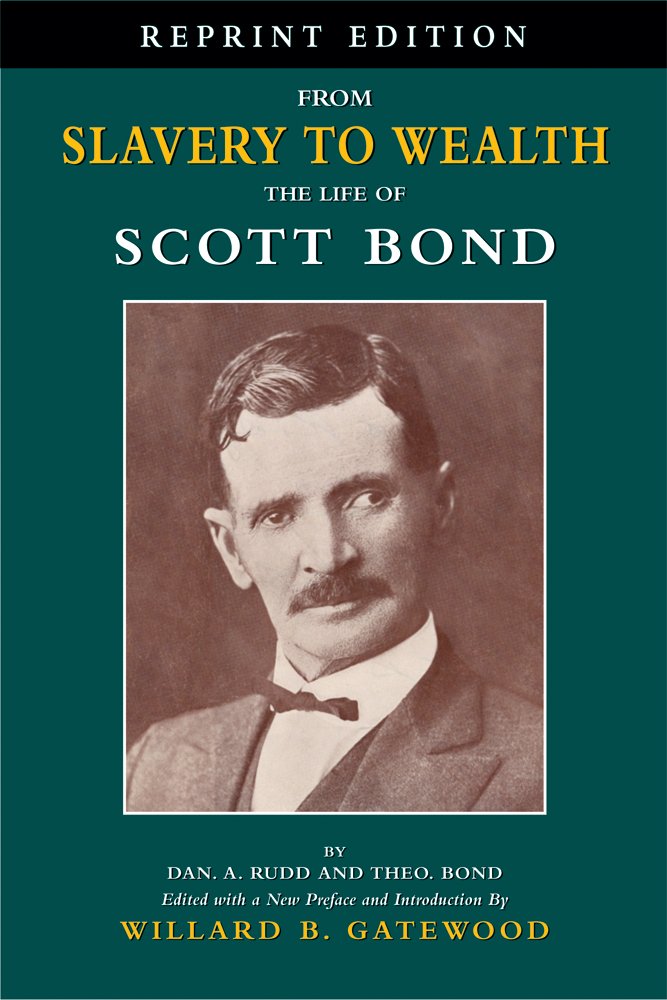
  • From Slavery to Wealth: The Life of Scott Bond

    University of Arkansas Press
    February 2008 (Originally Published: 1917)
    336 pages
    6 x 9; 72 photographs and index
    ISBN 13: 978-0-9768007-6-7 ISBN 10: 0-9768007-6-4

    Dan. A. (Daniel Arthur) Rudd (1854-1933)

    Theo. (Theophilus) Bond

    Edited with a new Preface and Introduction by

    Willard B. Gatewood, Alumni Distinguished Professor of History Emeritus
    University of Arkansas, Fayetteville

    In an era in which African Americans were oppressed and deprived of many of the rights and privileges of citizenship, Scott Bond rose from being born a slave in Madison County, Mississippi, in the early 1850s to wealth and status as a farmer, merchant, and business entrepreneur in Madison, Arkansas, by the early 1900s. From Slavery to Wealth is the story of an extraordinary individual widely known and respected at the time of its first publication in 1917, for his integrity, prodigious energy, and strong work ethic. Throughout his career he never wearied of imploring African Americans to seize the opportunities offered them in the South in general and in the Arkansas Delta in particular. Scott Bond enjoyed an enviable reputation among blacks as well as whites. This reputation ultimately extended far beyond his local community to prominent blacks throughout the South and elsewhere, especially after he gained wider exposure as a conspicuous figure in the National Negro Business League in the early years of the twentieth century.

    With this 2008 reprint edition, the current generation can be inspired by the man who has been referred to as the black John D. Rockefeller of Arkansas.

    Read the entire book (From Slavery to Wealth. The Life of Scott Bond. The Rewards of Honesty, Industry, Economy and Perseverance) via “Documenting the American South” here.

    Scott Bond was born in the early 1850s to an enslaved mother named Ann who worked in the Maben-Bond household near Canton, Mississippi. His father was the nephew of a white slave-owner to whom Bond’s mother had temporarily been hired out as a domestic servant. Just prior to the outbreak of the Civil War, Bond and his mother were moved to Arkansas, along with his step-father, William Bond, and the rest of the Maben-Bond family’s slaves. After Emancipation, Bond lived with his step-father until age twenty-two, when he “undertook to vouch for himself” and began work on his lifelong goal of becoming a successful businessman (p. 37). Bond accomplished this goal. At the time of his death he owned and farmed 12,000 acres, while also raising livestock and operating a large mercantile store, at least five cotton gins, a gravel pit, a lumber yard, and a saw mill. A member of the National Negro Business League, Bond supported the efforts of Booker T. Washington, whose philosophies regarding the social advancement of African Americans through economic and agricultural success mirrored Bond’s own. In 1877, he married Magnolia Nash, with whom he had eleven sons. Bond was killed in March 1933 by one of his registered bulls. According to his son, Ulysses, he “went down swinging and died among the things he loved” (p. 152)…

    Read the entire summary here.