• African ancestry of the population of Buenos Aires

    American Journal of Physical Anthropology
    Volume 128, Issue 1
    pages 164–170, September 2005
    DOI: 10.1002/ajpa.20083

    Laura Fejerman
    Institute of Biological Anthropology
    University of Oxford

    Francisco R. Carnese
    Sección Antropología Biológica
    Instituto de Ciencias Antropológicas
    Facultad de Filosofía y Letras
    Universidad de Buenos Aires

    Alicia S. Goicoechea
    Sección Antropología Biológica
    Instituto de Ciencias Antropológicas
    Facultad de Filosofía y Letras
    Universidad de Buenos Aires

    Sergio A. Avena
    Sección Antropología Biológica
    Instituto de Ciencias Antropológicas
    Facultad de Filosofía y Letras
    Universidad de Buenos Aires

    Cristina B. Dejean
    Sección Antropología Biológica
    Instituto de Ciencias Antropológicas
    Facultad de Filosofía y Letras
    Universidad de Buenos Aires

    Ryk H. Ward (1943-2003)
    Institute of Biological Anthropology
    University of Oxford

    The population of Argentina today does not have a “visible” black African component. However, censuses conducted during most of the 19th century registered up to 30% of individuals of African origin living in Buenos Aires city. What has happened to this African influence? Have all individuals of African origin died, as lay people believe? Or is it possible that admixture with the European immigrants made the African influence “invisible?” We investigated the African contribution to the genetic pool of the population of Buenos Aires, Argentina, typing 12 unlinked autosomal DNA markers in a sample of 90 individuals. The results of this analysis suggest that 2.2% (SEM = 0.9%) of the genetic ancestry of the Buenos Aires population is derived from Africa. Our analysis of individual admixture shows that those alleles that have a high frequency in populations of African origin tend to concentrate among 8 individuals in our sample. Therefore, although the admixture estimate is relatively low, the actual proportion of individuals with at least some African influence is approximately 10%. The evidence we are presenting of African ancestry is consistent with the known historical events that led to the drastic reduction of the Afro-Argentine population during the second half of the 19th century. However, as our results suggest, this reduction did not mean a total disappearance of African genes from the genetic pool of the Buenos Aires population.

    Read or purchase the article here.
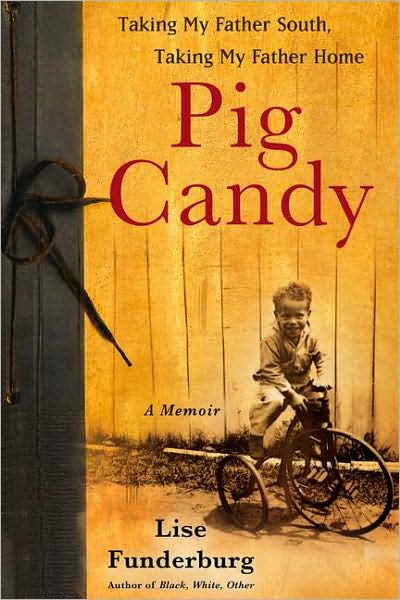
  • Pig Candy: Taking My Father South, Taking My Father Home—A Memoir

    Free Press (an imprint of Simon & Schuster)
    2008
    320 pages
    Hardback ISBN: 9781416547662
    Paperback ISBN: 9781416547679

    Lise Funderburg

    Pig Candy is the poignant and often comical story of a grown daughter getting to know her dying father in his last months. During a series of visits with her father to the South he’d escaped as a young black man, Lise Funderburg, the mixed-race author of the acclaimed Black, White, Other, comes to understand his rich and difficult background and the conflicting choices he has had to make throughout his life.

    Lise Funderburg is a child of the ’60s, a white-looking mixed-race girl raised in an integrated Philadelphia neighborhood. As a child, she couldn’t imagine what had made her father so strict, demanding, and elusive; about his past she knew only that he had grown up in the Jim Crow South and fled its brutal oppression as a young man. Then, just as she hits her forties, her father is diagnosed with advanced and terminal cancer—an event that leads father and daughter together on a stream of pilgrimages to his hometown in rural Jasper County, Georgia. As her father’s escort, proxy, and, finally, nurse, Funderburg encounters for the first time the fragrant landscape and fraught society—and the extraordinary food—of his childhood.

    In succulent, evocative, and sometimes tart prose, the author brings to life a fading rural South of pecan groves, family-run farms, and pork-laden country cuisine. She chronicles small-town relationships that span generations, the dismantling of her own assumptions about when race does and doesn’t matter, and the quiet segregation that persists to this day. As Funderburg discovers the place and people her father comes from, she also, finally, gets to know her magnetic, idiosyncratic father himself. Her account of their thorny but increasingly close relationship is full of warmth, humor, and disarming candor. In one of his last grand acts, Funderburg’s father recruits his children, neighbors, and friends to throw a pig roast—an unforgettable meal that caps an unforgettable portrait of a man enjoying his life and loved ones right up through his final days.

    Pig Candy takes readers on a stunning journey that becomes a universal investigation of identity and a celebration of the human will, familial love, and, ultimately, life itself.

  • CREE w/ Eduardo Bonilla-Silva, PhD

    Counter-Racist Evolving Engineer (CREE)
    Blog Talk Radio
    2013-06-16

    Eduardo Bonilla-Silva, Professor of Sociology
    Duke University

    Eduardo Bonilla-Silva, PhD,  is a professor of sociology and a council member of Center for Latin American and Caribbean Studies at Duke University.  He is the author of several books including the acclaimed Racism without Racists: Color-Blind Racism and the Persistence of Racial Inequality in America.  He is also the author and co-author of numerous other books and papers. Most interestingly for this program, Dr. Bonilla-Silva co-authored a chapter in Changing Terrain of Race and Ethnicity: Theory, Methods and Public Policy entitled “‘We are all Americans!’: The Latin Americanization of Race Relations in the USA”.

    The center question of this discussion will be the functionality of the term “non-black people” in eliminating the global system of racism (white/light domination).

    Listen to the episode here. Download the episode here.

  • Hapa Hoops: Japanese American Basketball and Community with Rex Walters

    Japanese American National Museum
    100 North Central Avenue
    Los Angeles, California, 90012
    Saturday, 2013-06-22, 14:00 PDT (Local Time)

    Join us as we explore the experiences of Hapa Japanese Americans and their experiences in Japanese American basketball leagues. Hapa Hoops will feature a screening of JANM’s basketball documentary Crossover  and will be followed by a conversation by Rex Walters, a veteran of both Japanese American basketball leagues and the NBA.

    In conjunction with the exhibition Visible & Invisible: A Hapa Japanese American History

    For more information, click here.

  • Mildred Loving, Who Battled Ban on Mixed-Race Marriage, Dies at 68

    The New York Times
    2008-05-06

    Douglas Martin

    Mildred Loving, a black woman whose anger over being banished from Virginia for marrying a white man led to a landmark Supreme Court ruling overturning state miscegenation laws, died on May 2 at her home in Central Point, Va. She was 68.

    Peggy Fortune, her daughter, said the cause was pneumonia.

    The Supreme Court ruling, in 1967, struck down the last group of segregation laws to remain on the books — those requiring separation of the races in marriage. The ruling was unanimous, its opinion written by Chief Justice Earl Warren, who in 1954 wrote the court’s opinion in Brown v. Board of Education, declaring segregated public schools unconstitutional.

    In Loving v. Virginia, Warren wrote that miscegenation laws violated the Constitution’s equal protection clause. “We have consistently denied the constitutionality of measures which restrict the rights of citizens on account of race,” he said.

    By their own widely reported accounts, Mrs. Loving and her husband, Richard, were in bed in their modest house in Central Point in the early morning of July 11, 1958, five weeks after their wedding, when the county sheriff and two deputies, acting on an anonymous tip, burst into their bedroom and shined flashlights in their eyes. A threatening voice demanded, “Who is this woman you’re sleeping with?”

    Mrs. Loving answered, “I’m his wife.”

    Mr. Loving pointed to the couple’s marriage certificate hung on the bedroom wall. The sheriff responded, “That’s no good here.”

    The certificate was from Washington, D.C., and under Virginia law, a marriage between people of different races performed outside Virginia was as invalid as one done in Virginia. At the time, it was one of 24 states that barred marriages between races…

    …Mildred Delores Jeter’s family had lived in Caroline County, Va., for generations, as had the family of Richard Perry Loving. The area was known for friendly relations between races, even though marriages were forbidden. Many people were visibly of mixed race, with Ebony magazine reporting in 1967 that black “youngsters easily passed for white in neighboring towns.”

    Mildred’s mother was part Rappahannock Indian, and her father was part Cherokee. She preferred to think of herself as Indian rather than black.

    Mildred and Richard began spending time together when he was a rugged-looking 17 and she was a skinny 11-year-old known as Bean. He attended an all-white high school for a year, and she reached 11th grade at an all-black school.

    When Mildred became pregnant at 18, they decided to do what was elsewhere deemed the right thing and get married. They both said their initial motive was not to challenge Virginia law.

    “We have thought about other people,” Mr. Loving said in an interview with Life magazine in 1966, “but we are not doing it just because somebody had to do it and we wanted to be the ones. We are doing it for us.”…

    Read the entire obituary here.

  • Mixed-Race People Fastest Growing Group, Census Data Shows

    KPIX 5 (CBS)
    San Francisco, California
    2013-06-14

    Elizabeth Cook, Co-Anchor

    Ryan Takeo, Reporter

    The face of the nation is changing rapidly, as Census data shows mixed-race people are the fastest-growing ethnic group. Ryan Takeo reports.

    Note from Steven F. Riley:

    • Features San Francisco State University Associate Professor of Ethnic Studies and American Indian Studies, Andrew Jolivétte.
    • Reporter Elizabeth Cook incorrectly states that 15% of all marriages are mixed. According to a 2012 Pew Research Center report, 15% of all new marriages in 2010 were mixed.  Pew reports that in 2010, 8.4% of all married couples were mixed regardless of when they married.

  • Whither White America?

    The American Prospect
    2013-06-13

    Jamelle Bouie

    More thoughts on the future of white people.

    “Majority-minority” is an unusual term—by definition, minorities are no longer such if they’re in the majority—but it’s a convenient shorthand for what most people expect to happen in the United States over the next few decades. A growing population of nonwhites—driven by Asian and Latino immigration—will yield a country where most Americans have nonwhite heritage, thus “majority-minority.”

    The most recent analysis from the Census Bureau seems to bear this out. Last year was the first year that whites were a minority of all newborns, and based on current rates of growth, they’ll become a minority of the under–five set by next year, if not the end of this one. Overall, the government projects that within five years, minorities will compromise a majority of all Americans under the age of eighteen, something to keep in mind when trying to project future political support for both parties…

    …One fact stands out in all of this, however. The fastest growing group of Americans—by far—fall under the “multiracial category.” If past research is any indication, these Americans are likely the product of intermarriage between whites and Hispanics (the most common interracial pairing) or whites and Asians (the next most common one). While we identify them as nonwhite, we don’t know how they’ll identify themselves in the future.

    My hunch is that—as (certain groups of) Latinos and Asians integrate themselves into American life—a good number will identify themselves as white, with Hispanic or Asian heritage, in the same way that many white Americans point to their Irish or Italian backgrounds…

    Read the entire article here.

  • Not Quite White: Arabs, Slavs, and the Contours of Contested Whiteness

    Typecast Releasing
    2012
    USA
    English
    24 minutes

    Jamil Khoury, Director and Writer

    Stephen Combs, Director

    Inspired by Jamil Khoury’s short play WASP: White Arab Slovak Pole, Not Quite White: Arabs, Slavs, and the Contours of Contested Whiteness is a thought-provoking documentary that explores the complicated relationship of Arab and Slavic immigrants to American notions of whiteness.

    The film integrates scenes from WASP alongside interviews with Arab American and Polish American academics who reflect upon contested and probationary categories of whiteness and the use of anti-Black racism as a “whitening” dye.

    In Not Quite White, Jamil Khoury (Artistic Director of Chicago’s Silk Road Rising) draws upon his own Arab (Syrian) and Slavic (Polish and Slovak) heritage as the lens through which to investigate the broader issue of immigrants achieving whiteness and hence qualifying as “fully American.” The film advances society’s on-going conversations about the meaning of whiteness and efforts at redefining whiteness.

    Not just for white people, and not just for Arabs and Slavs, Not Quite White proceeds from the assumption that whiteness affects all our lives and that we all need to critically engage whiteness. “Whiteness has everything to do with melanin and pigmentation and it has nothing to do with melanin and pigmentation,” Khoury observes. “Whiteness is about power and borders and authorship. And whiteness can, and does, change.”

    The academics featured in Not Quite White include: Roxane Assaf, Adjunct Faculty, School of the Art Institute of Chicago; Ann Hetzel Gunkel, Director of Cultural Studies, Columbia College Chicago; John Tofik Karam, Assistant Professor of Latin American and Latino Studies, De Paul University; Dominic A. Pacyga, Professor of History, Columbia College Chicago.

    DVD copies also include On Whiteness, a 16-minute video essay in which writer and co-director Jamil Khoury discusses the themes and ideas presented in his film. Khoury’s short film both/and is also available from Typecast here.

  • Dr. J .T. Mills: Helping Students Explore Concepts of Race

    Mixed Race Radio
    Blog Talk Radio
    2013-06-19, 16:00Z (12:00 EDT)

    Tiffany Rae Reid, Host

    John T. Mills, Assistant Director of Multicultural Affairs
    Rowan University, Glassboro, New Jersery

    Legitimate knowledge regarding the construction of race in America is absent in today’s youth and college aged students. It is imperative to have an understanding of the fluidity of race in America and its context to the systems that perpetuate the ongoing racial divisions in communities and disparities in health care, economic prosperity, and everyday interactions, for example.

    Such clarity for these issues is overshadowed by the notion of post racialism in this society that teaches us to avoid or suppress such discussions in the axiom of “political correctness.”  One only needs to look to the President of the United States who is described as the first African American/Black man to hold that office when he is in reality bi-racial. Moreover, the complexity of race in the United States can further be interrogated in his self identification because he is aware of the social, political, and global lenses that identify him as a man of color over his White ancestry.

    It is in this context that Dr. Mills works to create environments and opportunities for students to explore the nuances of race and race relations in America in the hopes of creating an awareness that would bring about greater understanding among and between all people.

    These discussions then must begin with analyzing why and how race came about in this country during the 17th and 18th centuries during the economic development of the United States when there was much more cross racial cooperation and even harmony at one point than our history books tell us. Blacks, Whites, and Native American Indians intermingled to create a nation and have had more historical commonalities that is being taught and that needs to be addressed to expose the modern forms of raced based oppression that exists today.

    For more information, click here.

  • Are you a biracial/mulitraical individual?

    Tufts University
    Social Psychology Program at Tufts University
    2013-06-18

    Sarah Gaither, M.S. (E-Mail)

    Are you biracial/multiracial or mixed race? We are looking for people to complete a short online study (around 10 minutes long) in exchange for a chance at $25.00 USD. The study will involve providing some ratings about a hypothetical person. We need mixed-race people in particular.

    To begin the online study, click here.

    Thanks so much for your interest in our study!