• Being Multiracial in a Country that Sees Black and White

    Interpolations: A Journal of First Year Writing
    Deparment of English, University of Maryland
    Fall 2009

    Lavisha McClarin
    University of Maryland

    In America mixed race individuals are becoming more prominent in the media, politics and sports throughout the country. Some of the most popular mixed race individuals that we see everyday include Tiger Woods, Vin Diesel, Mariah Carey, Dwayne “the Rock” Johnson, Derek Jeter, Halle Berry, Alicia Keys and of course President [Barack] Obama. The fact that this population of mixed race individuals is growing at an astounding rate is the reason behind the current discussion on the racial classification of such individuals. Before the 1960s many researchers considered “biracial identity [to be] equivalent to black identity…or a subset of blacks” (Rockquemore 21). This thought continued to exist in the United States by researchers until the 1990s [sic] when “biracial people were [considered] a separate [racial] group” (21). The multiracial movement that has arisen during the 1990s believes that “every person, especially every child, who is multi-ethnic/interracial has the same right as any other person to assert an identity that embraces the fullness and integrity of their actual ancestry” (Tessman 1). Although there are overall positive effects for these individuals from the movement, there are also negative affects that could potentially cause more problems for America’s current racial system. However, despite the negative effects of the movement, there is evidence that shows that this potential transition to a multiracial system in the US has beneficial aspects to it…

    Read the entire article here.
  • Firsthand multlicultural experience

    The Daily Independent (Ashland, Kentucky)
    2009-10-22

    Mike James

    Ashland — When he brings up the fact that he is biracial, Elliott Lewis most often hears platitudes.

    Some of them are flattering, others not so much. The one that drives him nuts is the question, “What are you?”

    It’s one of the things he has to cope with in a generation that is redefining what it is to be biracial.

    Lewis, a former television reporter now in law school at the University of Akron, spoke Thursday at Ashland Community and Technical College during the annual Teaching-Learning Conference.

    Diversity is the focus of the conference, and Lewis embodies the theme. As a young biracial American, Lewis sees a divide between two generations that have two ways of viewing racial identity.

    Had he been of his parents’ generation, grown to maturity before and during the civil rights struggles of the 1950s and 1960s, he would have been biracial by birth and black by experience. “There were no biracial water fountains in the south,” he said….

    …Multiracial Americans are a growing segment of the population and thus a group educators need to be informed about, said conference chairman Dan Mahan. “He (Lewis) is on the cutting edge of the subject.”

    Even in northeast Kentucky, student populations at the community college level are diverse and becoming more so, he said…

    Read the entire article here.

  • Fade: My Journeys in Multiracial America

    Basic Books an imprint of The Perseus Books Group
    2006-12-28
    302 pages
    ISBN: 9780786718825
    ISBN-10: 078671882X

    Elliott Lewis

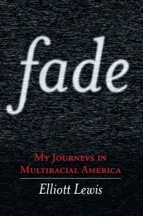
    Television journalist Elliott Lewis weaves his memoirs as a black-and-white biracial American with the voices of dozens of multiracial people who are challenging how we think and speak about race today. “What are you?” This seemingly ordinary but politically charged question has become a touchstone for debate around race and ethnicity. Now, more than ever, mixed race Americans are calling themselves biracial and multiracial rather than feeling forced to choose only one race. Nearly seven million people checked more than one racial category in the 2000 US census, the first time in history Americans had the option to mark more than one box. With Fade, Lewis offers a comprehensive look at the multiracial state of the union. Here he speaks with dozens of individuals, tackling hot button issues such as the often complicated lives of multiracial people in communities of color, interracial dating, transracial adoption, and the birth of the multiracial movement. The author also shares his own moving — and often humorous — firsthand experiences with race, along with intimate stories from those at the forefront of nationwide efforts to formally recognize the multiracial population.

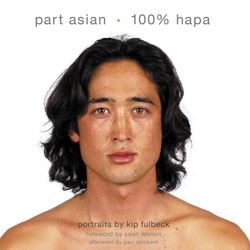
  • Part Asian, 100% Hapa: Portraits by Kip Fulbeck

    Chronicle Books
    February, 2006
    264 pages
    7 x 7 in; 125 color photographs
    ISBN 0811849597
    ISBN13 9780811849593

    Kip Fulbeck, Professor of Performative Studies, Video
    University of California, Santa Barbara

    Foreword by Sean Lennon

    Afterword by Paul Spickard, Professor of History
    University of California, Santa Barbara

    Part Asian, 100% Hapa — Originally a derogatory label derived from the Hawaiian word for half, Hapa is now being embraced as a term of pride by many people of Asian or Pacific Rim mixed-race heritage. Award-winning film producer and artist Kip Fulbeck has created a forum in word and image for Hapas to answer the question they’re nearly always asked: “What are you?” Fulbeck’s frank, head-on portraits are paired with the sitters’ own statements of identity. A work of intimacy, beauty, and powerful self-expression, Part Asian, 100% Hapa is the book Fulbeck says he wishes he had growing up. An introduction to the rest of the world and an affirmation for Hapas themselves—who now number in the millions—it offers a new perspective on a rapidly growing population.

  • The American Melting Pot? Miscegenation Laws in the United States

    Organization of American Historians Magazine of History
    Volume 15, Number 4, Summer 2001
    pages 80-84

    Bárbara C. Cruz, Associate Professor of Social Science Education
    University of South Florida, Tampa

    Michael J. Berson, Associate Professor of Social Science Education
    University of South Florida

    People of mixed heritage have been citizens of the United States since the country’s inception. Indeed, one scholar has insisted that “American History would be unrecognizable without ethnic intermarriage”. But while Americans proudly describe their nation as a “melting pot,” history shows that social convention and legal statutes have been less than tolerant of miscegenation, or “race mixing.” For students and teachers of history, the topic can provide useful context for a myriad of historical and contemporary issues.

    Laws prohibiting miscegenation in the United States date back as early as 1661 and were common in many states until 1967. That year, the Supreme Court ruled on the issue in Loving v. Virginia, concluding that Virginia’s miscegenation laws were unconstitutional. In this article, we look at the history of miscegenation in the United States, some motivations for anti-miscegenation policy, the landmark decision of Loving v. Virginia, and some applications of the topic for the social studies classroom…

    Read or purchase the article here.

  • Shades of Citizenship: Race and the Census in Modern Politics

    Stanford University Press
    2000
    256 pages
    4 tables.
    Cloth ISBN-10: 0804740135
    Cloth ISBN-13: 9780804740135
    Paper ISBN-10: 0804740593
    Paper ISBN-13: 9780804740593

    Melissa Nobles, Arthur and Ruth Sloan Professor of Political Science
    Massachusetts Institute of Technology

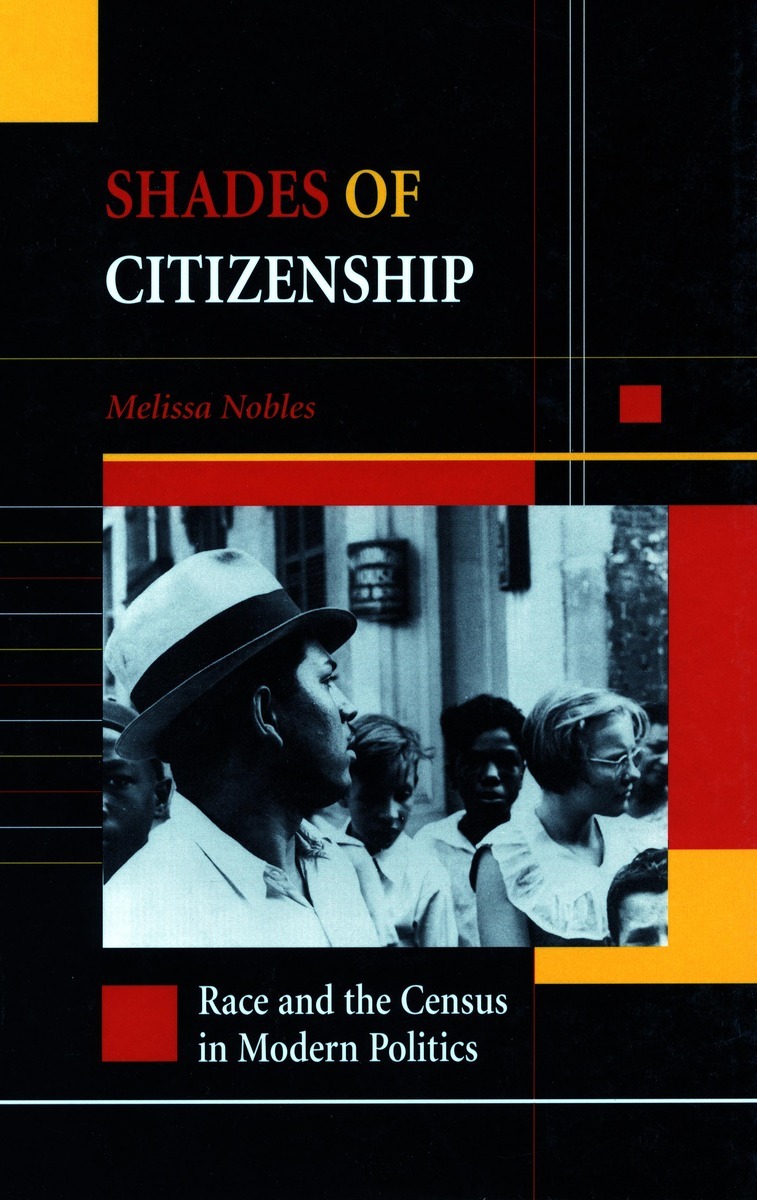
    This book explores the politics of race, censuses, and citizenship, drawing on the complex history of questions about race in the U.S. and Brazilian censuses. It reconstructs the history of racial categorization in American and Brazilian censuses from each country’s first census in the eighteenth and nineteenth centuries up through the 2000 census. It sharply challenges certain presumptions that guide scholarly and popular studies, notably that census bureaus are (or are designed to be) innocent bystanders in the arena of politics, and that racial data are innocuous demographic data.

    Using previously overlooked historical sources, the book demonstrates that counting by race has always been a fundamentally political process, shaping in important ways the experiences and meanings of citizenship. This counting has also helped to create and to further ideas about race itself. The author argues that far from being mere producers of racial statistics, American and Brazilian censuses have been the ultimate insiders with respect to racial politics.

    For most of their histories, American and Brazilian censuses were tightly controlled by state officials, social scientists, and politicians. Over the past thirty years in the United States and the past twenty years in Brazil, however, certain groups within civil society have organized and lobbied to alter the methods of racial categorization. This book analyzes both the attempt of America’s multiracial movement to have a multiracial category added to the U.S. census and the attempt by Brazil’s black movement to include racial terminology in census forms. Because of these efforts, census bureau officials in the United States and Brazil today work within political and institutional constraints unknown to their predecessors. Categorization has become as much a “bottom-up” process as a “top-down” one.

  • Post-Race on America’s Next Top Model

    International Communication Association, TBA
    2007 Conference
    San Francisco, CA
    2007-05-23

    Ralina L. Joseph, Assistant Professor of Communications, American Ethnic Studies and Women Studies
    University of Washington

    African American supermodel Tyra Banks’s popular reality show for aspiring young models, America’s Next Top Model, both reflects and produces twenty-first century ideals of post-feminism, a “girl power” moment in which second-wave feminism is antiquated, and post-race, a post-Civil Rights moment in which race is relic. ANTM features a sizable number of women of color contestants who are led by an African American female leader. The show’s explicit message is that racialized and gendered identities are equalized in the “Top Model” space. However, all of the contestants, both women of color and white women, are disciplined so that they must signify hyper-raced, hyper-sexed and essentialized versions of “difference.” At the same time, the contestants must also perform as safe, genteel, and essentially white middle class “Cover Girls.”

    In this paper I investigate performances of racial and gender masquerade in a 2004 episode of America’s Next Top Model. This episode features a confluence of race as costume, because the contestants “switch ethnicities” with the help of makeup and wigs, and gender as maternity, because the contestants don milk mustaches and three-year-old children as props. ANTM demonstrates that performances of post-ethnicity and post-feminism are always reliant upon racialized and gendered stereotypes and the logic of capitalism. While the mixed-race contestants are showcased as the most seamless transgressors of racialized and gendered identity, as all of the women slip on race and gender “costumes,” the show illustrates the seductive power of post-identity politics in the twenty first century United States.

    …As a graduate student I worked on notions of contemporary mixed-race African-American representations as being particularly emblematic of a post-race and postfeminist excuse that was vital in constructing neo-conservative political measures like California’s 1996 anti-affirmative action measure prop 209 and 2003’s racial privacy initiative prop[osition] 54. Historically and into the new millennium hybridized Black female bodies have been represented as not only sexually available, but also complicit in their exploitation (one of my favorite examples is Halle Berry’s much lauded academy award winning turn in 2001’s Monster’s Ball where she screams out in her sex scene with her death row inmate husband’s prison guard/executioner Billy Bob Thornton, “make me feel good!”). What I’ve been working on post-grad school is how these connected ideologies of post-race and post-feminism operate in other popular culture where mixed-race functions more often as a metaphor. One cite I’ve been investigating is the celebrity of thirty-three year old African American supermodel turned media mogul Tyra Banks and the phenomenon of her reality television show, America’s Next Top Model

    Read the entire article here.

  • Sexual Naturalization: Asian Americans and Miscegenation

    Stanford University Press
    2005
    224 pages
    Cloth ISBN-10: 0804747288; ISBN-13: 9780804747288
    Paper ISBN-10: 0804747296; ISBN-13: 9780804747295

    Susan Koshy, Associate Professor of English and Asian American Studies
    University of Illinois, Urbana-Champaign

    Sexual Naturalization offers compelling new insights into the racialized constitution of American nationality. In the first major interdisciplinary study of Asian-white miscegenation from the late nineteenth to the end of the twentieth century, Koshy traces the shifting gender and racial hierarchies produced by antimiscegenation laws, and their role in shaping cultural norms. Not only did these laws foster the reproduction of the United States as a white nation, they were paralleled by extraterritorial privileges that facilitated the sexual access of white American men to Asian women overseas. Miscegenation laws thus turned sex acts into race acts and engendered new meanings for both.

    Koshy argues that the cultural work performed by narratives of white-Asian miscegenation dramatically transformed the landscape of desire in the United States, inventing new objects and relations of desire that established a powerful hold over U.S. culture, a capture of imaginative space that was out of all proportion to the actual numbers of Asian residents.

    Read an excerpt of chapter 1 here.

    Table of Contents

    • Acknowledgments
    • Introduction
    • Part One: Sexual Orients and the American National Imaginary
      • Mimic Modernity: “Madame Butterfly” and the Erotics of Informal Empire
      • Eugenic Romances of American Nationhood
    • Part Two: Engendering the Hybrid Nation
      • Unincorporated Territories of Desire: Hypercorporeality and Miscegenation in Carlos Bulosan’s Writings
      • Sex Acts as Assimilation Acts: Female Power and Passing in Bharati Mukherjee’s Wife and Jasmine
    • Notes
    • Bibliography
    • Index
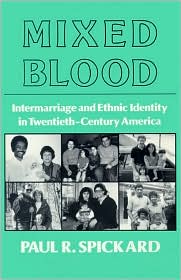
  • Mixed Blood: Intermarriage and Ethnic Identity in Twentieth-Century America

    University of Wisconsin Press
    December 1989
    544 pages
    6 x 9, 4 tables
    Paperback ISBN-10: 0-299-12114-3
    Paperback ISBN-13: 978-0-299-12114-3

    Paul R. Spickard, Professor of History
    University of California, Santa Barbara

    Named an “Outstanding Book on Human Rights in the United States” by the Gustavus Myers Center for the Study of Human Rights.

  • More Than Black? Humanitis Series

    University of California Television
    February 2003
    00:50:32

    G. Reginald Daniel, Professor of Sociology
    University of California, Santa Barbara

    Introduced by:

    Paul R. Spickard, Professor of History
    University of California, Santa Barbara

    In the United States, anyone with even a trace of African American ancestry has been considered Black. Even as the twenty-first century opens, a racial hierarchy still prevents people of color, including individuals of mixed race, from enjoying the same privileges as Euro-Americans. In his book, G. Reginald Daniel argues that we are at a cross-roads, with members of a new multiracial movement pointing the way toward equality. Presented as part of the Humanitas Lecture Series at UC Santa Barbara. Series: “Humanitas” [2/2003] [Humanities] [Show ID: 7094]

    G. Reginald Daniel discusses his book, More Than Black? Multiracial Identity and the New Racial Order.