• Rachel Dolezal and racial identity

    jennifer j. roberts
    2015-06-13

    Jennifer J. Roberts

    “…and she also chairs a police oversight commission”

    Writing about race, to me, always seems to require a “side”, a perspective: I’m writing as a black woman… I’m writing as a white woman… I’m writing as a bi-racial woman. I could never fully dig my heels in on a side, because I never fully felt like any of those things completely. I was never quite sure what I was, so taking any perspective under those labels felt like taking a side and that felt like fraud.

    Each of those racial designations stem from how you experience yourself in the world and, more importantly, how you are experienced by others. It felt different for me every day. There was no template, and my race was a moving target. Black to some, Hispanic to others, mystifying to most. White, as far as my mother was concerned. I looked just like her and she was, according to her, Irish.

    My mother countered every swing of the racial bat with our Irish heritage, which was real but clearly, only part of who she was or we were. That other part, the part she didn’t want to know about, was me, looking her in the eyes…the spit of her; dark skinned and frizzy haired

    Read the entire article here.

  • ‘Passing’ keeps its writing simple, asking viewers to lean in for greater understanding

    The Los Angeles Times
    2022-01-18

    Rebecca Hall

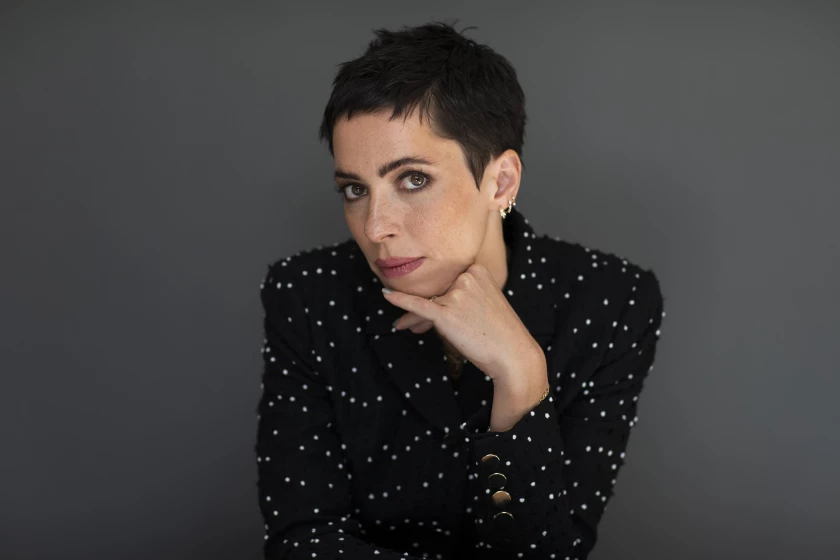
    Adapting Nella Larsen’s slim novella took writer-director Rebecca Hall 13 years. “Ultimately, I did my best to build my script and my film, not so much out of language as out of small moments of behavior,” she says. (Myung J. Chun / Los Angeles Times)

    My adaptation of Nella Larsen’s “Passing” had a slow birth, even by the often glacial standards of script development. When I started writing, I was an actress in my 20s with vague but fervent aspirations to one day direct. I wrote the first draft in 10 days, immediately after first reading the novel, in something of a fugue state. I was fascinated but also mystified by that fascination, and my first draft was crude and impractical. I didn’t think for a second that I would ever have the means or the courage to turn it into a film.

    In retrospect, I probably could never have written it otherwise. Over the years, I tinkered, adjusting it radically and then minutely and then radically again until it became something of a piece of me — not so much a project or a process as a thing that I have lived in dialogue with for the better part of my adult life.

    The main challenge of the adaptation revolved around the character of Irene. Contemporary reviewers often missed both Irene’s centrality and her fundamental unreliability. Clare, the object of Irene’s obsession, was frequently taken to be the main character, rather than one half of the extraordinary — and extraordinarily complicated — relationship that drives the action…

    Read the entire article here.

  • Surnames, by Counties and Cities, of Mixed Negroid Virginia Families Striving to Pass as “Indian” or White by Walter A. Plecker (ca. 1943)

    Commonwealth of Virginia
    Department of Health
    Bureau of Vital Statistics
    Richmond, Virginia
    (Source: Encyclopedia Virginia)

    December 1943

    To Local Registrars, Clerks, Legislators, and others responsible for, and interested in, the prevention of racial intermixtures:

    In our January 1943 annual letter to local registrars and clerks of courts, with list of mixed surnames, we called attention to the greatly increased effort and arrogant demands now being made for classification as whites, or at least for recognition as Indians, as a preliminary step to admission into the white race by marriage, of groups of the descendants of the “free negroes,” so designated before 1865 to distinguish them from slaves.

    According to Mendel’s law of heredity, one out of four of a family of mixed breeds, through the introduction of illegitimate white blood, is now so near white in appearance as to lead him to proclaim himself as such and to demand admission into white schools, forbidden by the State Constitution. The other three find it more difficult to make the grade. As a climax of their ambition, colored people of this type are applying for licenses to marry whites, or for white license when intermarrying amongst themselves. These they frequently secure with ease when they apply in a county or city not the home of the woman and are met by a clerk or deputy who justifies himself in accepting a casual affidavit as the truth and in issuing a license to any applicant regardless of the requirements of Section 5099a, Paragraph 4, of the Code. This Section places the proof upon the applicants, not upon the clerks. We have learned that affidavits cannot always be accepted as truth. This loose practice (to state it mildly) of a few clerks is now the greatest obstacle in the way of the proper registration by race required of the State Registrar of Vital Statistics in that Section. Local registrars, who are supposed to know the people of their registration areas, of course, have no excuse for not catching false registration of births and deaths.

    In many cases negroids have white marriage certificates, while the Bureau demands correct Legal registration as to race when their children’s births are reported. Armed with the clerk’s marriage certificate, they leave home and easily pass as white, when a birth certificate with the pedigree on the back is not requires. They are even threatening legal action against the State Registrar but have difficulty in securing a lawyer if he first applies to the Bureau of Vital Statistics for the facts.

    The Virginia Bureau of Vital Statistics, through the exceptional, painstaking, and laborious work of the highly trained genealogist whom it is fortunate in having, has made a study by groups and families of the principal borderline aspirants for racial change. The chief sources of information are the early birth and death records, made by tax assessors from 1853 to 1896; marriage records from 1853 to date; United States Census reports for 1830, 1850, and 1870, especially a printed list of free negroes by counties from the 1830 Census; county tapayer lists by races, now in the State Library, which have been studied back to 1808; and, not of least value, their own proclamation of race made by applicants for registration as voters, made soon after the War Between the States, to United States military authorities, now preserved in the State Library. The progenitors of the present would-be whites then marched up voluntarily and registered, for the first time in the life of their race in Virginia, as negro voters—not as Indians, not as whites.

    Public records in the office of the Bureau of Vital Statistics, ana in the State Library, indicate that there, does not exist today a descendant of Virginia ancestors claiming to be an Indian who is unmixed with negro blood. Since our more complete investigation of all of these records and the statements (mostly signed) of numerous trustworthy old citizens, many now dead, all preserved in our “racial integrity” files, no one has attempted by early recorded evidence to disprove this finding. If such evidence exists, our research worker would have found it.

    One weak point, which is giving us endless trouble, is the fact that many birth certificates since 1912 have, without realization of future danger, been accepted with false registration as “Indian.” Not a few, when we were off our guard, have slipped by as white. The General Assembly should empower us to state the recorded pedigree on the backs of such certificates and transcripts, to protect those desiring the truth now and in the future.

    SURNAMES, BY COUNTIES AND CITIES, OF MIXED NEGROID VIRGINIA FAMILIES STRIVING TO PASS AS “INDIAN” OR WHITE.

    Albemarle: Moon, Powell, Kidd, Pumphrey Amherst: (Migrants to Alleghany and Campbell) Adcock (Adcox), Beverly (this family is now trying to evade the situation by adopting the name of Burch or Birch, which was the name of the white mother of the present generation), Branham, Duff, Floyd, Hamilton, Hartless, Hicks, Johns, Lawless, Nuckles (Knuckles), Painter, Ramsey, Redcross, Roberts, Southards (Suthards, Southerds, Southers), Sorrells, Terry, Tyree, Fillis, Clark, Cash, Wood. Bedford: McVey, Maxey, Branham, Burley. (See Amherst County) Rockbridge: (Migrants to Augusta) Cash, Clark, Coleman, Duff, Floyd, Hartless, Hicks, Mason, Mayse (Mays), Painters, Pults, Ramsey, Southerds (Southers, Southards, Suthards), Sorrells, Terry, Tyree, Wood, Johns. Charles City: Collins, Dennis, Bradby, Howell, Langston, Stewart, Wynn, Adkins. King William: Collins, Dennis, Bradby, Howell, Langston, Stewart, Wynn, Custalow (Custaloe), Dungoe, Holmes, Miles, Page, Allmond, Adams, Hawkes, Spurlock, Doggett. New Kent: Collins, Bradby, Stewart, Wynn, Adkins, Langston. Henrico and Richmond City: See Charles City, New Kent, and King William. Caroline: Byrd, Fortune, Nelson. (See Essex) Essex and King and Queen: Nelson, Fortune, Byrd, Cooper, Tate, Hammond, Brooks, Boughton, Prince, Mitchell, Robinson. Elizabeth City & Newport News: Stewart (descendants of Charles City families). Halifax: Epps (Eppes), Stewart (Stuart), Coleman, Johnson, Martin, Talley, Sheppard (Shepard), Young. Norfolk County & Portsmouth: Sawyer, Bass, Weaver, Locklear (Locklair), King, Bright, Porter, Ingram. Westmoreland: Sorrells, Worlds (or Worrell), Atwells, Gutridge, Cliff. Greene: Shiflett, Shiflet. Prince William: Tyson, Segar. (See Fauquier) Fauquier: Hoffman (Huffman), Riley, Colvin, Phillips. (See Prince William) Lancaster: Dorsey (Dawson). Washington: Beverly, Barlow, Thomas, Hughes, Lethcoe, Worley. Roanoke County: Beverly. (See Washington) Lee and Smyth: Collins, Gibson (Gipson), Moore, Goins, Ramsey, Delph, Bunch, Freeman, Miso, Barlow, Bolden (Bolin), Mullins, Hawkins—Chiefly Tennessee Melungeons.” Scott: Dingus. (See Lee County.) Russell: Keith, Casell, Stillwell, Meade, Proffitt. (See Lee & Tazewell) Tazewell: Hammed, Duncan. (See Russell) Wise: See Lee, Smyth, Scott, and Russell Counties.

    Very truly yours,

    W. A. Plecker, M. D.
    State Registrar of Vital Statistics
  • Racial Passing off the Record: A Journey in Reconnection and Navigating Shifting Identities

    Genealogy
    Volume 6, Issue 1 (March 2022)
    Published online 2022-01-18
    8 pages
    DOI: 10.3390/genealogy6010008

    Gabby C. Womack, Reference/Access Services Associate, McQuade Library
    Merrimack College, North Andover, Massachusetts

    Anyone of African descent or with African ancestry who engages in a genealogy project soon learns that the U.S. Census is a helpful yet frustrating tool. In 2016, equipped with my history degree and an online ancestry search engine, I searched for my great-grandfather Leroy in census records after I saw a picture of him as a young man at work in Philadelphia. This image would have been unremarkable had it not been for the fact that my African American ancestor was so light skinned that he seemed to blend in with his co-workers at Kramer’s Fruit and Vegetables. I thought there had to be a story behind this. Classified as, “Mu”, for mulatto in most of his records, Leroy became “Black” on the census in 1930. My first thought was to question whether this categorization changed for other folks like him. My research led me to my master’s thesis “From ‘Mulatto’ to ‘Negro’: How Fears of ‘Passing’ Changed the 1930 United States Census”. Through this research, I also became closer to my father’s family. This piece will take you through this journey of discovery and my frustrations along the way.

    Read the entire article in HTML or PDF format.

  • What it’s like growing up mixed race in Scotland

    The Social
    BBC
    2020-07-15

    Aleisha Omeike, The Social contributor

    Aleisha details her experience of growing up as a mixed-race person in Glasgow.

    I grew up in an overwhelmingly white neighbourhood. I hated being different. Throughout my childhood, I would navigate and shape my racial identity based solely on my white Scottish heritage, often dismissing or denying my Black African roots.

    I remember the first time I experienced racial abuse. I was around 5 years of age and I was at school. I had come out into the playground after lunch. Some girls in the year below me were pointing directly at me, shouting and dancing, calling me “blackie”. Turns out, that was just the start.

    Since then, I have been labelled almost every racial slur in the book. The most common of these slurs is “half caste”. People do not realise how offensive “half caste” is. Calling someone half of anything is dehumanising and derogatory.

    Throughout my childhood, I have been asked where I am from and people would not accept my answer. I grew up in a small town in North Lanarkshire. People found that fact hard to believe because of my skin colour…

    Read the entire story here.

  • Unsung hero: As a pioneering attorney and judge, Elreta Alexander-Ralston left indelible mark on civil rights, criminal justice reform

    The News & Record
    Greensboro, North Carolina
    2021-12-19

    Nancy McLaughlin

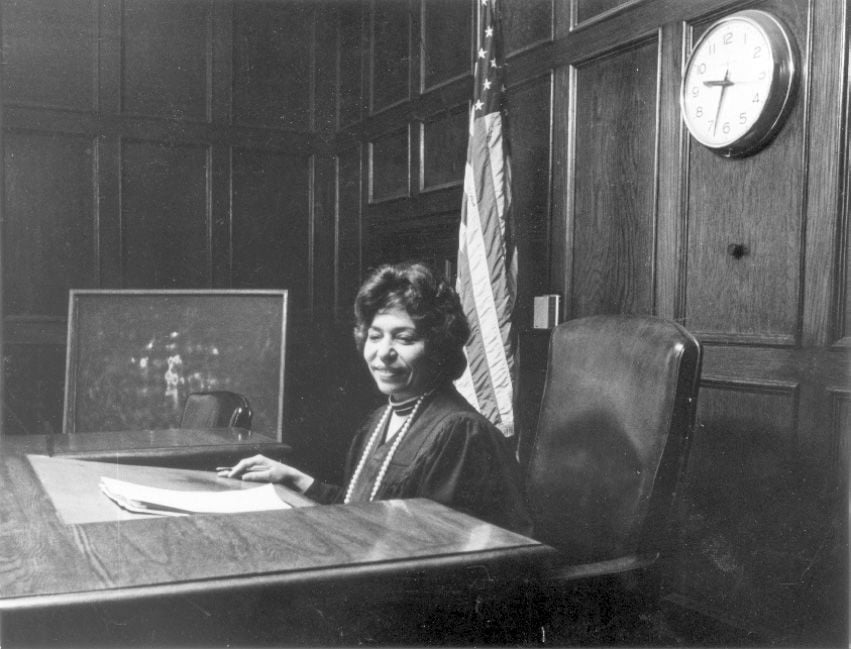
    Historian and UNCG professor Virginia Summey’s biography of Elreta Melton Alexander-Ralston goes back to the history-making judge’s childhood, including her years at Dudley High School and N.C. A&T.
    News & Record archives

    GREENSBORO — Former attorney and District Court Judge Elreta Alexander-Ralston was known for the sheer force of her personality and style.

    Outspoken. Flamboyant. Fierce. Unforgettable. Bold. She had an air of authority about her that left no doubt who was in charge.

    And oh the stories, said historian and UNCG fellow Virginia Summey, the author of a new biography of the history-making judge.

    “I can’t imagine I will have as much fun on another book,” Summey said.

    Summey was watching an oral-history interview with Alexander-Ralston when she heard the judge say she hired legendary attorney F. Lee Bailey to defend her over a judicial complaint.

    “She would say something in her oral history and I could say, that could not be true,” Summey said. “But it was.”

    With Bailey, it was the drama of her driving to Massachusetts and showing up at his front door, Summey said.

    “I called him right before he died and he was like, ‘Oh yeah, Elreta…,” Summey said, of the story he would go on to tell about her hiring him.

    The Life of Elreta Melton Alexander: Activism within the Courts” is available through pre-order from the University of Georgia Press and includes her years at Dudley High School and N.C. A&T. Alexander-Ralston built her legal reputation as Elreta Alexander.

    Alexander-Ralston died in 1998 and is remembered for an unusual career pioneering legal reform among an impressive list of firsts, including the first Black woman in the nation to sit on the bench who was elected by voters…

    Read the entire article here.

  • Ijoma Mangold: “I was a Wagner fan already at 15”

    Exberliner
    Berlin, Germany
    2022-01-06

    Alexander Wells


    Photo: Christian Werner

    Ijoma Mangold is a man who speaks his mind. One of Germany’s top literary critics, he currently lives in Berlin as the culture and politics correspondent for Die Zeit, while featuring regularly on German television and on literary prize juries. Late last year, DAS Editions published his memoir about growing up biracial in 1970s Heidelberg, The German Crocodile, in an award-winning English translation by Ruth Ahmedzai Kemp. This compelling work covers Mangold’s relationship with his single mother, his burgeoning passion for German literature, the belated appearance of his father and formative visits he made to both Nigeria and the USA. The narrative is shaped throughout by Mangold’s subtle literary touch, his understated wit – and a fierce intellectual independence.

    What led you to write a book about your youth?

    The catalyst was the death of my mother in 2010. That triggered a lot of beautiful, even idyllic memories of my childhood, including ones I didn’t know I had. So I began writing about that. But then I realised that the reader would be wondering, with all this talk about a mother and child – where is the father? I would have to explain that. It became clear that this was the essential story of the book: what it means to grow up in a completely idyllic German setting when you look different, have an unusual first name, and don’t have a father around. I also quickly realised I was bringing some tonalities and perspectives that aren’t exactly typical for this genre. Which is to say that my book isn’t one of accusation, or of trauma. On the contrary, I had an extraordinarily happy childhood. And I wouldn’t say that I really experienced racism. Still, as a child, I had this growing consciousness of being different that I carried around with me…

    Read the entire interview here.

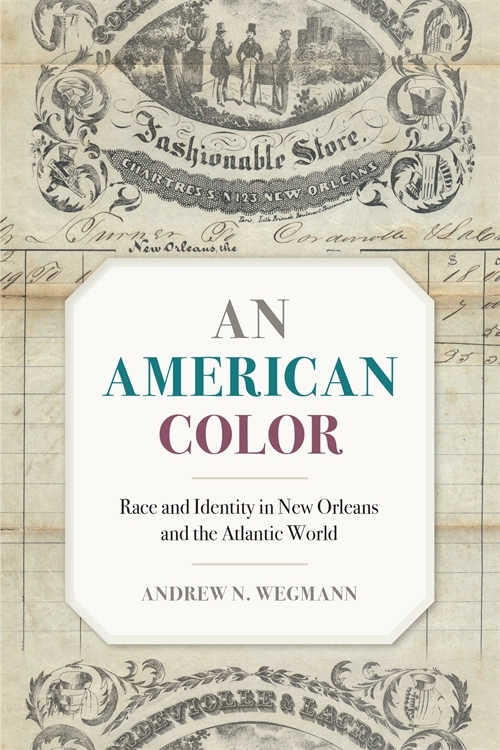
  • An American Color: Race and Identity in New Orleans and the Atlantic World

    University of Georgia Press
    2022-01-15
    272 pages
    Trim size: 6.000in x 9.000in
    Hardcover ISBN: 9-780-8203-6076-8
    Paperback ISBN: 9-780-8203-6078-2

    Andrew N. Wegmann, Associate Professor of History
    Delta State University, Cleveland, Mississippi

    For decades, scholars have conceived of the coastal city of New Orleans as a remarkable outlier, an exception to nearly every “rule” of accepted U.S. historiography. American only by adoption, New Orleans, in most studies, serves as a frontier town of the circum-Caribbean-a vestige of North America’s European colonial era along the southern coast of a foreign, northern, insular United States. Beneath that, too, many have argued, a complex algorithm of racial mixtures was at work well into the nineteenth century, a complexity of racial understanding and treatment that almost every scholar to date has claimed simply did not exist within the more “American” states further north and outside the bounds of the Caribbean’s bizarre socioracial influence.

    The reality, as An American Color explains, is that on the surface, New Orleans did have a racial and social system that confounded the more prudent and established black-white binary at work in the social rhetoric of the British-descended states further north. But this was not unique, especially within the United States. As Andrew N. Wegmann argues, New Orleans is representative of a place with different words for the same practices found throughout the North American continent and the Atlantic world. From New Orleans to Charleston and Richmond, the social construction of race remained constant and Atlantic in nature, predicated on a complex, socially infused, multitier system of prescribed racial value that challenged and sometimes abandoned preordained definitions of “black” and “white” for an assortment of fluid but meaningful designations in between. New Orleans is thus an entry point for the study of color in an Atlantic United States.

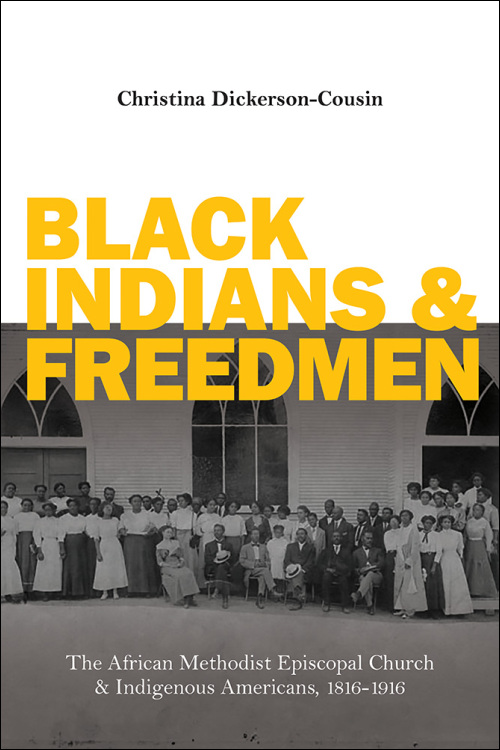
  • Black Indians and Freedmen: The African Methodist Episcopal Church and Indigenous Americans, 1816-1916

    University of Illinois Press
    December 2021
    256 pages
    6 black & white photographs, 2 maps, 3 tables
    6 x 9 in.
    Cloth ISBN: 978-0-252-04421-2
    Paper ISBN: 978-0-252-08625-0

    Christina Dickerson-Cousin, Assistant Professor of History
    Quinnipiac University, Hamden, Connecticut

    The union of Native Americans and a black church institution

    Often seen as ethnically monolithic, the African Methodist Episcopal (AME) Church in fact successfully pursued evangelism among diverse communities of indigenous peoples and Black Indians. Christina Dickerson-Cousin tells the little-known story of the AME Church’s work in Indian Territory, where African Methodists engaged with people from the Five Civilized Tribes (Cherokees, Creeks, Choctaws, Chickasaws, and Seminoles) and Black Indians with various ethnic backgrounds. These converts proved receptive to the historically black church due to its traditions of self-government and resistance to white hegemony, and its strong support of their interests. The ministers, guided by the vision of a racially and ethnically inclusive Methodist institution, believed their denomination the best option for the marginalized people. Dickerson-Cousin also argues that the religious opportunities opened up by the AME Church throughout the West provided another impetus for black migration.

    Insightful and richly detailed, Black Indians and Freedmen illuminates how faith and empathy encouraged the unique interactions between two peoples.

  • Racial Passing in Early Modern England

    Online- via Zoom
    2022-01-20, 17:30-19:00Z (12:30-14:00 EST)

    Lubaaba Al-Azami, Ph.D. Candidate in English Literature
    University of Liverpool, Liverpool, United Kingdom

    Lubaaba al-Azami (@lubaabanama) is a doctoral candidate at the University of Liverpool, funded by the AHRC NWCDTP. Her research project is a decolonial and feminist consideration of early modern English encounters with Mughal Indian imperial femininity, exploring English theatrical and travel literature alongside Mughal royal memoirs. She is founder of Medieval and Early Modern Orients (MEMOs), an AHRC NWCDTP-funded collaborative digital resource on early English encounters with the Islamic worlds.

    All welcome. This event is free but booking is required.

    For more information and to register, click here.