• First Encounters: Chi-Chi Nwanoku and Keith Pascoe

    The Irish Times
    2017-05-03

    Frances O’Rourke


    Chi-Chi Nwanoku

    ‘Ireland brought us back together’

    Chi-Chi Nwanoku is a double bassist and a founder member of the Orchestra of the Age of Enlightenment. The eldest of five children of a Nigerian father and an Irish mother, she pursued a career in music after injury ended a promising athletics career. She grew up in Kent and Berkshire and now lives in London

    The first time I saw Keith was when we were college students in our early 20s. He seemed incredibly composed, confident, like a good fun guy – he had a mischievous twinkle in his eye which I liked. We weren’t in each other’s social circles but I registered Keith as a kindred spirit.

    I’d only started playing the double bass when I was 18, after an athletics injury. When I came out of hospital, my A Levels music teacher said, you have music coursing through your veins – now that your sprinting career is over, if you pick an unpopular orchestral instrument, you could just possibly have a career. I’d played piano since I was seven but I’d never played in an orchestra before. A few years later I got into the Royal Academy of Music

    …I had been in Ireland just once before when I’d taken my mother there in 1986. She hadn’t been back to Ireland in 36 years, didn’t know how she’d be received: she was born in Cappamore in Limerick, grew up in Thurles, but was kind of abandoned by her family after she met and married my father, an Igbo from east Nigeria, in London. We grew up with lots of wonderful stories and memories that she gave us but she had a very very tough time. In London in the 1950s, it was “no blacks, no Irish, no dogs” – it was as much as my parents could do to find a roof over their heads…

    Read the entire article here.
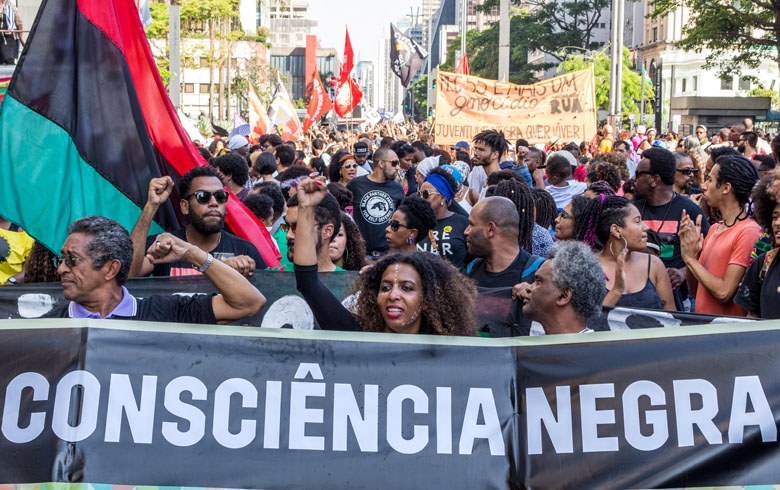
  • Brazilians defining themselves as black has grown 15%; while pretos and pardos are considered black, pretos are those defining themselves as simply black

    Black Women of Brazil
    2017-12-12

    Source: Jornal Floripa, Tudo que Preciso SaberNº de pessoas que se declara preta ou parda cresce 14,9%

    Note from BW of Brazil: So what does today’s report really mean in plain English? It’s a topic that’s been discussed here since the debut of this blog back in 2011. Depending on how you look at it, Brazil could have as many 112.7 million black people, which would be 54.8% of the country’s total population of 205.5 million people. Or, looking at it from another perspective, the black population could be around 16.8 million people, which would represent about 8.2% of all Brazilians. Why such a huge discrepancy? Well, again, it depends on how you see it. To come to a figure of 112.7 million black people, one has to include the population of people who define themselves as “pardos”, loosely meaning ‘brown’ or ‘mixed’. At almost 96 million people, they make up about 46.7% of the Brazilian population. For decades, due to quality of life and socioeconomic statistics, black activists have defined the country’s população negra (black population) as the combination of self-declared pretos (blacks) and pardos. The question here would be, how many of those pardos have a phenotype that most would consider black? The world may never know.

    The number of Brazilians who declare themselves pretos (blacks) has increased 14.9% to 16.825 million people between 2012 and 2016, according to the Brazilian Institute of Geography and Statistics (IBGE), which announced on Friday the “Características gerais dos moradores 2012-2016” (General characteristics of residents 2012 -2016), raised by the National Continuous Household Sample Survey (PNAD).

    According to the survey, the number of Brazilians who declared themselves pardos (or were declared pardos by the resident interviewed) also grew between 2012 and 2016, by 6.6%, to 95.9 million people. This is the largest group, accounting for 46.7% of the population, a condition it assumed from 2015.

    The number of Brazilians declaring themselves brancos (whites) in turn continued to shrink: they were 90.9 million in 2016, 1.8% less than in 2012. Of 46.6% of residents in the country in 2012, the declared white population accounted for 44.2% of the total in 2016. Those declared black were 8.2%.

    According to Maria Lucia Vieira, research manager, the data indicate an increasing miscegenation in Brazil. There are basically three possible explanations, according to her: increased self-assertion of pretos e pardos (blacks and browns); marriage growth between races; higher fertility rate among pretos and pardos…

    Read the entire article here.

  • Black people have always accepted mixed-race people as part of their community. With [Barack] Obama, I think white people needed to be OK with voting for him. They needed to feel that he would look out for them. One way to do that was to emphasize the white part of his identity … With Meghan Markle, people want to correct the cognitive dissonance where [in their minds] black women aren’t princesses or duchesses. If she’s half-white, then that’s closer to the reality that makes sense. There’s a lot of people who are uncomfortable with the idea of a black person in such a position. It’s a way to set the world back right for them [by focusing on her white heritage]. —Camille Z. Charles

    Valerie Russ, “In an increasingly mixed-race America, who decides what we call ourselves?,” The Philadelphia Inquirer, December 18, 2017. http://www.philly.com/philly/news/meghan-markle-race-camille-charles-biracial-post-20171218.html.

  • In an increasingly mixed-race America, who decides what we call ourselves?

    The Philadelphia Inquirer
    2017-12-18

    Valerie Russ, Staff Writer


    (Andy Stenning/Pool Photo via AP)
    Prince Harry and his fiancee Meghan Markle speak with teachers at the Nottingham Academy Dec. 1.

    Last week, the Meghan Markle controversy was her anticipated visit with Prince Harry to Queen Elizabeth’s estate at Sandringham for Christmas, an unprecedented invitation for an unmarried couple.

    Before that, the debate was about Markle’s mixed-race identity: Do her African American mother and white father make her white, black, or biracial? After her engagement to Harry, some women celebrated the notion of a “black princess” — although she’ll actually be a duchess — while others argued she should be described as biracial, not black.

    How to define, describe, and label mixed-race identity has been a brewing controversy in recent decades as the country becomes more racially diverse. Since the 2000 census, when Americans were first able to choose more than one race, the Census Bureau reported that people of color will be the majority in the nation by the 2040s and that more than half of American children will be part of a minority race or ethnic group by 2020. In fact, as of last year, the census said minority or ethnic-group children under the age of 1 are already in the majority.

    The sociologist Herbert Gans blamed Census Bureau data for the increase in white nationalism and alt-right fear “that they are being threatened and overwhelmed by a growing tide of darker-skinned people.” He predicted that mixed-race Latinos and Asians will eventually identify themselves as white.

    Camille Z. Charles, the director of the Center for Africana Studies at the University of Pennsylvania, is the daughter of an African American mother and a white father. Charles identifies as black. She is working on a book exploring the intra-racial diversity among black Americans who identify either as African American, mixed-race/biracial, or black immigrant, tentatively titled The New Black: Race-Conscious or Post-Racial?

    Read the entire article here.

  • The Mutating Immutable: Black, Mixed, Bi-Racial

    iMiXWHATiLiKE!: Emancipatory Journalism and Broadcasting
    2017-12-14

    Jared Ball, Host and Associate Professor of Communication Studies
    Morgan State University, Baltimore, Maryland

    Panama Jackson of Very Smart Brothas joined us to discuss the shifting dynamics and politics around being “mixed” and “Black.”

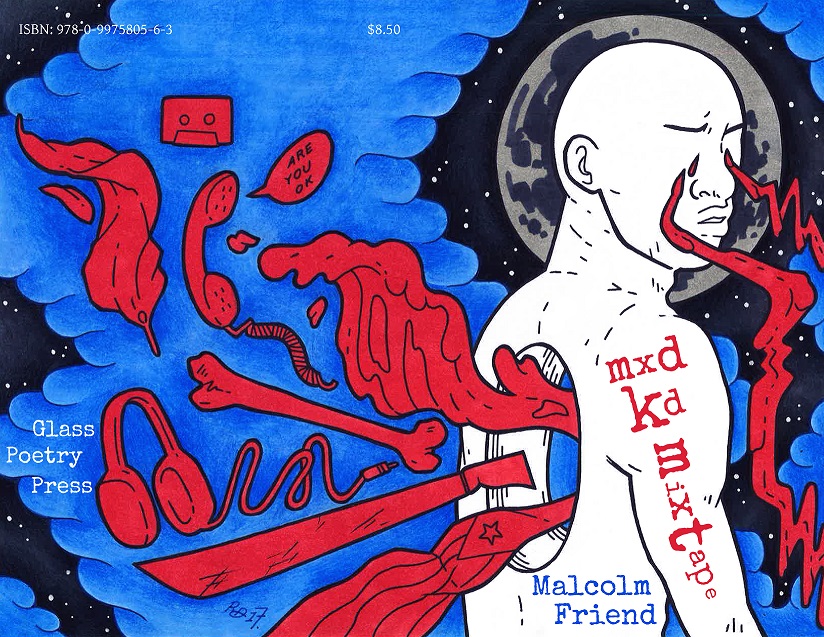
  • mxd kd mixtape

    Glass Poetry Press
    2017
    Chapbook ISBN: 978-0-9975805-6-3

    Malcolm Friend, Poet, Performer, Educator


    Cover by Raychelle Duazo

    In his debut chapbook mxd kd mix tape, Malcolm Friend offers us a speaker on the fringe of becoming. If he were a superhero this would be his origin story. The musicality & rhythm that is promised in the title more than delivers, but what Friend also delivers on are poems forged within the many rooms of his identity. & these rooms are decorated with poetic craft & a keen knowledge of the songs that have shaped him. This collection, & Friend are a valuable addition to America’s poetic landscape. I look forward to many more work from this fresh new voice.

    — Yesenia Montilla, author of The Pink Box

    In mxd kd mixtape, Malcolm Friend gracefully blends personal and public history, crafting a dynamic archive in verse. As Friend sets voices of remembrance against the forces of oppression, violence, and neglect, we hear how the richest points of identification — in poetry, in music, in life — occur as intersections: musicality and masculinity, Puerto Rican and Jamaican heritage, safety and threat, question and answer. The result is a chapbook filled with necessary poems that “echo of insistent survival.” I’m so grateful for this talented and convicted poet, who has risked reminding us, because we need reminding, especially when staring down the many faces of erasure, “this is why we turn to song.”

    — Geffrey Davis, author of Revising the Storm

    mxd kd mixtape hits all the right young poet notes: identity, awareness, inquiry, a politically charged imagination with the right doses of social value. Friend alludes to our heroes, our irony, our singers, as he sifts through the nuances of diaspora, untold stories, and lyrical re-interpretations of Black Caribbean complexes. This debut asks us to confront our biases, our mask-wearing tendencies, our ability to stay silent; it resists the violence of definitions until we have no choice but to sing. Friends’ poetry does what all good albums of their time seek to do: set the record straight.

    — Willie Perdomo, The Essential Hits of Shorty Bon Bon

  • Turner Prize Goes to Lubaina Himid, Whose Work Depicts African Diaspora

    The New York Times
    2017-12-05

    Anna Codrea-Rado


    Lubaina Himid won Britain’s leading contemporary art prize for “her uncompromising tackling of issues” including colonial history and racism, the jury chairman said.
    Credit Edmund Blok for Modern Art Oxford

    The visual artist Lubaina Himid, best known for her paintings, installations and drawings depicting the African diaspora, won the Turner Prize on Tuesday night, making her the first nonwhite woman to be given the leading British contemporary art award…

    …Alex Farquharson, Tate Britain’s director and the chairman of the Turner Prize jury, said in a statement that the jury “praised the artist for her uncompromising tackling of issues including colonial history and how racism persists today.” Ms. Himid won for three of her shows this year, in Oxford, Bristol and Nottingham, he said.

    Among the selection of Ms. Himid’s work on display at the Turner Prize exhibition in Hull was a collection of English ceramics painted with images of black slaves.

    Ms. Himid, 63, is the oldest recipient in the prize’s history; a rule change made her eligible. This year’s award was the first since 1991 that was open to artists over 50…

    …This year’s shortlist was also noted for being one of the most diverse. All of the nominees have connections abroad, either by birth or through parentage. Ms. Nashashibi, 44, was born in London to a Palestinian father and an Irish mother; Ms. Büttner, 46, is German-born; Mr. Anderson is the son of Jamaican immigrants; and Ms. Himid was born in Tanzania…

    Read the entire article here.

  • My Mother Is White. I Am Not: On Being Biracial Without Identity Issues

    Very Smart Brothas
    The Root
    2017-12-05

    Panama Jackson


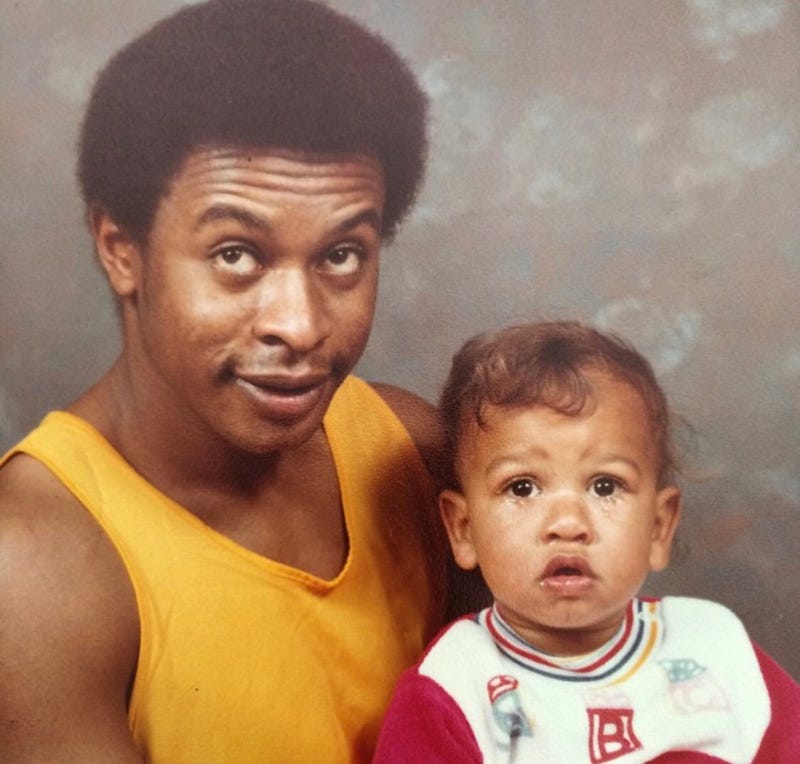
    Panama Jackson, 1 year old, with his dad (Panama Jackson)

    Editor’s note: This piece speaks from the perspective of being biracial with black and white parents. I realize that other biracial ethnic mixes may or may not share any of these experiences.

    A few weeks ago, I wrote a piece called “Black Folks Who, Though Invited, Probably Wouldn’t Come to the Cookout.” On this list I included the following people: Mariah Carey, Meghan Markle, Rashida Jones and Lenny Kravitz. Would they come? We many never know, but sure as shootin’ an early comment on Facebook pointed out, solely, that “Mariah Carey is biracial. I believe Megan Merkel [sic] is biracial as well …”

    While I can’t speak for the commenter, my assumption is that their biracialness excludes them from the list with the lead of “Black Folks,” though I’m surprised he didn’t realize that Rashida and Lenny are also biracial in the way that Sean Fury can appreciate. Put a pin in this…

    Self-identity is defined as the recognition of one’s potential and qualities as an individual, especially in relation to social context.

    Self-identity.

    Here is where I point out some facts about myself. I am mixed. I’m the product of a Caucasian woman from France and a black man from Alabama. I will tell you, without hesitation, that I am biracial.

    What I will also tell you, without hesitation and with pride, is that I’m black. I identify as black. I was raised that way. I was raised in a household by my black father and black stepmother and my black sisters. My upbringing was full of blackness, not even intentionally but by virtue of who my parents are. My white mother obviously had a hand in raising me—we spent summers with her in Michigan—but largely, my foundation, self-esteem, pride and identity were crafted by my black parents….

    Read the entire article here.

  • By phone I’m white, British and middle class. A Londoner maybe. Definitely educated and probably called Oliver. An accent they can’t place on a black baritone that blends with feminine cadences. Physically, I’m often mistaken for half-Asian. Occasionally when my broad shoulders, thick thighs and big belly are accounted for, the answer is Samoan. But my beard suggests I have a relationship with the Quran, certainly when it comes to airports in Southend, Stockholm and San Francisco.

    So I feel the double-take when people meet me for the first time.

    “Oh!” they will say. “I had no idea you were…”

    …Gay?

    Ashley Thomas, “Life in The Hinterlands; Growing up Gay & Mixed Race on The Isle of White,” The Afropean: Adventures in Afro Europe, May 9, 2017. http://afropean.com/life-in-the-hinterlands-growing-up-gay-mixed-race-in-the-isle-of-white/.

  • A Way of Sharing

    UMKC Today
    University of Missouri, Kansas City
    2015-06-08


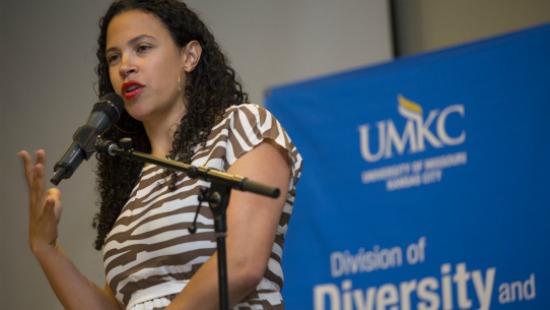
    Photo credit: Janet Rogers, Division of Strategic Marketing and Communications

    Knowledge, Expertise and Experience

    Women from Africa, Asia, Europe, South America and nearby states in North America attended the 2015 Women of Color Leadership Conference.

    MC Mia Ramsey strolled across the stage in her black sweater, black skirt, white T and pink sneakers. An energetic lady, Ramsey was ready to inspire and encourage women through song, jokes, personal stories and rousing introductions of presenters.

    The 10th annual conference, “Together We Rise: 10 Years of Paving the Way,” at the University of Missouri-Kansas City focused on improving the lives of all women of color. More women of diverse backgrounds attend each year to share their expertise and to learn from facilitators and speakers.

    Shortly after keynote speaker Lacey Schwartz took to the podium, she made an emphatic statement: “Tell the truth about things that are hard to tell the truth about.” If that had been the case, her life would have been less complicated, and she would have known far sooner exactly who she was.

    In the documentary “Little White Lie,” Schwartz tells her story of growing up in New York with her parents and a strong sense of her Jewish identity, only to discover she was not white, but biracial. She created the documentary to start a conversation about difficult conversations…

    Read the entire article here.