• The president’s words, perhaps consigned to a long-ago news cycle now, remain powerful: they validate experiences that blacks have undergone in their everyday lives. Obama’s voice resonates with those philosophical voices (Frantz Fanon, for example) that have long attempted to describe the lived interiority of racial experiences. He has also deployed the power of narrative autobiography, which is a significant conceptual tool used insightfully by critical race theorists to discern the clarity and existential and social gravity of what it means to experience white racism. As a black president, he has given voice to the epistemic violence that blacks often face as they are stereotyped and profiled within the context of quotidian social spaces.

    George Yancy, “Walking While Black in the ‘White Gaze’,” The New York Times, (September 1, 2013). http://opinionator.blogs.nytimes.com/2013/09/01/walking-while-black-in-the-white-gaze.

  • Are There Human Races? The Evolutionary Biology—Or Not—Of Race

    The Subversive Archaeologist
    2013-05-19

    Robert H. Gargett, Research Scholar of Archaeology / Human Origins
    Ronin Institute

    Foreword: I ran a series on “race” and racism that began on October 7, 2011, which was the SA’s third day in cyberspace. I’ll be putting it up again in its several parts, beginning today [revised and expanded, as the publishers say]. If you’ve seen it before, please forgive my publishing “re-runs.” Fighting bigotry should be our full-time job, and bigotry is nowhere as insidious as it is in the concept of “race.” So, it won’t hurt to air these thoughts again, in the hope of reaching a different audience this time around.

    From the Age of Exploration—beginning at the end of the Middle Ages—Europeans and their descendants legitimated their imperialist expansion ideologically by seeing non-European people through the lens of a racial worldview. Wherever Europeans colonized, and for differing lengths of time, you saw the usurpation of power and territory at the expense of indigenous people who were inevitably deemed to be a different race. In many cases the oppressed were seen as not just non-European, but non-human. Today, wherever Europeans are still in power, indigenous people suffer existence at the margins of society, bereft of any real power, and often bereft of any connection with their past other than through the memories of degradation they experienced during and after the European invasion.

    Where indigenous people have retaken control of former colonies, they live with the heritage of divisive and authoritarian colonialism: inefficient and inadequate infrastructure, and the legacy of old hatreds generated by colonial governments that pitted one group against another. In some cases those same Europeans enslaved the indigenous people, and the descendants of those slaves exist as a permanent underclass in the United States, Brazil, and elsewhere. And let’s not forget that this might never have taken place without the complicity, and greed, of powerful, indigenous African groups.

    Race matters, today, because we all live with its twin—racism (itself the bastard offspring of a more broad-ranging bigotry). Anthropology (and through it, archaeology) has much to contribute to the race debate in the present, even if it has a somewhat uneven record, historically, on the matter of race. As much as anthropologists have made substantial additions to knowledge of the human species, they have also—implicitly and explicitly—added much fuel to the social conflagration that is racism.

    It’s long since time to make amends…

    Read the entire article here.

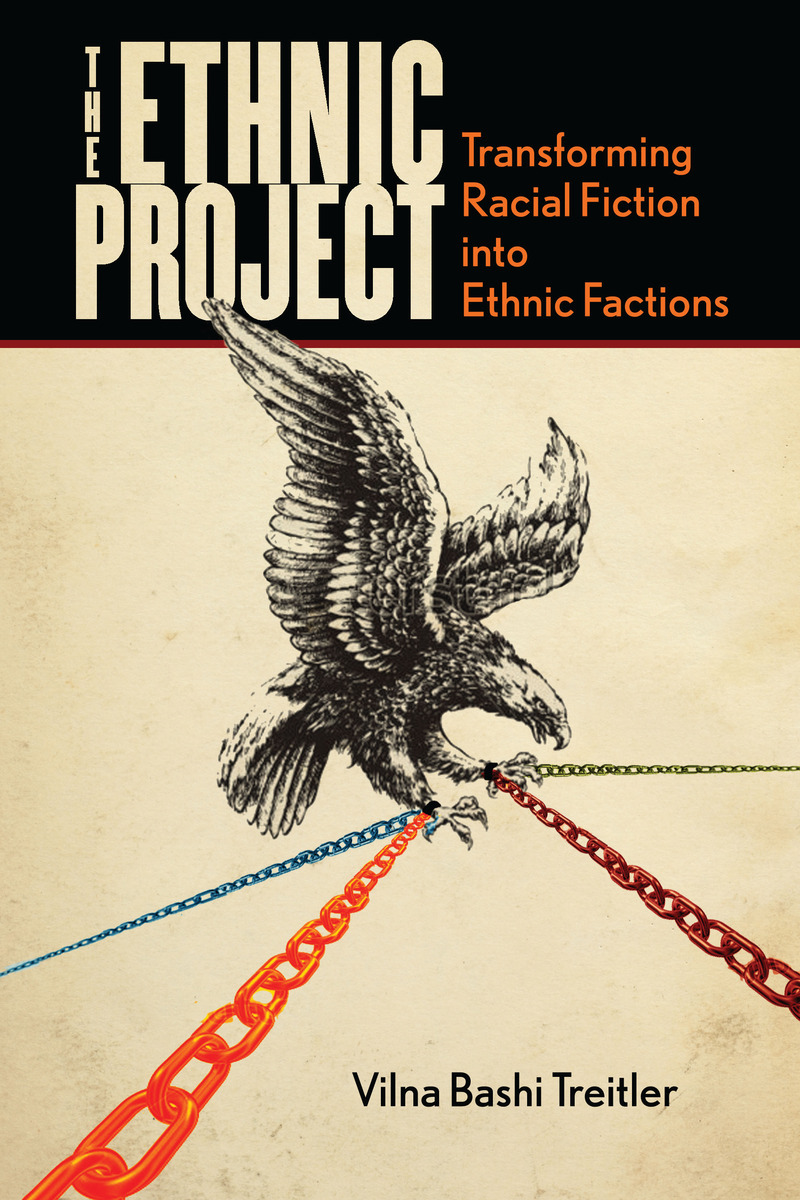
  • The Ethnic Project: Transforming Racial Fiction into Ethnic Factions

    Stanford University Press
    2013
    240 pages
    7 illustrations
    Cloth ISBN: 9780804757713
    Paper ISBN: 9780804757720
    E-bok ISBN: 9780804787284

    Vilna Bashi Treitler, Professor of Sociology and Black and Hispanic Studies
    Baruch College, City University of New York

    Race is a known fiction—there is no genetic marker that indicates someone’s race—yet the social stigma of race endures. In the United States, ethnicity is often positioned as a counterweight to race, and we celebrate our various hyphenated-American identities. But Vilna Bashi Treitler argues that we do so at a high cost: ethnic thinking simply perpetuates an underlying racism.

    In The Ethnic Project, Bashi Treitler considers the ethnic history of the United States from the arrival of the English in North America through to the present day. Tracing the histories of immigrant and indigenous groups—Irish, Chinese, Italians, Jews, Native Americans, Mexicans, Afro-Caribbeans, and African Americans—she shows how each negotiates America’s racial hierarchy, aiming to distance themselves from the bottom and align with the groups already at the top. But in pursuing these “ethnic projects” these groups implicitly accept and perpetuate a racial hierarchy, shoring up rather than dismantling race and racism. Ultimately, The Ethnic Project shows how dangerous ethnic thinking can be in a society that has not let go of racial thinking.

    Contents

    • Acknowledgments
    • 1. Racism and Ethnic Myths
    • 2. How Ethnic and Racial Structures Operate
    • 3. Ethnic Winners and Losers
    • 4. The Irish, Chinese, Italians, and Jews: Successful Ethnic Projects
    • 5. The Native Americans, Mexicans, and Afro-Caribbeans: Struggling Ethnic Projects
    • 6. African Americans and the Failed Ethnic Project
    • 7. The Future of U.S. Ethnoracism
    • Notes
    • Index
  • Quadroons for Beginners: Discussing the Suppressed and Sexualized History of Free Women of Color with Author Emily Clark

    The Huffington Post
    2013-09-04

    Stacy Parker Le Melle

    “As a historian, I knew that mixed race women and interracial families were everywhere in America from its earliest days. And I knew that most of the free women of color in antebellum New Orleans bore no resemblance to the quadroons of myth.” —Dr. Emily Clark

    As an American, I follow my roots like trails across the globe. My mother is from Kansas and is of German descent, and my deceased father was black with roots in North Carolina, and before then, Africa. Arguably you can trace all of us back to Africa. But my parents’ union created me: a black American woman, a woman of color, a mixed kid, a mulatta, maybe an Oreo, definitely a myriad of identities and categories to embrace or resist.

    Living in Harlem, I see so many mixed marriages, mixed kids everyday all the time. Traveling the South, I see so many kids with the telltale curly locks. Growing up in Metro Detroit in the 80s, I knew there were other black & white mixes like me. I just didn’t know them. Only at college in Washington, DC, did I meet mixed girls and have them as friends. And not until my English, women’s studies, and African-American history courses did I learn any American history about women like me.

    Before college, maybe I’d encounter a definition of “miscegenation” – that very special crime of racemixing in segregated America. And maybe an explanation of the “one drop rule” that went on to create the classifications of “mulatto” and “quadroon” and “octaroon“—your label dependent upon which fraction of African was in your genealogy. But that was it. In my high school American History texts, I don’t remember any acknowledgement of centuries of rape and consensual relationships between whites and blacks. None of my suburban history teachers lingered on the taboo. Maybe I didn’t either. When I think of the mania around racemixing, and of the cultural trope of the “tragic mulatta“—the woman doomed because she is too white for the blacks, too black for the whites—it was easy to assume that the history of mixed-race women in America was simple in its sadness and injustice.

    Yet there is nothing simple about the American Quadroon. Once she was the picture of irresistible beauty, the symbol of a city thought of as irredeemably “other”, an earthbound goddess who conjured so much desire that white men made her concubines, and slavetraders scoured the states for enslaved girls that fit her description to fulfill buyer demand. That was the myth, the dominant story. But as Tulane historian Emily Clark writes in her richly-researched and compelling The Strange History of the American Quadroon: Free Women of Color in the Revolutionary Atlantic World (UNC Press), she was also a family-woman, marrying men of color, living the propriety dream in her New Orleans society. If her myth was simple in its power, her reality was rich and complicated—by no means a single story…

    How do you define an “American Quadroon”?

    Dr. Clark: There are really two versions. One is the virtually unknown historical reality, the married free women of color of New Orleans who were paragons of piety and respectability. The other is the more familiar mythic figure who took shape in the antebellum American imagination. If you asked a white nineteenth-century American what a quadroon was, they would answer that she was a light-skinned free woman of color who preferred being the mistress of a white man to marriage with a man who shared her racial ancestry. In order to ensnare white lovers who would provide for them, quadroons were supposedly schooled from girlhood by their mothers to be virtuosos in the erotic arts. When they came of age, their mothers put them on display at quadroon balls and negotiated a contract with a white lover to set the young woman up in a house and provide enough money to support her and any children born of the liaison. The arrangement usually ended in heartbreak for the quadroon when the lover left her to marry a white woman. If this sounds like a white male rape fantasy, that is exactly what it was. There is one other key characteristic of the mythic American Quadroon: she was to be found only in New Orleans…

    Read the entire interview here.
  • N.Y. mayor’s race front-runner cast as a ‘socialist redistributionist’

    The Christian Science Monitor
    2013-09-04

    Harry Bruinius, Staff writer

    Democrat Bill de Blasio, the most liberal major candidate in the New York City mayor’s race, is leading polls ahead of the Sept. 10 primary. Republicans sense an opportunity.

    The surprising ascendancy of New York City Public Advocate Bill de Blasio may have energized the liberal wing of city Democrats, but the commanding mayoral front-runner has some Republicans cheering as well.

    Despite the fact that the Republican line has won the mayor’s office five consecutive times in New York, conventional wisdom has long had the Democratic nominee easily winning the Nov. 5 general election this year.

    It is still a city in which registered Democrats outnumber Republicans 6 to 1, after all, and which gave Obama 81 percent of its votes in 2012. Even the Democrat-turned-Republican-turned-Independent Mayor Michael Bloomberg, who won three terms on the Republican line, has deftly played down standard partisan divisions during his 12-year tenure.

    But Mr. de Blasio has stunned the more moderate Democratic candidates the past few weeks with his relentless critique of the Bloomberg administration, as well as his dogged liberal message of income inequality in the shadow of Wall Street wealth. He also was very effective showcasing his interracial family – including his teenage son, Dante, whose Afro-style hair and descriptions of his father in campaign commercials have become some of the most memorable of the race…

    …But even de Blasio’s multicultural and nontraditional family could cause some problems in the general election – even in a city like New York. His wife, Chirlane McCray, was a high-profile lesbian activist who wrote a groundbreaking article for Essence magazine in 1979, describing her coming out as a gay black woman.

    According to GOP consultant Johnson, who says he is familiar with some of the internal polling of the Lhota campaign, there are a number of groups, including many Jewish voters, who remain uncomfortable with de Blasio.

    “Despite all the popularity, despite everything we’ve heard about his son stealing the show, they’re also seeing, too, that there is still some backlash about the mixed marriage,” he says…

    Read the entire article here.

  • Multiple Identities: Migrants, Ethnicity, and Membership

    Indiana University Press
    2013-03-22
    344 pages
    3 b&w illus
    6 x 9
    Cloth ISBN: 978-0-253-00804-6
    Paper ISBN: 978-0-253-00807-7
    eBook ISBN: 978-0-253-00811-4

    Edited by:

    Paul Spickard, Professor of History
    University of California, Santa Barbara

    In recent years, Europeans have engaged in sharp debates about migrants and minority groups as social problems. The discussions usually neglect who these people are, how they live their lives, and how they identify themselves. Multiple Identities describes how migrants and minorities of all age groups experience their lives and manage complex, often multiple, identities, which alter with time and changing circumstances. The contributors consider minorities who have received a lot of attention, such as Turkish Germans, and some who have received little, such as Kashubians and Tartars in Poland and Chinese in Switzerland. They also examine international adoption and cross-cultural relationships and discuss some models for multicultural success.

    Table of Contents

    • Acknowledgments
    • Part 1. Orientations
      • 1. Many Multiplicities: Identity in an Age of Movement \ Paul Spickard, University of California, Santa Barbara
      • 2. Ethnic Identities and Transnational Subjectivities \ Anna Rastas, University of Tampere
    • Part 2. The Complexities of Identities
      • 3. Between Difference and Assimilation: Young Women with South and Southeast Asian Family Background Living in Finland \ Saara Pellander, University of Helsinki
      • 4. Doing Belonging: Young Women of Middle Eastern Backgrounds in Sweden \ Serine Gunnarsson, Uppsala University
      • 5. To Be or Not to Be a Minority Group? Identity Dilemmas of Kashubians and Polish Tatars \ Katarzyna Warmińska, Cracow University of Economics
      • 6. “When You Look Chinese, You Have to Speak Chinese”: Highly Skilled Chinese Migrants in Switzerland and the Promotion of a Shared Language \ Marylène Lieber and Florence Lévy, Neuchatel University
    • Part 3. Family Matters
      • 7. Intercountry Adoption: Color-b(l)inding the Issues \ Saija Westerlund-Cook
      • 8. The Children of Immigrants in Italy: A New Generation of Italians? \ Enzo Colombo and Paola Rebughini, University of Milan
      • 9. Possible Love: New Cross-cultural Couples in Italy \ Gaia Peruzzi, Sapienza University of Rome
    • Part 4. Modes of Multicultural Success?
      • 10. Divided Identities: Listening to and Interpreting the Stories of Polish Immigrants in West Germany \ Mira Foster, University of California, Santa Barbara
      • 11. The Politics of Multiple Identities in Kazakhstan: Current Issues and New Challenges \ Karina Mukazhanova, Karaganda State University and University of Oregon
      • 12. Chinese Americans, Turkish Germans: Parallels in Two Racial Systems \ Paul Spickard, University of California, Santa Barbara
    • Bibliography
    • Contributors
    • Index
  • Black Coral: A Daughter’s Apology To Her Asian Island Mother

    Research at the National Archives and Beyond
    BlogTalk Radio
    Thursday, 2013-09-05, 21:00 EDT, (Friday, 2013-09-06, 01:00Z)

    Bernice Bennett, Host

    C. D. Holmes-Miller, Clergywoman, Theologian, Designer, Author

    Mother with Clergywoman, Theologian, Communications Designer and author, The Rt. Reverend Dr. Cheryl D. Holmes-Miller aka Bishop Miller, M.S., MDiv.

    She tells of her tumultuous, emotional teen agony of trying to accept her multiracial, multiethnic family as they struggle to fit in a “one box, one drop” racial category of being Negroes. Her coming of age story during the Civil Rights Movement leads to her back to the future 21st century revelations of her true heritage. Once taboo, her story is vogue and trending…her memoir is  a genuine catalyst for talking about race and culture, and those discussions start within the context of our families. She is the Senior Minister of The North Stamford Congregational Church in Stamford, Connecticut.

    For more information, click here.

  • The Forgotten People: Cane River’s Creoles of Color (revised edition)

    Louisiana State University Press
    November 2013 (First published in 1977)
    480 pages
    6.00 x 9.00 inches
    25 halftones, 3 maps, 3 charts
    Paperback ISBN: 9780807137130

    Gary B. Mills (1944–2002), Professor of History
    University of Alabama

    Revised by:

    Elizabeth Shown Mills

    Foreword by:

    H. Sophie Burton

    Out of colonial Natchitoches, in northwestern Louisiana, emerged a sophisticated and affluent community founded by a family of freed slaves. Their plantations eventually encompassed 18,000 fertile acres, which they tilled alongside hundreds of their own bondsmen. Furnishings of quality and taste graced their homes, and private tutors educated their children. Cultured, deeply religious, and highly capable, Cane River’s Creoles of color enjoyed economic privileges but led politically constricted lives. Like their white neighbors, they publicly supported the Confederacy and suffered the same depredations of war and political and social uncertainties of Reconstruction. Unlike white Creoles, however, they did not recover amid cycles of Redeemer and Jim Crow politics.

    First published in 1977, The Forgotten People offers a socioeconomic history of this widely publicized but also highly romanticized community—a minority group that fit no stereotypes, refused all outside labels, and still struggles to explain its identity in a world mystified by Creolism.

    Now revised and significantly expanded, this time-honored work revisits Cane River’s “forgotten people” and incorporates new findings and insight gleaned across thirty-five years of further research. This new edition provides a nuanced portrayal of the lives of Creole slaves and the roles allowed to freed people of color, tackling issues of race, gender, and slave holding by former slaves. The Forgotten People corrects misassumptions about the origin of key properties in the Cane River National Heritage Area and demonstrates how historians reconstruct the lives of the enslaved, the impoverished, and the disenfranchised.

  • Pauline Johnson: Selected Poetry and Prose

    Dundurn Press
    June 2013
    240 pages
    5.5 in x 8.5 in
    Paperback ISBN: 978-1-45970-426-8
    eBook ISBN: 978-1-45970-428-2

    Pauline Johnson (1861-1913)

    Compiled and Introduced by:

    Michael Gnarowski

    Pauline Johnson was an unusual and unique presence on the literary scene during the late 19th and early 20th centuries. Part Mohawk and part European, she was a compelling female voice in the midst of an almost entirely male writing community. Having discovered her talent for public recitation of poetry, Johnson relied on her ancestry and gender to establish an international reputation for her stage performances, during which she appeared in European and native costume. These poems were later collected under the title of Flint and Feather (1912) and form the source of the selections appearing in this volume.

    Later, suffering from ill health, Pauline Johnson retired from the stage and devoted herself to the writing of prose, collected in Legends of Vancouver, The Moccasin Maker (1913), and The Shagganappi (1913), gleanings from which form part of this collection.

  • Master of None: How a Hong Kong high-flyer overcame the devastating experience of imprisonment

    Blacksmith Books
    October 2011
    312 pages
    colour photo section
    Size: 14.6 x 21.6 cm
    Hardback ISBN: ISBN: 978-988-19002-7-2

    John Hung

    Does a man need a stint in jail to complete his life experiences?

    From Stanley Prison, corporate high-flyer John T. Hung recounts his life in a sweep of Hong Kong history over five generations – from his family roots in the 19th century through World War II to the present.

    The story tracks the richness of his mixed heritage and upbringing, his steady rise and precipitous fall from the pinnacles of corporate Hong Kong to the life-destroying court case and heartbreaking incarceration.

    With wry and subtle humour, Hung describes his colourful yet volatile life, interwoven into the social, commercial, political and sporting tapestry of Hong Kong and South East Asia.

    Master of None is a soulful exploration of human achievements, frailties, resilience in the face of adversity, and above all, the importance of family support in overcoming whatever fate may deal us.