• French MP Harlem Désir set to become first black man to lead a major European political party

    The Independent
    London, England
    2012-09-12

    John Lichfield

    The French Euro MP Harlem Désir appears certain next month to become the first black man to lead a major European political party.

    After weeks of wrangling, Mr Désir, 52, was today named as the official choice of the hierarchy of the French Socialist party to replace Martine Aubry as its “first secretary” or national leader. The ruling party’s annual conference, set to take place between 26 and 28 October, is expected to endorse the choice overwhelmingly, giving Mr Désir a position once held by the late President François Mitterrand, the former Prime Minister Lionel Jospin and the current President, François Hollande.

    Mr Désir is seen as a safe pair of hands and competent administrator rather than a man likely to emerge as Mr Hollande’s successor as a “French Obama” or the Next Big thing on the Left. His choice is, nonetheless, a significant event in a country in which racial minorities have only recently started to play leading political roles.

    Born “Jean-Philippe” in Paris in 1959, with a West Indian father and a Jewish mother, Mr Désir emerged in the 1980s as a Trotskyist, student and anti-racist activist. He changed his first name to “Harlem” in homage to African-American political leaders…

    Read the entire article here.

  • Cedric Dover

    Wasafiri
    Volume 27, Issue 2 (2012)
    pages 56-57
    DOI: 10.1080/02690055.2012.662322

    Cedric Dover was born in Calcutta in 1904. Dover’s mixed ancestry (English father, Indian mother) and his studies in zoology led to a strong interest in ethnic minorities and their marginalisation. After his studies, he joined the Zoological Survey of India as a temporary assistant entomologist. He also wrote several scientific articles and edited the Eurasian magazine New Outlook.

    Dover settled in London In 1934 to continue his anthropological studies on issues of race. He published Half-Caste in 1937, followed by Hell in the Sunshine (1943). During the 1940s Dover contributed regularly to the BBC Indian Section of the Eastern Service alongside many other British-based South Asians. There he befriended George Orwell, in 1947 he published Feathers in the Arrow: An Approach for Coloured Writers and Readers. Dover moved to the United States in the same year and took up a range of visiting academic posts. He was a member of the faculty of Fisk University, as Visiting Lecturer in Anthropology. He also briefly lectured at the New School of Social Research, New York, and Howard University. Dover held a lifelong interest in African-American art, culture and literature and his influential book American Negro Art was published in 1960. Dover returned to London in the late 1950s. He continued to lecture and write on minority issues and culture until his death in 1961.

    A Note on the Text

    These poems were first published in Brown Phoenix (London; College Press. 1950).

    Brown Phoenix

    I am the brown phoenix
    Fused in the flames
    Of the centuries’ greed.

    I am tomorrow’s man
    Offering to share
    Love, and the difficult quest,
    In the emerging plan.

    Do you see a dark man
    Whose mind you shun,
    Whose heart you never know,
    Unable to understand
    That I am the golden bird
    With destiny clear?
    Fools cannot destroy me
    With arrogant fear.

    Listen brown man, black man,
    Yellow man, mongrel man,
    And you white friend and comrade:
    I am the brown phoenix—I am you.

    ‘There is my symbol for us all.’

    For we are tomorrow’s men,
    But not you,
    Little pinkwhite man,
    Not you!

    Read or purchase the article here.

  • Race relations in Angola

    This is Africa: Africa for a New Generation
    2012-09-26

    Lula Ahrens

    ANGOLA, LUANDA | “Angolan women don’t like the Portuguese,” says Amelia (30, office cleaner) in a matter-of-fact manner to This is Africa. If you’re not familiar with Angola you might expect this to be the start of a rant against her racist ex-colonisers, but it is, instead, more about aesthetics, as she goes on to explain that the Portuguese are “ugly, impolite and arrogant”. “They’re hideous and short, with fat stomachs, and their asses are turned inwards,” she says with a broad, naughty smile, hilariously imitating their allegedly inelegant walking style and funny accents. “Of course some of them are nice,” she adds.

    The jokey way in which she says all this is illustrative of the relaxed way the various races in Angola interact.

    “Race relations in Angola are amazing. Amazing,” said dark-skinned Angolan Kelse (30), logistics coordinator at an international oil company, in one of Luanda’s mixed bars. His English is fluent, his accent American. Kelse has many white, black and mixed-race friends and relatives, and has been together with his white Angolan girlfriend for two years. “I’ve been to South Africa more than once and there I see this big separatism: white people in one place, black people in another.” He saw the same during his holiday in Kenya and Uganda. “It made me sad.” In Kenya and Uganda, Kelse experienced discrimination. “I stood out because I was in between these white guys. The black guys were like ‘Why is he hanging with them?’ They just assumed I was American. I was so happy to be back in my home country where you see everyone mixing, no matter the colour of your skin.”

    And indeed they do, everywhere, clubs, restaurants, on the work floor. As in many former Portuguese colonies, racial mixing was actively encouraged during the early years of colonization, in contrast to how things worked in the French and British colonies…

    …Mestiço envy

    There have been interracial relationships in Angola since the early days of Portuguese colonalization, resulting in the ‘mestiços,’ or ‘mulatos’; mixed race people. Angola is said to have the largest non-English-speaking mestiço community in Africa, even though they constitute only between 2% and 3% of Angola’s estimated population of 21 million. The European population is said to have never surpassed 1%. In Luanda, mestiços can be seen everywhere, especially in high positions within companies and in the city’s priciest clubs and restaurants.
     
    Mestiços are traditionally Roman Catholic, speak Portuguese, live in coastal cities and have access to good education. When Angola was declared a Portuguese province in 1951, most mestiços were able to register as Portuguese citizens. Most ethnic Angolans did not have that opportunity.

“The mestiços are an undefined class,” Ico said. “We call them the bats among the birds. They are the wealthiest and best connected individuals in Angola, up to the extent that we use the popular expression ‘I want a mulato life’.
     
    The fact that the mestiços are seen as a privileged group arouses widespread envy in Angola. “White people’s kids generally get a good education. Unfortunately many black people don’t have that opportunity,” Kelse explained. “If you’re gonna do a job interview and you have the choice between a black guy and a mulato, the mulato speaks better and knows more. That’s not racism, it’s a fact. Unfortunately. Overall, mulatos have better jobs, better salaries, better everything. And when people start saying, ‘The mulatos get all the privileges,’ that’s where racism begins.”…

    Read the entire article here.
  • The L.A. Scene: Teaching Race and Popular Music in the 1950s

    Organization of American Historians Magazine of History
    Volume 26, Issue 4
    pages 17-20
    DOI: 10.1093/oahmag/oas030

    Luis Alvarez, Associate Professor of History
    University of California, San Diego

    In 1956, Little Julian Herrera had one of the biggest rhythm and blues hits of the year in Los Angeles. His soulful, doo-wop style ballad, “Lonely Lonely Nights,” turned Herrera into an overnight sensation. He was soon known across the city for spectacular live performances that later drew comparisons to a young James Brown. He became a teen idol and heartthrob among Mexican American girls on the Eastside. What many of his fans may not have known, however, was that Herrera was neither Mexican American nor from L.A. He was an East Hungarian Jew who had run away from his Massachusetts home at age eleven. His given name was Ezekiel, though his probation officer knew him as Ron Gregory. After hitchhiking to Southern California, he was taken in by a Mexican American family in the Boyle Heights neighborhood of East L.A. and eventually took their surname as his own.

    “Lonely Lonely Nights” was produced by the legendary Johnny Otis. Born the son of Greek immigrants in Vallejo, California, Otis came of musical age as a drummer and bandleader playing African American jazz and blues joints along Central Avenue in L.A. By the mid-1950s when he helped launch Little Julian Herrera into local stardom, Otis already was a formidable figure in the L.A. music scene who soon became known as the “Godfather of Rhythm and Blues.” He produced records, hosted radio and television programs, and organized dances and concerts. He was also regularly harassed by local authorities for creating and promoting music whose performers and audiences often crossed racial lines. Otis, in fact, considered himself “black by persuasion.” He once remarked, “Genetically, I’m pure Greek. Psychologically, environmentally, culturally, by choice, I’m a member of the black community”. In a scenario emblematic of the racial diversity of L.A.’s 1950s…

    Read or purchase the article here.

  • Toward a Narratology of Passing: Epistemology, Race, and Misrecognition in Nella Larsen’s Passing

    Callaloo
    Volume 35, Number 3, Summer 2012
    pages 778-794
    DOI: 10.1353/cal.2012.0078

    Gabrielle McIntire, Professor of English
    Queens University, Kingston, Ontario, Canada

    In one of his posthumously published essays Georges Bataille poses a question that we might borrow to consider the narratological and epistemological quandaries at the heart of Nella Larsen’s telling of racial unbelonging in her 1929 novella, Passing. Bataille writes, “why must there be what I know? Why is it a necessity? . . . In this question is hidden—it doesn’t appear at first—an extreme rupture, so deep that only the silence of ecstasy answers it” (109). Bataille queries the necessary binding of ontology and epistemology—that mysterious and what he calls “divine” strangeness that what and how we know, and the language we use to conceptualize the world, inevitably condition our ways of being. I want to suggest that Larsen’s novella works its way toward some similar questions. What happens in 1920s Harlem when one’s skin color does not announce a clearly decipherable racial genealogy? How does one know how to belong to a “race” when race itself is inordinately prone to the mutable semiotics of skin and the prejudices of its (always racially traversed) readers? How does “race” bind communities and ban its outlaws? Further, how do we discover the truth content of a story concerned with racial, sexual, and familial belonging whose heroine/anti-heroine, Irene Redfield—the figure with whom the omniscient narrator is most identified—develops relationships with both her husband, Brian, and her childhood friend, Clare Kendry, in conjunction with a severely limited (and possibly paranoid) epistemological frame? Must what Irene knows function as the limit of what we, as readers, know? In seeking to answer these questions, I want to propose that Passing still takes us to the largely inarticulable limits of both race and desire—how they mean, and how they function together—by performatively embedding confusions about the legibilities of race and desire within a commensurately riddled narration where none of its plot-lines or dominant preoccupations (with the ethics and allures of passing, with anxieties about an extramarital affair, or with the lesbian-erotic subtext) submit to a definitive reading. Instead, all of these polyvalent concerns co-exist in a matrix of meaning which suggestively proposes that an echolalic symmetry exists between broken sexual and racial epistemes and the tasks of their telling.

    Critics, though, often want to insist that Passing can be read to produce very particular (often hierarchized) answers about the relative importance of its homoerotic, racial, and psychological concerns. Instead of pursuing a line of inquiry that would propose another variant on the ambiguities of the story, I want to suggest that part of why this novella continues to fascinate is because of its mise en abîme structure of indecipherability. The story draws us in so powerfully because Larsen’s palimpsestic layering of race with desire’s own signal unknowability approximates the enigmatic bind between knowledge and power that animates the projects of both reading and telling. As if it were a detective story, just as we think we have discovered and joined all the pieces of its puzzle, Passing surprises us and asks us to double back and look again. The proliferation of interpretive possibilities within this short narration mimics the stress lines at play in twentieth- and twenty-first century American culture around what it means to inhabit African American-ness, or to know race, with Larsen insisting that sexual, racial, and psychic un-narratability together provoke us and draw us into a maze of epistemological unrest. Ultimately Larsen shows us that the vagaries of narration and interpretation are as prone to misrecognitions and mistakes as are race and desire; in other words, she reveals that race and desire are structured as forms of narration and are thus replete with potentially hazardous misreadings. In the process, Larsen offers a book that seems to “pass” for a readable document and yet ceaselessly withholds resolution on multiple levels at once.

    Part of what Larsen achieves in her interrogation of modes of passing is a warning against sealed epistemologies or…

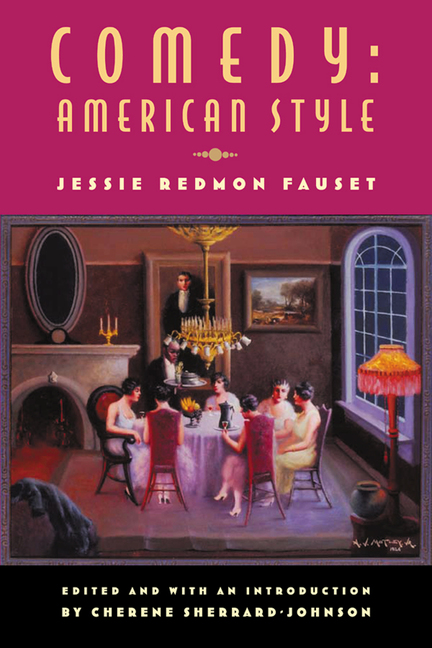
  • Comedy: American Style

    Rutgers University Press
    October 2009 (Originally Published in 1933)
    304 pages
    Paper ISBN: 978-0-8135-4632-2
    Cloth ISBN: 978-0-8135-4631-5

    Jessie Redmon Fauset (1882-1961)

    Edited and with an Introduction by:

    Cherene Sherrard-Johnson, Professor of English
    University of Wisconsin, Madison

    Comedy: American Style, Jessie Redmon Fauset’s fourth and final novel, recounts the tragic tale of a family’s destruction—the story of a mother who denies her clan its heritage. Originally published in 1933, this intense narrative stands the test of time and continues to raise compelling, disturbing, and still contemporary themes of color prejudice and racial self-hatred. Several of today’s bestselling novelists echo subject matter first visited in Fauset’s commanding work, which overflows with rich, vivid, and complex characters who explore questions of color, passing, and black identity.

    Cherene Sherrard-Johnson’s introduction places this literary classic in both the new modernist and transatlantic contexts and will be embraced by those interested in earlytwentieth-century women writers, novels about passing, the Harlem Renaissance, the black/white divide, and diaspora studies. Selected essays and poems penned by Fauset are also included, among them “Yarrow Revisited” and “Oriflamme,” which help highlight the full canon of her extraordinary contribution to literature and provide contextual background to the novel.

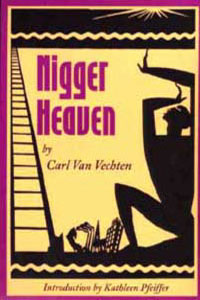
  • Nigger Heaven

    University of Illinois Press
    2000 (Originally published in 1926)
    336 pages
    5.5 x 8.25 in.
    Paper ISBN: 978-0-252-06860-7

    Carl Van Vechten (1880-1964)

    Introduction by:

    Kathleen Pfeiffer, Professor of English
    Oakland University, Rochester, Michigan

    Foreward by:

    Philip Levine

    A controversial but appealing, amusing, and vivacious celebration of Harlem and the Harlem Renaissance in the 1920’s

    No other contemporary novel received the volume and intensity of criticism and curiosity that greeted Nigger Heaven upon its publication in 1926. Carl Van Vechten’s novel generated a storm of controversy because of its scandalous title and fed an insatiable hunger on the part of the reading public for material relating to the black culture of Harlem’s jazz clubs, cabarets, and social events.

    “The book and not the title is the thing,” James Weldon Johnson insisted with regard to Nigger Heaven, and the book is indeed a nuanced and vibrant portrait of “the great black walled city” of Harlem. Opening on a scene of tawdry sensationalism, Nigger Heaven shifts decisively to a world of black middle-class respectability, defined by intellectual values, professional ambition, and an acute consciousness of class and racial identity.

    Here is a Harlem where upper-class elites discuss art in well-appointed drawing rooms; rowdy and lascivious drunks spend long nights in jazz clubs and speakeasies; and politically conscious young intellectuals drink coffee and debate “the race problem” in walk-up apartments. At the center of the story, two young people—a quiet, serious librarian and a volatile aspiring writer—struggle to love each other as their dreams are slowly suffocated by racism.

    This reissue is based on the seventh printing, which included poetry composed by Langston Hughes especially for the book. Kathleen Pfeiffer’s astute introduction investigates the controversy surrounding the shocking title and shows how the novel functioned in its time as a site to contest racial violence. She also signals questions of racial authenticity and racial identity raised by a novel about black culture written by a white admirer of that culture.

  • Passing as White: The Life Altering Effects on Loved Ones

    Southern Connecticut State University
    May 2006
    122 pages
    Publication Number: AAT 1435422
    ISBN: 9780542641824

    Kathleen Daubney

    A Thesis Submitted to the School of Graduate Studies In Partial Fulfillment of the Requirement for the Degree of Master of Science

    This thesis analyzes the theme of passing in Harlem Renaissance literature and deals with the consequences that such transitions to white society had on the passers’ friends and relatives. Choices that one person makes can have a domino and long lasting effect on his or her family and friends. This study focuses on: Passing by Nella Larsen, The Autobiography of an Ex-Coloured Man by James Weldon Johnson, “Passing,” by Langston Hughes, and Comedy: American Style and Plum Bun both by Jessie Fauset. This thesis discusses if the family and friends have knowledge of the passing, if they had a voice in the novel, and if the children had knowledge of their heritage. It also discusses the effects passing had on the families and friends of the passers, along with their responses.

    TABLE OF CONTENTS

    • PASSING AS WHITE: THE LIFE ALTERING EFFECTS ON LOVED ONES
    • FAUSET’S PLUM BUN: PASSING AND RETURNING
    • LARSEN’S PASSING: ESCAPE, WEALTH, OR APPEARANCE
    • THE AUTOBIOGRAPHY OF AN EX-COLOURED MAN: WHITE, BLACK, WHITE?
    • HUGHES “PASSING”: I LOVE YOU, BUT
    • COMEDY AMERICAN STYLE: OLIVIA’S PASSING, THE FAMILY’S ESCAPE
    • CONCLUSION: TO PASS OR NOT TO PASS
    • REFERENCES

    Purchase the dissertation here.

  • Racechanges: White Skin, Black Face in American Culture

    Oxford University Press
    May 1997
    356 pages
    Paperback ISBN13: 9780195134186; ISBN10: 0195134184

    Susan Gubar, Distinguished Professor Emerita and Ruth N. Halls Professor Emerita of English
    Indiana University

    When the actor Ted Danson appeared in blackface at a 1993 Friars Club roast, he ignited a firestorm of protest that landed him on the front pages of the newspapers, rebuked by everyone from talk show host Montel Williams to New York City’s then mayor, David Dinkins. Danson’s use of blackface was shocking, but was the furious pitch of the response a triumphant indication of how far society has progressed since the days when blackface performers were the toast of vaudeville, or was it also an uncomfortable reminder of how deep the chasm still is separating black and white America?

    In Racechanges: White Skin, Black Face in American Culture, Susan Gubar, who fundamentally changed the way we think about women’s literature as co-author of the acclaimed The Madwoman in the Attic, turns her attention to the incendiary issue of race. Through a far-reaching exploration of the long overlooked legacy of minstrelsy–cross-racial impersonations or “racechanges”—throughout modern American film, fiction, poetry, painting, photography, and journalism, she documents the indebtedness of “mainstream” artists to African-American culture, and explores the deeply conflicted psychology of white guilt. The fascinating “racechanges” Gubar discusses include whites posing as blacks and blacks “passing” for white; blackface on white actors in The Jazz Singer, Birth of a Nation, and other movies, as well as on the faces of black stage entertainers; African-American deployment of racechange imagery during the Harlem Renaissance, including the poetry of Anne Spencer, the black-and-white prints of Richard Bruce Nugent, and the early work of Zora Neale Hurston; white poets and novelists from Vachel Lindsay and Gertrude Stein to John Berryman and William Faulkner writing as if they were black; white artists and writers fascinated by hypersexualized stereotypes of black men; and nightmares and visions of the racechanged baby. Gubar shows that unlike African-Americans, who often are forced to adopt white masks to gain their rights, white people have chosen racial masquerades, which range from mockery and mimicry to an evolving emphasis on inter-racial mutuality and mutability.

    Drawing on a stunning array of illustrations, including paintings, film stills, computer graphics, and even magazine morphings, Racechanges sheds new light on the persistent pervasiveness of racism and exciting aesthetic possibilities for lessening the distance between blacks and whites.

  • Between Arab and White: Race and Ethnicity in the Early Syrian American Diaspora

    University of California Press
    May 2009
    296 pages
    Paperback ISBN: 9780520255340
    Hardcover ISBN: 9780520255326
    PDF E-Book ISBN: ISBN: 9780520943469

    Sarah Gualtieri, Associate Professor of History and American Studies and Ethnicity
    University of Southern California

    This multifaceted study of Syrian immigration to the United States places Syrians—and Arabs more generally—at the center of discussions about race and racial formation from which they have long been marginalized. Between Arab and White focuses on the first wave of Arab immigration and settlement in the United States in the years before World War II, but also continues the story up to the present. It presents an original analysis of the ways in which people mainly from current day Lebanon and Syria—the largest group of Arabic-speaking immigrants before World War II—came to view themselves in racial terms and position themselves within racial hierarchies as part of a broader process of ethnic identity formation.

    Contents

    • List of Illustrations
    • Acknowledgments
    • Note on Terms and Transliterations
    • Introduction
    • 1. From Internal to International Migration
    • 2. Claiming Whiteness: Syrians and Naturalization Law
    • 3. Nation and Migration: Emergent Arabism and Diasporic Nationalism
    • 4. The Lynching of Nola Romey: Syrian Racial Inbetweenness in the Jim Crow South
    • 5. Marriage and Respectability in the Era of Immigration Restriction
    • Conclusion
    • Epilogue: Becoming Arab American
    • Notes
    • Bibliography
    • Index