• The Relationship Between Colour and Identity in the Literature of Nella Larsen and Richard Wright

    Lethbridge Undergraduate Research Journal
    Volume 3, Number 2 (June 2008)
    ISSN 1718-8482

    Elisabeth Hudson
    King’s College London

    The fiction of Nella Larsen and Richard Wright explores the struggle of African-American men and women to forge an identity for themselves that is free of the bonds placed on them by society. The protagonists of Larsen’s Quicksand and Passing and Wright’s Black Boy all have one thing in common: they do not wish for their identities to be defined by their race. Helga Crane, Irene Redfield, Clare Kendry, and the young Richard Wright all try to create identities for themselves that transcend racial boundaries. Because of this desire, they all have trouble relating completely to either white society or black society and, as a result, feel estranged from their communities.

    In Nella Larsen’s Quicksand, the protagonist Helga Crane, who Hazel Carby called ‘the first truly sexual black female protagonist in Afro-American fiction,’ is trapped between two racial identities. The daughter of a white Danish woman and a black jazz musician she has never known, Helga has never had a black family member, and therefore struggles with the disconnect between her outward appearance and her external reality. Helga never truly feels at home in the company of either black people or white people and, as a result, is constantly fleeing from place to place in search of a society wherein she can ‘fit in.’ Wherever Helga finds herself, she is portrayed as the ‘other.’ In black society, she feels ostracised because of her colourful, flamboyant clothing, her distaste for ‘the race problem,’ and her ethnic identity as a mulatto. In white society, she is objectified as an exotic, primitive creature without agency. She is portrayed as a spectacle, almost never as spectator. Because she does not belong to one race completely, she never truly finds a place where she belongs. Helga’s sense of self is always censored by society’s restrictions and expectations. She never finds a version of reality that is not mediated by her surroundings…

    Read the entire article here.

  • Clare Kendry’s “True” Colors: Race and Class Conflict in Nella Larsen’s Passing

    Callaloo
    Volume 15, Number 4 (Autumn, 1992)
    pages 1053-1065

    Jennifer DeVere Brody, Professor of Drama
    Stanford University

    Interpretations of Nella Larsen’s Passing (1929) often have failed to explain the complex symbolism of the narrative. Indeed, dismissive or tendentious criticisms of the text have caused it to be eclipsed by Larsen’s “earlier and more intriguing” book, Quicksand (1928). This essay reexamines Passing as a work concerned with the simultaneous representation and construction of race and especially class, within a circumscribed community. As such, my paper contributes to debates within Black feminist criticism about the value of these aspects of identity in relation to the production of black female subjectivities. I contend that the novel’s main characters are neither purely “psychological” beings, as Claudia Tate asserts, nor are they essentially “sexual” creatures, as Deborah McDowell argues. Rather, I read Irene Redfield and Clare Kendry as representatives of different ideologies locked in struggle for dominance.

    In her introduction to Passing Deborah McDowell one of the most astute critics of Larsen’s work, states that “many critics have been misled by the novel’s epigraph … [since] it invites the reader to place race at the center of any critical interpretation.” It would appear that McDowell herself has been misled by Passing’s obviously unreliable narrator. So too, McDowell seems to agree with Claudia Tate’s belief that, “Race is peripheral to Passing. It is more a device to sustain the suspense than a compelling social issue.” I disagree with these assertions because it seems to me that the text is “all about race” or rather, the mediation of race in relation to sexuality and class.

    McDowell recognizes certain tropes employed by Larsen and, like many other critics, she maintains that Irene Redfield is the primary referent of the novel’s title. Ultimately, however, McDowell is unable to give a full explication of the texf s meaning since she tries to read/uce the text as a tale of latent sexual passion without discussing the key issues of race and class. Thus, while her discussion is certainly valuable, one might also say that it reifies sexuality at the risk of not exploring how sexuality is connected inextricably with other historically produced phenomena such as race and class. In order to sustain her ingenious reading of Passing as a tale that “passes for straight” and sublimates lesbian desire, McDowell misses the more intricate implications addressed by Larsen’s work. The iconography McDowell reads as sexual is simultaneously racial: it also expresses class positionality. For example, the objective correlative envelope used in the first paragraph of the novel signifies not only the “sexual” (McDowell reads it as a “metaphorical vagina”) but also the sender’s race (alien) and class (elite). Thus, my reading emends McDowell’s by insisting on the importance of race and class in Passing.

    If race as well as class conflict must occupy a primary position in any discussion of…

  • The Hypervisible Man: Obama as the First Black, Mixed-Race, Asian American and now Gay President

    Mixed Dreams: towards a radical multiracial/ethnic movement
    2012-05-24

    Nicole Asong Nfonoyim

    “I have always sensed that he [Obama] intuitively understands gays and our predicament—because it so mirrors his own. And he knows how the love and sacrifice of marriage can heal, integrate, and rebuild a soul. The point of the gay-rights movement, after all, is not about helping people be gay. It is about creating the space for people to be themselves. This has been Obama’s life’s work. And he just enlarged the space in this world for so many others, trapped in different cages of identity, yearning to be released and returned to the families they love and the dignity they deserve.” −Andrew Sullivan, “The First Gay President,” Newsweek

    I admit, I’ve missed quite a bit being oceans and continents away from the US of A. But one watershed moment managed to reach my little apartment in Udaipur last week as I was sipping my morning chai. Front page of the Times of India was Obama’s declaration of support for marriage equality. Between you and I, I was always of the camp that believed Obama’s previous stance was no more than a mere (albeit calculated and predictable) front to protect his political hide as the over-hyped newbie presidential candidate. Seems my sentiments were shared by Andrew Sullivan in his cover article in this week’s edition of Newsweek, which featured the above image and the headline “The First Gay President.”

    Reading Sullivan’s article, I remembered a talk I attended at Oberlin College for Asian Pacific American Month in 2010 where the speaker’s last slide was entitled “The First Asian-American President” beneath two photographs of Obama, one as a child in Indonesia and one hugging his sister Maya Soetoro-Ng at his high school graduation in Hawaii. The speaker insisted that Obama’s early childhood spent in Indonesia with  his mother and stepfather, his youth spent in Hawaii, his identity as a hyphen American, and immigrant son made his experience akin to that of many Asian-Americans and thus earned him the title “First Asian-American President.” And in those terms it totally made sense. Obama could be Asian-American. Obama’s identity lends itself quite easily to repeated acts of reading and (re)interpretation. Though he’s self-identified as African-American, many still call him “The First Multiracial President.” Because it matters much less what Obama thinks of himself than what we the people think of him—what images we project onto his being.

    In my course, I used Obama’s story, his identity as a tool to understand how multiraciality contains multitudes and how a multiracial critique could be instrumental in breaking down monolithic notions of identity. So I encouraged students to talk about multiraciality as part of black identities, as part of Asian-American identities, Latin@, Native, White, adoptee and queer identities. If anything multiraciality benefits a great deal from a queer critique—queering race. And there’s increasingly more out there in Academe that works at the rich intersection. That being said, I still found myself a bit surprised to see such a bold act of race queering on the cover of a mainstream American publication such as Newsweek

    Read the entire essay here.

  • Black White & Jewish: Autobiography of a Shifting Self

    Riverhead Press (an imprint of Penguin Press)
    2002-01-08
    336 pages
    5.23 x 8.03in
    ISBN 9781573229074

    Rebecca Walker

    ALA Best Book for Young Adults

    The Civil Rights movement brought author Alice Walker and lawyer Mel Leventhal together, and in 1969 their daughter, Rebecca, was born. Some saw this unusual copper-colored girl as an outrage or an oddity; others viewed her as a symbol of harmony, a triumph of love over hate. But after her parents divorced, leaving her a lonely only child ferrying between two worlds that only seemed to grow further apart, Rebecca was no longer sure what she represented. In this book, Rebecca Leventhal Walker attempts to define herself as a soul instead of a symbol—and offers a new look at the challenge of personal identity, in a story at once strikingly unique and truly universal.

  • The Commoditization of Hybridity in the 1990s U.S. Fashion Advertising: Who Is cK one?

    in Beyond the Frame: Women of Color and Visual Representation
    Palgrave MacMillan
    September 2005
    272 pages
    5 1/2 x 8 1/4 inches
    Hardcover ISBN: 978-1-4039-6533-2, ISBN10: 1-4039-6533-1

    Edited by

    Neferti X. M. Tadiar, Professor of Women’s, Gender & Sexuality Studies
    Barnard College, Columbia University

    Angela Y. Davis, Distinguished Professor Emerita
    University of California, Santa Cruz

    pages 31-47

    Laura J. Kuo

    …an important caveat follows for postcolonial practices,namely the risk that hybridity might be re-colonised by the apparatus of power as either compensation for our losses,or as the velvet glove of enjoyment that goes hand in hand with the iron fist of exclusion. —Kobena Mercer

    How does a concept like hybridity travel within different economies—between the academy, activist arenas, and the media, for example—and what forms does it take on within these smart mutations? Is the adoption of a complex concept like hybridity by the media the simple appropriation of culture by capital? The usages, travels, and permutations of hybridity are more complex and elaborate than a blanket confiscation of its political value. After all, capital is culture (among other things) and hybridity is another sign within postmodern commodity systems. By engaging the structure of these systems we can begin to identify the ways in which hybridity operates within—and in the service of—the dominant logic of postmodern capitalist neoliberalism, and its massive contradictions. In this essay I investigate hybridity as a site of possible transgressions of fixed identities, and as a potentially productive space that has been recolonized by market multiculturalism—a space that views everyone as mixed and thus elides structural differences and persistent hierarchies of race, class, gender, and sexuality.

    Specifically within the context of advertising, hybridity becomes, atone level, a strategy that stabilizes discursive power relations within transnational capital. For example, there are complex relations between multinational corporations in the United States and U.S./Third World and gendered immigrant labor practices on the one hand, and the cooptation of political coalitional work on the other. At another level, images of hybridity in advertising generate value in a global world where these commodities circulate. Certainly, a racialized economic hegemony is stabilized through appropriations of racial diversity discourses within market multiculturalism. Yet it is too easy to declare that global capital exploits the labor of women of color in the Third World and in the United States, that advertising hides this exploitative relationship, and that the images therefore should be criticized and dismissed. Instead, I am interested in the way in which this practice of “hiding” constitutes a necessary vector of postmodern diference that enables the dominant logic of late capitalism, which inturn depends upon exploitation, appropriation, and difference. Advertising hybridity becomes complicitous with the act of hiding, yet at the same time images of hybridity open up new communities of possibilities for people who take up the ads within their specifics of home and place, looking toward new forms of identifications and affective communities withinc apitalism’s cultural logic.

    The observations in this essay are based on the principal photograph of the cK one advertising campaign, which has been displayed prolifically on billboards and in magazines. This photo (see figure 2.1), which served as the prototype on which other early cK one ads were based, is called “Jenny, Kate & Company” in the Calvin Klein Cosmetics press packet. Using this ad as a sort of case study, I investigate how images of hybridity and multiculturalism in advertising serve to conflate race, class, gender, sexuality, ethnicity, nation, and culture within a totalizing logic of neoliberalism. I call the discursive practice of homogenizing race, class, nation, gender, sexuality, ethnicity, andculture—and the elision of the specificities of their individual locations and their intersections—commoditized hybridity. Commoditized hybridity is a manifestation of a particular practice of the relentless marketing of race. It is informed by processes of consumption of race within postmodern capitalism. Commoditized hybridity also can be represented under the guise of “multiculturalism.”…

    …The cK one photos establish hybrid racial relations through biologistic portrayals of appearance. The staging of the models constructs whiteness as a racial essence cosmetically arranged with “other” racialessences in order to convey an impression of harmony/unity/solidarity. In this respect, cK one potentially closes off a space to discuss the different positions whites and people of color occupy in relation to practice,history, and social formations, and structures and relations of power.Through juxtapositions of differently racialized bodies in its ads—which are staged against a homologous black and white backdrop—cK one constructs a notion of multiraciality that postures as social diversity. The hybrid figures of 1990s fashion are bodies on which a racialized seamlessness/sameness is inscribed. The models in cK one photos are racially diverse, and when they are staged together they signify the currency of a multicultural decade. Their bodies are arranged together and “equalized” in a contrived dynamic through photographic distortion and a deliberate homogeneity of height, weight, pose, style, and expression that invokes a sense of cultural similarity, of oneness. The images are presented in black and white, creating a ground tone of similarity against which difference, as separation, is muted, and heterogeneity is emphasized. The models are always already in contact, integrated, and hybrid. They are aesthetically seductive—extremely cool, hip, and sexy—and they become part of the lure to cK one-ness. The models of color appear to be “one” with the white models, creating an illusion of common social and economic positions and cultural identifications. The commoditization of hybridity takes rich heterogeneous spaces of racial and cultural diversity and turns these spaces of promise against their potential, effectively disrupting their ability to spawn real social change. It recolonizes desirable and hopeful formulations of cultural hybridity and transforms them into weapons against the spectator. In short, these ads erase historical memory and social analysis, offering fragrance in return…

    Read the entire chapter here.

  • Bessora: A Writer with a Thirty-Eight Shoe Size

    Wasafiri
    Volume 24, Issue 2 (2009)
    pages 60-65
    DOI: 10.1080/02690050902771779

    Adele King

    The character of literary criticism combined with pedagogical strategies tends to categorise, moving one accepted orthodoxy forward by pushing another out of the way. Early approaches to European literature were to treat it as a body of work by white Europeans and Americans. New classifications of it are, of course, more varied, but still include such undifferentiated general categories as black, immigrant, mixed race etc. The problem is that such comparlmentalisatlons not only ignore the actual diversity of people and their social contexts but, by imposing a presumed political or cultural vision on something quite different including writing against such categorisation—can also obscure what writers are actually doing. I am not going to review the history of postcolonial criticism and pedagogy here, but want to introduce a very good author writing in French who not onfy does not fit reductive categories, but who also seems to be writing against them. Bessora’s work has been well received; in 2000 she won the prestigious Prix Félix-Fénéon, for a literary work by an author under thirty-five (previously awarded to Robbe-Grillet among others) for Les Tachts d’Encre [Ink Stains], and Cueillez-Moi Joiis Messieurs [Pick Me Nice Gentlemen] won the Grand Prix Litteraire d’Afnque Notre in 2007. Bessora’s work has not yet, however, received any extended literary attention.

    In contrast to the UK, where a number of writers of mixed African-European parentage were born and work, there are few part-sub-Saharan African, part-European writers in France. Bessora (her full name is Sandrine Bessora Nan Ngueaia), who was born in Belgium in 1968, is part Swiss, part Gabonese. To my knowledge, the only other writers in French born in Europe to mixed European and sub-Saharan African parentage and living outside Africa are: Sylvie Kandé, a poet and university professor of French-Senegalese parentage, who now teaches in the United States; Binéka Lissoumba, of French-Congolese parentage, who now teaches in Canada; and Véronique Tadjo of French-Côte d’Ivoire parentage, who has taught at universities in Africa and lived in the United States, England and South Africa. Like Bessora, these writers are from social elites and are well educated, holding advanced degrees. They are less likely to have faced direct racial prejudice than to have encountered more nuanced occlusions, which come from not being identified with either white or black communities. They are not really representative of immigrant communities, unlike second generation writers of part North African origin (the beurs), who are a different, larger group, sometimes from poor immigrant families.

    Bessora’s fiction is part of a change from the overly serious treatment of political themes of much earlier African writing. Among her contemporaries in the francophone world, her work has similarities with a few other writers—a younger generation who never lived under colonialism and who came to France when they were in their early twenties. While of African parentage, they are cultural hybrids, who usually write about individual problems rather than the community. Such works include Abdourahman Waberi’s comic anthropological treatment of Djibouti in Cobier nomade (1996); Alain Mabanckou’s satiric tales of life in Congo in Memoires de porc-epic (2006); Kangni Alem’s Cola Cola Jazz (2002), a book that often playfully refers to itself and that mocks Togolese society; and, from the previous generation. Boubacar Boris Diop’s Le temps de Tomango (1981), with its science fiction tales of wildly differing historical periods, from the era of slavery to the mid-twenty-first century. Bessora, however, as the only métisse [mixed race woman] of this group, is more concerned with the paradoxes that result from classifying people by skin colour and with questions of identity in Europe. She is also more amusing.

    Bessora’s life, places of abode and education have been international. Her father is a Gabonese diplomat. Her mother is Swiss, of German and Polish origin, the daughter of a pastry chef. Her father had four children by his first wife, as well as two children, Bessora and a brother, by his second. As a child she lived in Switzerland, France, Austria and Washington, D.C. during her father’s career as a diplomat, as well as in Gabon. She studied business management and applied economics at a prestigious HEC—Hautes Etudes Commerciales—in Switzerland. Later, when she came to France, she studied anthropology and wrote a doctoral thesis on the myths and legends of the oil business in Gabon. This…

    Read or purchase the article here.

  • Cuban surrealist Wifredo Lam fetches record price

    BBC News
    2012-05-24

    A painting by Cuban surrealist artist Wifredo Lam fetched a record personal price at a Latin American art sale at auctioneers Sotheby’s in New York.

    An unnamed South American collector paid $4.5m (£2.9m) for Lam’s 1944 Idol (Oya/Divinite de l’Air et de la mort), well above the $2m-3m guide price…

    …But Diego Rivera’s 1939 painting Girl in Blue and White, considered the main attraction, remained unsold.

    The work by the Mexican artist had been expected to sell at a price between $4m and $6m.

    In contrast, Lam’s piece, which had been in private hands since 1947, sold for more than double the previous top price for his paintings.

    An Afro-Cuban, Lam died in 1982 and was heavily influenced both by surrealism and by santeria, an Afro-Caribbean religion based on Yorùbá and Roman Catholic beliefs…

    Read the entire article here.

  • Obama’s election changed racial identity of black students

    Chronicle Online
    Cornell University
    2012-02-16

    Karene Booker, Extension Support Specialist
    Department of Human Development

    Barack Obama’s historic election in 2008 stimulated individual and national reflection on race and changed African-American college students’ perceptions of being black, reports a new Cornell study published in Developmental Psychology (47:6).

    But how these changes will shape public discourse as the 2012 presidential campaign unfolds or whether the 2012 election outcome will generate similar changes in racial identity is still unknown, say the researchers.

    “Obama’s election triggered deep explorations or ‘encounter experiences’ in which these African-Americans [in our study] were challenged to think through the importance and positive value that can be associated with being black,” said Anthony Burrow, assistant professor of human development in Cornell’s College of Human Ecology, co-author of the study with Anthony Ong, associate professor of human development at Cornell, and lead author Thomas Fuller-Rowell, Ph.D. ’10, now a Robert Wood Johnson postdoctoral fellow at the University of Wisconsin-Madison…

    Read the entire article here.

  • Changes in racial identity among African American college students following the election of Barack Obama

    Developmental Psychology
    Volume 47, Number 6 (November 2011)
    pages 1608-1618
    DOI: 10.1037/a0025284

    Thomas E. Fuller-Rowell, Robert Wood Johnson Postdoctoral Fellow
    University of Wisconsin, Madison

    Anthony L. Burrow, Assistant Professor of Human Development
    Cornell University

    Anthony D. Ong, Associate Professor of Human Development
    Cornell University

    The current study considered the influence of the 2008 presidential election on the racial identity of African American college students (Mage = 19.3 years; 26.3% male). The design of the study consisted of 2 components: longitudinal and daily. The longitudinal component assessed 3 dimensions of racial identity (centrality, private regard, and public regard) 2 weeks before and 5 months after the election, and the daily diary component assessed racial identity and identity exploration on the days immediately before and after the election. Daily items measuring identity exploration focused on how much individuals thought about issues relating to their race. Analyses considered the immediate effects of the election on identity exploration and the extent to which changes in exploration were shaped by racial identity measured prior to the election. We also considered immediate and longer term changes in racial identity following the election and the extent to which longer term changes were conditioned by identity exploration. Findings suggest that the election served as an “encounter” experience (Cross, 1991, 1995, pp. 60–61), which led to increases in identity exploration. Moreover, analyses confirmed that changes in identity exploration were most pronounced among those with higher levels of racial centrality. Results also suggest that the election had both an immediate and a longer term influence on racial identity, which in some instances was conditioned by identity exploration.

    Read or purchase the article here.

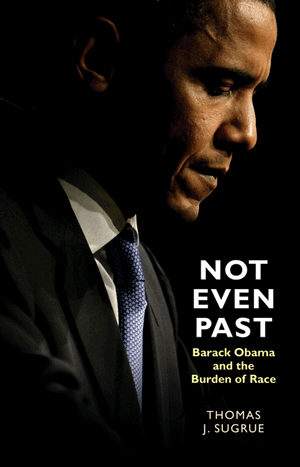
  • Not Even Past: Barack Obama and the Burden of Race

    Princeton University Press
    2010
    178 pages
    5 1/2 x 8 1/2
    Cloth ISBN: 9780691137308
    eBook ISBN: 9781400834198

    Thomas J. Sugrue, David Boies Professor of History and Professor of Sociology
    University of Pennsylvania

    Finalist, The 2010 Benjamin L. Hooks Institute for Social Change National Book Award, The University of Memphis

    Barack Obama, in his acclaimed campaign speech discussing the troubling complexities of race in America today, quoted William Faulkner’s famous remark “The past isn’t dead and buried. In fact, it isn’t even past.” In Not Even Past, award-winning historian Thomas Sugrue examines the paradox of race in Obama’s America and how President Obama intends to deal with it.

    Obama’s journey to the White House undoubtedly marks a watershed in the history of race in America. Yet even in what is being hailed as the post-civil rights era, racial divisions–particularly between blacks and whites—remain deeply entrenched in American life. Sugrue traces Obama’s evolving understanding of race and racial inequality throughout his career, from his early days as a community organizer in Chicago, to his time as an attorney and scholar, to his spectacular rise to power as a charismatic and savvy politician, to his dramatic presidential campaign. Sugrue looks at Obama’s place in the contested history of the civil rights struggle; his views about the root causes of black poverty in America; and the incredible challenges confronting his historic presidency.

    Does Obama’s presidency signal the end of race in American life? In Not Even Past, a leading historian of civil rights, race, and urban America offers a revealing and unflinchingly honest assessment of the culture and politics of race in the age of Obama, and of our prospects for a postracial America.

    Table of Contents

    • Introduction
    • CHAPTER I: “This Is My Story”: Obama, Civil Rights, and Memory
    • CHAPTER II: Obama and the Truly Disadvantaged: The Politics of Race and Class
    • CHAPTER III: “A More Perfect Union”? The Burden of Race in Obama’s America
    • Acknowledgments
    • Notes

    Introduction

    It is now a commonplace that the election of Barack Obama marks the opening of a new period in America’s long racial history. The unlikely rise of a black man to the nation’s highest office—someone who was a mostly unknown state senator only five years before he was inaugurated president—confirms the view of many, especially whites, that the United States is a postracial society. At last, the shackles of discrimination have been broken and individual merit is rewarded, regardless of skin color. In this view, blackness—once the clearest marker of difference in American society—has lost some or all of its stigma. Barack Obama, in the most common formulation, transcends race; his ancestry fuses African and European into a new hybrid; his political vision of unity discredits those who cling bitterly to notions of racial superiority and, at the same time, rebukes those who harbor a divisive identity politics fueled by an exaggerated sense of racial grievance.

    As with all interpretations of the relationship between the past and the present, the notion that Obama’s election marks an epochal change in racial dynamics is not without its critics. Obama himself offers a tempered view, suggesting that even if America has advanced considerably over the last forty years, some racial prejudices remain in place and some racial discrimination still exists. In his view, we have realized much, but not all, of the dream of racial equality. Other commentators, like Berkeley historian David Hollinger, suggest that Obama heralds the emergence of a new, multihued racial order, a majority-minority society where static notions of race are losing their purchase, and where race-specific remedies like affirmative action have outlived their usefulness. Many scholars and pundits further to the left, by contrast, are skeptical that much has changed at all. They point to the angry denunciations of Obama during his campaign and since his inauguration (Obama as Muslim, Obama as black man in whiteface, Obama as witch doctor, Obama as noncitizen) as evidence of a deep-seated racism that is inflamed by the discomfiting presence of a brown-hued man in the White House.

    In the most dystopian vision, offered by Duke sociologist Eduardo Bonilla-Silva, the symbolism of an African-descended president obscures a deeper, more troubling reality: the “Latin Americanization” of the United States, namely, the emergence of a society where a tripartite system of color gradation will supplant the “one-drop rule” of racial classification, but where the darkest-skinned racial minorities remain concentrated at the bottom…

    …To understand Obama’s life and times requires an examination of race and racial politics. It is safe to say that few domestic issues have been more controversial in late twentieth- and early twenty-first-century America. And few issues have generated more passion among scholars and journalists. Debates about civil rights, black power, race consciousness, and inequality are often couched in predictable and analytically problematic formulations that reflect the moral dualism that still shapes our understandings of race. The first binary—“race versus class”—inflects much scholarship and liberal journalism about race. Either race matters as a dominant force or it is a screen—or a form of false consciousness—that masks far deeper inequalities of class. This is a simplistic formulation that downplays the ways that racial and economic disadvantages are fundamentally intertwined, and fails to address how the American economy generates inequalities that affect people regardless of their background but are still disproportionatelyborne by people of color. A second binary—with special hold in public discourse—is “racism versus color blindness.” This contrasts a pathology and a principle, a flawed reality and an ideal. But it, too, does not stand up to close scrutiny. As legal scholar Richard Thompson Ford has argued, to hurl the invective “racist” loosely is to put too much weight on individual beliefs or values. And conversely, to proclaim color blindness is to overlook the ways that racial inequalities persist and sometimes harden regardless of the good intentions or the benign disposition of any single actor. There are stone-cold racists in America, and there are people who believe that they are wholly free of prejudice. Ultimately, the most enduring racial inequalities in the United States today are not the consequence of conspiracy or intention, or even the unconscious prejudice that neuropsychologists argue exists in the amygdala; rather they stem from the long-term institutional legacies of economic and public policies that have systematically disadvantaged African Americans and, when left unaltered, continue to do so in key realms of American life today. The third binary is “pessimism versus optimism.” Either America is still a profoundly racist society, or we have mostly overcome past racial injustices. Any clear-eyed examination of race in modern America must recognize the changes that have transformed the life chances of African Americans in the United States since the mid-twentieth century, and that enabled Barack Obama’s remarkable ascent through some of America’s most prestigious institutions and ultimately to the White House—most of them the result of grassroots activism, litigation, and public policy innovation. And it must also account for what even a cursory review of census data, opinion surveys, and health, educational, and housing statistics reveals: namely, that racial gaps are deep and persistent in American life. Those statistics, the way that Obama understands and interprets them, and the ways that Americans in general make sense of them, are at the heart of this book…

    Read the entire Introduction here.