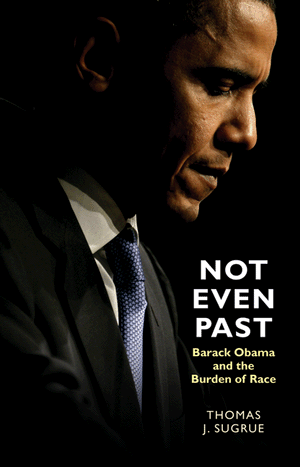
• Not Even Past: Barack Obama and the Burden of Race

    Princeton University Press
    2010
    178 pages
    5 1/2 x 8 1/2
    Cloth ISBN: 9780691137308
    eBook ISBN: 9781400834198

    Thomas J. Sugrue, David Boies Professor of History and Professor of Sociology
    University of Pennsylvania
    Finalist, The 2010 Benjamin L. Hooks Institute for Social Change National Book Award, The University of Memphis

    Barack Obama, in his acclaimed campaign speech discussing the troubling complexities of race in America today, quoted William Faulkner’s famous remark “The past isn’t dead and buried. In fact, it isn’t even past.” In Not Even Past, award-winning historian Thomas Sugrue examines the paradox of race in Obama’s America and how President Obama intends to deal with it.

    Obama’s journey to the White House undoubtedly marks a watershed in the history of race in America. Yet even in what is being hailed as the post-civil rights era, racial divisions–particularly between blacks and whites—remain deeply entrenched in American life. Sugrue traces Obama’s evolving understanding of race and racial inequality throughout his career, from his early days as a community organizer in Chicago, to his time as an attorney and scholar, to his spectacular rise to power as a charismatic and savvy politician, to his dramatic presidential campaign. Sugrue looks at Obama’s place in the contested history of the civil rights struggle; his views about the root causes of black poverty in America; and the incredible challenges confronting his historic presidency.

    Does Obama’s presidency signal the end of race in American life? In Not Even Past, a leading historian of civil rights, race, and urban America offers a revealing and unflinchingly honest assessment of the culture and politics of race in the age of Obama, and of our prospects for a postracial America.

    Table of Contents

    • Introduction
    • CHAPTER I: “This Is My Story”: Obama, Civil Rights, and Memory
    • CHAPTER II: Obama and the Truly Disadvantaged: The Politics of Race and Class
    • CHAPTER III: “A More Perfect Union”? The Burden of Race in Obama’s America
    • Acknowledgments
    • Notes

    Introduction

    It is now a commonplace that the election of Barack Obama marks the opening of a new period in America’s long racial history. The unlikely rise of a black man to the nation’s highest office—someone who was a mostly unknown state senator only five years before he was inaugurated president—confirms the view of many, especially whites, that the United States is a postracial society. At last, the shackles of discrimination have been broken and individual merit is rewarded, regardless of skin color. In this view, blackness—once the clearest marker of difference in American society—has lost some or all of its stigma. Barack Obama, in the most common formulation, transcends race; his ancestry fuses African and European into a new hybrid; his political vision of unity discredits those who cling bitterly to notions of racial superiority and, at the same time, rebukes those who harbor a divisive identity politics fueled by an exaggerated sense of racial grievance.

    As with all interpretations of the relationship between the past and the present, the notion that Obama’s election marks an epochal change in racial dynamics is not without its critics. Obama himself offers a tempered view, suggesting that even if America has advanced considerably over the last forty years, some racial prejudices remain in place and some racial discrimination still exists. In his view, we have realized much, but not all, of the dream of racial equality. Other commentators, like Berkeley historian David Hollinger, suggest that Obama heralds the emergence of a new, multihued racial order, a majority-minority society where static notions of race are losing their purchase, and where race-specific remedies like affirmative action have outlived their usefulness. Many scholars and pundits further to the left, by contrast, are skeptical that much has changed at all. They point to the angry denunciations of Obama during his campaign and since his inauguration (Obama as Muslim, Obama as black man in whiteface, Obama as witch doctor, Obama as noncitizen) as evidence of a deep-seated racism that is inflamed by the discomfiting presence of a brown-hued man in the White House.

    In the most dystopian vision, offered by Duke sociologist Eduardo Bonilla-Silva, the symbolism of an African-descended president obscures a deeper, more troubling reality: the “Latin Americanization” of the United States, namely, the emergence of a society where a tripartite system of color gradation will supplant the “one-drop rule” of racial classification, but where the darkest-skinned racial minorities remain concentrated at the bottom…

    …To understand Obama’s life and times requires an examination of race and racial politics. It is safe to say that few domestic issues have been more controversial in late twentieth- and early twenty-first-century America. And few issues have generated more passion among scholars and journalists. Debates about civil rights, black power, race consciousness, and inequality are often couched in predictable and analytically problematic formulations that reflect the moral dualism that still shapes our understandings of race. The first binary—“race versus class”—inflects much scholarship and liberal journalism about race. Either race matters as a dominant force or it is a screen—or a form of false consciousness—that masks far deeper inequalities of class. This is a simplistic formulation that downplays the ways that racial and economic disadvantages are fundamentally intertwined, and fails to address how the American economy generates inequalities that affect people regardless of their background but are still disproportionatelyborne by people of color. A second binary—with special hold in public discourse—is “racism versus color blindness.” This contrasts a pathology and a principle, a flawed reality and an ideal. But it, too, does not stand up to close scrutiny. As legal scholar Richard Thompson Ford has argued, to hurl the invective “racist” loosely is to put too much weight on individual beliefs or values. And conversely, to proclaim color blindness is to overlook the ways that racial inequalities persist and sometimes harden regardless of the good intentions or the benign disposition of any single actor. There are stone-cold racists in America, and there are people who believe that they are wholly free of prejudice. Ultimately, the most enduring racial inequalities in the United States today are not the consequence of conspiracy or intention, or even the unconscious prejudice that neuropsychologists argue exists in the amygdala; rather they stem from the long-term institutional legacies of economic and public policies that have systematically disadvantaged African Americans and, when left unaltered, continue to do so in key realms of American life today. The third binary is “pessimism versus optimism.” Either America is still a profoundly racist society, or we have mostly overcome past racial injustices. Any clear-eyed examination of race in modern America must recognize the changes that have transformed the life chances of African Americans in the United States since the mid-twentieth century, and that enabled Barack Obama’s remarkable ascent through some of America’s most prestigious institutions and ultimately to the White House—most of them the result of grassroots activism, litigation, and public policy innovation. And it must also account for what even a cursory review of census data, opinion surveys, and health, educational, and housing statistics reveals: namely, that racial gaps are deep and persistent in American life. Those statistics, the way that Obama understands and interprets them, and the ways that Americans in general make sense of them, are at the heart of this book…

    Read the entire Introduction here.

  • (19) Half-frican: Black Identity in the Caribbean, England, and the United States

    The Colloge of Wooster, Wooster, Ohio
    2011

    Shannon King, Assistant Professor of History

    During the last presidential election, Rush Limbaugh, the controversial and conservative Republican radio personality, dubbed Barack H. Obama, our 44th President of the United States, as a “Half-frican.” Limbaugh, in his own way, was getting at Obama’s multiracial and multicultural background, which at the time seemed unusual to many Americans. In this seminar, we will examine black identity by engaging literature, history, autobiography, and memoir that address how people of African descent have grappled with their own identity in the Caribbean, England, and the United States. The objective of the seminar is to de-center the notion that black identity and culture is based on skin color or necessarily nationality by illustrating how identity formation is a process. By using an interdisciplinary approach as well as a range of sources, we will learn how immigration, wars, racism, and other social and political forces forged black identity. Readings may include: Notes on a Native Son by James Baldwin; A Mercy by Toni Morrison; Color me English by Caryl Phillips; and Brother, I’m Dying by Edwidge Danticat.

  • In the Shadow of Her Ancestry: The New Tragic Mulatta

    North Carolina State University, Raleigh
    2004
    60 pages

    Vonda Marie Easterling

    A thesis submitted to the Graduate Faculty of North Carolina State University in partial fulfillment of the requirements for the Degree of Master of Arts

    This thesis examines the plight of the infamous tragic mulatta. Because of the mulatta’s lack of black features and her close resemblance to the white race, she was labeled by white society as the privileged of the black race. She was also referred to as the most tragic of all beings and elevated by white society over the darker skinned blacks. Thus, the mulatta found herself in a peculiar position in a race oriented, black-white society. Isolated from the black community and rejected as a part of the white community, the mulatta’s existence was then considered tragic.

    Over the years, social and emotional change has occurred within the mulatta community. No longer considered the taboo of transgression, the mulatta still suffers from many of the same injustices as her ancestral mulatta. This research examines the psychological and emotional effects depicted in the 1959 film of Fannie Hurst’s Imitation of Life with sections of Toni Morrison’s The Bluest Eye and events from actress Dorothy Dandridge’s life. The research also analyzes Passing, Nella Larsen’s complex novel of the 1920s, to interrogate the strategy that many unidentifiably mulatto people mastered in order to achieve social and financial mobility. Lastly, the research explores the experience of the contemporary mulatta through Rebecca Walker’s memoir, Black, White and Jewish: Autobiography of a Shifting Self, in order to explore the issues of the newly termed bi-racial person. The research explores the lineage between the historical mulatta figure and the new bi-racial persons to defuse the theory of the tragic mulatta as a mythical allusion.

    Table of Contents

    • Introduction
    • Chapter One: Reel to Real: The Cinematic Mulatta
    • Chapter Two: To ‘Pass’ or Not to ‘Pass’: The Multi-Layered Practice of ‘Passing’
    • Chapter Three: As Time Goes By: The New Tragic Mulatta
    • Conclusion
    • Works Cited

    Read the entire dissertation here.

  • The Black Peril and Miscegenation: The Regulation of Inter-racial Sexual Relations in Southern Rhodesia, 1890-1933

    McGill University, Montreal, Quebec, Canada
    September 1991
    140 Pages

    Katherine Gombay

    A Thesis submitted to the Faculty of Graduate Studies and Research in partial fulfillment of the requirements of the degree  of M.A.

    For over forty years, at the turn of this century, the white settlers of Southern Rhodesia devoted considerable energy to the discussion and the regulation of inter-racial sexual relations. The settlers’ worries about maintaining their position in power were expressed, in part, in the periodic outbreaks of ‘black peril’ hysteria, a term which well-captures white fears about the threat that African men were thought to represent to white women. Although voluntary sexual encounters between white women and black men were prohibited from 1903 onwards, no such prohibition existed for white men in their relations with black women. The white women made several attempts to have legislation passed prohibiting such liasons, and failed largely because in doing so they were perceived to be challenging the authority of the white men. The regulation of interracial sexual intercourse thus served to reinforce the white male domination of Rhodesian society.

    Table of Contents

    • Introduction
    • Chapter 1—Setting the Scene: The White Settlement of Southern Rhodesia, 1890-1903.
    • Chapter 2—1903-1916: The Black Peril and the Immorality Acts.
    • Chapter 3—The Miscegenation Debates, 1916 -1930.
    • Conclusion
    • Bibliography

    Read the entire thesis here.

  • Sharing Outsider Status and a Style of Coping

    The New York Times
    2012-05-25

    Jodi Kantor

    The United States quietly passed a milestone this spring, mostly lost amid the clamor of the presidential race: for the first time, neither party’s candidate is a white Protestant. The contenders are both from outsider groups that were once persecuted, and despite Harvard degrees and notable successes, both men have felt the sting of being treated as somehow strange or different.

    The campaigns have mostly been in a state of détente on identity politics, trying to avoid mutually assured destruction. But the outsider backgrounds of Barack Obama and Mitt Romney have marked the race in subtler ways, shaping the candidates and campaigns, causing them to mirror each other in many ways.

    Both sides face the specter of longstanding prejudices that no ad, slogan or speech may be able to dispel. In a Wall Street Journal/NBC News survey conducted last week, 27 percent of those polled said that having a Mormon president raised concerns for them or someone they know, and 12 percent said the same for a black president. Some voters say outright that they will not vote for Mr. Obama because he is black; others make jokes about Mr. Romney belonging to a cult…

    …There are also parallels between the two candidates themselves, like their elliptical language: In a speech at Liberty University this month, Mr. Romney talked about his faith without ever saying “Mormon.” Weighing in on the racially fraught Trayvon Martin case, the president never used the word “black,” instead saying, indirectly but with clear feeling, “If I had a son, he’d look like Trayvon.”…

    …Their approaches are safe but also somewhat obscuring. Being the first black president is one of the richest, most singular veins of Mr. Obama’s experience, but he almost never lets the country know what it is like. Mr. Romney has called being a member of the Church of Jesus Christ of Latter-day Saints one of his chief influences, and yet he does not reveal whatever emotion, lessons or moral force he derives from faith. Neither man is a voluble, heart-on-sleeve politician to begin with, and refusing to discuss central aspects of their identities can make each seem yet more remote…

    Read the entire article here.

  • Left By the Ship

    Independent Lens
    Public Broadcasting Service
    2010

    Filmmakers:

    Emma Rossi-Landi
    Alberto Vendemmiati

     In the 1970s and 1980s, the world was touched by the stories of Amerasian children, the offspring of U.S. military personnel stationed in Asia and the Pacific in the aftermath of World War II, and during the Korean and Vietnam wars. Many of these children were born to impoverished prostitutes who worked on the outskirts of the American military bases, and left behind by their American fathers as soon as their deployment ended.

    In 1982, the United States Congress passed the Amerasian Act to allow Amerasian children and their parents from Vietnam, Korea, Thailand, and other Asian countries, to relocate to the United States. One of the exceptions was the Philippines, where the United States military maintained active military bases into the 1990s (Japan was also left out of the legislation). Children of U.S. soldiers and Filipino citizens are not covered by the Amerasian Act — they have to be claimed by their American fathers to be permitted to claim a right to relocate or take advantage of the Child Citizenship Act, which gives citizenship rights to children of American citizens.

    …An estimated 50,000 Amerasians live in the Philippines today. As in other Asian countries, these mixed-race young people (especially kids of African American servicemen) often face discrimination and are ostracized. Some were abandoned as infants, and many are teased for being “illegitimate” children of presumed prostitutes and fathers who abandoned them. They are routinely labelled “Iniwan ng Barko” (left by the ship)…

    For more information, click here.

  • The Myth of Majority-Minority America

    Slate
    2012-05-22

    Matthew Yglesias, Business and Economics Correspondent

    It’s rare that a Census Bureau press release dominates the front pages, but last week’s headline “Most Children Younger Than 1 Are Minorities, Census Reports” was the thrilling exception. The shortage of white Anglo babies, the press was eager to tell us, was a glimpse of things to come, of America’s future as a majority-minority nation.

    I have my doubts. “A minority,” the census release clarified, “is anyone who is not single-race white and not Hispanic.” It’s not that the census is counting the wrong thing. Rather, I suspect an awful lot of these “minority” babies are going to be white when they grow up.

    When I filled out my 2010 census form I was, like many Americans with Spanish surnames, a bit puzzled. Prompted to ask if I am “of Hispanic, Latino or Spanish origin” I said that I was. But it seems like a bit of a fraud. My grandfather is José Yglesias, and his parents immigrated to the United States from Cuba. He grew up speaking Spanish at home in the Spanish-dominant community of Ybor City in Tampa, Fla. His books are published (in English) by Arte Público Press as part of their Pioneers of Modern U.S. Hispanic Literature series. It’s right there on the cover. And I am, obviously, a descendant of my own grandfather. So if he’s a pioneer of Hispanic literature, then clearly I am of Hispanic origin.

    Back in the real world, though, I’m just another white dude….

    …It’s conceivable that 40 years from now nobody will care about race at all. But if they do still care, it will still be the case that—by definition—whiteness is the racial definition of the sociocultural majority. If the only way for that to happen is to recruit large swathes of the Hispanic and fractionally Asian population into whiteness, then surely it will happen. Indeed, while the Census Bureau has always been very clear that some people are white, others black, and yet others Native American or Indian, the federal government has frequently changed its mind about the rest. The first time an additional option showed up was in Census 1870’s addition of a “Chinese” race. By 1890 you were also allowed to be “Japanese,” and “mulatto,” “quadroon,” and “octoroon” categories were implemented for the fractionally black. These mixed-race categories vanished in 1900, but mulatto returned in 1910, and in 1920 “Hindu,” “Korean,” and “Filipino” became races. Mulatto vanished in 1930, and “Mexican” became a race, though people of Mexican ancestry had been living in large parts of the United States since those parts of the country actually belonged to Mexico. In 1940, Mexicans were granted white status—a measure backed up by a 1943 Texas law passed in part as an act of wartime solidarity, in appreciation of Latin American support for the anti-Nazi cause…

    …The point of this long-winded recitation is simply that with the important exception of the black/white dichotomy, America has never operated with a stable conception of race. The factoid that 50 percent of our latest baby crop is other than non-Hispanic white is true only relative to the 2000 census scheme. There’s no reason to believe that this particular categorization will continue as bureaucratic practice or social reality…

    …Everyone knows that a large share of the black population is in fact partially white, while a smaller—but not entirely trivial—share of the white population is partially black. The future of American whiteness will likely evolve to include a larger share of ancestry from Asia and Latin America, just as in the past it’s expanded to include people from eastern and southern Europe…

    Read the entire article here.

  • Beyond Fixed or Fluid: Degrees of Fluidity in Racial Identification in Latin America

    The Project on Ethnicity and Race in Latin America
    Princeton University
    2012-05-23
    60 pages

    Edward E. Telles, Professor of Sociology
    Princeton University

    Tianna S. Paschel, Post Doctoral Fellow (Neubauer Family Assistant Professor of Political Science as of July 2012)
    Department of Political Science
    University of Chicago

    Com­par­a­tive research on race and eth­nic­ity has often turned to Latin Amer­ica where racial iden­tity is seen as fluid. Using nation­ally rep­re­sen­ta­tive data from the 2010 America’s Barom­e­ter, we exam­ined the extent to which skin color, nation, class and region shape who iden­ti­fies as black or mulato in Brazil, Costa Rica, Panama, Colom­bia and the Domini­can Repub­lic. While racial cat­e­gories over­lap sig­nif­i­cantly, skin color largely deter­mines both black and mulatto self-identification in all five coun­tries although its effect varies con­sid­er­ably. We dis­cov­ered dis­tinc­tive pat­terns in racial flu­id­ity, in how color shapes racial clas­si­fi­ca­tion, in the fre­quency of black and mixed-race cat­e­gories, and in the influ­ence of sta­tus and region on racial clas­si­fi­ca­tion. We sug­gest that these pat­terns are related to nation­al­ist nar­ra­tives, state poli­cies and black move­ment orga­niz­ing. These find­ings chal­lenge widely held assump­tions about race rela­tions in Latin Amer­ica, sug­gest­ing rather that unique national his­to­ries have given way to dif­fer­ent sys­tems of race clas­si­fi­ca­tion in each coun­try. We advance the con­cept of racial schemas and vis­cos­ity to bet­ter under­stand these differences.

    Read the entire paper here.

  • Melungeon DNA Study Reveals Ancestry, Upsets ‘A Whole Lot Of People’

    The Associated Press
    2012-05-24

    Travis Loller

    Jack Goins poses with a photo dated to have been taken in 1898 of his step-great-great grandfather George Washington Goins, who died in 1817, left, and great-great grandmother, Susan Minor-Goins who died in 1813 at the Hawkins County Archives Project building Wednesday, May 23, 2012 in Rogersville, Tenn. Goins is of Melungeon descent and has researched Melungeon history for around 40 years. A new DNA study in the Journal of Genetic Genealogy found that the families historically called Melungeons are the offspring of sub-Saharan African men and white women of northern or central European origin. (AP Photo/Wade Payne)

    NASHVILLE, Tenn. — For years, varied and sometimes wild claims have been made about the origins of a group of dark-skinned Appalachian residents once known derisively as the Melungeons. Some speculated they were descended from Portuguese explorers, or perhaps from Turkish slaves or Gypsies.

    Now a new DNA study in the Journal of Genetic Genealogy attempts to separate truth from oral tradition and wishful thinking. The study found the truth to be somewhat less exotic: Genetic evidence shows that the families historically called Melungeons are the offspring of sub-Saharan African men and white women of northern or central European origin.

    And that report, which was published in April in the peer-reviewed journal, doesn’t sit comfortably with some people who claim Melungeon ancestry.

    “There were a whole lot of people upset by this study,” lead researcher Roberta Estes said. “They just knew they were Portuguese, or Native American.”…

    …In recent decades, interest in the origin of the Melungeons has risen dramatically with advances both in DNA research and in the advent of Internet resources that allow individuals to trace their ancestry without digging through dusty archives.

    G. Reginald Daniel, a sociologist at the University of California-Santa Barbara who’s spent more than 30 years examining multiracial people in the U.S. and wasn’t part of this research, said the study is more evidence that race-mixing in the U.S. isn’t a new phenomenon.

    “All of us are multiracial,” he said. “It is recapturing a more authentic U.S. history.”

    Estes and her fellow researchers theorize that the various Melungeon lines may have sprung from the unions of black and white indentured servants living in Virginia in the mid-1600s, before slavery…

    Read the entire story here.

  • Kept in, kept out: the Formation of Racial Identity in Brazil, 1930-1937

    Simon Fraser University
    November 1996
    95 pages

    Veronica Armstrong

    Thesis submitted in partial fulfillment of the requirements for the degree of Master of Arts in the Latin American Studies Program

    This thesis examines the roles of historian Gilberto Freyre and the Sao Paulo black press in the formation of racial identity in Brazil in Casa Grande e Senzala. published in 1933, Freyre presented a hypothesis of Brazilian national identity based on positive interpretations of slavery and miscegenation. His emphasis on racial harmony met with the approval of Getúlio Vargas, a president intent on the unification of Brazilian society. With Vargas’ backing, racial democracy became Brazilian national identity. Supporters included the black press which welcomed an idea that brought blacks into definitions of Brazilianness. Yet, blacks were embracing an interpretation of Brazilian identity that would replace a growing black racial awareness. Reasons for the undermining of black racial consciousness and the enshrining of racial democracy as Brazilian national identity emerge in an overview of shifts occurring during the first decades of the twentieth century.  The forces of mass immigration, negative evaluations of Brazil by scientific racism, and the nation-building politics of Vargas affected the elite minority and the poverty-stricken majority of Brazilians, but in differing ways. For while economic stability and national pride were the goals of the former, research suggests that survival was the paramount aim of the latter. Addressing the needs of both groups, the adoption of racial democracy as national ideology in the late 1930s maintained elite privilege, defused the potential of racial unrest, and promised social mobility to the masses.

    Benefits to the largely-black masses, however, had strings attached. Social mobility depended on their acting “white” and becoming “white” through miscegenation. In the face of desperate poverty, blacks had few options and assimilation seemed a way to move beyond their low socio-economic status. Furthermore, contrasts with American segregation convinced black writers that battling discrimination had to be secondary to the economic survival of their community. The thesis concludes by seeking to explain the paradox of a society characterised by many foreigners and most Brazilians as a racial paradise from the 1930s to the 1970s even though Brazilian reality evinces gross inequality between the small Europeanised elite and the large black and mixed-race underclass.

    TABLE OF CONTENTS

    • Approval
    • Abstract
    • Acknowledgments
    • Preface
    • Introduction Kept in, Kept out: The Question of Brazilianness and Black Solidarity 1930-1937
      • The search for national identity
      • Brazilianness vs. Blackness
    • Chapter 1. Ideology and Identity.
      • The dawning of a new era of national thought
      • A historic moment
      • Whitening
      • A New Era
    • Chapter 2. Race
      • Miscegenation and Racial Terminology
      • Racial Democracy: Theory and Revision
    • Chapter 3. The Making of a Cultural Hero
      • Freyre: the child and the man
      • Freye’s “Old Social Order”
      • Casa Grande e Senzala
      • Freyre, the Intellectual
      • Freyre, Father of National Identity
    • Chapter 4. The Politics of Identity
      • The Black Press in Brazil
      • The Meaning of Language
      • From the mulato to the black press
      • The Black Press: an alternative path
      • Assimilation vs. segregation
      • A Frente Negra
    • Chapter 5. Only we, the Negros of Brazil, know what it is to feel colour prejudice
      • AVoz da Raça
    • Conclusion: We are Brazilian
      • Intellectuals and Ideology
      • Searching for identity
    • Epilogue
    • Bibliography

    Read the entire thesis here.